
The Delhi Darbar of Akbar II l, made by Ghulam Murtaza Khan in circa 1811
Auctioned at Christie's in 2001 for US$28,200.
Read this thread
- In this painting attributed to the artist Ghulam Murtaza Khan, the Mughal emperor Akbar II (r. 1806-37 CE) holds court from atop an
1/10
Auctioned at Christie's in 2001 for US$28,200.
Read this thread
- In this painting attributed to the artist Ghulam Murtaza Khan, the Mughal emperor Akbar II (r. 1806-37 CE) holds court from atop an
1/10
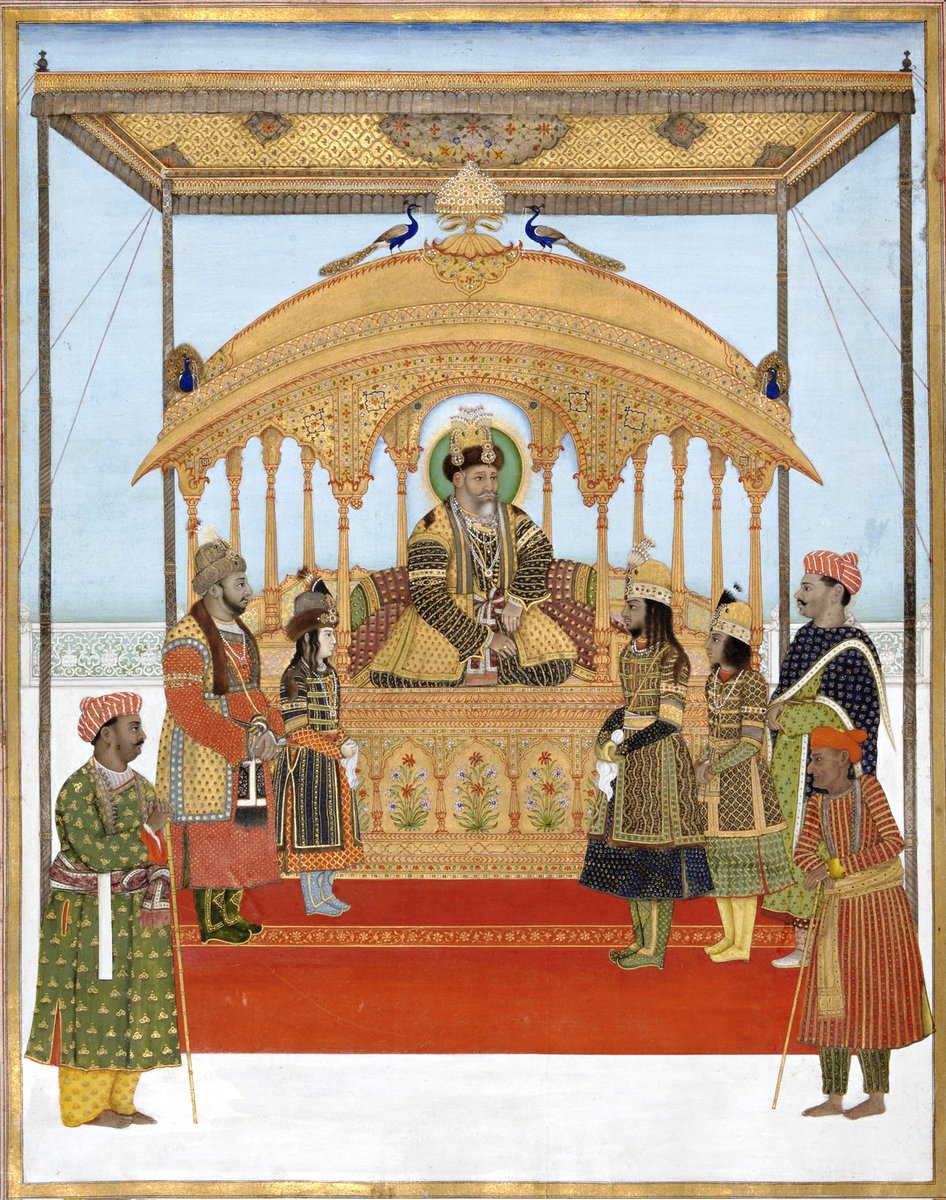
exquisite, jewel-encrusted jharoka, or throne, covered by a baldachin and topped with an embroidered canopy; the jharoka is a copy of the famous Peacock Throne looted by the Iranians under the Afsharid ruler Nadir Shah (r. 1736-47 CE) in 1738-39 CE.
2/10
2/10
Akbar’s sons, Abu Zafar Siraj al-Din (the future Bahadur Shah II and the last ruler of the Mughal dynasty, r. 1838-57 CE), Mirza Salim, Mirza Jahangir and Mirza Babur, stand in attendance on either side of their father. They are visually distinguished from the two barefoot
3/10
3/10
servants flanking the scene by their dress, their situation on the royal red carpet, and their closer proximity to Akbar, whose figure fills the centre of the picture plane.The scene represents a continuation of the Mughal practice of darshan, the presentation ceremony for
4/10
4/10
the Mughals, into the nineteenth century. Darshan reflected a merging of the Hindu practice of that name, meaning “beholding,” with the notion of the king being accessible to his subjects and imparting auspicious blessings to them in the same manner a deity’s image would to
5/10
5/10
its beholder (Asher 1993, p. 282). The Mughal adoption of the darshan ritual from Hindu culture enhanced the rulers’ semi-divine image,alluded to in paintings such as this one by the glowing halo around the ruler’s head.
The setting in which Akbar II appears is known as the
6/10
The setting in which Akbar II appears is known as the
6/10
jharoka-i khass-u-?amm, where the ruler would hold court and take care of administrative duties. The darbar, or assembly, could consist of all classes of people, from family members and court grandees to the general public ( (Koch 1997, p. 133)
The level of portraiture and
7/10
The level of portraiture and
7/10
detail is exceedingly fine in this painting of a darbar scene. The faces are depicted with subtle shading and highly individualistic features such as the light beards, rounded chins or in the case of the old emissary at right, sunken cheeks. The scene likely takes place in
8/10
8/10
the winter because of the warm clothing, turbans, and headdresses shown.
Though the Mughal Empire was disintegrating, Smart also remarks that the early 19th century was a high point in the production of high quality painting. The artist was successful in capturing the
9/10
Though the Mughal Empire was disintegrating, Smart also remarks that the early 19th century was a high point in the production of high quality painting. The artist was successful in capturing the
9/10
glittering sophistication and decadence of the court, which juxtaposed with the anxious expressions on the principal figures, poignantly evoke the waning Mughal era.
10/10
10/10
Loading suggestions...