

Inheritance
Here we will look at how genetic information is passed from generation to generation.
Here we will look at how genetic information is passed from generation to generation.
1/ We will start with a grandparent generation and see how those chromosomes get passed to parents then children. This will help demonstrate the way chromosome gets passed from generation to generation.
2/ Inheritance patterns follow how chromosomes are passed from parents to children. This is a cool concept if your trying to figure out if you got blue eyes from grandma or a dimple in your chin from grandpa, but it becomes very important when studying genetic disorders.

3/ Each of your parents got 46 chromosomes with 23 coming from grandma and 23 coming from grandpa. Those chromosomes were randomly passed to mom or dad. Your mom and dad are a random collection of both grandma's and grandpa's chromosomes.
4/ Your mom could end up with Grandma's Chromosome 1, 2, and 5 while getting Grandpa's chromosome 3, 4 and 6. The process of a chromosomes being deposited into any gamete is 50/50. This is called the law of independent assortment.
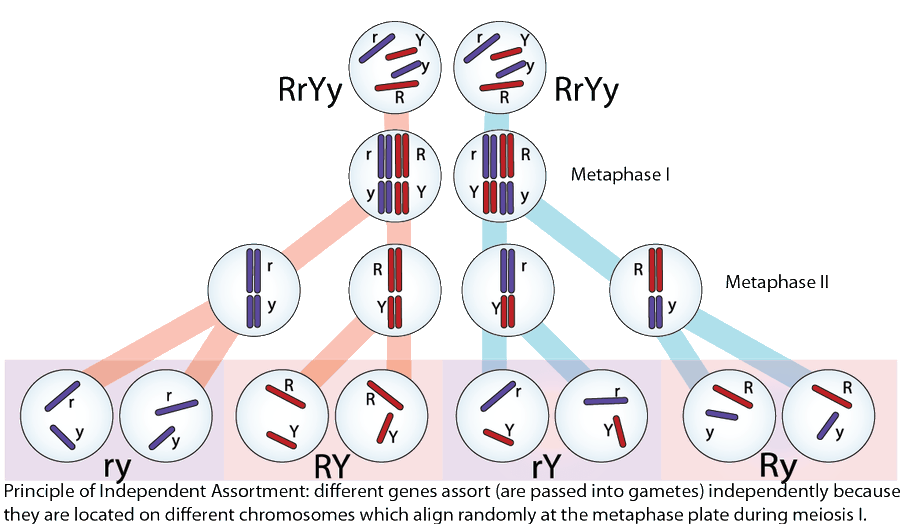
5/ The meiosis process ensures each gamete gets 1 of each chromosome, but it selects them randomly. The potential possibilities between the 46 chromosomes of Grandma and the 46 chromosomes Grandpa are over 8 million different chromosome arrangements.
6/ This is to promote variation in our species which helps with evolution and survival. This makes each of your parents 50% grandma and 50% grandpa since they get 1 of each chromosome from each of them.
7/ Then those chromosomes from your mom and dad will then get randomly assorted again and you will end up with 50% of your mom's and 50% of your dad's chromosomes. You could end up with those blue eyes from grandma and those dimples from grandpa.
8/ This study of inheritance was developed by Gregor Mendel and is often called Mendellian Genetics instead of Transmission Genetics. It tracks how these possible combinations of genes from the parents get passed to the children.
9/ Mendel did all his genetic research using pea plants. He laid all the ground work and rules for the passing of genetic information from one generation to the next.
10/ The monohybrid cross is a tool that allows us to predict the distribution of the gene possibilities. When we look at a specific gene, we will label all of the possible alleles.
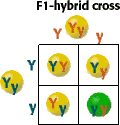
11/ The picture above shows the use of capital Y for a dominant yellow trait and lower case y for the recessive green trait.
12/ We use this capital letter for dominance and lower case letter for recessive all the time in genetics. Since you can get 1 of 2 possibilities from mom and 1 of 2 possibilities from dad, we use this hybrid cross chart to figure out the possible offspring.
13/ On the right in blue you see the first parent's genes with 1 big Y for Yellow and 1 little y for green. The first parent is heterozygous for Yellow and green, but has the phenotype of Yellow as it is a complete dominant gene.
14/ At the top in red, we have the second parent with 1 big Y for Yellow and 1 little y for green. The second parent happens to be heterozygous too.
15/ This is how it works. You match the parent on left to the parent on the top for each box and carry them into that box. In the first box you get the big Y from Parent one and the big Y from parent 2. The second box has big Y from parent one and little y from parent 2.
16/ In the 3rd box you have little y from parent one and big Y from parent 2. In the last box you have both little y's in this box from parent one and parent two. This cross shows you the 4 genotypes of the possible offspring.
17/ You will get one homozygous dominant Yellow, 2 Heterozygous Yellow, and 1 homozygous recessive green. Notice the 1:2:1 pattern. This is what happens when you crossbreed 2 heterozygous parents. Notice 3 of these 4 offspring will be Yellow as its the dominant allele.
18/ If you did this cross with parent one being homozygous YY yellow, then every single child will be Yellow with their phenotype as yellow is dominant. Below is a hybrid cross diagram of a TT for tall homozygous parent with a homozygous tt recessive parent.
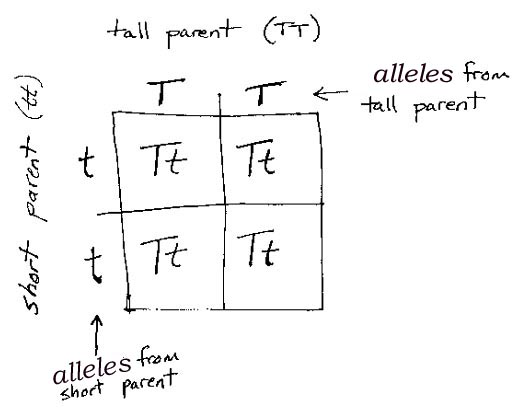
19/ Notice every child ends up with a heterozygous genotype, but will all end up with a tall phenotype as it is the dominant trait. You can do these hybrid crosses for any gene. You just put one parent on the left and the other across the top and match them up.
20/ Once you are use to these ratios of the genotypes, you can translate this into probability ratios. Using probability makes it faster when doing multiple genes at one time.
21/ When you see a parent with TtYy and another parent with TtYy, you can quickly do the math for these children using math. Each probability is 1 in 4 for the monohybrid and using 2 traits gets you to 1 in 16 for each possibility which becomes ¼ * ¼.
22/ There is a 1/16th chance for a TTYY child and a 1/16th chance for a ttyy child. Getting into the math of probability is way to complex for this genetics guide, but you can find many Youtube videos on the use of probability calculation in genetics.
23/ Then you can calculate a problem like parent 1 has AaBbCcDdEe genotype and breeds with parent 2 having a AaBbCcDdEe phenotype, what is the odds of getting a child with aabbccddee genotype?
24/ You can do the probability of each child to find out what are the odds of getting the child that had all 5 recessive alleles of aabbccddee. The math is ¼ * ¼ * ¼ * ¼ * ¼ = 1 in 1024.
Loading suggestions...