
Thread: “Important events which led to the demolition of Babri Mosque”
1. In December 1949, the idols of Ram and Sita (Ram's wife) were placed inside the Babri Masjid by the two officers of the Uttar Pradesh provincial civil service (the Deputy Commissioner, K.K.K. Nayar, and...
1. In December 1949, the idols of Ram and Sita (Ram's wife) were placed inside the Babri Masjid by the two officers of the Uttar Pradesh provincial civil service (the Deputy Commissioner, K.K.K. Nayar, and...

the City Magistrate, Guru Datta Singh) who were both members of the RSS. Instead of removing the idols at once and restoring the property to the Muslim community, the court through an order of interim injunction, locked the mosque denying the Muslims their right to worship.
2. On 11 February 1986, ironically but unsurprisingly with Congress collusion, a Faizabad lawyer, Umesh Chandra Pandey, moved an appeal before District and Session Judge K.M. Pandey to unlock the Babri Masjid. While the legal case of the Babri Masjid was still pending in the...
..Allahabad High Court the district judge in Faizabad allowed Hindus to conduct their worship of their idols by opening the gates of the mosque while prohibiting the Muslims to enter the site.
3. Arun Nehru, one of Rajiv Gandhi’s closest associates delivered a letter to...
3. Arun Nehru, one of Rajiv Gandhi’s closest associates delivered a letter to...
..Judge Pandey and informed him that Congress would not object to the unlocking of the Babri Masjid. At the same time, an agreement was concluded between the BJP and Congress by Buta Singh and Narain Datta Tiwari (the then Chief Minister of UP) approving of a Shilanya Ceremony..
..that would be conducted by the BJP/VHP after Babri Masjid had been reopened, thus affording symbolic legitimation of its eventual replacement on the Janambhumi by a Ram mandir.
4. It is interesting to note that in 1989 Rajiv Gandhi began his electoral campaign from the same..
4. It is interesting to note that in 1989 Rajiv Gandhi began his electoral campaign from the same..
..Faizabad district, "tacitly supporting the Ramlila program and promising to establish 'Ram Rajya' in India".
Rajiv said:
“If Hindus wanted Ram Rajya, they should vote for Congress as it was the only party which could bring Ram Rajya to the country”
(Times of India, 1989).
Rajiv said:
“If Hindus wanted Ram Rajya, they should vote for Congress as it was the only party which could bring Ram Rajya to the country”
(Times of India, 1989).
5. As the political atmosphere was heating up, Doordarshan ran a highly sophisticated dramatisation of the Ramayana whose episodes ran for eighteen months commencing in January of 1987, and then followed it up with a ninety-one-episode version of the Mahabharata.
6. In Sept 1990, BJP President L.K. Advani organized the Ram Rath Yatra. Different affiliates of the Sangh Parivar participated in the so called journey of faith. Between April 1989 and April 1990, 262 people died in Gujarat, mostly were Muslims. In October 1990, days after....
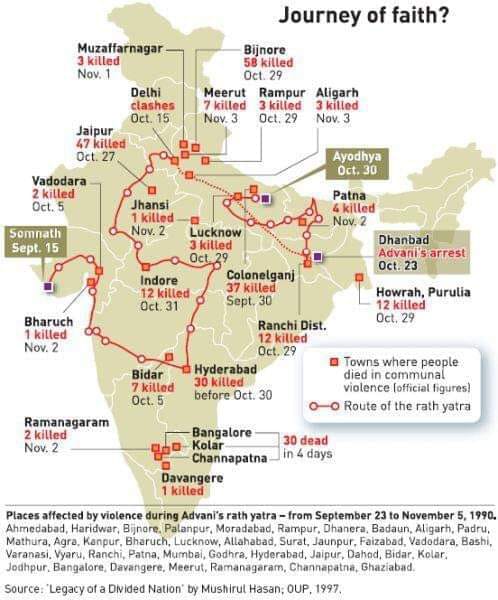
..Advani’s yatra began, 41 were killed in Ahmedabad. The same month, 52 were killed in Jaipur, 20 in Jodhpur, 33 in Lucknow, over 100 in Delhi, 37 in Assam, 18 in Patna and 165 in Hyderabad. Also in October, a pogrom against Muslims in Bhagalpur, Bihar, saw 960 killed in which..
..900 were Muslims. In Nov, 31 were killed in Agra, again mostly Muslim and 13 in Indore. In Dec, 60 were killed in Karnataka and 134 in Hyderabad. Many parts of India remained tense for long periods of time. Between April and May 1990, three riots in Kanpur killed 30;
..between May and November 1991 more than 50 were killed in Varanasi. In May 1991, 26 including 24 Muslims were killed in Vadodara. In October 1992, 44 were killed in Sitamarhi.
7. The reward of mass killings during the Rath Yatra was a doubling of the BJP’s vote share.
7. The reward of mass killings during the Rath Yatra was a doubling of the BJP’s vote share.
In the general elections held in mid-1991, the BJP got 20% of the total vote and won 120 seats. From 1951 to 1990, Bharatiya Jana Sangh which formed Bharatiya Janta Party (BJP) in 1980 could not win a single state.
8. On December 6 1992, around 150,000 Kar Sevaks of the RSS,
8. On December 6 1992, around 150,000 Kar Sevaks of the RSS,
..VHP and BJP demolished the Babri Masjid which was planned 10 months in advance by top leaders of RSS, BJP and VHP while Congress Prime Minister Narasimha Rao remained a mere spectator. No RSS leaders were imprisoned even after the demolition and shakhas were never closed.
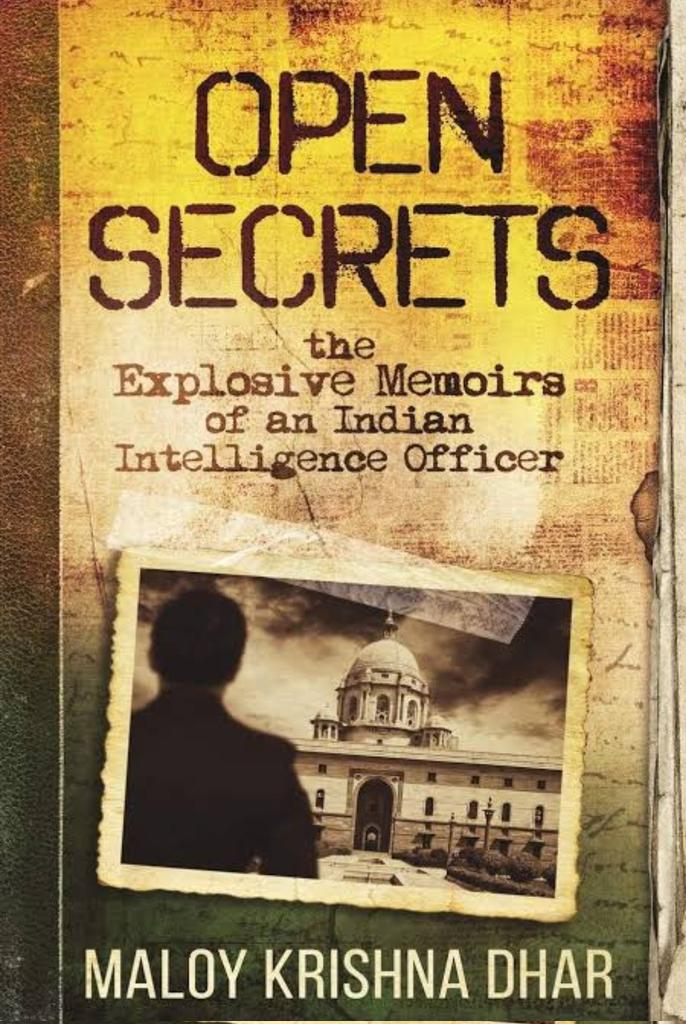
9. Maloy Krishna Dhar, former head of IB, claimed in his book “Open Secrets” that he was directed to provide security to the meeting held by Sangh Parivar where demolition of Babri mosque was planned. Tapes of the meeting were handed over to PM Rao who tacitly approved the plan.
10. The first elections after demolition of Babri Mosque were held in 1996. The BJP won 161 seats. The party's success was built on corpses of Muslims and cemented with their blood.
Over 3,400 Indians were killed in the violence triggered by Advani’s campaign but it brought...
Over 3,400 Indians were killed in the violence triggered by Advani’s campaign but it brought...
...BJP to the doorstep of power. In July 1992, L.K. Advani said in the Lok Sabha Speaker’s chamber:
“You must recognise the fact that from two seats in Parliament in 1985 we have come to 117 seats in 1991. This has happened primarily because we took up this issue [Ayodhya].”
“You must recognise the fact that from two seats in Parliament in 1985 we have come to 117 seats in 1991. This has happened primarily because we took up this issue [Ayodhya].”
11. A primary school mathematics textbook in India has a question:
“If 15 kar sevaks (Hindu volunteers) demolish the Babri mosque in 300 days, how many kar sevaks will it take to demolish in 15 days?”
Reference: N.K.Singh, MP: Learning acquires a saffron Hue in RSS run school
“If 15 kar sevaks (Hindu volunteers) demolish the Babri mosque in 300 days, how many kar sevaks will it take to demolish in 15 days?”
Reference: N.K.Singh, MP: Learning acquires a saffron Hue in RSS run school
12. Bhanwar Meghwansh wrote a book titled ‘I Could Not Be Hindu : The Story of a Dalit in the RSS’ in which he explained how the Sangh Pracharaks used Dalits and lower caste Hindus for their political gains. He wrote about the scenes from Ajmer Station when Kar Sevaks arrived:
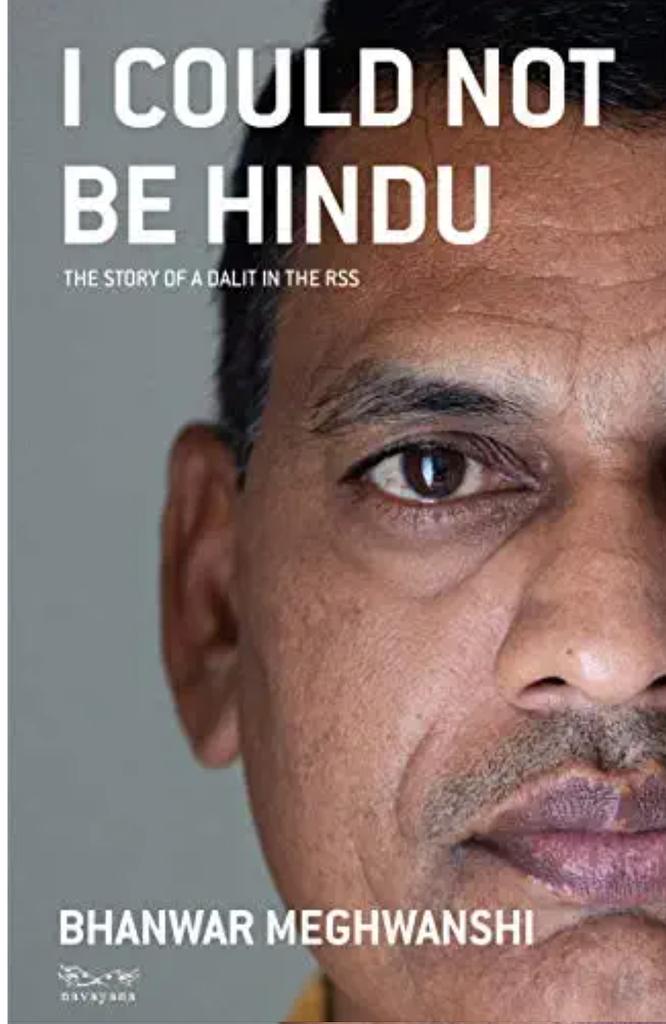
‘I saw how one by one, the big folk, the industrialists, the sangh pracharaks, the leaders of VHP and BJP, all excused themselves. Having wished us well, they went back to their homes. Only people like me remained—impassioned Dalits, Adivasis, young people from the lower castes’.
13. In 2019, the Supreme Court of India ruled that the land of Babri Masjid would be allotted to the Hindu community. Muslims were offered an alternate site to build a mosque. This was a victory for Hindutva but at the cost of Muslims; a communally and politically skewed form...
..of justice was offered to them by India’s highest court.
14. In February 2020, Prime Minister Narendra Modi announced in the Lok Sabha that the govt had given its approval to the proposal for "Shri Ramjanmabhoomi Tirtha Kshetra" trust to take care of the construction of...
14. In February 2020, Prime Minister Narendra Modi announced in the Lok Sabha that the govt had given its approval to the proposal for "Shri Ramjanmabhoomi Tirtha Kshetra" trust to take care of the construction of...
..grand Ram temple in Ayodhya and other related issues.
15.Six months later, Prime Minister Modi visited Ayodhya to lay the foundation stone (a 40 kg silver brick) for the construction of the Ram Mandir at the Ram Janmbhoomi site.
15.Six months later, Prime Minister Modi visited Ayodhya to lay the foundation stone (a 40 kg silver brick) for the construction of the Ram Mandir at the Ram Janmbhoomi site.
16.There are nearly 600 mosques all over India, and fifty-three in Delhi alone, where Muslims cannot pray because they are notified as historical monuments under the control of the Archaeological Survey of India (ASI).
17. Almost 30 years after Sangh Parivar destroyed Babri Masjid, they have their sights set on another mosque in the state – the Gyanvapi mosque in Varanasi. They have made false claims that a shivling has been found in the mosque complex. Muslims are no longer allowed to pray.
18. The Sangh Parivar have crafted a very successful strategy to erase Muslim culture, religion, and heritage from India. They are drawing on the strong support they receive from Narendra Modi’s Hindu nationalist govt, which is set to complete 8 years in power later this month.
19. For the minorities, India has become a veritable chamber of horrors. The RSS whose political front is ruling India considers Muslims, Christians and Communists as a major internal threat.
(Reference: MS Golwalkar, Bunch of thoughts)
(Reference: MS Golwalkar, Bunch of thoughts)
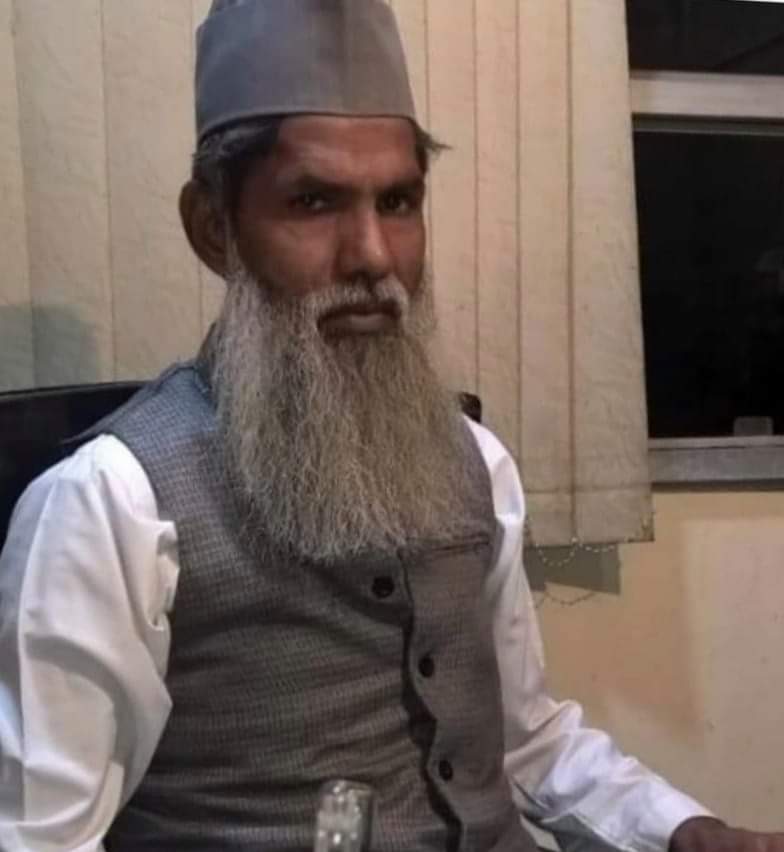
20. Balbir Singh was among the leading Karsevaks who demolished the Babri Mosque in 1992. He later on repented his act by accepting Islam and named himself Muhammad Amir. He was on a mission of constructing 100 mosques.
Sadly he's no more among us. May Allah bless his soul.
Sadly he's no more among us. May Allah bless his soul.
Reference:
1. “The Babri Masjid and the secular contract” by Harold A. Gould
2. “Sunrise Over Ayodhya” by Salman Khurshid
3. “The tragedy of Babri Masjid” by Serajul Islam
4. “Our Hindu Rashtra” by Aakar Patel
5. “The Babri Mosque and Hindu Extremists Movements” by Abdul Majid
1. “The Babri Masjid and the secular contract” by Harold A. Gould
2. “Sunrise Over Ayodhya” by Salman Khurshid
3. “The tragedy of Babri Masjid” by Serajul Islam
4. “Our Hindu Rashtra” by Aakar Patel
5. “The Babri Mosque and Hindu Extremists Movements” by Abdul Majid
Loading suggestions...