

As promised, here is a thread on why India will need more investment - specifically foreign inflows.
We all know that India has a lot of people (1.4bn) but not enough capital to allow people to be full-employed or raise productivity.
The good news? The gov wants to change that
We all know that India has a lot of people (1.4bn) but not enough capital to allow people to be full-employed or raise productivity.
The good news? The gov wants to change that
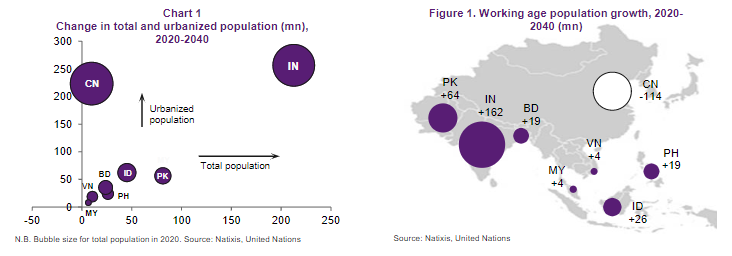
First, the stats. India has 1.4bn people and will have 1.6bn by 2040.
Working age population will rise to 1,102m from 950m now. Additionally, more of those people will urbanize.
That is a lot of people now & even more in the future. A lot of pressure on existing infrastructure
Working age population will rise to 1,102m from 950m now. Additionally, more of those people will urbanize.
That is a lot of people now & even more in the future. A lot of pressure on existing infrastructure
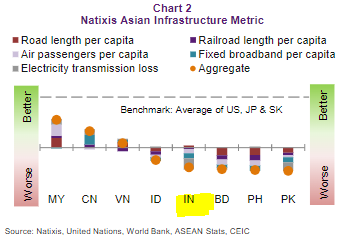
Let's talk about India's existing infrastructure. Did you know that it has built more road than China? Well, but quality of road is not as well. Either way, if u take the stock of infra relative to current population, India is very short. Relative to the region, India is behind.
If you take the existing supply and then add the population growth into it, then the situation is worse.
Meaning, demand to supply will be the largest for India in Asia.
Depending where u stand, this is good and bad.
Meaning, demand to supply will be the largest for India in Asia.
Depending where u stand, this is good and bad.
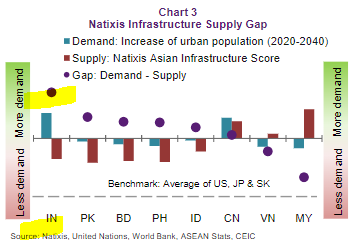
Why is this good? Well, at the least, we can say that it doesn't have a demand for infrastructure problem.
There is a lot of slack. The bad? Well, we gotta get building. And a lot of it.
Good news? The government realizes this & is pushing for infra cap ex in budget & long-term
There is a lot of slack. The bad? Well, we gotta get building. And a lot of it.
Good news? The government realizes this & is pushing for infra cap ex in budget & long-term
The good news is that this sector, from energy (renewable) to roadbuilding etc, is getting policy support, either via the fiscal budget or policies that help the sector.
Now, the bad news? India runs a current account deficit and government deficit.
What does that mean?
Now, the bad news? India runs a current account deficit and government deficit.
What does that mean?
It means that whatever the government takes in revenue, it spends more than it takes in so it has a DEFICIT.
That's the government sector. As an economy, including households & corporates, India runs an income OUTFLOW. As in it CONSUMES MORE THAN IT SAVES.
Income is negative.
That's the government sector. As an economy, including households & corporates, India runs an income OUTFLOW. As in it CONSUMES MORE THAN IT SAVES.
Income is negative.
How does that limit India's long-term ambition to build/growth/invest/create jobs to capitalize on its demographic dividend or to put it another way to turn the burden into a dividend.
Well, first, if the government runs a deficit, then what it prioritizes, as in infrastructure, will do well, but then it has to borrow from the people of India to fund its deficit.
Let me first explain India's expenditure. I like to express as a share of GDP.
Let me first explain India's expenditure. I like to express as a share of GDP.
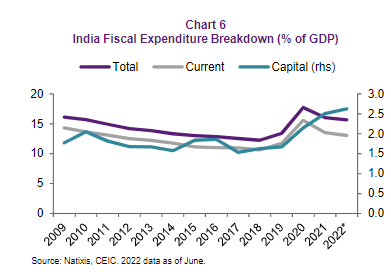
With higher allocation to capital spending, it has risen to 2.6% of GDP vs 1.9% in the past five years.
So good news it is spending more. But its current spending is rather sticky. Current is just recurring operating costs (subsidies/wages etc)
So good news it is spending more. But its current spending is rather sticky. Current is just recurring operating costs (subsidies/wages etc)
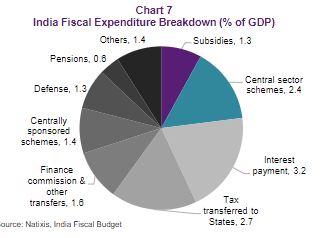
India expenditure is 15.7% of GDP & here's the breakdown based on the budget of what they spend on. So u can see that expenditure has some good trends like higher capital allocation but remains high.
What about tax revenue? India introduced GST in July 2017 so GST added 3% more to GDP.
That's good news. But the issue here is that India CUT the corporate tax in 2019 so the income side (direct taxation) actually is less. Corporates pay less taxes while consumption taxes rose.
That's good news. But the issue here is that India CUT the corporate tax in 2019 so the income side (direct taxation) actually is less. Corporates pay less taxes while consumption taxes rose.
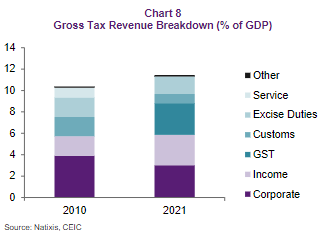
We know that expenditure is 15.7% of GDP but revenue has only increased to 11.3% of GDP (btw this is already higher than 10% of GDP in 2010).
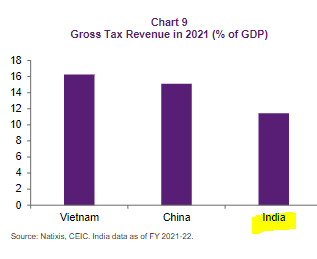
India gross tax revenue is lower than Vietnam & China. The government hasn't been able to take more for the coffer from total GDP.
India gross tax revenue is lower than Vietnam & China. The government hasn't been able to take more for the coffer from total GDP.
When you have a deficit, you have to finance it. As in your revenue is less than your spending so you borrow.
The government issues government bonds to borrow from the public. The public BUYS bonds & gives the government $ to get some coupons.
Who funds the government deficit?
The government issues government bonds to borrow from the public. The public BUYS bonds & gives the government $ to get some coupons.
Who funds the government deficit?
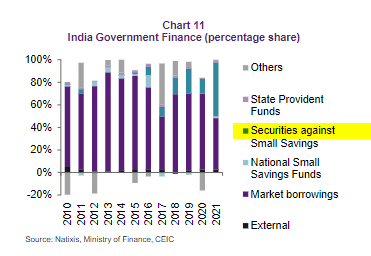
If you pay taxes u do, but then that's not enough so the gov issues bonds to borrow so you can fund it again via purchases of bonds.
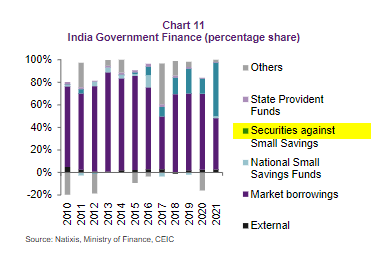
Pension funds, markets (banks/insurance/asset managers etc), and recently SMALL SAVINGS or retail.
India DOES NOT DEPEND ON FOREIGNERS MUCH.
Pension funds, markets (banks/insurance/asset managers etc), and recently SMALL SAVINGS or retail.
India DOES NOT DEPEND ON FOREIGNERS MUCH.
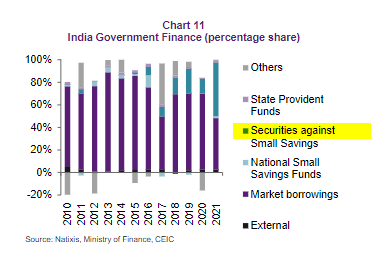
The government has a 6% cap on total government borrowing for foreigners but TOTAL FOREIGN OWNERSHIP OF GOVIES IS LESS THAN 2%.
In recent years, MOSTLY DOMESTIC.
So what you say?
In recent years, MOSTLY DOMESTIC.
So what you say?
Well, as you know, and I alluded, the government runs a deficit, and ALL OF INDIA RUNS AN INCOME DEFICIT.
So when the government BORROWs more, well, it means there is less to go around for other economic agents. What do I mean by this? Well, I am talking about Indian corporates!
So when the government BORROWs more, well, it means there is less to go around for other economic agents. What do I mean by this? Well, I am talking about Indian corporates!
When the government promotes certain sectors and spends and then borrow to fund, those sectors do well. But then we know that it funds from domestic agents, and so that means that THE POOL OF LIQUIDITY IS BEING CHANNELED TOWARDS THE GOVERNMENT & PRIORITIZED SECTORS.
Meaning?
Meaning?
Meaning, as a total, Indian corporates are BEING SQUEEZED OUT BY THE GOVERNMENT. Is it a good or bad thing? Well, depends.
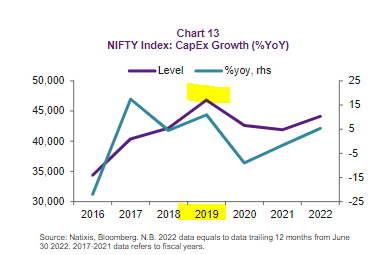
But let me show u capital spending or investment of India publicly listed firms in NIFTY.
What do u see? A LOT OF CONTRACTION EXCEPT ENERGY AND MATERIALS.
But let me show u capital spending or investment of India publicly listed firms in NIFTY.
What do u see? A LOT OF CONTRACTION EXCEPT ENERGY AND MATERIALS.
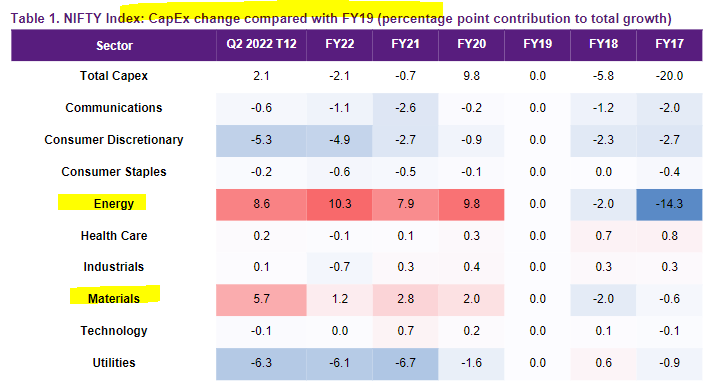
Remember that India companies, in comparison to Chinese ones, are NOT AS LEVERAGED.
Well, to put it another way, they also DON'T INVEST that much. They don't borrow to invest & so total cap ex is very limited.
Sectors prioritized by the government doing better.
Well, to put it another way, they also DON'T INVEST that much. They don't borrow to invest & so total cap ex is very limited.
Sectors prioritized by the government doing better.
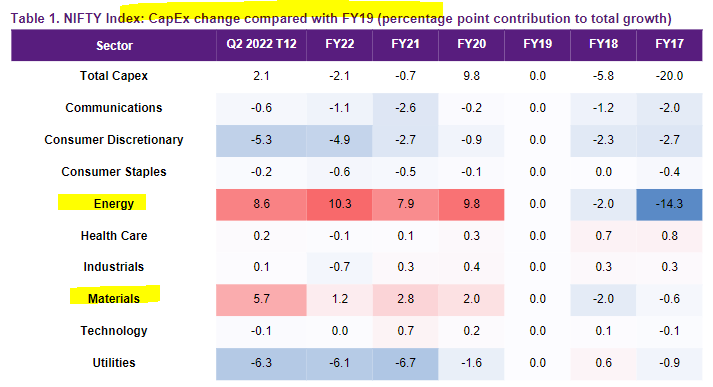
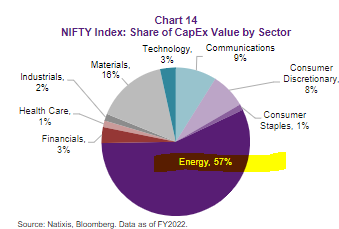
The energy sector is the key driver of India cap ex and is 53% of total with materials followed by second at 14%. While these sectors excel, the rest are trailing, based on NIFTY index data.
Chart of investment level & u can see that while growth has recovered, not there yet.
Chart of investment level & u can see that while growth has recovered, not there yet.
Who invests in India? Well, the energy sector!!!
Okay, so what?
Okay, so what?
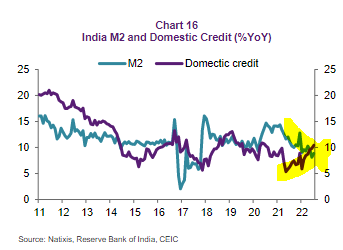
First, we know growth is strong in India, as in credit growth is ACCELERATING.
But as that rises, liquidity is tightening (my chart is a lil old but thesis still solid).
And the RBI raised rates so costs of fund for corporates higher.
Meaning, they are being squeezed...
But as that rises, liquidity is tightening (my chart is a lil old but thesis still solid).
And the RBI raised rates so costs of fund for corporates higher.
Meaning, they are being squeezed...
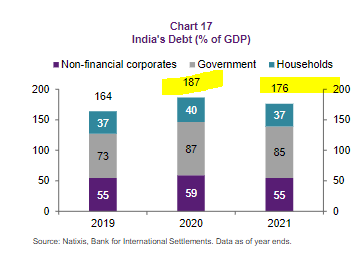
This is India debt as a share of GDP. It is amongst the LEAST INDEBTED major countries. In fact, it has deleveraged since 2020, a feat that many cannot claim.
Look at Indian corporates!!! They have deleveraged MOST.
Look at Indian corporates!!! They have deleveraged MOST.
What am I ranting about? Well, my point is to say that India NEEDS MORE LIQUIDITY. Because its pool of liquidity is limited, as in current account deficit (negative income flow). And the government is sucking up more of this income by FUNDING IT PRIMARILY THROUGH DOMESTIC SOURCES
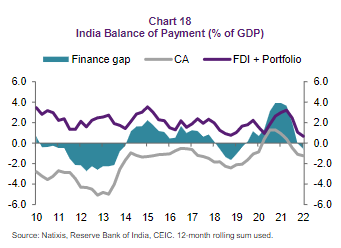
So what? They can offset the pressure/squeeze on Indian corporates by funding some of it externally, as in foreign investors.
Russia got kicked out by key bond indices. India should get itself there to PLUG SOME OF THE FUNDING GAP to ease liquidity strains on corporates.
Russia got kicked out by key bond indices. India should get itself there to PLUG SOME OF THE FUNDING GAP to ease liquidity strains on corporates.
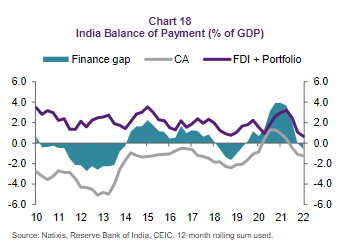
India portfolio flows have averaged only 0.5% of GDP. They can easily raise this to 2% of GDP. And they should to fund this public infrastructure ambition.
What else? Well I believe it should also attract more FDI flows because that's stickier & got other benefits too...
What else? Well I believe it should also attract more FDI flows because that's stickier & got other benefits too...
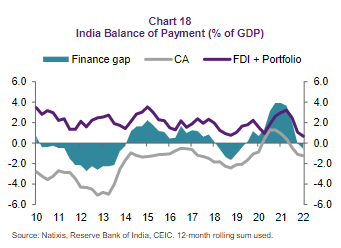
India FDI inflows are rising but India can attract more. This is level. As a share of GDP, I think India can rise to 3% of GDP in the short-term and maybe even 4% of GDP.
These few percentages matters because they can help plug funding gap.
And???
These few percentages matters because they can help plug funding gap.
And???
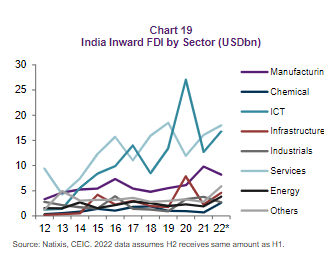
They are KEY to increase the pool of liquidity to allow INDIAN CORPORATES to INVEST and flourish.
Right now, they are being crowded out by the state. Sustainable growth in India NEEDS more investment by Indian corporates.
Read my op-ed here:
asia.nikkei.com
Right now, they are being crowded out by the state. Sustainable growth in India NEEDS more investment by Indian corporates.
Read my op-ed here:
asia.nikkei.com

Loading suggestions...