
Technology
Finance
Cryptocurrency
Ethereum
Optimistic Rollups
Modular Blockchains
Blockchain scalability
zkRollups
zkEVMs
L3s
Zero-knowledge rollups
Zeroknowledge EVMs
Monolithic blockchains
Crypto innovation
Blockchain adoption

Thread🧵 A complete overview of Ethereum scaling solutions.
The future of blockchain scalability is here! But what are zk-Rollups, zkEVM's, L3's and modular blockchains?🧐
A deep dive that you can actually understand. It's time to level up your knowledge 🧠👇 (1/27)
The future of blockchain scalability is here! But what are zk-Rollups, zkEVM's, L3's and modular blockchains?🧐
A deep dive that you can actually understand. It's time to level up your knowledge 🧠👇 (1/27)
Today I'll cover:
⬩ Ethereum dominance going forward
⬩ Optimistic rollups vs zero-knowledge rollups
⬩ Zero-knowledge EVM's (zkevm)
⬩ L3's
⬩ Modular blockchains vs Monolithic blockchains
Let's dive in.
⬩ Ethereum dominance going forward
⬩ Optimistic rollups vs zero-knowledge rollups
⬩ Zero-knowledge EVM's (zkevm)
⬩ L3's
⬩ Modular blockchains vs Monolithic blockchains
Let's dive in.
1/ Per some recent research into the tech side of blockchain & defi, it has has become more apparent that Ethereum will take the centre stage in regards to crypto innovation and adoption.
My summarized thoughts are as following:
My summarized thoughts are as following:
2/ The L1 narrative and rotation in 2021 was driven by:
1️⃣ High blockspace demand and low Ethereum scalability (high gas fees pricing out retail)
2️⃣ Unsustainable liquidity mining incentives driving increased demand to alt-L1 chains
How are these alt-L1's fairing today?
1️⃣ High blockspace demand and low Ethereum scalability (high gas fees pricing out retail)
2️⃣ Unsustainable liquidity mining incentives driving increased demand to alt-L1 chains
How are these alt-L1's fairing today?
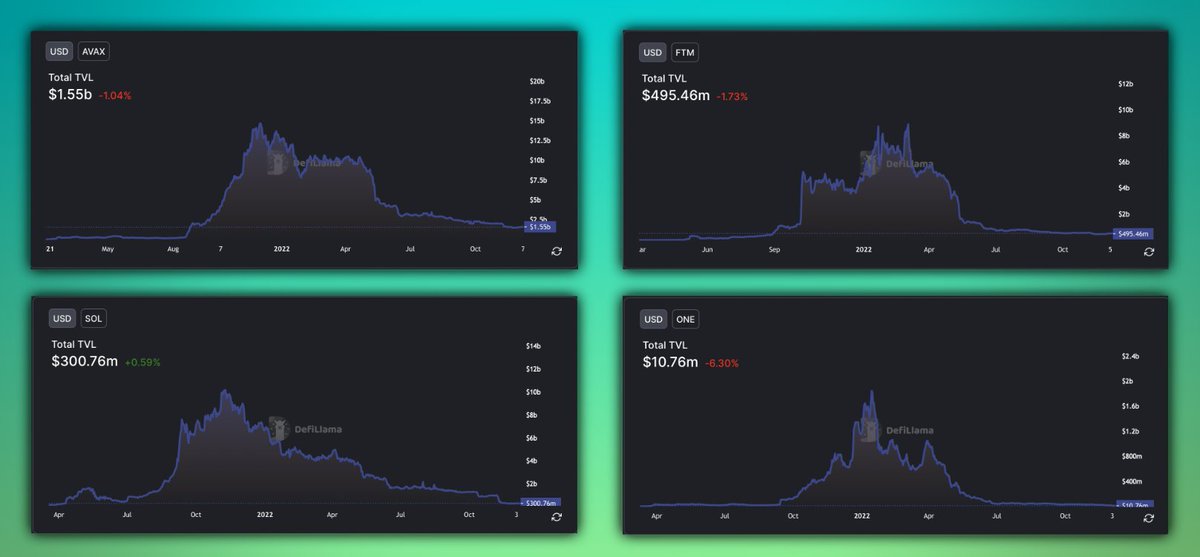
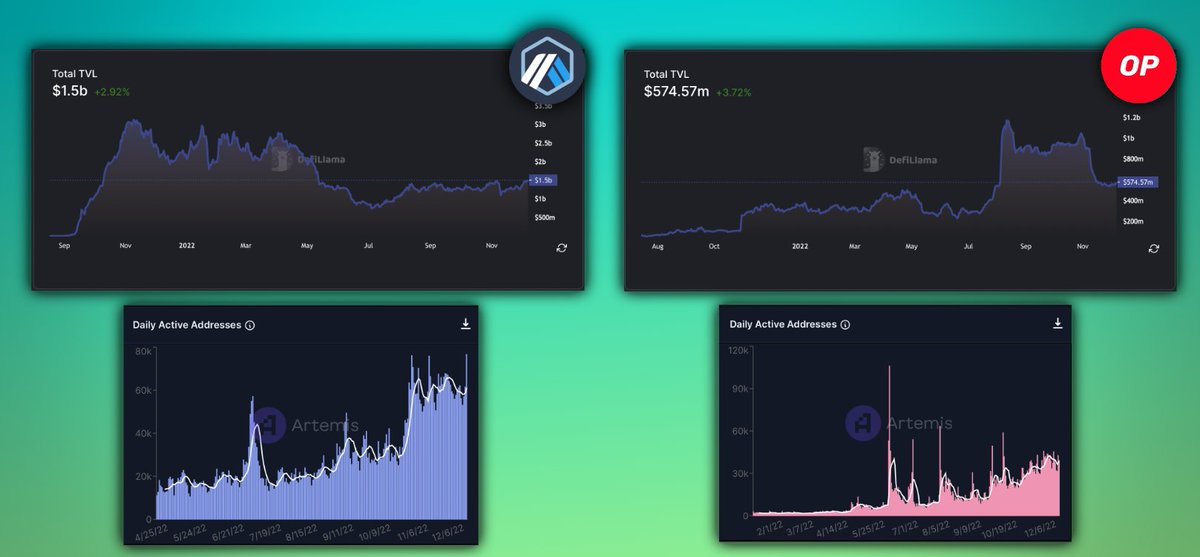
3/ To be fair, the majority of defi has been down only.
There is however a distinct difference when looking at the TVL of Arbitrum and Optimism as well as their amount of daily users.
Note that Arbitrum has no native token nor incentives.
(Sources: @DefiLlama, @Artemis__xyz)
There is however a distinct difference when looking at the TVL of Arbitrum and Optimism as well as their amount of daily users.
Note that Arbitrum has no native token nor incentives.
(Sources: @DefiLlama, @Artemis__xyz)
4/ This bear market has proven that as gas fees are dropping significantly, most on-chain activity happens on Ethereum.
Now that scalable L2's have emerged with security inherited from Ethereum itself, it seems that the next cycle will be more Ethereum ecosystem-centric.
Now that scalable L2's have emerged with security inherited from Ethereum itself, it seems that the next cycle will be more Ethereum ecosystem-centric.
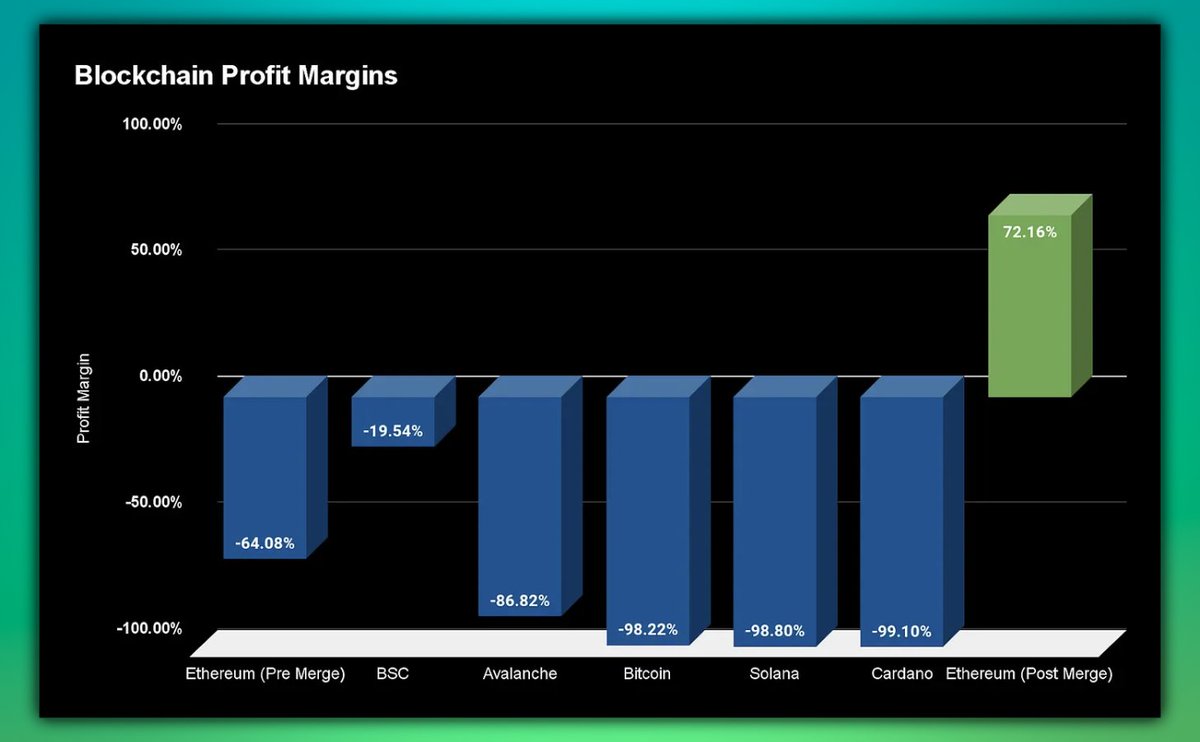
5/ There are more than 435,000 validators on Ethereum while Solana has ~3.5k and many other L1's < 1000.
Scalability is far from enough in itself.
The picture below further illustrates a significant difference between alt-L1's and Ethereum post merge (🦇🔊)
Scalability is far from enough in itself.
The picture below further illustrates a significant difference between alt-L1's and Ethereum post merge (🦇🔊)
6/ So by now it's clear Ethereum and it's scalability solutions will play at least somewhat of a significant role in the future of blockchain technology and defi.
But there is a big difference between these different scaling solutions. Let's taker a closer look👇
But there is a big difference between these different scaling solutions. Let's taker a closer look👇
7/ Rollups (L2's) are designed to remove a majority of the load from the Ethereum mainnet by keeping only a small amount of data-per-transaction and compressing the rest.
This allows for more TPS (transactions per second) and far lower fees.
This allows for more TPS (transactions per second) and far lower fees.

8/ As stated on the Ethereum website:
"A layer 2 is a separate blockchain that extends Ethereum and inherits the security guarantees of Ethereum."
L2's are separate blockchains that send bundles of transactions back to Ethereum mainnet.
"A layer 2 is a separate blockchain that extends Ethereum and inherits the security guarantees of Ethereum."
L2's are separate blockchains that send bundles of transactions back to Ethereum mainnet.
9/ The layer 2 blockchain therefore inherits a similar level of security and decentralization as Ethereum itself.
This model allows eth-mainnet to focus on security/decentralisation and the L2's on scalability.
This model allows eth-mainnet to focus on security/decentralisation and the L2's on scalability.
10/ Now let's define some terminology:
⬩Optimistic rollups: Utilizes fraud proofs (Arbitrum and Optimism)
⬩ Zero-knowledge (zk) rollups: Utilizes validity proofs (zkSync, Starknet, zk-EVM's)
Key words: Fraud proofs, validity proofs
⬩Optimistic rollups: Utilizes fraud proofs (Arbitrum and Optimism)
⬩ Zero-knowledge (zk) rollups: Utilizes validity proofs (zkSync, Starknet, zk-EVM's)
Key words: Fraud proofs, validity proofs
11/ Fraud proofs (Optimistic rollups):
Information is exchanged between the so-called 'prover' and 'verifier'.
The information is assumed to be true and added to the transaction batch and is later reviewed by 'watchers' to ensure that nothing malicious is happening.
Information is exchanged between the so-called 'prover' and 'verifier'.
The information is assumed to be true and added to the transaction batch and is later reviewed by 'watchers' to ensure that nothing malicious is happening.
12/ Validity proofs (zk-rollups):
Here, the exchange of information between the 'prover' and the 'verifier' relies on cryptography & math. The information is shared but never revealed.
There are two types of validity proofs. SNARKS and STARKS. STARKS being more scalable.
Here, the exchange of information between the 'prover' and the 'verifier' relies on cryptography & math. The information is shared but never revealed.
There are two types of validity proofs. SNARKS and STARKS. STARKS being more scalable.
13/ Validity proofs (zk-rollups) are more difficult to implement, but because they rely on cryptography there's a higher level of privacy and data security.
The general consensus is that validity proofs and zk-rollups are the superior scaling technology in most aspects.
The general consensus is that validity proofs and zk-rollups are the superior scaling technology in most aspects.
14/ This is not to say that the future will be dictated by one over the other. We've seen that both Arbitrum and Optimism have been very successful in building a scalable model and growing a large ecosystem/community.
Now let's move on to talk about zk-EVM's
Now let's move on to talk about zk-EVM's
15/ The zk-EVM is one of the most anticipated scaling solutions with several products lurking around the corner such as @zksync and @0xPolygonHermez.
This technology has been underway for a very long time and is finally getting ready to be shipped.
This technology has been underway for a very long time and is finally getting ready to be shipped.
16/ zk-EVM's uses zk-rollups to handle execution. More specifically zk-SNARKS (a type of validity proofs) to validate transactions.
Per the article from @VitalikButerin, there are 4 different types of zk-EVM's: (vitalik.ca)
Per the article from @VitalikButerin, there are 4 different types of zk-EVM's: (vitalik.ca)

17/
1️⃣ Fully Ethereum-equivalent
2️⃣ Fully EVM-equivalent
3️⃣ EVM-equivalent except gas costs
4️⃣ Solidity equivalent
All types face a tradeoff between EVM-compatibility and performance. Most current zk-EVM projects are somewhere between 2 and 4.
1️⃣ Fully Ethereum-equivalent
2️⃣ Fully EVM-equivalent
3️⃣ EVM-equivalent except gas costs
4️⃣ Solidity equivalent
All types face a tradeoff between EVM-compatibility and performance. Most current zk-EVM projects are somewhere between 2 and 4.
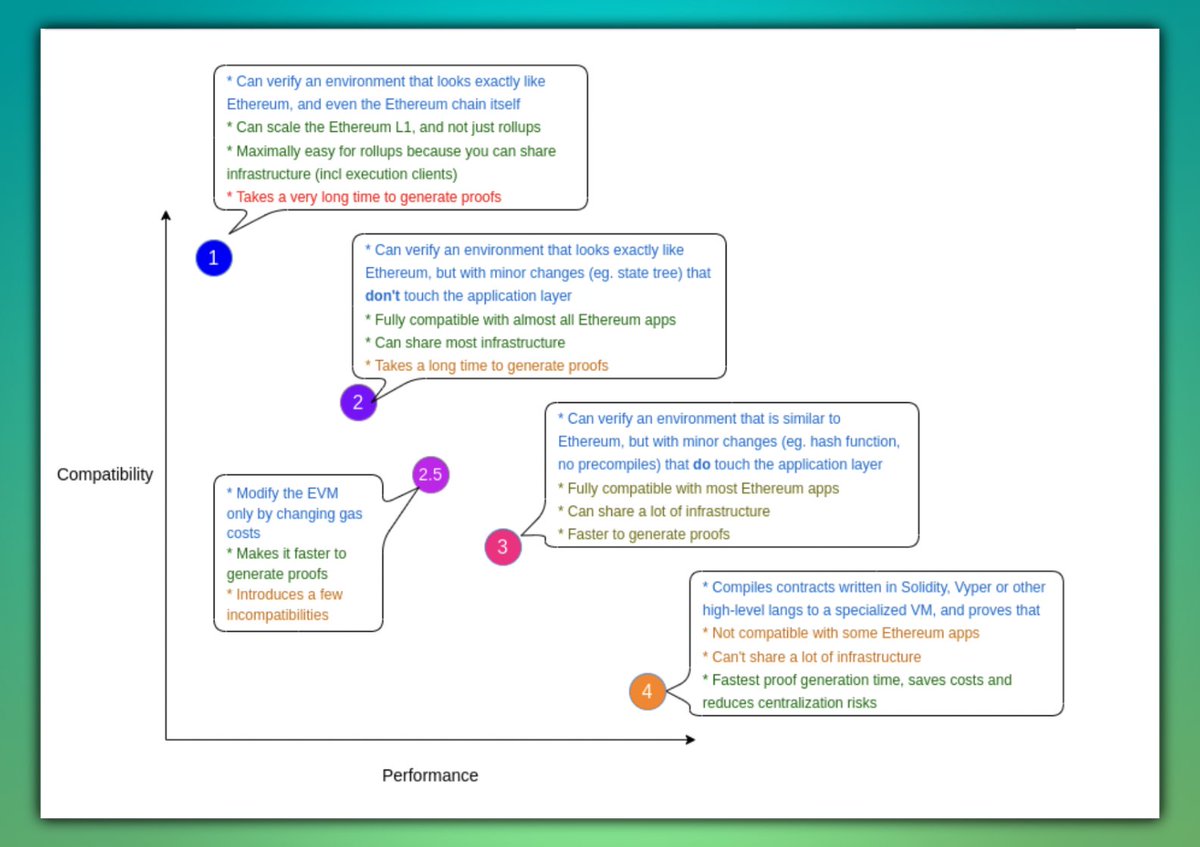
18/ The Polygon zk-EVM (Polygon Hermes) is type 2. It's still very compatible with Ethereum however a bit of compatibility is lost in return for better performance.
Performance is measured in the time it takes to generate the zk-proofs. The faster, the more scalable.
Performance is measured in the time it takes to generate the zk-proofs. The faster, the more scalable.
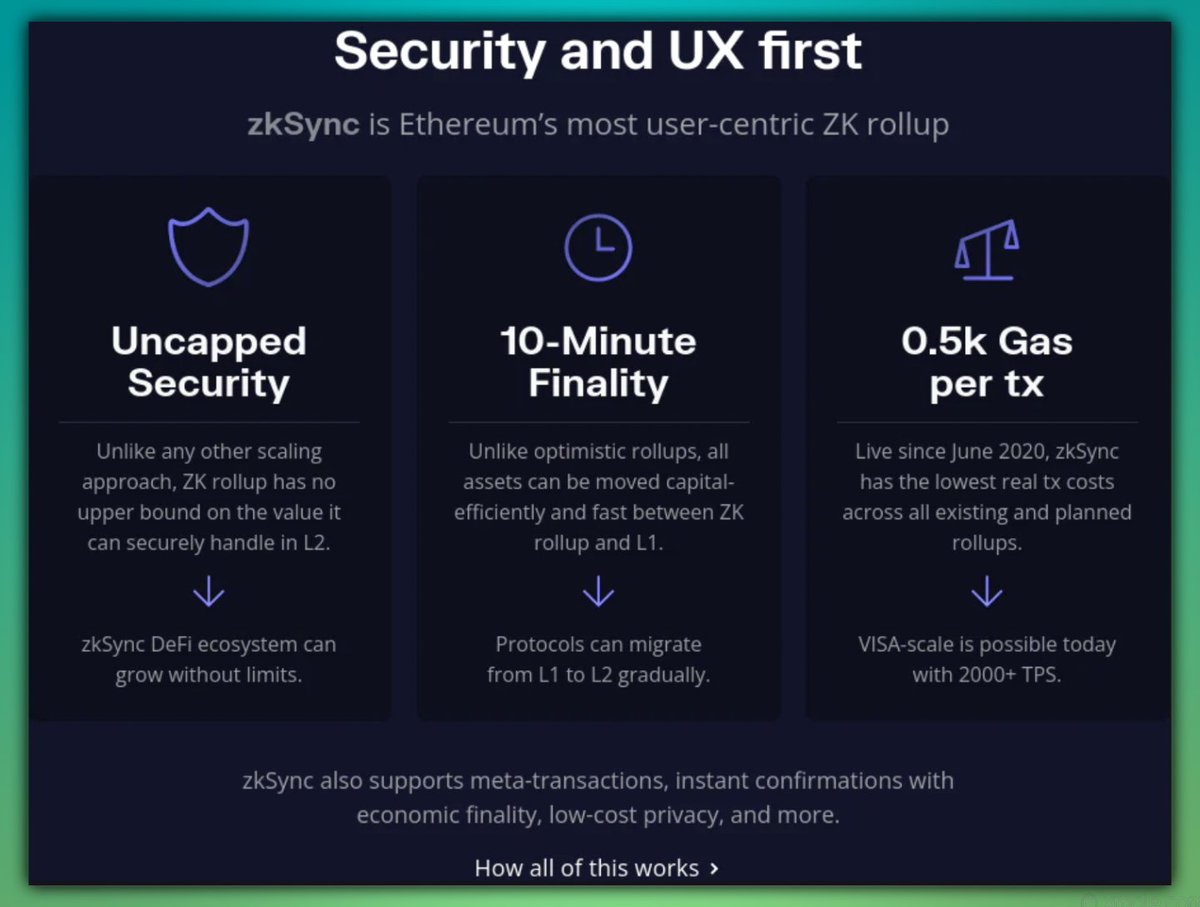
20/ In general terms the byte code is sent to a so-called LLVM-compiler and then finally the ZinkVM.
Despite the lower compatibility it's, according to the @zksync team still quite easy to transfer dapps from eth-mainnet to the zk-EVM.
Despite the lower compatibility it's, according to the @zksync team still quite easy to transfer dapps from eth-mainnet to the zk-EVM.
21/ From the podcast episodes with @zksync on Bankless it seems that there is a large demand from protocols to launch on this upcoming ecosystem.
zk-EVM's are complex and I recommend reading more about these as this thread only touches the surface.
Let's now move on to L3's👇
zk-EVM's are complex and I recommend reading more about these as this thread only touches the surface.
Let's now move on to L3's👇
22/ Layer 3? Why are we even talking about this when layer 2 technology is still being developed?
L3's can be thought of as application specific rollups and present many use cases for companies looking to take their business on-chain in a scalable and secure way.
L3's can be thought of as application specific rollups and present many use cases for companies looking to take their business on-chain in a scalable and secure way.
23/ The example below is Starknet.
L3's are more specifically either a 'validium' or a 'volition'.
Validiums (a type of L3) is a zk-rollup where the data is handled off chain (e.g. on the L2).
On the image below StarkEx is the app-specific L3 and Starknet the L2.
L3's are more specifically either a 'validium' or a 'volition'.
Validiums (a type of L3) is a zk-rollup where the data is handled off chain (e.g. on the L2).
On the image below StarkEx is the app-specific L3 and Starknet the L2.
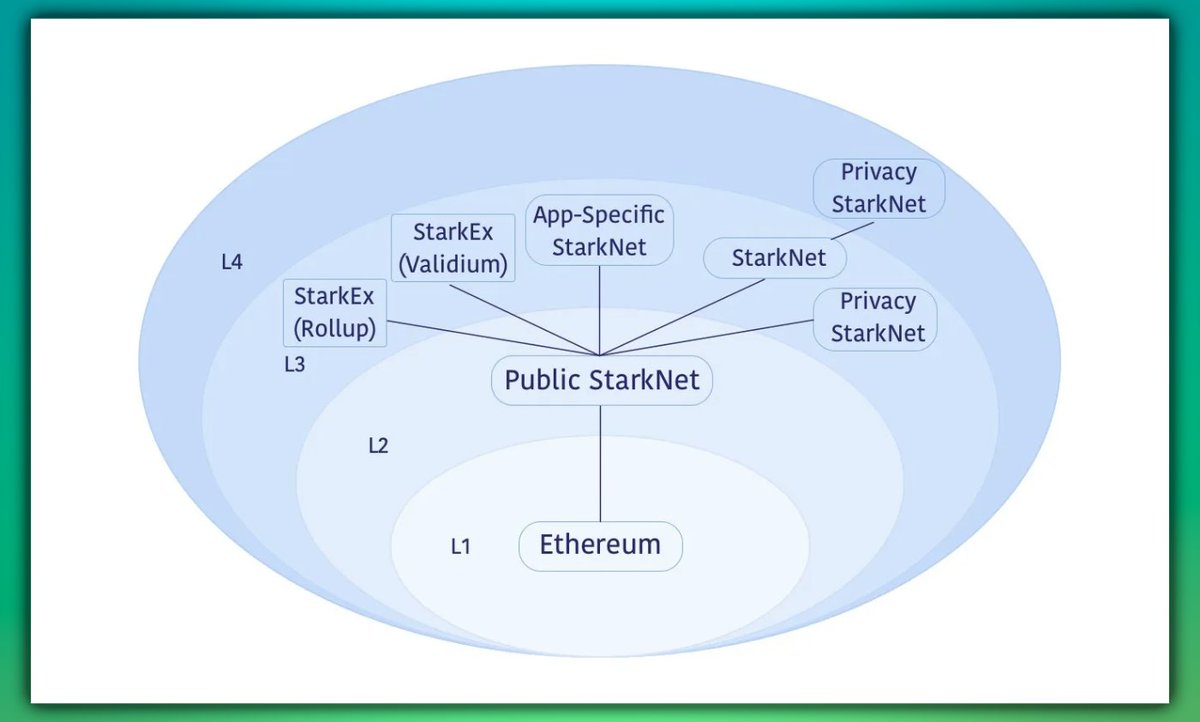
24/ The L3 generates the proofs off-chain to increase scalability in terms of transactions per second.
These are then sent in a bulk to the L2 similarly to how the L2 sends bulks of transactions to the L1 (eth-mainnet).
So can this go on forever with L4's, L5's, L6's etc?
These are then sent in a bulk to the L2 similarly to how the L2 sends bulks of transactions to the L1 (eth-mainnet).
So can this go on forever with L4's, L5's, L6's etc?
25/ The tradeoff is scalability vs security. The further away from eth-mainnet we go the less secure.
zkPorter (a product by @zksync) is also a L3. Users can chose between the L3 with higher TPS but lower security or the zkRollup (L2) for more security but less TPS.
zkPorter (a product by @zksync) is also a L3. Users can chose between the L3 with higher TPS but lower security or the zkRollup (L2) for more security but less TPS.
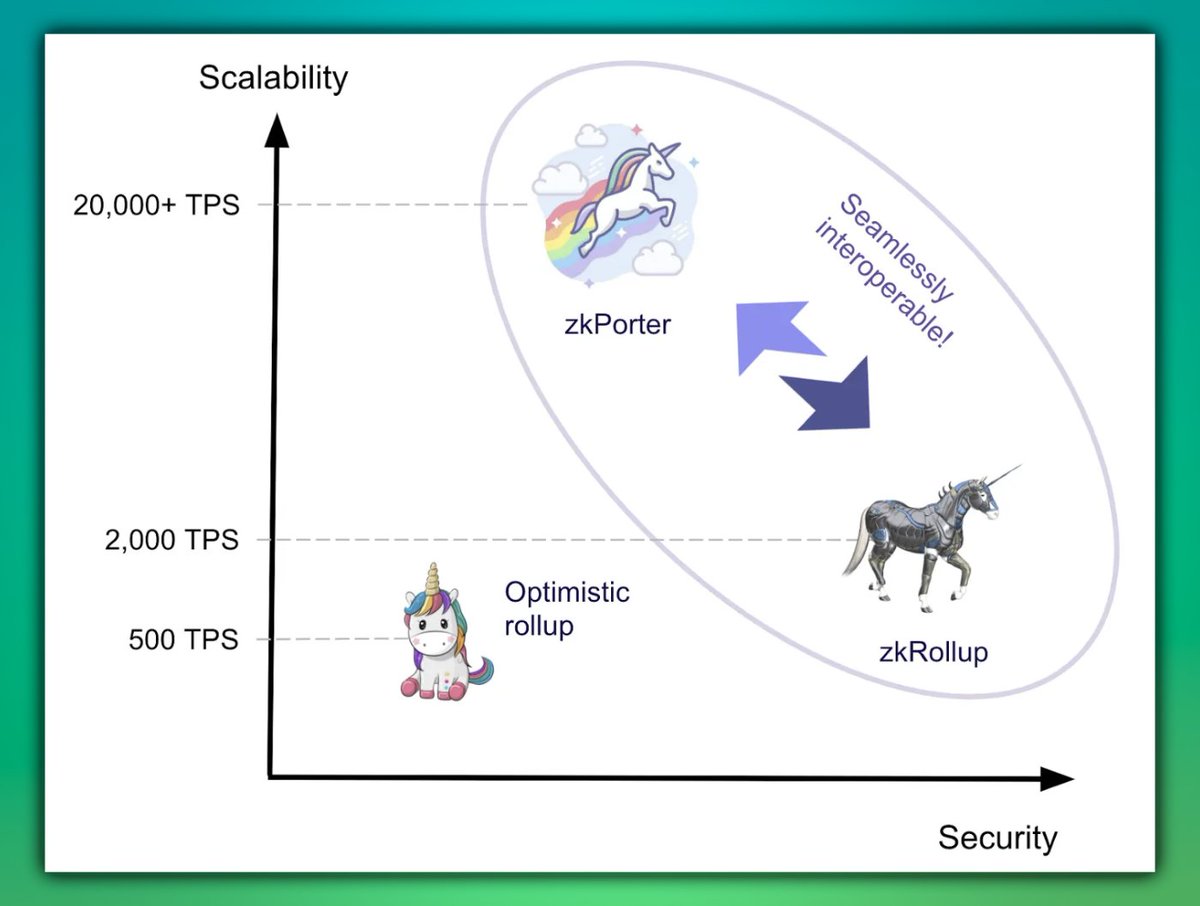
26/ The L3 structure I have just described is as mentioned a 'validium'.
A 'volition' is in its essence a combination of an L3 and a zk-Rollup L2. In this case users therefore don't have to pick between security and TPS.
A 'volition' is in its essence a combination of an L3 and a zk-Rollup L2. In this case users therefore don't have to pick between security and TPS.
27/ Now this was A LOT of information.
If you want to really grasp this I recommend reading this thread a few times. Also, study the pictures - that helped me a ton.
As the thread is super long already, I'll wait with modular vs monolithic chains for a future thread.
If you want to really grasp this I recommend reading this thread a few times. Also, study the pictures - that helped me a ton.
As the thread is super long already, I'll wait with modular vs monolithic chains for a future thread.
If you want to learn more I therefore recommend following me (@ThorHartvigsen)
Also, if you enjoyed the thread please show it some love by
⬩Liking
⬩Retweeting the first post😁
Also, if you enjoyed the thread please show it some love by
⬩Liking
⬩Retweeting the first post😁
This thread is highly inspired by the article written by @knowerofmarkets.
No doubt one of the best Substack articles I've read this year! If you have the time and the curiosity, definitely give this a read!
Also make sure to give him a follow - it's well worth it!
No doubt one of the best Substack articles I've read this year! If you have the time and the curiosity, definitely give this a read!
Also make sure to give him a follow - it's well worth it!
Loading suggestions...