
A scientific problem can be classified as a kind of jigsaw puzzle, logical puzzle, puzzle requiring a connection, or a puzzle requiring 'outside the box' thinking. But while working on the project you can't be sure what kind of puzzle you're in. Here's a 🧵on 'puzzle-switching'.
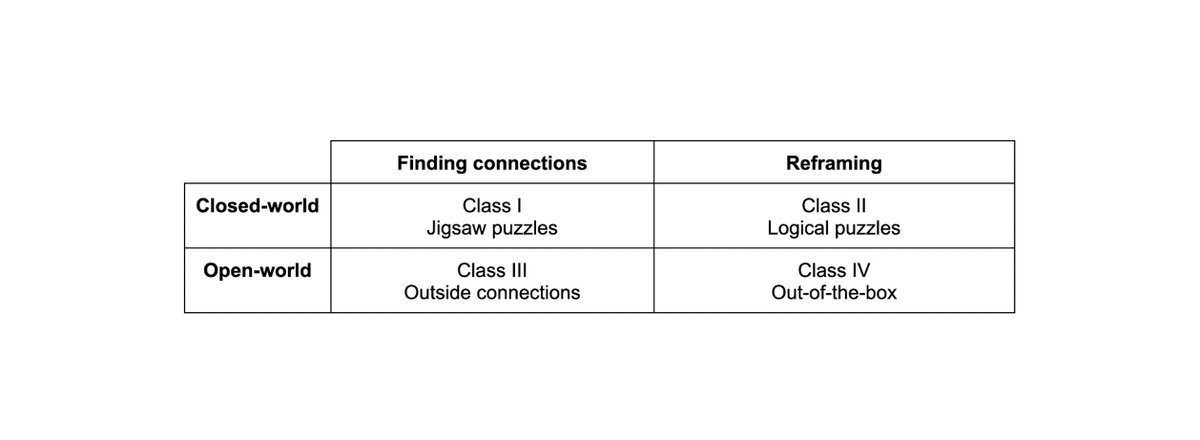
Class I puzzles are 'closed-world': You are presented with all of the pieces & you have to figure out how to put them together; as in a jigsaw puzzle. Science examples are: obtaining a protein’s 3D structure, assembling a complete genome, or defining an embryonic cell lineage.

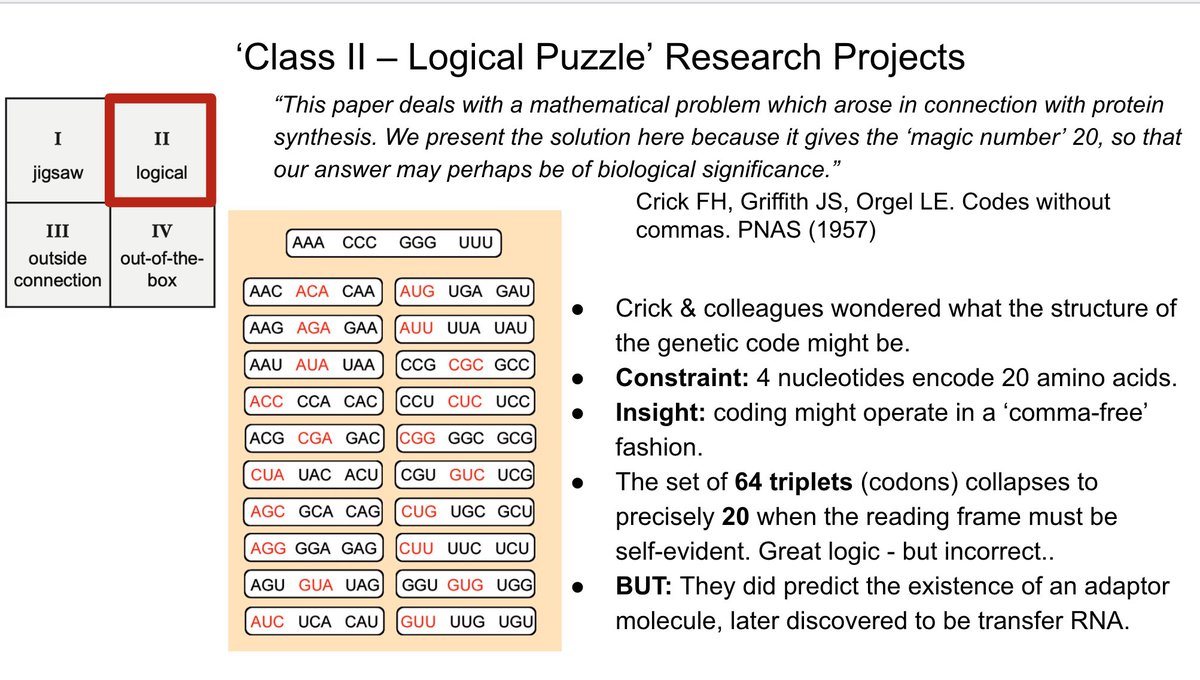
Class II puzzles are also 'closed-word', but a logical leap is required to arrive at the solution; as in a logical riddle. An example is Crick and colleagues proposal that the genetic code might operate in a ‘comma-free’ fashion because that constrains the number of codons to 20.
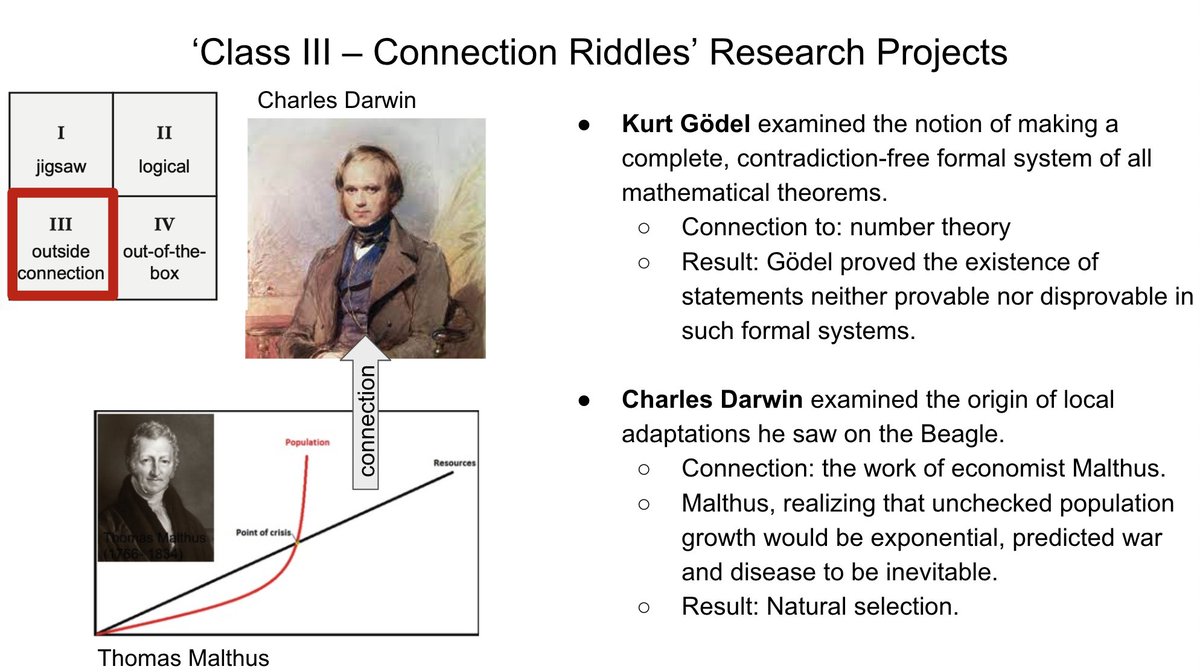
Class III puzzles require an external connection, i.e. you are missing important information; as in a word riddle.
Darwin made a connection between adaptations and the work of Malthus, realizing that unchecked population growth is exponential. The result is natural selection.
Darwin made a connection between adaptations and the work of Malthus, realizing that unchecked population growth is exponential. The result is natural selection.
Class IV puzzles require 'outside the box' thinking. You need a deeper insight through a mental leap; as in trick questions. An example is CRISPR where 'spacers' were originally dismissed as unimportant, though they actually form the basis of an adaptive bacterial defense system.
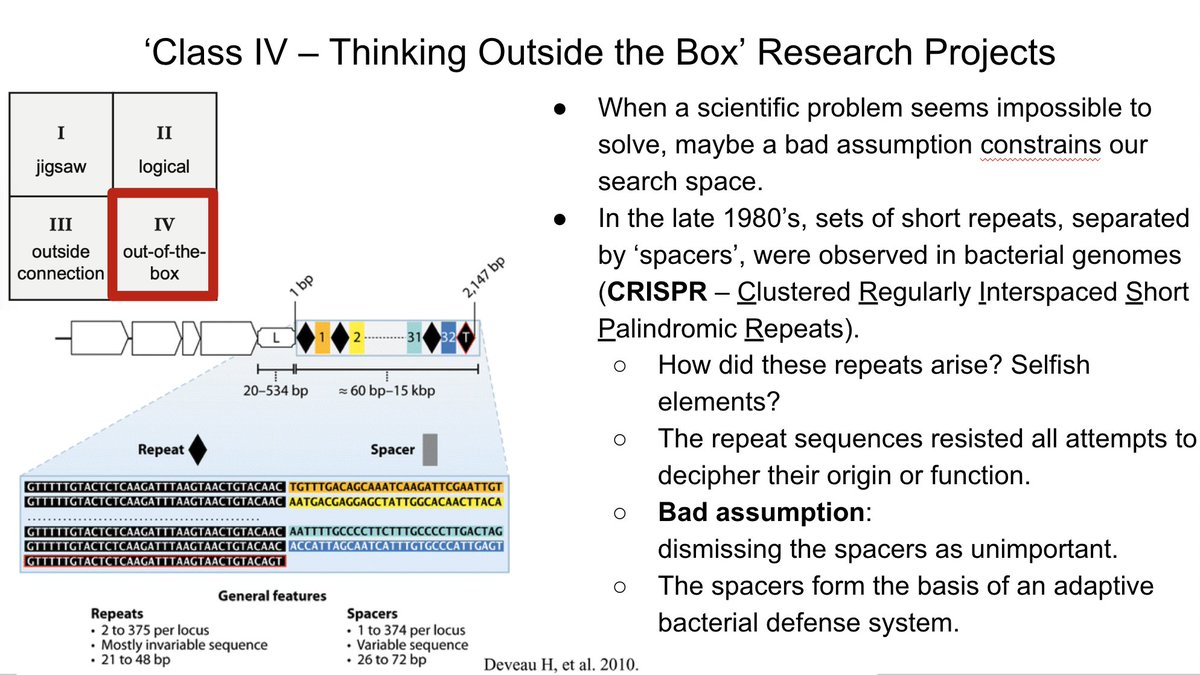
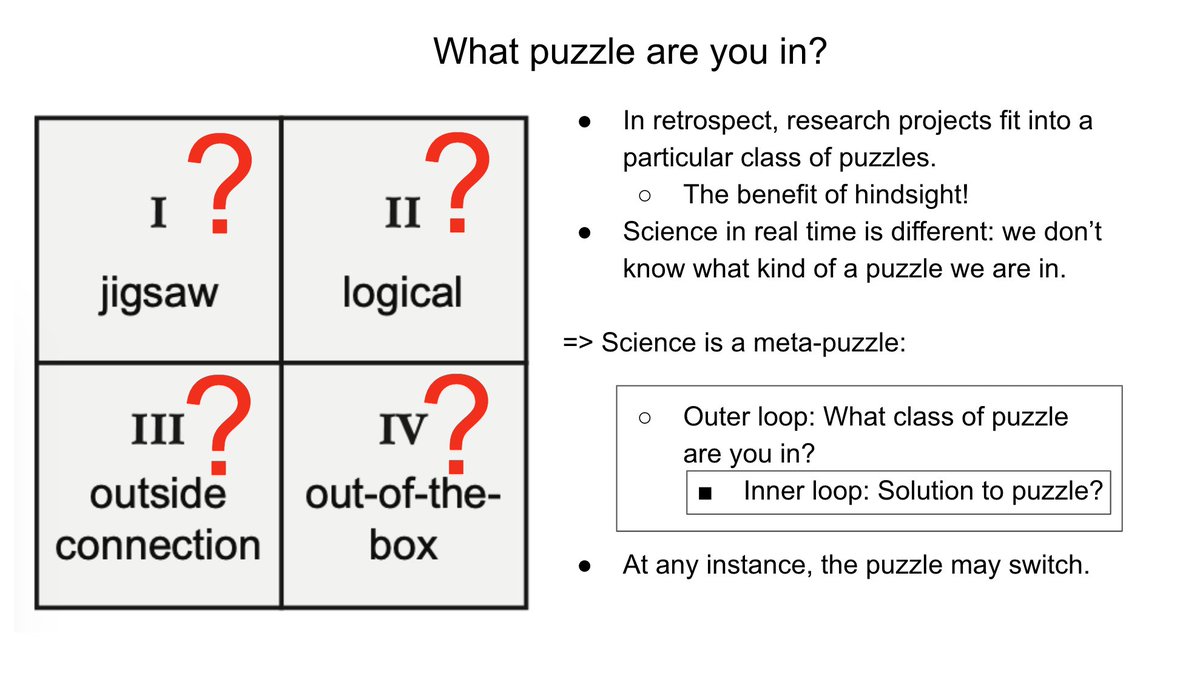
What puzzle are you in? In retrospect, research projects fit into a particular class of puzzles – the benefit of hindsight! But science in real time is different: we don’t know what kind of a puzzle we are in.
=> Science is a meta-puzzle: at any instance, the puzzle may switch.
=> Science is a meta-puzzle: at any instance, the puzzle may switch.
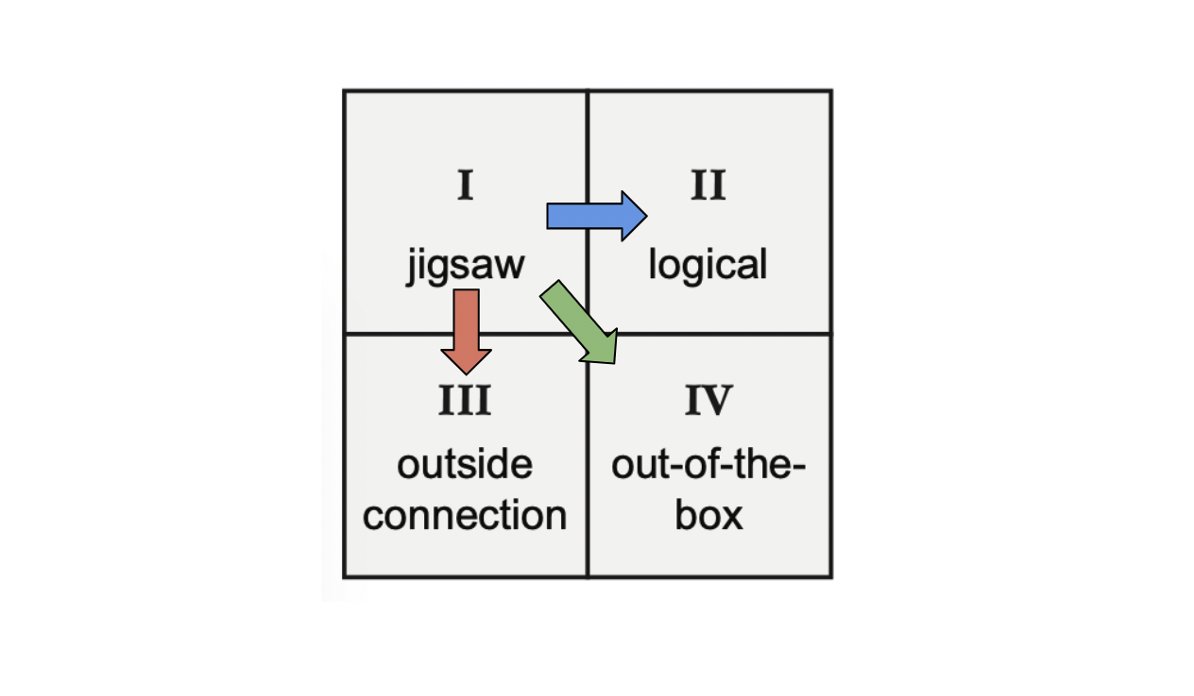
Try 'puzzle switching'! A new project tends to begin in Class I 'jigsaw puzzle' mindset. When there are obstacles, try to switch:
(Class II) identify deeper logical or mathematical problems;
(Class III) find connections to other phenomena;
(Class IV) identify wrong assumptions.
(Class II) identify deeper logical or mathematical problems;
(Class III) find connections to other phenomena;
(Class IV) identify wrong assumptions.
For more on these ideas check out our Night Science editorial in @GenomeBiology. genomebiology.biomedcentral.com @MartinJLercher
Loading suggestions...