
THREAD: THE TWITTER FILES PART FIVE.
THE REMOVAL OF TRUMP FROM TWITTER.
THE REMOVAL OF TRUMP FROM TWITTER.
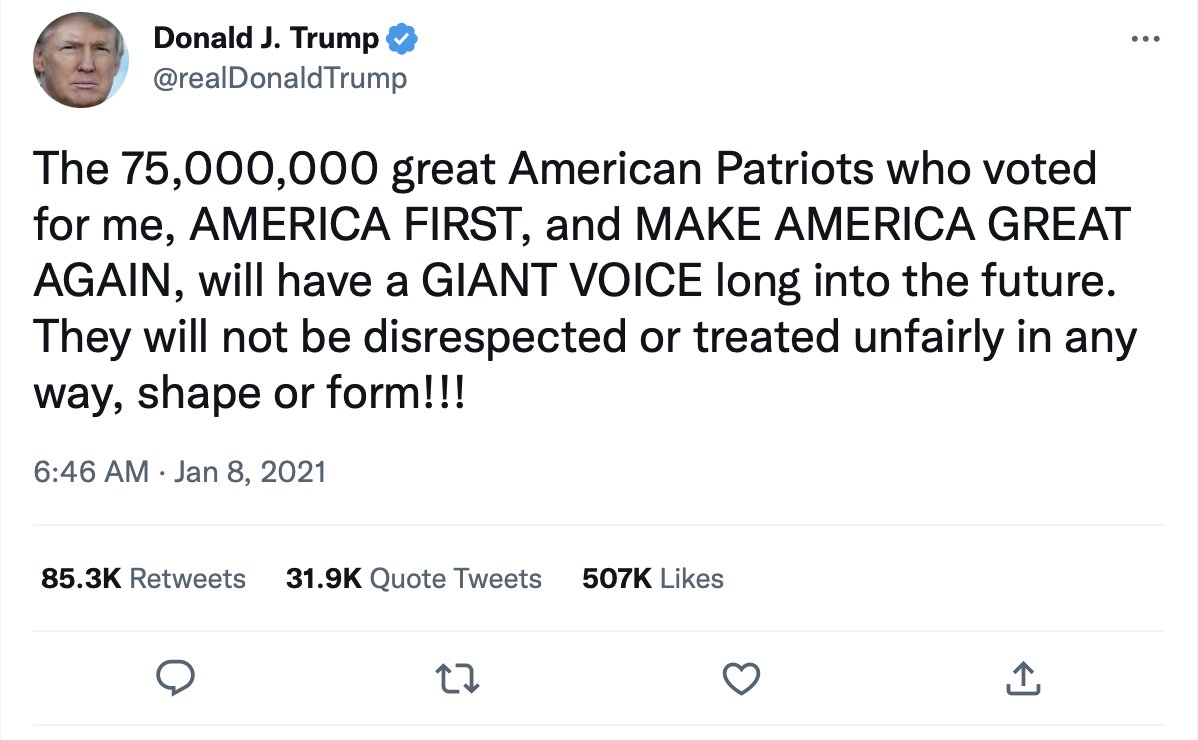
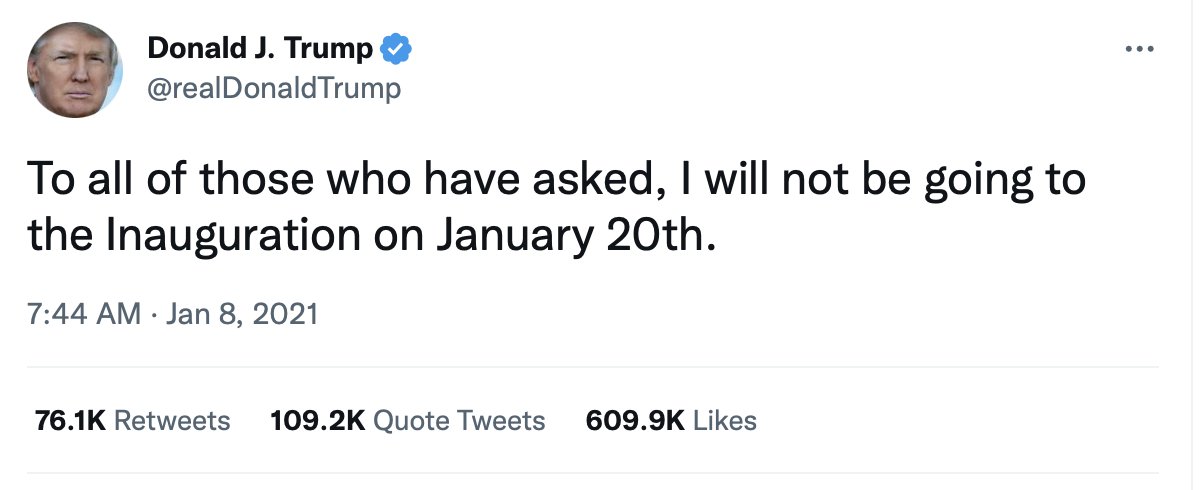
1. On the morning of January 8, President Donald Trump, with one remaining strike before being at risk of permanent suspension from Twitter, tweets twice.
2. 6:46 am: “The 75,000,000 great American Patriots who voted for me, AMERICA FIRST, and MAKE AMERICA GREAT AGAIN, will have a GIANT VOICE long into the future. They will not be disrespected or treated unfairly in any way, shape or form!!!”
3. 7:44 am: “To all of those who have asked, I will not be going to the Inauguration on January 20th.”
4. For years, Twitter had resisted calls both internal and external to ban Trump on the grounds that blocking a world leader from the platform or removing their controversial tweets would hide important information that people should be able to see and debate.
5. “Our mission is to provide a forum that enables people to be informed and to engage their leaders directly,” the company wrote in 2019. Twitter’s aim was to “protect the public’s right to hear from their leaders and to hold them to account.”
blog.twitter.com
blog.twitter.com

6. But after January 6, as @mtaibbi and @shellenbergermd have documented, pressure grew, both inside and outside of Twitter, to ban Trump.
7. There were dissenters inside Twitter.
“Maybe because I am from China,” said one employee on January 7, “I deeply understand how censorship can destroy the public conversation.”
“Maybe because I am from China,” said one employee on January 7, “I deeply understand how censorship can destroy the public conversation.”
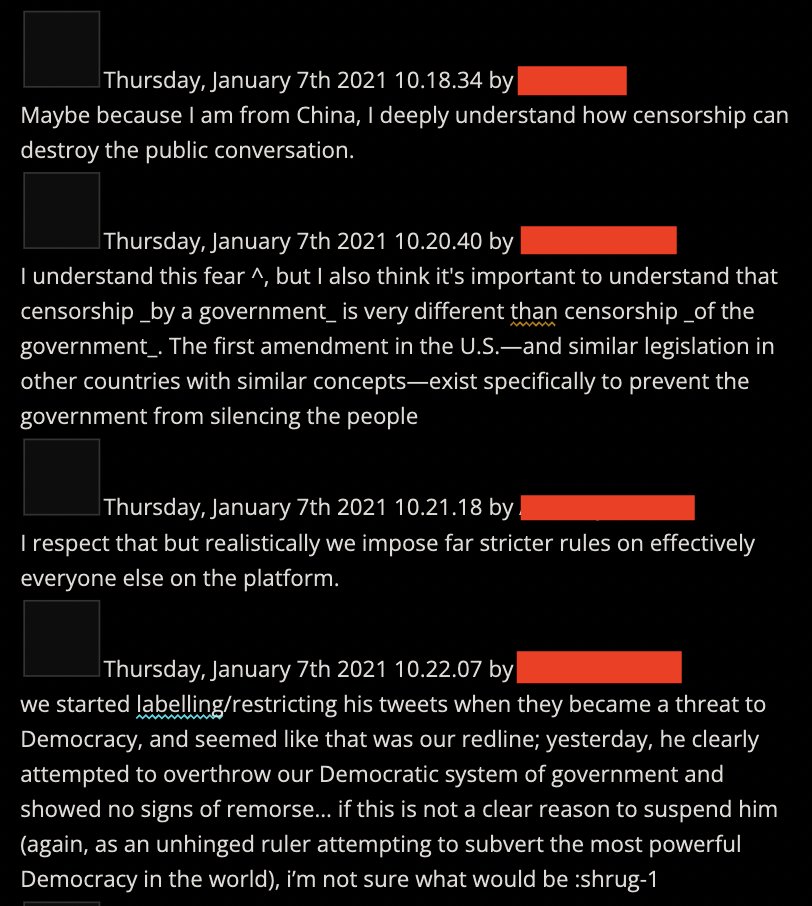
8. But voices like that one appear to have been a distinct minority within the company. Across Slack channels, many Twitter employees were upset that Trump hadn’t been banned earlier.
9. After January 6, Twitter employees organized to demand their employer ban Trump. “There is a lot of employee advocacy happening,” said one Twitter employee.
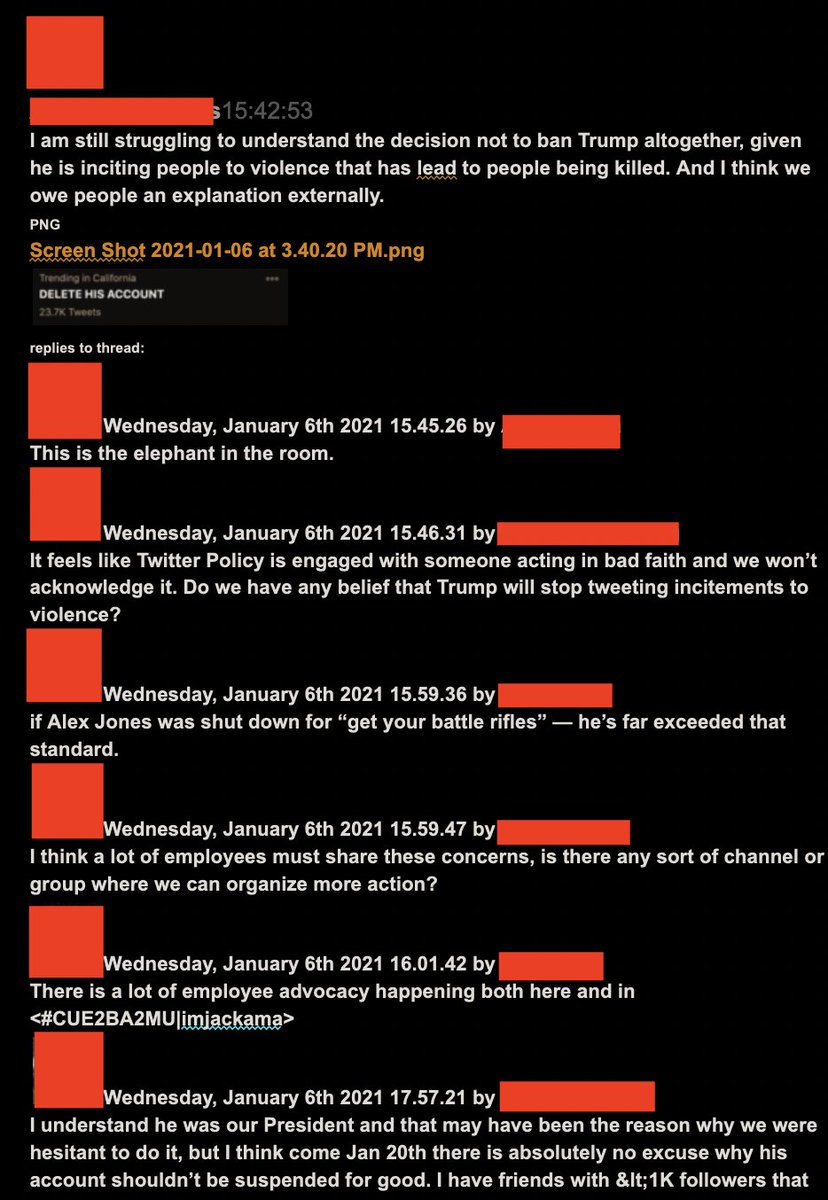
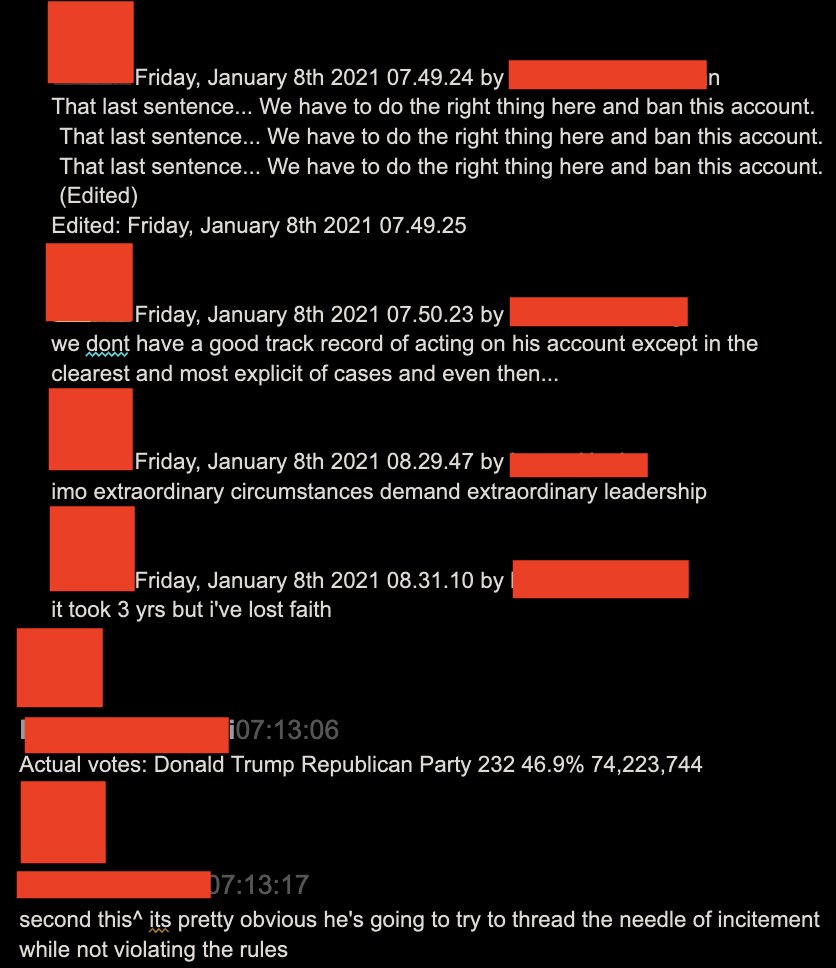
10. “We have to do the right thing and ban this account,” said one staffer.
It’s “pretty obvious he’s going to try to thread the needle of incitement without violating the rules,” said another.
It’s “pretty obvious he’s going to try to thread the needle of incitement without violating the rules,” said another.
11. In the early afternoon of January 8, The Washington Post published an open letter signed by over 300 Twitter employees to CEO Jack Dorsey demanding Trump’s ban. “We must examine Twitter’s complicity in what President-Elect Biden has rightly termed insurrection.”
12. But the Twitter staff assigned to evaluate tweets quickly concluded that Trump had *not* violated Twitter’s policies.“I think we’d have a hard time saying this is incitement,” wrote one staffer.
13. “It's pretty clear he's saying the ‘American Patriots’ are the ones who voted for him and not the terrorists (we can call them that, right?) from Wednesday.”
14. Another staffer agreed: “Don’t see the incitement angle here.”
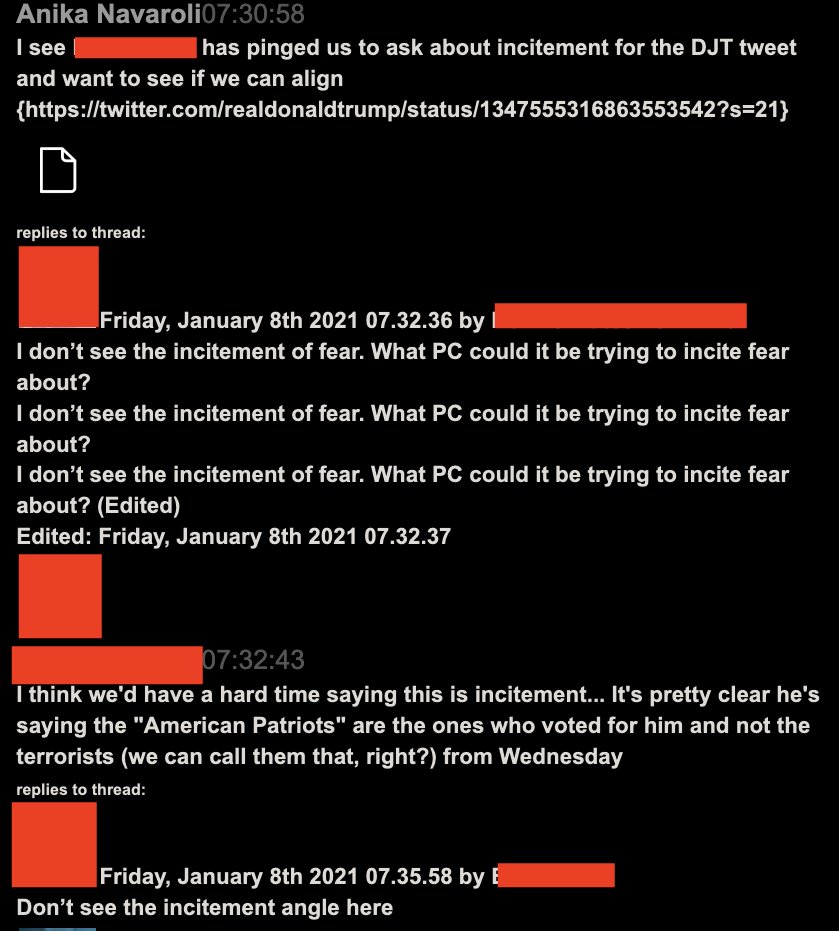
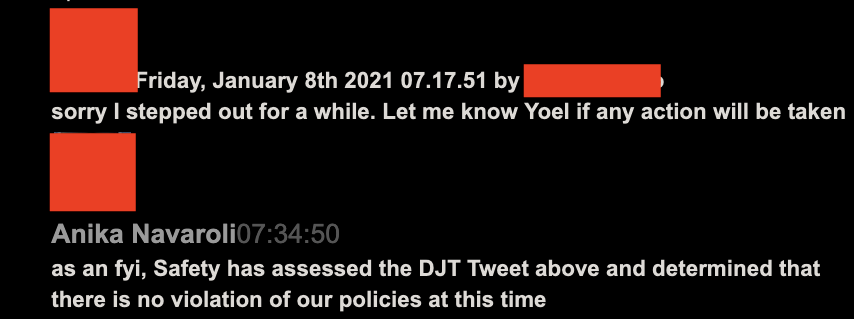
15. “I also am not seeing clear or coded incitement in the DJT tweet,” wrote Anika Navaroli, a Twitter policy official. “I’ll respond in the elections channel and say that our team has assessed and found no vios”—or violations—“for the DJT one.”
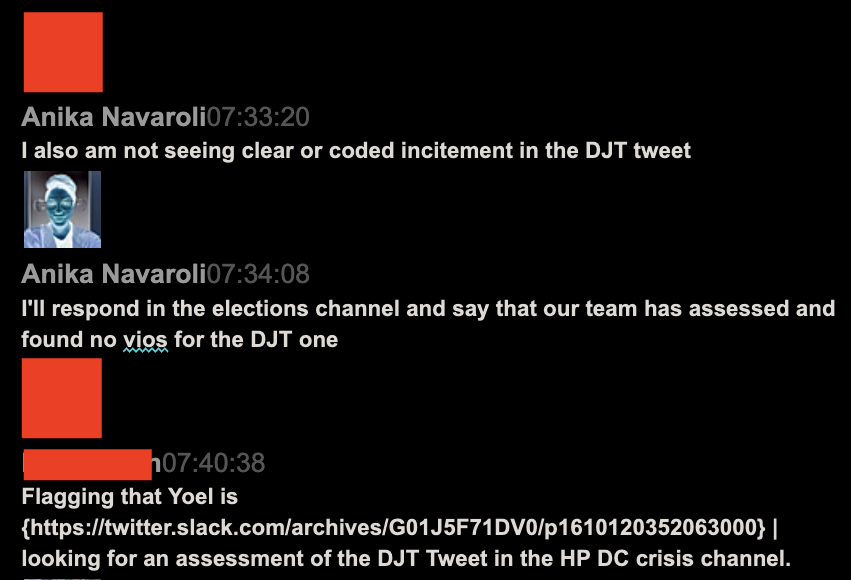
16. She does just that: “as an fyi, Safety has assessed the DJT Tweet above and determined that there is no violation of our policies at this time.”
17. (Later, Navaroli would testify to the House Jan. 6 committee:“For months I had been begging and anticipating and attempting to raise the reality that if nothing—if we made no intervention into what I saw occuring, people were going to die.”)
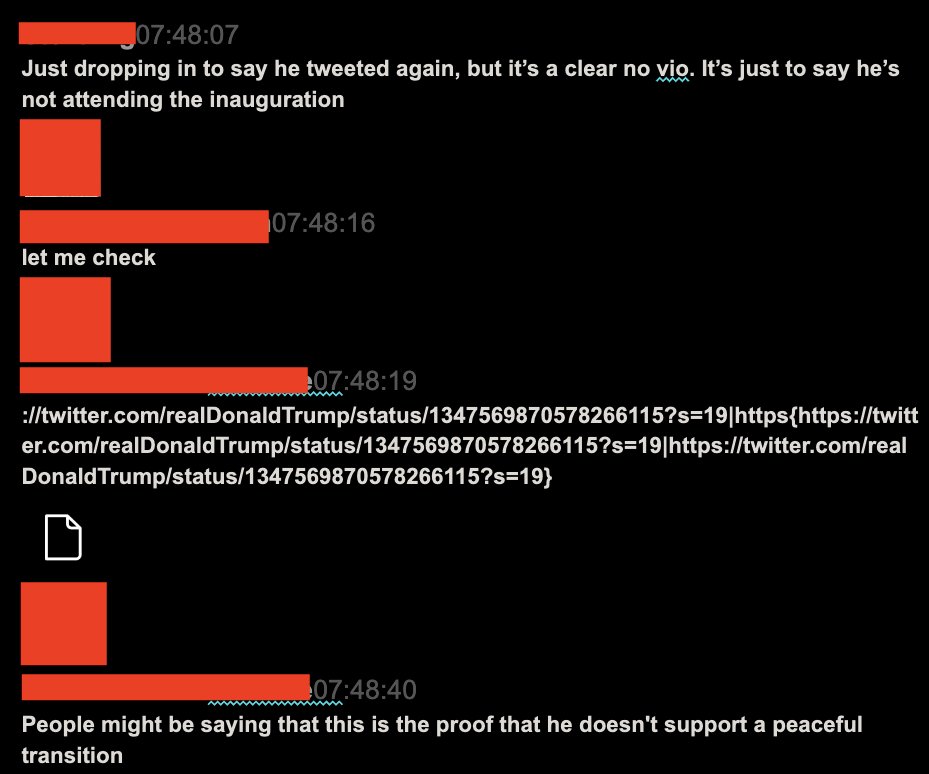
18. Next, Twitter’s safety team decides that Trump’s 7:44 am ET tweet is also not in violation. They are unequivocal: “it’s a clear no vio. It’s just to say he’s not attending the inauguration”
19. To understand Twitter’s decision to ban Trump, we must consider how Twitter deals with other heads of state and political leaders, including in Iran, Nigeria, and Ethiopia.
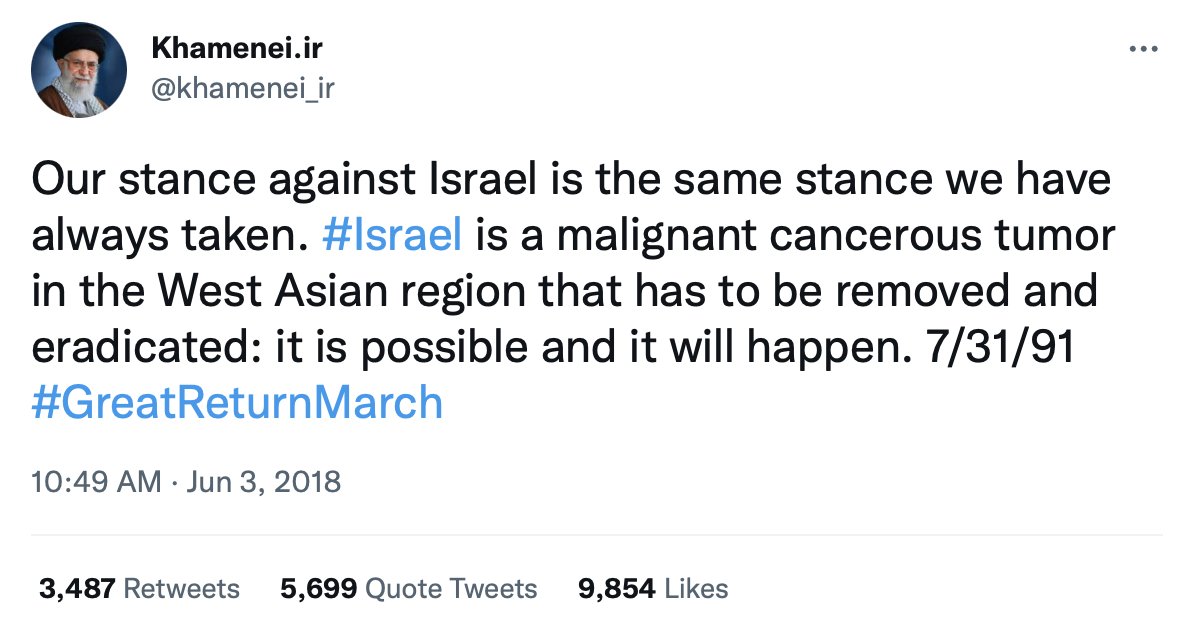
20. In June 2018, Iran’s Ayatollah Ali Khamenei tweeted, “#Israel is a malignant cancerous tumor in the West Asian region that has to be removed and eradicated: it is possible and it will happen.”
Twitter neither deleted the tweet nor banned the Ayatollah.
Twitter neither deleted the tweet nor banned the Ayatollah.
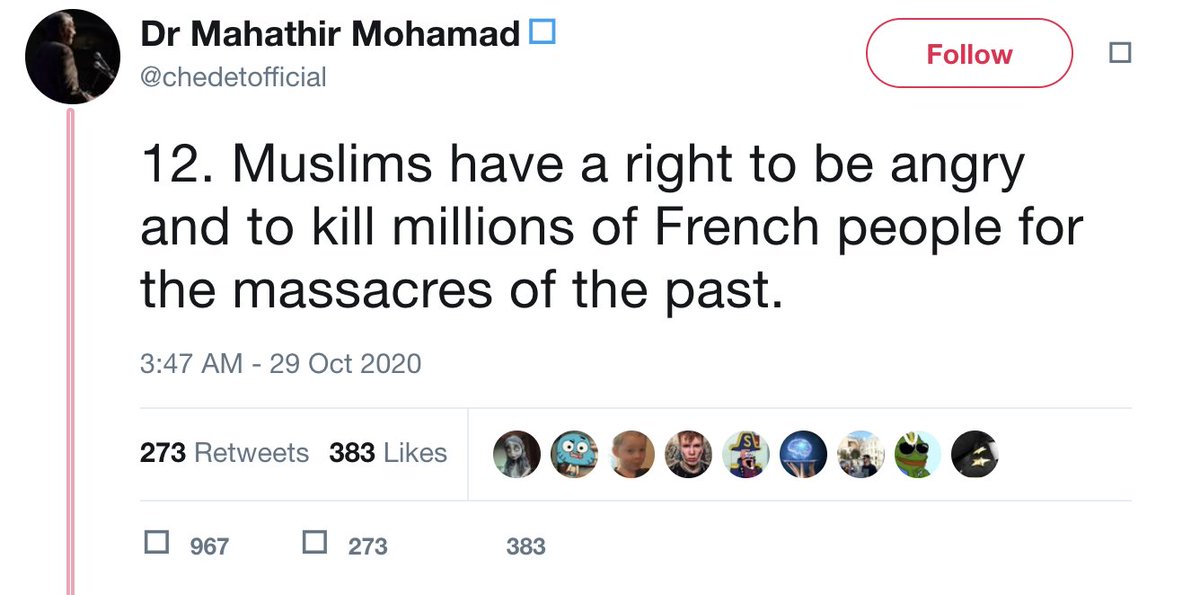
21. In October 2020, the former Malaysian Prime Minister said it was “a right” for Muslims to “kill millions of French people.”
Twitter deleted his tweet for “glorifying violence,” but he remains on the platform. The tweet below was taken from the Wayback Machine:
Twitter deleted his tweet for “glorifying violence,” but he remains on the platform. The tweet below was taken from the Wayback Machine:
22. Muhammadu Buhari, the President of Nigeria, incited violence against pro-Biafra groups.“Those of us in the fields for 30 months, who went through the war,” he wrote, “will treat them in the language they understand.”
Twitter deleted the tweet but didn't ban Buhari.
Twitter deleted the tweet but didn't ban Buhari.
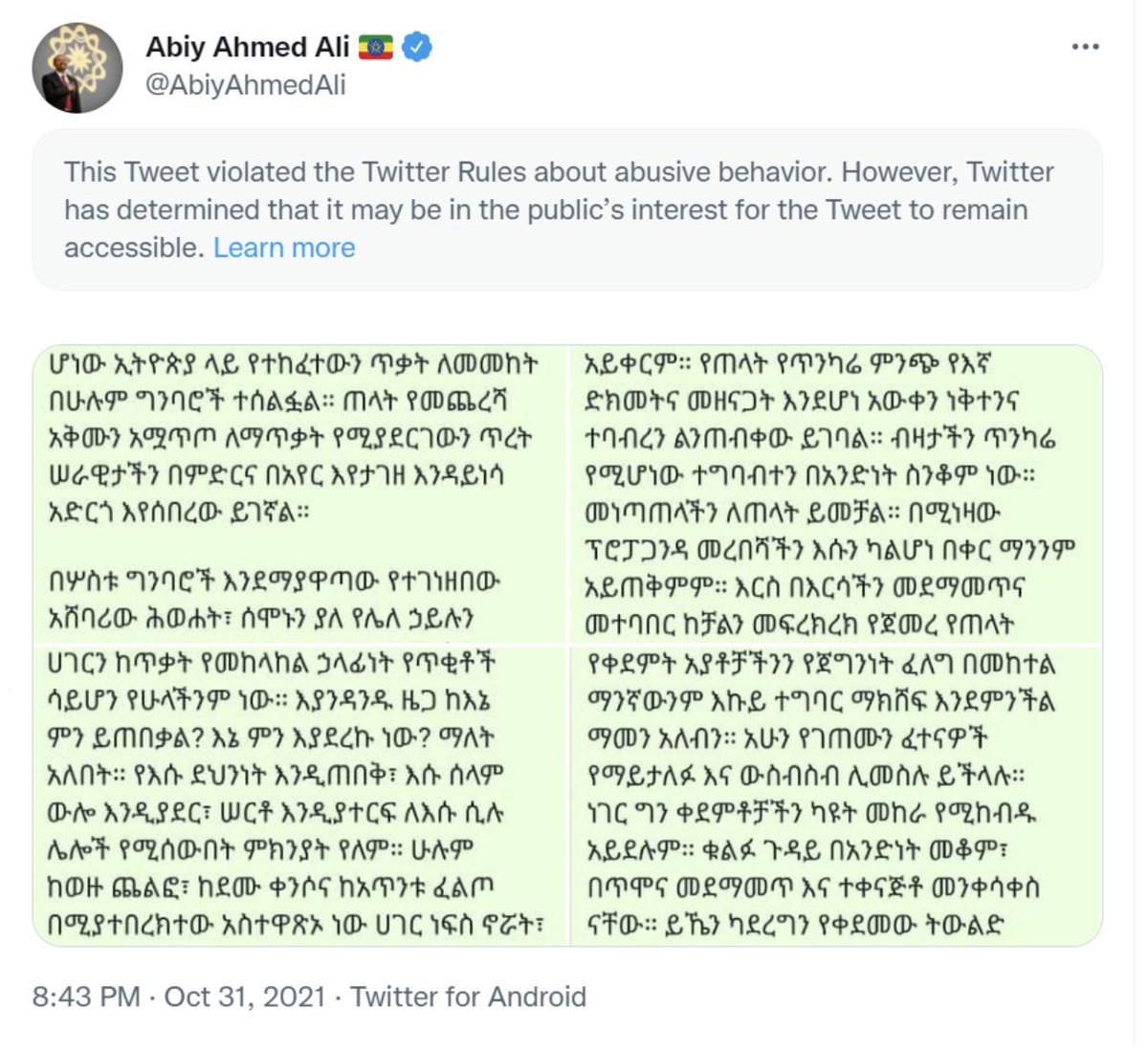
23. In October 2021, Twitter allowed Ethiopian Prime Minister Abiy Ahmed to call on citizens to take up arms against the Tigray region.
Twitter allowed the tweet to remain up, and did not ban the prime minister.
Twitter allowed the tweet to remain up, and did not ban the prime minister.
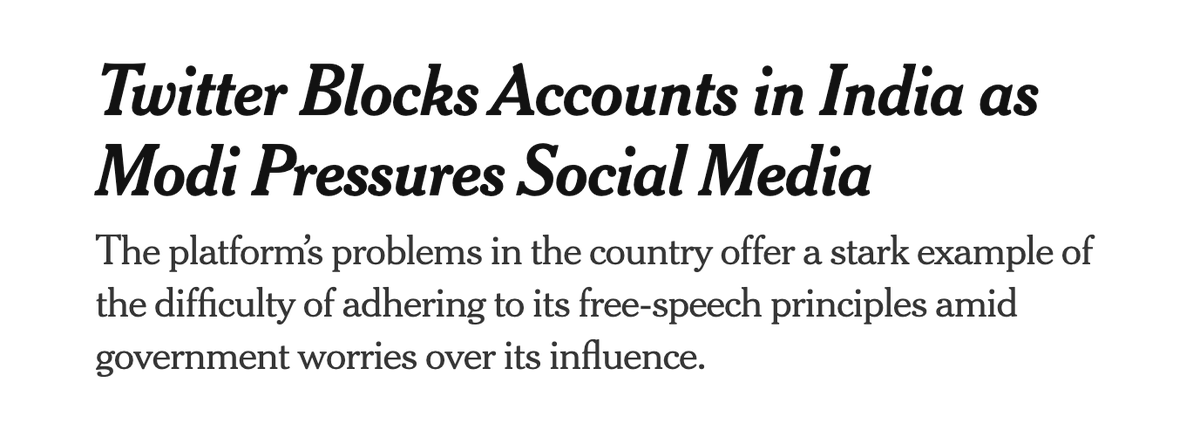
24. In early February 2021, Prime Minister Narendra Modi’s government threatened to arrest Twitter employees in India, and to incarcerate them for up to seven years after they restored hundreds of accounts that had been critical of him.
Twitter did not ban Modi.
Twitter did not ban Modi.
25. But Twitter executives did ban Trump, even though key staffers said that Trump had not incited violence—not even in a “coded” way.
26. Less than 90 minutes after Twitter employees had determined that Trump’s tweets were not in violation of Twitter policy, Vijaya Gadde—Twitter’s Head of Legal, Policy, and Trust—asked whether it could, in fact, be “coded incitement to further violence.”
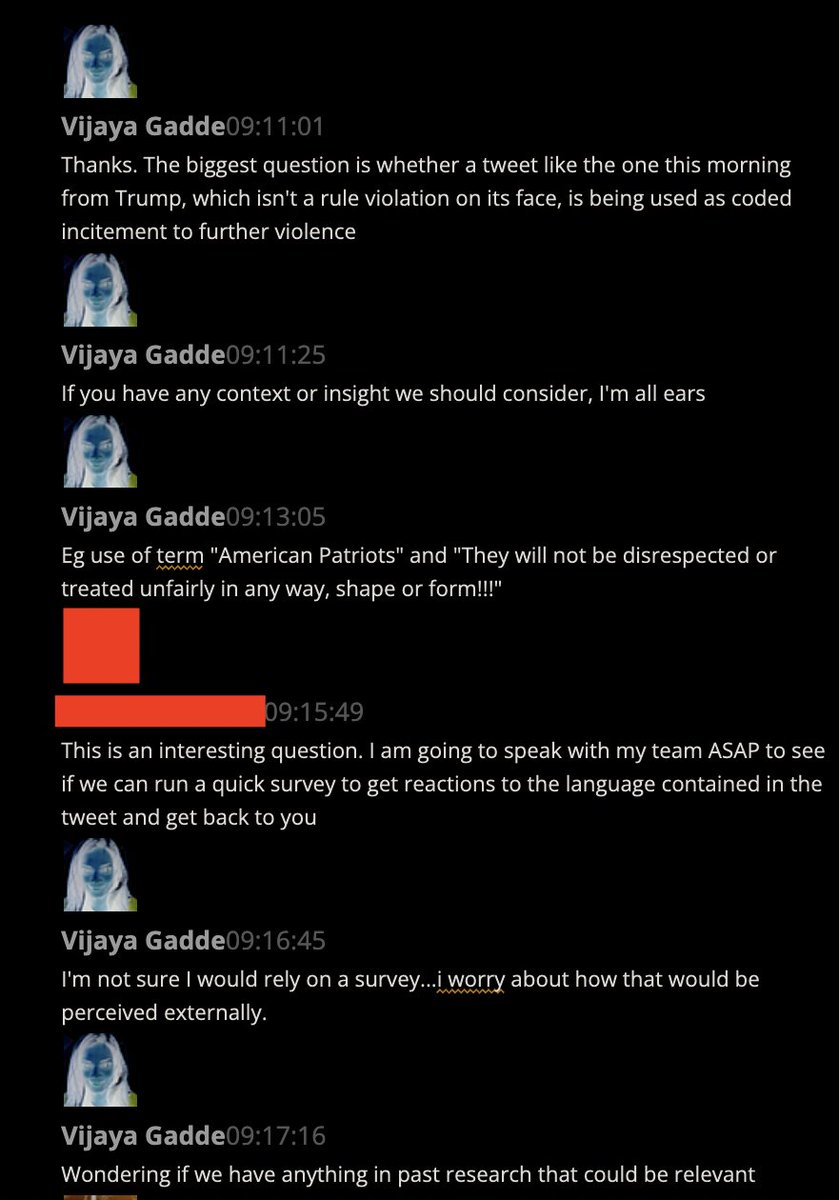
27. A few minutes later, Twitter employees on the “scaled enforcement team” suggest that Trump’s tweet may have violated Twitter’s Glorification of Violence policy—if you interpreted the phrase “American Patriots” to refer to the rioters.
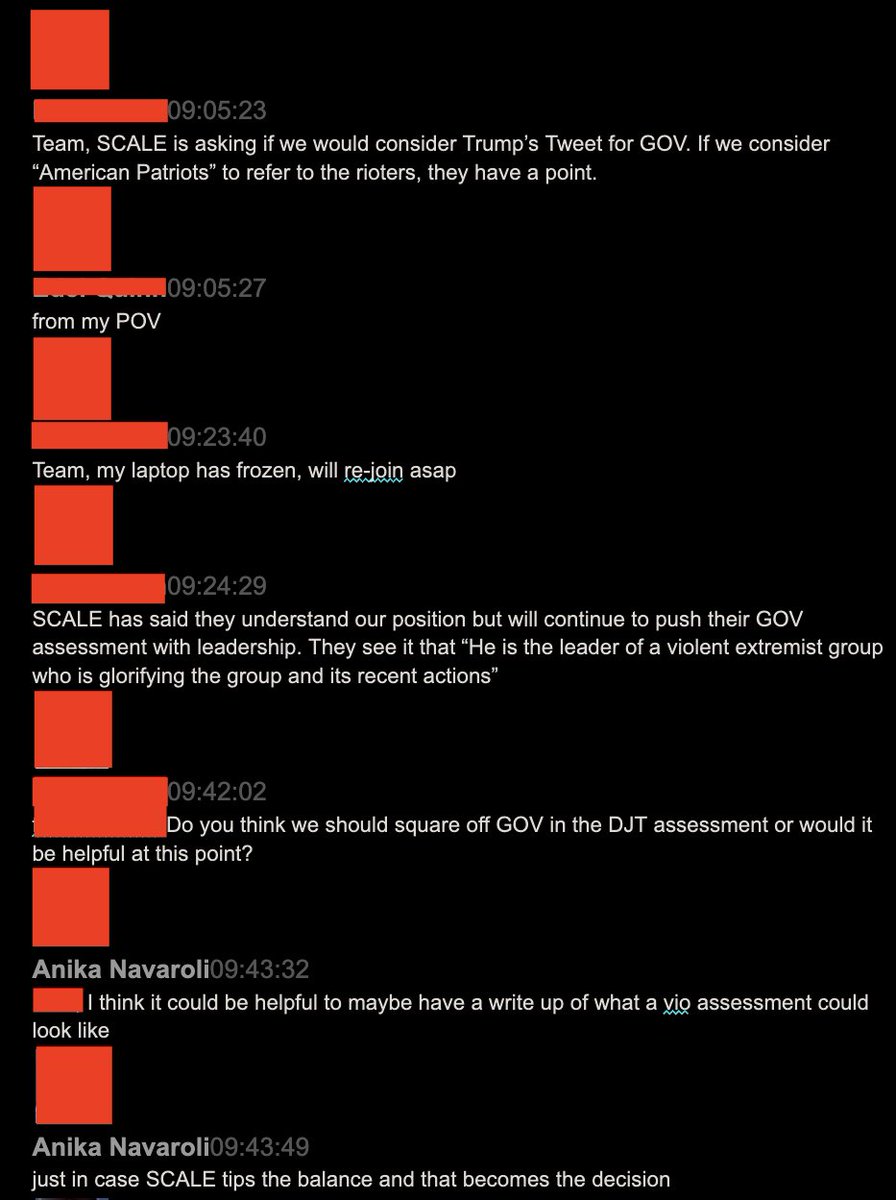
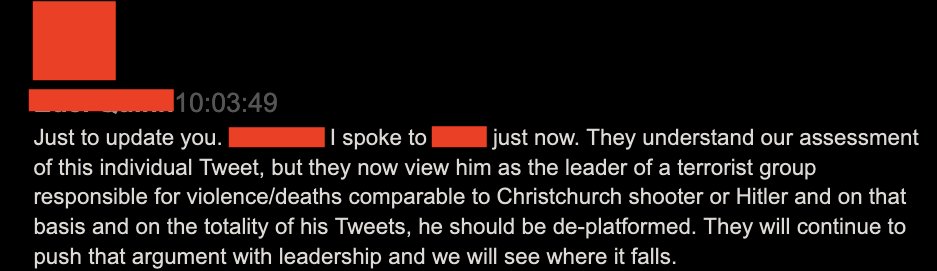
28. Things escalate from there.
Members of that team came to “view him as the leader of a terrorist group responsible for violence/deaths comparable to Christchurch shooter or Hitler and on that basis and on the totality of his Tweets, he should be de-platformed.”
Members of that team came to “view him as the leader of a terrorist group responsible for violence/deaths comparable to Christchurch shooter or Hitler and on that basis and on the totality of his Tweets, he should be de-platformed.”
29. Two hours later, Twitter executives host a 30-minute all-staff meeting.
Jack Dorsey and Vijaya Gadde answer staff questions as to why Trump wasn’t banned yet.
But they make some employees angrier.
Jack Dorsey and Vijaya Gadde answer staff questions as to why Trump wasn’t banned yet.
But they make some employees angrier.
30. “Multiple tweeps [Twitter employees] have quoted the Banality of Evil suggesting that people implementing our policies are like Nazis following orders,” relays Yoel Roth to a colleague.
![30. “Multiple tweeps [Twitter employees] have quoted the Banality of Evil suggesting that people imp...](https://pbs.twimg.com/media/FjzGfcVVsAAo3bF.jpg)
31. Dorsey requested simpler language to explain Trump’s suspension.
Roth wrote, “god help us [this] makes me think he wants to share it publicly”
Roth wrote, “god help us [this] makes me think he wants to share it publicly”
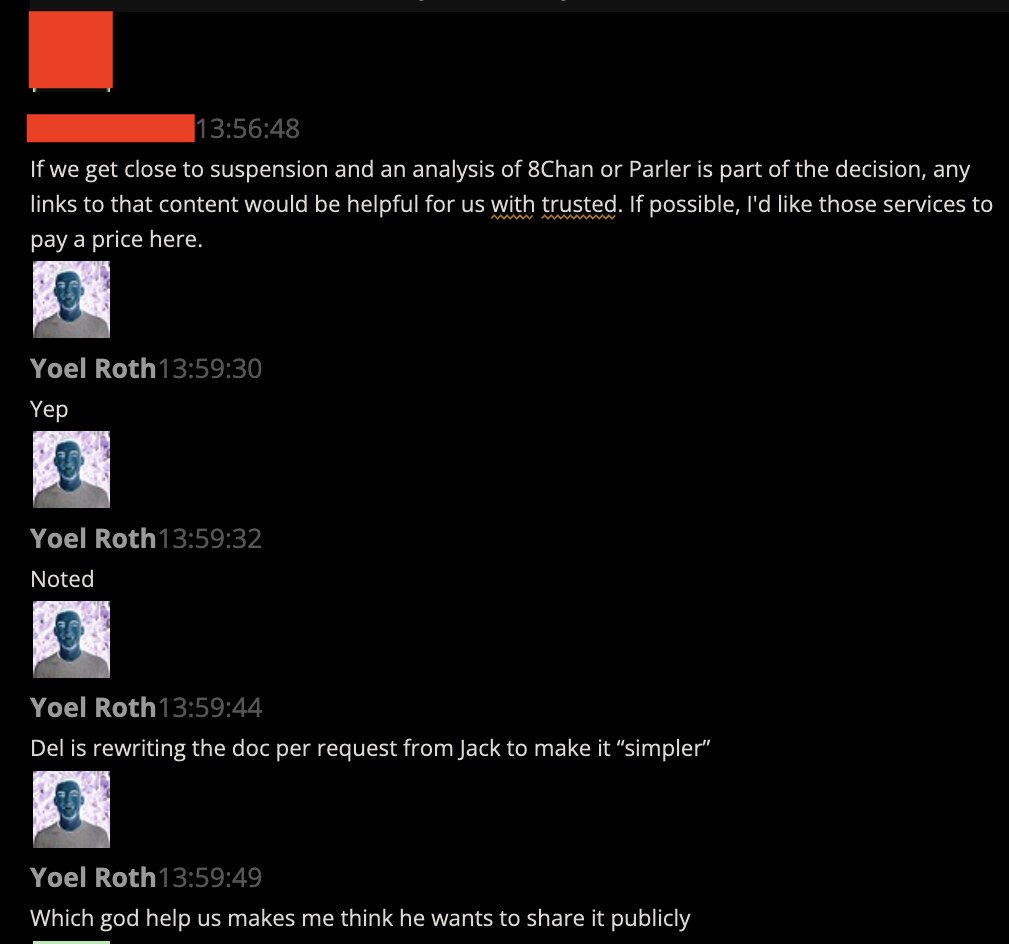
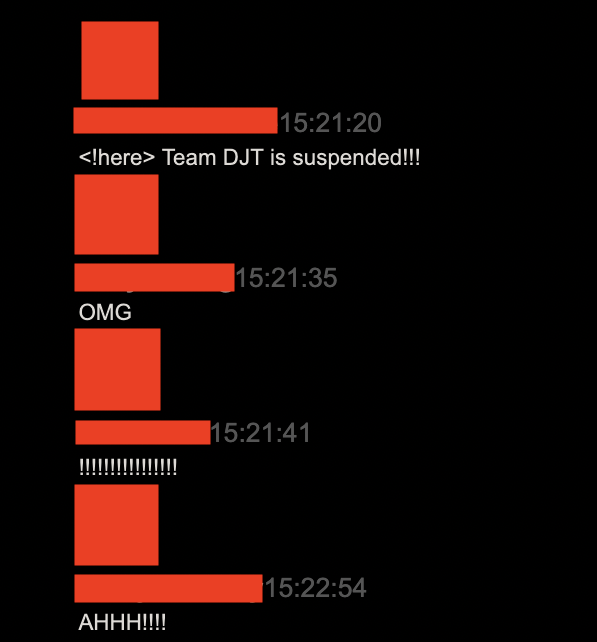
32. One hour later, Twitter announces Trump’s permanent suspension “due to the risk of further incitement of violence.”
33. Many at Twitter were ecstatic.
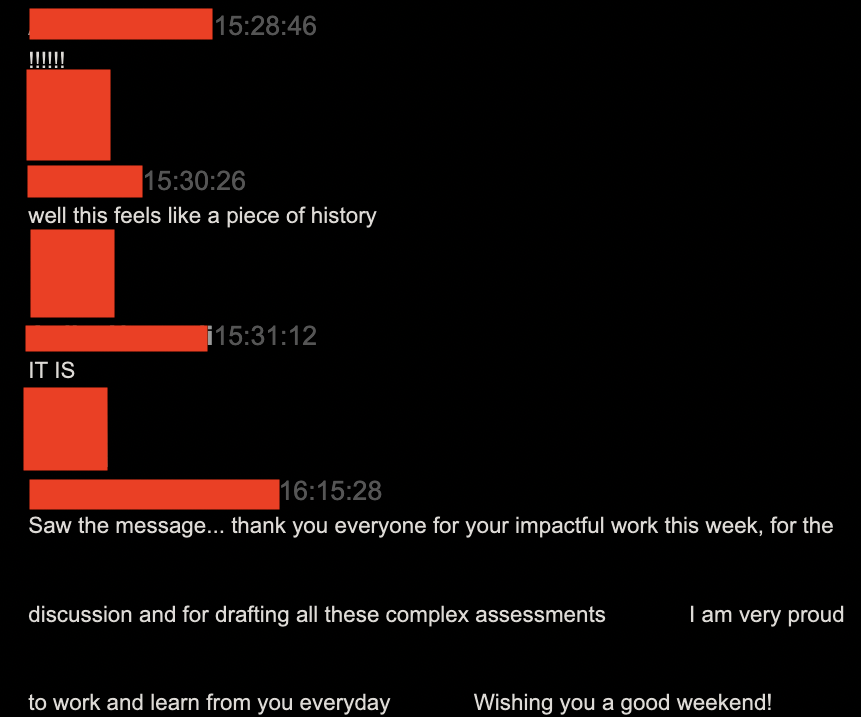
34. And congratulatory: “big props to whoever in trust and safety is sitting there whack-a-mole-ing these trump accounts”
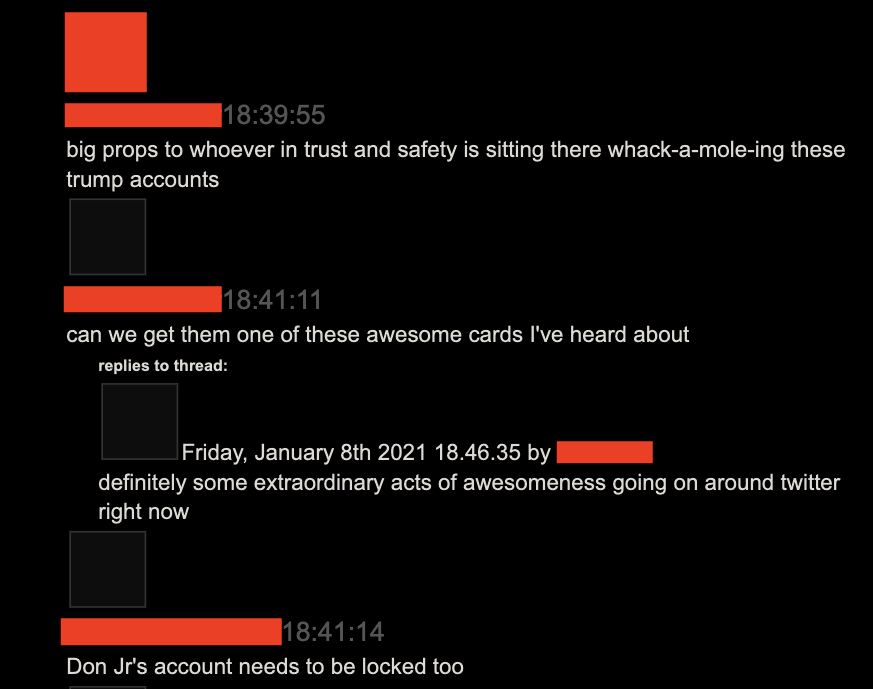
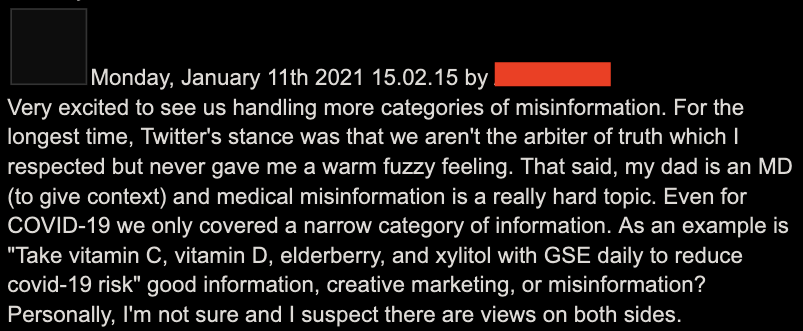
35. By the next day, employees expressed eagerness to tackle “medical misinformation” as soon as possible:
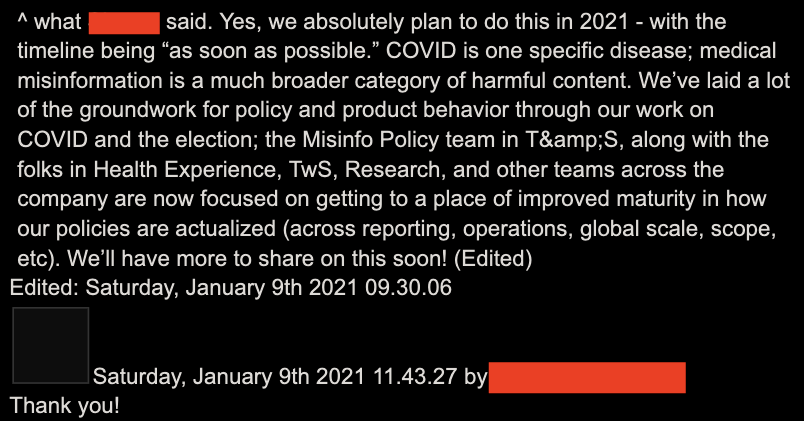
36. “For the longest time, Twitter’s stance was that we aren’t the arbiter of truth,” wrote another employee, “which I respected but never gave me a warm fuzzy feeling.”
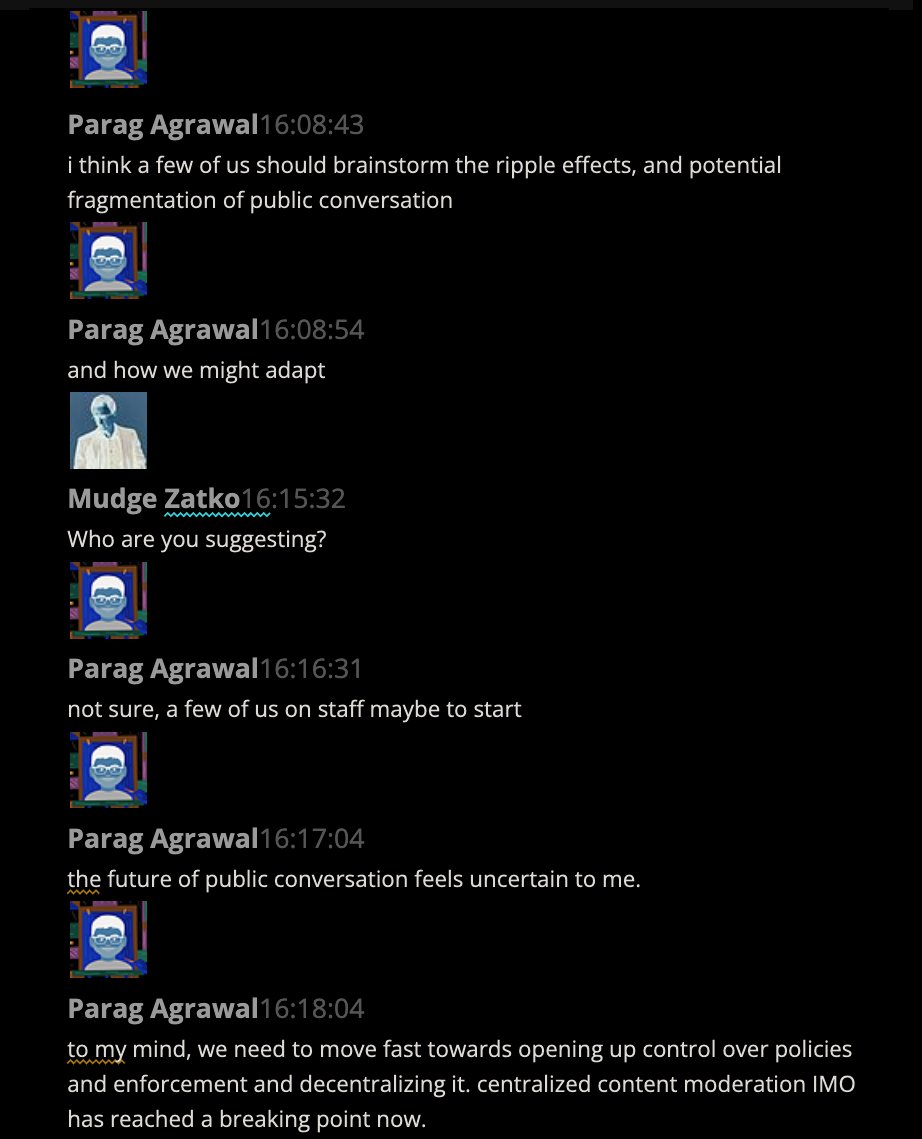
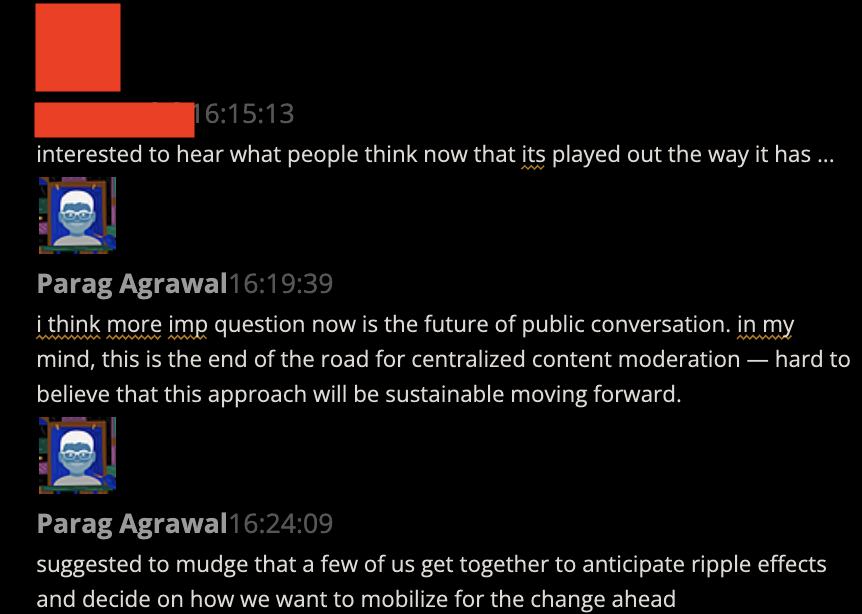
37. But Twitter’s COO Parag Agrawal—who would later succeed Dorsey as CEO—told Head of Security Mudge Zatko: “I think a few of us should brainstorm the ripple effects” of Trump's ban. Agrawal added: “centralized content moderation IMO has reached a breaking point now.”
38. Outside the United States, Twitter’s decision to ban Trump raised alarms, including with French President Emmanuel Macron, German Prime Minister Angela Merkel, and Mexico's President Andres Manuel Lopez Obrador.
39. Macron told an audience he didn’t “want to live in a democracy where the key decisions” were made by private players. “I want it to be decided by a law voted by your representative, or by regulation, governance, democratically discussed and approved by democratic leaders.”
40. Merkel’s spokesperson called Twitter’s decision to ban Trump from its platform “problematic” and added that the freedom of opinion is of “elementary significance.”
Russian opposition leader Alexey Navalny criticized the ban as “an unacceptable act of censorship.”
Russian opposition leader Alexey Navalny criticized the ban as “an unacceptable act of censorship.”
41. Whether you agree with Navalny and Macron or the executives at Twitter, we hope this latest installment of #TheTwitterFiles gave you insight into that unprecedented decision.
42. From the outset, our goal in investigating this story was to discover and document the steps leading up to the banning of Trump and to put that choice into context.
43. Ultimately, the concerns about Twitter’s efforts to censor news about Hunter Biden’s laptop, blacklist disfavored views, and ban a president aren’t about the past choices of executives in a social media company.
44. They’re about the power of a handful of people at a private company to influence the public discourse and democracy.
45. This was reported by @ShellenbergerMD, @IsaacGrafstein, @SnoozyWeiss, @Olivia_Reingold, @petersavodnik, @NellieBowles. Follow all of our work at The Free Press: @TheFP
46. Please click here to subscribe to The Free Press, where you can continue reading and supporting independent journalism: thefp.com

Loading suggestions...