

The name of River Thames comes from the same Proto-Indo-European root that gives us the Sanskrit word tamas (तमस्) meaning “dark.”
It’s an allusion to the river’s murky color thanks primarily to its high silt content.
But that isn’t the only fun bit about it.
It’s an allusion to the river’s murky color thanks primarily to its high silt content.
But that isn’t the only fun bit about it.
The fun bit is the river’s anthropomorphism.
We often think it’s something we only do in India, that too with major rivers like the Ganges (Ganga mata) Godavari.
But that isn’t quite true. Thames has a human form too. Just with a different gender.
We often think it’s something we only do in India, that too with major rivers like the Ganges (Ganga mata) Godavari.
But that isn’t quite true. Thames has a human form too. Just with a different gender.
So the river is often said to originate in a Gloucestershire hamlet called Seven Springs. If you go there, you’ll find a plaque from 2012 that refers to two stone inscriptions in the vicinity and translates them in English.
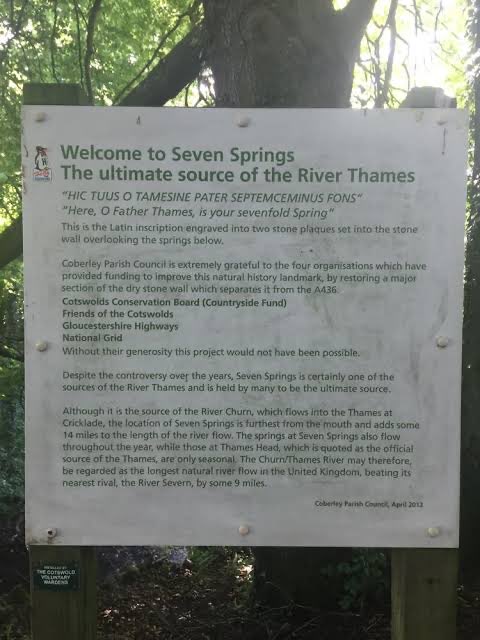
The inscription are in Latin:
“Hic tuus o Tamesine pater septemgeminus fons.”
Here, Tamesine is Latin for Thames. Almost rhymes with tamas, no?
Translation:
“Here, O Father Thames, is your sevenfold source.”
Father Thames!
“Hic tuus o Tamesine pater septemgeminus fons.”
Here, Tamesine is Latin for Thames. Almost rhymes with tamas, no?
Translation:
“Here, O Father Thames, is your sevenfold source.”
Father Thames!
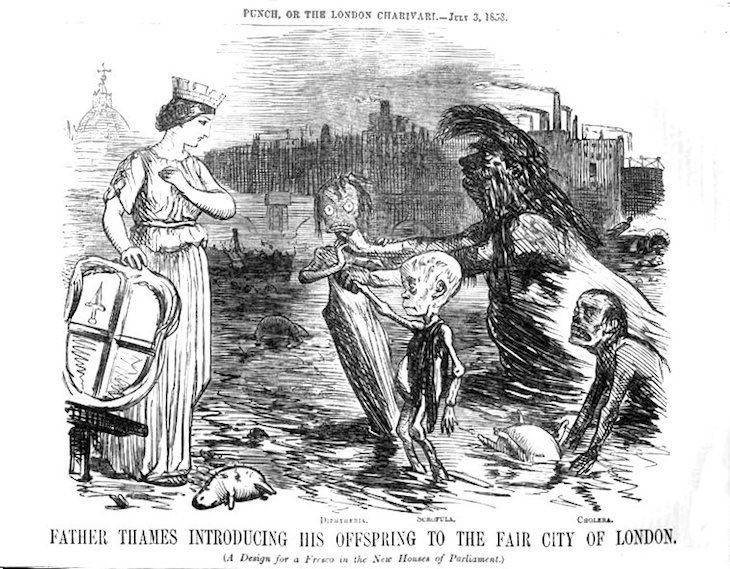
In this human form, Father Thames is also seen as father figure to three diseases, namely diphtheria, scrofula, and cholera, all of which saw some of their most devastating spreads through the river in question.
Interestingly, a section that passes through Oxford is also locally called Isis. The name is a direct reference to the Ancient Egyptian goddess associated with the Nile.
An 18th-century couplet by Matthew Prior reads:
An 18th-century couplet by Matthew Prior reads:
““Where beauteous Isis and her Husband Tame
With mingl'd Waves, for ever, flow the Same.”
With mingl'd Waves, for ever, flow the Same.”
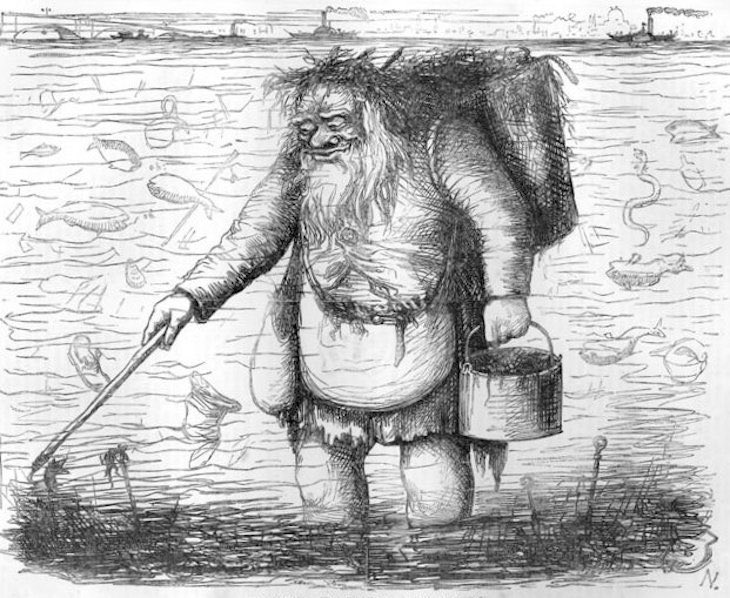
Here’s a cartoon that represents Father Thames in a rather unflattering way. It appeared as an illustration to a poem in an 1848 Punch magazine edition.
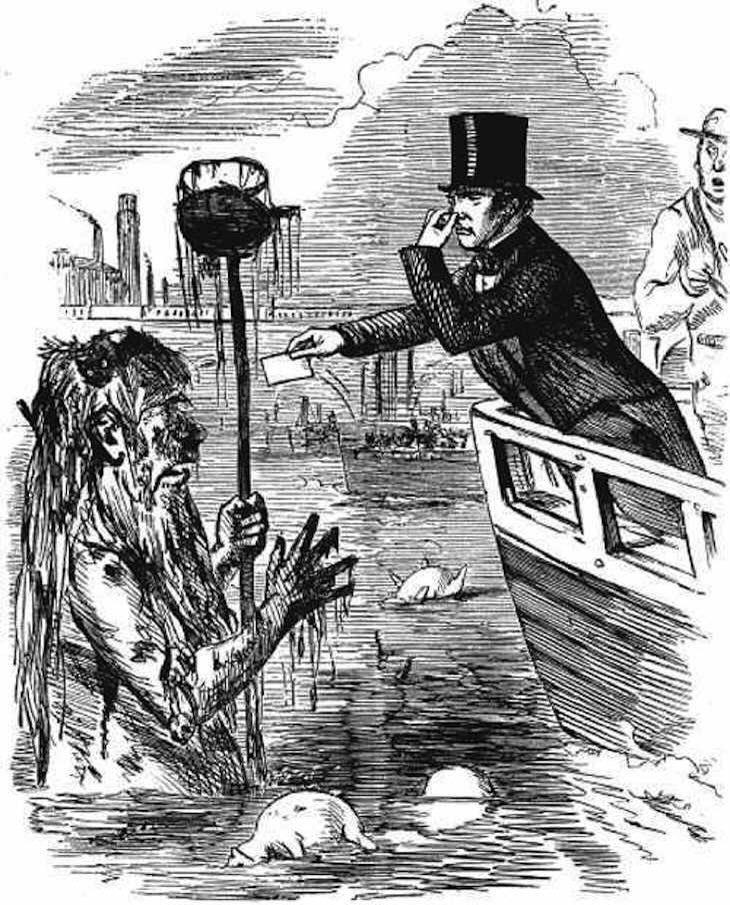
Here’s another from the same magazine in 1855 illustrating Faraday’s strong opinions on the river’s sickening pollution.
And here’s the most evocative of all by John Leach in 1858. This one depicts Father Thames offering his three children (diphtheria, cholera and scrofula) to the “Fair City of London.”
This was the year of what we call “The Great Stink.”
This was the year of what we call “The Great Stink.”
And now, one last interesting bit before we end this:
It’s not just a “Father.”
See this map.
The river starts from the left and empties into the Channel at a place called Southend-on-Sea.
Note the dot named Teddington.
It’s not just a “Father.”
See this map.
The river starts from the left and empties into the Channel at a place called Southend-on-Sea.
Note the dot named Teddington.
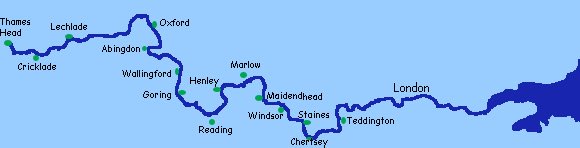
That’s the place that divides the river into two sections. One on the left, and the other on the right. The latter, downstream section experiences considerable tidal forces and also happens to be the one that passes through London.
This section is personified as Mama Thames.
This section is personified as Mama Thames.
So just as we have Mother Ganges, they have a Father Thames. Which eventually becomes a “mother” which is what you’re most likely to have seen in pictures.
References:
1. Book: I Never Knew That about the River Thames by Christopher Winn, 2010
2. londonist.com
References:
1. Book: I Never Knew That about the River Thames by Christopher Winn, 2010
2. londonist.com

Loading suggestions...