

83% of business owners would not pass a basic finance test.
But it doesn't have to be this way.
Here are 9 tips to make you financially smarter (in less than 5 minutes):
But it doesn't have to be this way.
Here are 9 tips to make you financially smarter (in less than 5 minutes):
1. Read financial statements
Accounting is the language of business.
If you want to be successful, know these by heart:
• Balance sheet
• Income statement
• Cash flow statement
Make your life easy and download my FREE Accounting Essentials guide.
theantonioreza.com
Accounting is the language of business.
If you want to be successful, know these by heart:
• Balance sheet
• Income statement
• Cash flow statement
Make your life easy and download my FREE Accounting Essentials guide.
theantonioreza.com
2. Think like an investor
A successful business — from a financial standpoint — is one that is growing, generating cash, and returning profits to its owners.
Focusing on these 3 things is your north star.
If one is not materializing, pivot and implement corrective actions.
A successful business — from a financial standpoint — is one that is growing, generating cash, and returning profits to its owners.
Focusing on these 3 things is your north star.
If one is not materializing, pivot and implement corrective actions.
3. Learn to use financial ratios
Analyzing ratios can help you identify areas of improvement in your business.
There are 4 main categories of financial ratios:
• Profitability ratios
• Operating ratios
• Liquidity ratios
• Leverage ratios
Let's go through them.
Analyzing ratios can help you identify areas of improvement in your business.
There are 4 main categories of financial ratios:
• Profitability ratios
• Operating ratios
• Liquidity ratios
• Leverage ratios
Let's go through them.
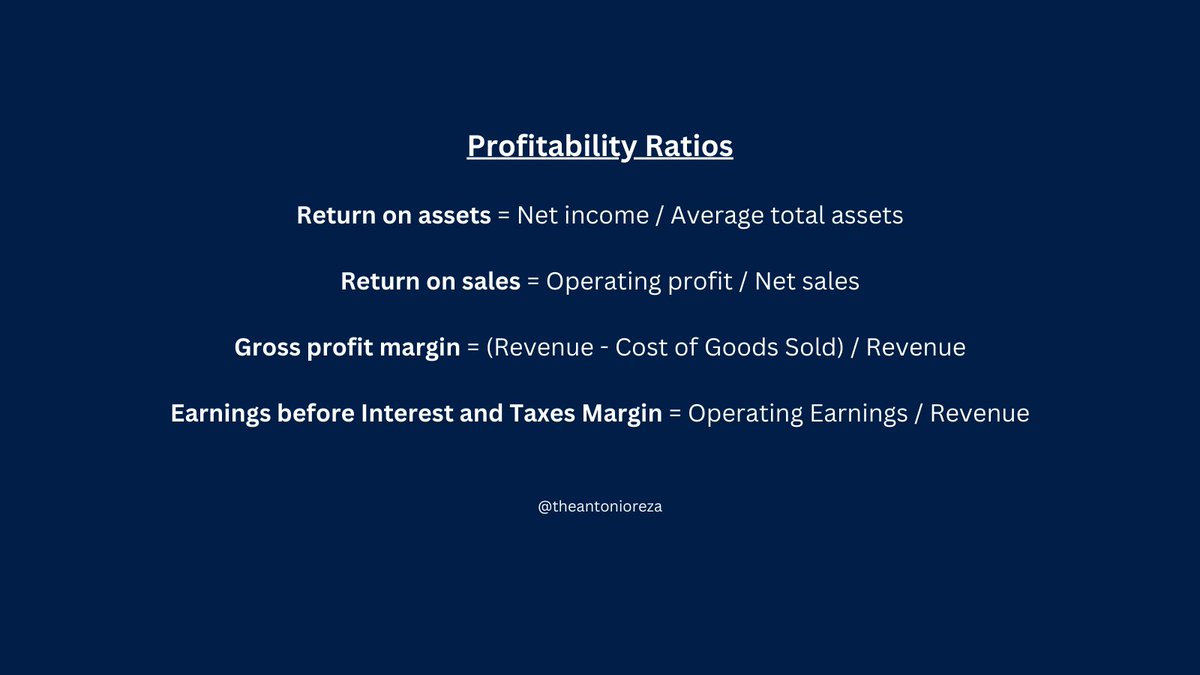
3.1. Profitability ratios
Return on Assets: Are assets being utilized effectively?
Return on Sales: Are costs down and sales turning into profit?
Gross Profit Margin: Is the company efficient?
EBIT (Earnings Before Interest and Taxes): Is the company profitable overall?
Return on Assets: Are assets being utilized effectively?
Return on Sales: Are costs down and sales turning into profit?
Gross Profit Margin: Is the company efficient?
EBIT (Earnings Before Interest and Taxes): Is the company profitable overall?
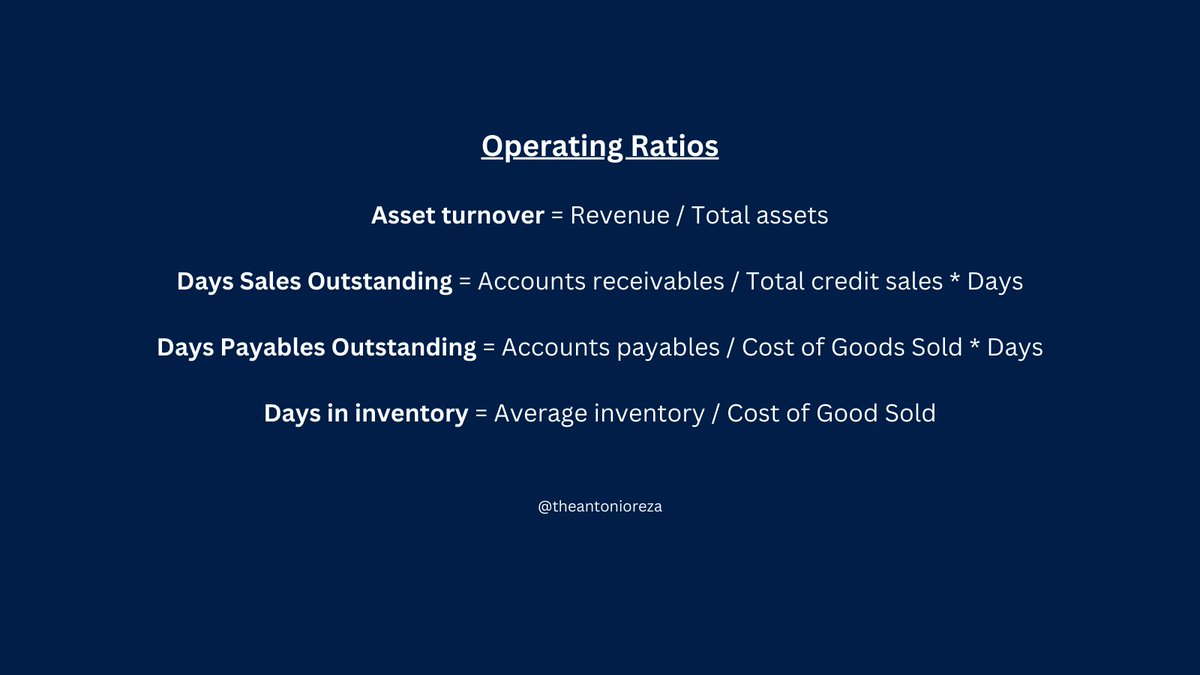
3.2. Operating ratios
Asset Turnover: Are assets generating enough revenue?
Days Sales Outstanding: Are receivables being collected fast enough?
Days Payables Outstanding: Are suppliers being paid timely?
Days in Inventory: Is inventory being sold fast enough?
Asset Turnover: Are assets generating enough revenue?
Days Sales Outstanding: Are receivables being collected fast enough?
Days Payables Outstanding: Are suppliers being paid timely?
Days in Inventory: Is inventory being sold fast enough?
3.3. Liquidity ratios
Current ratio: Can you pay your short-term obligations with your current assets?
Quick ratio: Can you pay your short-term obligations with your most liquid assets (excluding inventory)?
Current ratio: Can you pay your short-term obligations with your current assets?
Quick ratio: Can you pay your short-term obligations with your most liquid assets (excluding inventory)?

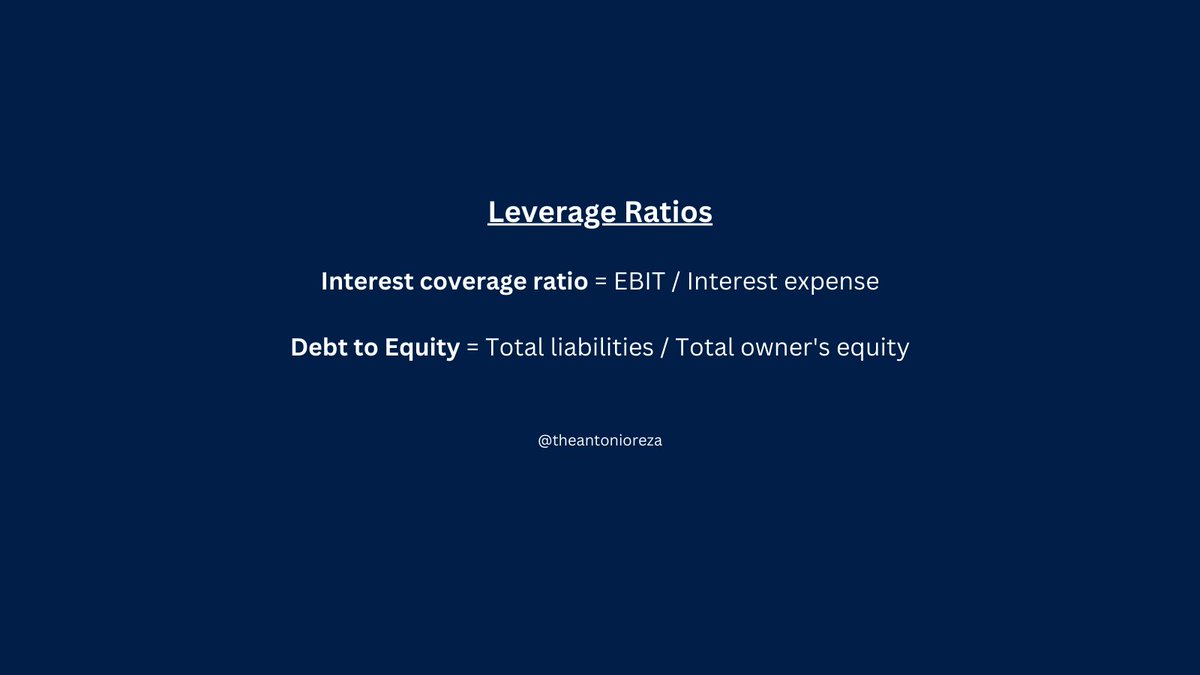
3.4. Leverage ratios
Interest coverage: Can you make interest payments on outstanding debt?
Debt to equity: Are you overleveraged or could you use debt to generate profits?
Interest coverage: Can you make interest payments on outstanding debt?
Debt to equity: Are you overleveraged or could you use debt to generate profits?
4/ Balance profit and cash
A successful business needs both.
If you're short on cash, reduce the gap and timing between outflows/inflows of cash, sell an asset, or borrow.
If you're short on profit, sell more, raise prices, and cut costs.
A lot easier said than done, though.
A successful business needs both.
If you're short on cash, reduce the gap and timing between outflows/inflows of cash, sell an asset, or borrow.
If you're short on profit, sell more, raise prices, and cut costs.
A lot easier said than done, though.
5/ Optimize cash flow
Always look for ways to improve your cash position.
Customers might not be paying you because of:
• Unfavorable macroeconomic conditions
• Quality issues with your product
• Unclear contractual terms
Understand what's causing a cash drag and fix it.
Always look for ways to improve your cash position.
Customers might not be paying you because of:
• Unfavorable macroeconomic conditions
• Quality issues with your product
• Unclear contractual terms
Understand what's causing a cash drag and fix it.
6/ Maximize return on investment
Always think about spending money as an investment.
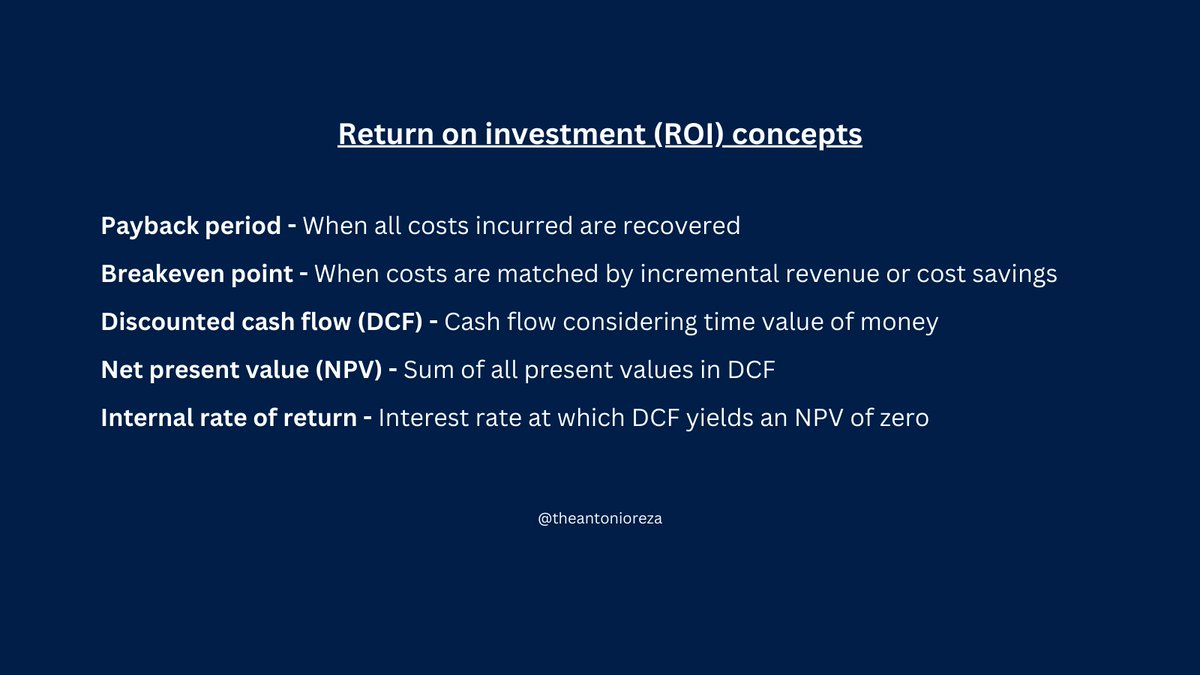
5 concepts to help you with it:
Payback period
Breakeven point
Discounted cash flow
Net present value
Internal rate of return
Remember: One dollar today is worth more than a dollar tomorrow.
Always think about spending money as an investment.
5 concepts to help you with it:
Payback period
Breakeven point
Discounted cash flow
Net present value
Internal rate of return
Remember: One dollar today is worth more than a dollar tomorrow.
7/ Use cost-benefit analysis
6 steps to evaluate an opportunity:
• What are the associated costs?
• What additional revenues will it bring?
• What cost savings will it bring?
• What's the timeline for costs and revenues?
• What are the non-quantifiable benefits or costs?
6 steps to evaluate an opportunity:
• What are the associated costs?
• What additional revenues will it bring?
• What cost savings will it bring?
• What's the timeline for costs and revenues?
• What are the non-quantifiable benefits or costs?
8/ Understand the budgeting process
Get clear on what activities get you closer to your end goal.
If you have to hit a sales number, consider number of leads and customer touchpoints.
If you have to hit a product cost number, consider material inflation and outsourcing.
Get clear on what activities get you closer to your end goal.
If you have to hit a sales number, consider number of leads and customer touchpoints.
If you have to hit a product cost number, consider material inflation and outsourcing.
9/ Account for external business forces
Always consider the context your business operates in.
Internal politics, customer satisfaction surveys, and competitor behavior influence the decisions you make.
Consider both internal and external data to make the best decision.
Always consider the context your business operates in.
Internal politics, customer satisfaction surveys, and competitor behavior influence the decisions you make.
Consider both internal and external data to make the best decision.
TL;DR
Finance fundamentals for your business
In this thread you'll learn:
• 3 financial statements
• Think like an owner
• Financial ratios
• Profit vs cash
• Optimize cash
• Language of ROI
• Cost-benefit analysis
• Learn budget process
• External business forces
Finance fundamentals for your business
In this thread you'll learn:
• 3 financial statements
• Think like an owner
• Financial ratios
• Profit vs cash
• Optimize cash
• Language of ROI
• Cost-benefit analysis
• Learn budget process
• External business forces
I hope you enjoyed reading this thread.
If you learned something valuable today:
1. Follow me @theantonioreza for more
2. RT the first tweet so more people can learn
If you learned something valuable today:
1. Follow me @theantonioreza for more
2. RT the first tweet so more people can learn
Loading suggestions...