

As a Cardiology fellow, we get a lot of consults for myocardial infarction. Here are some of the common (tested) post-MI complications.
Part 5: Right Ventricular Failure
-thread 🧵-
#arjuncardiology #MedTwitter #Cardiotwitter #IMG #MedEd
Part 5: Right Ventricular Failure
-thread 🧵-
#arjuncardiology #MedTwitter #Cardiotwitter #IMG #MedEd
Background:
- Mild RV dysfunction is common after MI of the inferior or infero-posterior wall
- Hemodynamically significant RV impairment occurs in ~10 % of patients
- The proximal RCA is commonly involved
- RV has lower O2 requirements b/c of smaller muscle mass than LV
- Mild RV dysfunction is common after MI of the inferior or infero-posterior wall
- Hemodynamically significant RV impairment occurs in ~10 % of patients
- The proximal RCA is commonly involved
- RV has lower O2 requirements b/c of smaller muscle mass than LV
Presentation:
- Triad of hypotension, JVD, and clear lung fields is highly specific (poor sensitivity)
- Can hav low cardiac output w/ diaphoresis, cool/clammy extremities, and altered mental status
- Can be hypotensive and oliguric
- Nitrates/BB will precipitate symptoms
- Triad of hypotension, JVD, and clear lung fields is highly specific (poor sensitivity)
- Can hav low cardiac output w/ diaphoresis, cool/clammy extremities, and altered mental status
- Can be hypotensive and oliguric
- Nitrates/BB will precipitate symptoms
Physical Findings:
- Patients may have an elevated JVP with clear lungs
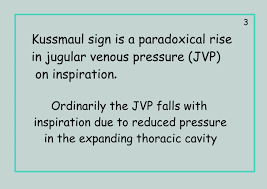
- Combination of JVP > 8 cm H20 and Kussmaul sign (failure of JVP to decrease with inspiration) is sensitive and specific for RV failure
- Patients may have an elevated JVP with clear lungs
- Combination of JVP > 8 cm H20 and Kussmaul sign (failure of JVP to decrease with inspiration) is sensitive and specific for RV failure
Diagnostic Testing:
- ECG: may show inferior ST-elevation; ST segment elevation in V4R can be seen
- CXR: Normal, no pulmonary congestion
- TTE: May see RV dilation, severe RV dysfunction
- RHC: High RA pressure, low PCWP, low cardiac output state
- ECG: may show inferior ST-elevation; ST segment elevation in V4R can be seen
- CXR: Normal, no pulmonary congestion
- TTE: May see RV dilation, severe RV dysfunction
- RHC: High RA pressure, low PCWP, low cardiac output state
Therapy:
- Fluid administration: Helps to increase fluid overload; have to be careful b/c RV dilation can shift inter-ventricular septum and lead to paradoxical decrease in LV preload
- Inotropes: Dobutamine can help augment RV contractility and increase cardiac output
- Fluid administration: Helps to increase fluid overload; have to be careful b/c RV dilation can shift inter-ventricular septum and lead to paradoxical decrease in LV preload
- Inotropes: Dobutamine can help augment RV contractility and increase cardiac output
*Always discuss with your fellow/attending, and not to use for medical advice*
Always have a high clinical suspicion for RV failure in the setting of an inferior infarction and profound hypotension. Follow-up on the TTE and provide fluids, and avoid nitrates!
Always have a high clinical suspicion for RV failure in the setting of an inferior infarction and profound hypotension. Follow-up on the TTE and provide fluids, and avoid nitrates!
Loading suggestions...