

Middle Eastern influences in Shakira's singing voice
—🧵 Thread
—🧵 Thread

At this time, we are all presumably aware of Shakira's paternal Lebanese ancestry which has served as the conduit for the incorporation of (loosely) Middle Eastern cultural elements into her art—music, performance apparel, and, most notably, dance.

But a little known-known fact is that these influences also extend to vocals, and have formed part of shaping this voice that is full of culture and tradition, and is unmatched in uniqueness in all the music industry.
During her press conference in Morocco, Shakira revealed growing up listening to Arab vocalists—most notably Umm Kulthum, the Egyptian specialist and legend in traditional Middle Eastern Tarab singing—which we may regard as the sources of these influences.

Vocally analysing Shakira 2011 “Je l'aime à mourir” performance, voice teacher Beth Roars remarked on and confirmed Shakira's use of Arabic scales (or maqamat).
(Therefore, this thread will mainly be focused on TECHNIQUE.)
(Therefore, this thread will mainly be focused on TECHNIQUE.)

Shakira's voice is remarkable for its nasal, tense laryngeal, and heavy chesty quality. (Though her versatile voice allows her to remove these qualities for a bright, brisk quality.)

And based on early performances, we can see that these features are indeed deep-rooted in Shakira's voice.
Footage of pre-adolescent Shakira singing the Arabic poem “A3tini Alnay Wa Ghanni”:
Footage of pre-adolescent Shakira singing the Arabic poem “A3tini Alnay Wa Ghanni”:
These features—rooted in the nature of the Arabic language, and the nature of the artform that values vocal improvisation and self-training—are all characteristic of traditional ME singing, confirmed and elaborated on in the study Hamdan et al. 2008: shorturl.at

Example #1 of singing in this technique.

Example #2.

“Ojos Así” is one of a handful of Shakira's songs that *best demonstrate her ability to sing in this style (more authentically in the live versions), though they are present in her very voice across the entirety of her discography.
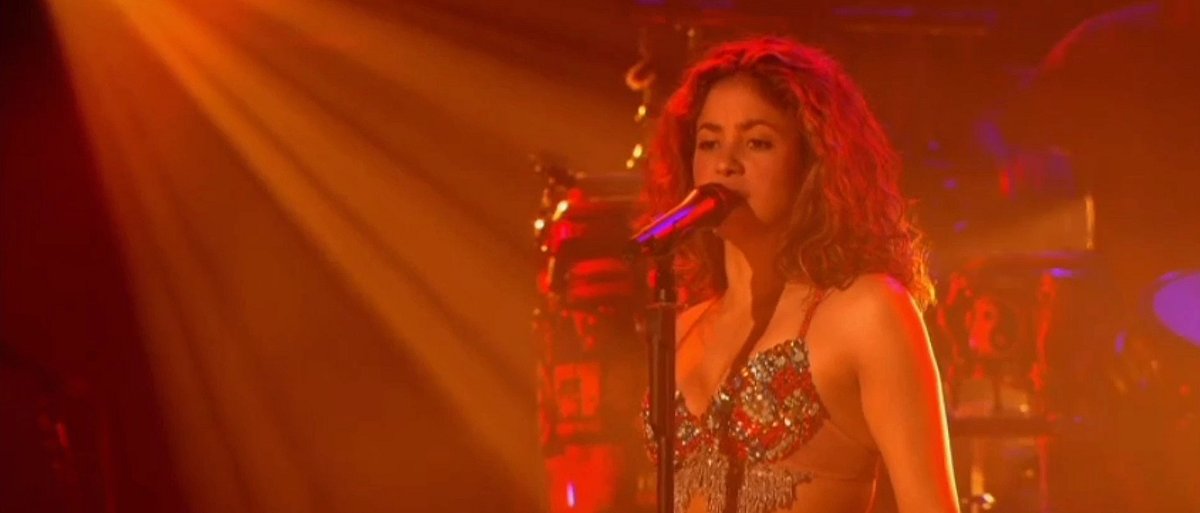
Another example can be seen in the often overlooked track “Años Luz”.

Overall, Shakira's voice is a cultural manifestation of her mixed ethnic background, reflecting three different regions of the world. This thread aimed to highlight one part that lends itself to creating Shakira's exotic voice.
Thank you for reading.
🧵 —END.
Thank you for reading.
🧵 —END.
Loading suggestions...