

Female "short term" mating strategies in actual practice are more rare than people seem to think. 🧵
Not everyone is equally predisposed to short or long term mating.
The extent to which someone pursues a short term mating strategy is individually variable.
The extent to which someone pursues a short term mating strategy is individually variable.
This has been framed as an individual fast/slow life strategy.
Alternately, as high/low sociosexuality.
The point is that not everyone is predisposed to both equally.
Not everyone will engage in "short term" mating to the same extent - or at all.
Alternately, as high/low sociosexuality.
The point is that not everyone is predisposed to both equally.
Not everyone will engage in "short term" mating to the same extent - or at all.
This short/long term divide was first described by Buss & Schmitt in Sexual Strategies Theory.
First difference in short term orientation - men are expected to engage this more.
First difference in short term orientation - men are expected to engage this more.
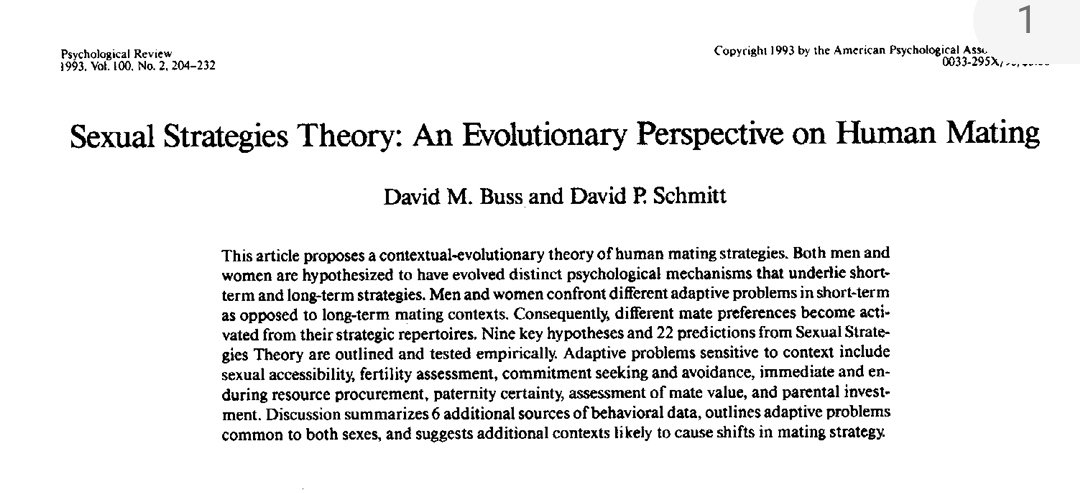
Going back to the original theory, you could put it this way:
Men are short term maters, women are long term maters.
Big oversimplification, but to illustrate the sex difference in short and long term mating predisposition.
Men are short term maters, women are long term maters.
Big oversimplification, but to illustrate the sex difference in short and long term mating predisposition.
Consider the Coolidge effect - men show higher interest in novel women after sex, also shortening the sexual refractory period.
The Coolidge effect either doesn't exist for women, or manifests much less strongly if/when it does.
psypost.org
The Coolidge effect either doesn't exist for women, or manifests much less strongly if/when it does.
psypost.org

Even when women engage in short term mating they are assessing the male as a potential long term mate.

The more recent Mate Switching Hypothesis in evolutionary psychology: most female "short term" mating is just a stepping-stone to a long term mate.
sciencedirect.com
sciencedirect.com


There is little reason to believe women get much at all out of a short term mate.
Not only per SST and the evolutionary framework, but also considering other outcomes associated with short term mating, such as the orgasm gap.
Not only per SST and the evolutionary framework, but also considering other outcomes associated with short term mating, such as the orgasm gap.

Most women also regret casual sex. (Many men do too, surprisingly.)
Women regret casual sex at rates higher than men.
And they regret casual sex even more when the sex is bad. Which, as the orgasm gap literature shows, is most casual sex.
tandfonline.com
Women regret casual sex at rates higher than men.
And they regret casual sex even more when the sex is bad. Which, as the orgasm gap literature shows, is most casual sex.
tandfonline.com
The "good genes" dual mate hypothesis has been caught up in the replication crisis.
So the major evo explanation for why women engage in short term sex - to capture those delicious "good genes" - hasn't panned out.
So the major evo explanation for why women engage in short term sex - to capture those delicious "good genes" - hasn't panned out.
Additionally, practically all male traits that have been associated with a short-term mate desirability have similarly been associated with long-term mate desirability.
Differences have been in magnitude, but not type.
Differences have been in magnitude, but not type.
And traits that have no obvious benefit for short-term mating are somehow still valued highly in short-term mates.
Why?
The best explanation, in my opinion, is that most short term relationships are merely jump-off points to long term relationships.
Why?
The best explanation, in my opinion, is that most short term relationships are merely jump-off points to long term relationships.
Most research on long/short term mating does not quantify the frequency of the two.
Research questions are more likely to take the form of a hypothetical:
"Rate the desirability of this man for a short term relationship."
Research questions are more likely to take the form of a hypothetical:
"Rate the desirability of this man for a short term relationship."
This does not tell you if a woman is actually willing to engage in a short term relationship at all.
It just asks "what if."
But the abundance of research asking this hypothetical may make it seem more common than it is.
It just asks "what if."
But the abundance of research asking this hypothetical may make it seem more common than it is.
We also mentally categorize relationships as "short term" when they are not.
For example, in this study researchers broke down casual sex into:
1. One Night Stand
2. Booty Call
3. Fuck Buddy
4. Friends With Benefits.
1. One Night Stand
2. Booty Call
3. Fuck Buddy
4. Friends With Benefits.
Fewer than 25% fell into the ONS category.
Most of what we think of as casual sex is also an extended sexual relationship with the same person.
Not a one-off with a random.
Most of what we think of as casual sex is also an extended sexual relationship with the same person.
Not a one-off with a random.
And of course this does not represent the most common arrangement - monogamous sex with a spouse or partner.
True across genders and age groups.
datepsychology.com
True across genders and age groups.
datepsychology.com

It is also an observed effect that we overestimate the sexual activity, frequency, and willingness of our peers.
And the effect is stronger for women.
We inaccurately think that women are more comfortable with casual sex to a greater degree.
And the effect is stronger for women.
We inaccurately think that women are more comfortable with casual sex to a greater degree.

A related effect - men also overestimate the sexual interest of women and this overestimation is mediated by men's own sociosexuality.
journals.sagepub.com
journals.sagepub.com
I have noticed a tendency for people to say "but that's for long term mating, what about short term mating" when general tendencies of mating behavior are described.
As if these two strategies were equally relevant, or appeared at the same rate.
As if every woman pursued both.
As if these two strategies were equally relevant, or appeared at the same rate.
As if every woman pursued both.
This confuses mating strategy (an individual predisposition) with what is perceived as attractive (largely the same regardless of short/long term orientation).
It exaggerates the relevance of the "promiscuous 10%" - the minority with a high sociosexuality who pursue short term.
It exaggerates the relevance of the "promiscuous 10%" - the minority with a high sociosexuality who pursue short term.
Or, think about it this way: the pursuit of monogamous relationships can be generalized to most people.
Hypersexuality, high promiscuity, sex without emotional attachment, ONSs, etc. cannot.
Not judging anything btw - just describing.
Hypersexuality, high promiscuity, sex without emotional attachment, ONSs, etc. cannot.
Not judging anything btw - just describing.
Men who are interested in forming long-term relationships, or people in general who want to understand typical behavior, make a mistake by trying to generalize from short term strategists.
It is definitely not representative of most "female nature" or whatever else.
It is definitely not representative of most "female nature" or whatever else.
Loading suggestions...