

Glaha for wager or stake (at a game of dice) is a variant on this word only.
In the Vedas it's simply used to mean "throw of the dice." Sometimes it's used in the Itihasas too, e.g. Shakuni arguably uses it in this sense when he likens the dyutakrida to a war.
ग्लहान्धनूंषि मे विद्धि शरानक्षांश्च भारत।
अक्षाणां हृदयं मे ज्यां रथं विद्धि ममास्फुरम्॥
ग्लहान्धनूंषि मे विद्धि शरानक्षांश्च भारत।
अक्षाणां हृदयं मे ज्यां रथं विद्धि ममास्फुरम्॥
"Know, O Bharata, the throws (of the dice) to be my bows, the dies to be my arrows, expertise at gambling to be my bowstring, and the adhidevanam to be my chariot."
Nilakantha Chaturdhara gives ग्लहान्पणान्॥३॥ आस्फुरमक्षविन्यासपातनादिस्थानम्॥४॥, so he takes glaha to mean "wager" or "bet" here as well, but I'm not sure if that's the intention of Vyasa.
Ganguli's translation more or less follows Nilakantha's Bhavadipa.
"Know, O Bharata, that betting is my bow, the dice are my arrows, the marks on them my bow-string, and the dice-board my car."
"Know, O Bharata, that betting is my bow, the dice are my arrows, the marks on them my bow-string, and the dice-board my car."
The translation by @bibekdebroy is perplexing.
"O descendant of the Bharata lineage! Know that the bow and arrows are my dice. The heart of the dice is the string of my bow. Know that the carpet 109 is my chariot."
Under footnote 109 he gives "On which the game is played.
"O descendant of the Bharata lineage! Know that the bow and arrows are my dice. The heart of the dice is the string of my bow. Know that the carpet 109 is my chariot."
Under footnote 109 he gives "On which the game is played.
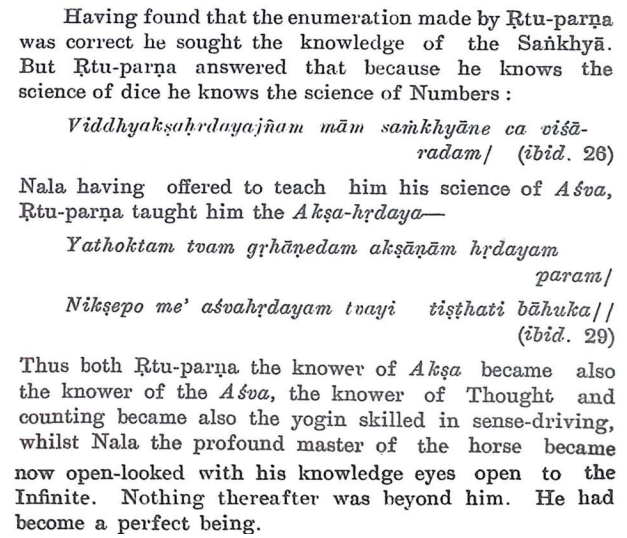
I assumed that अक्षाणां हृदयम् there referred to the same type of counting/calculating skill that was taught by Rituparna to Nala and not "heart of the dice" and "marks on the dice"
Loading suggestions...