

1. Strategic Blunder and Lost Opportunity
The Thumb Rule of Geopolitics
In the modern world, the meeting of India’s and China’s borders was inevitable. But wars are always fought better at the enemy’s territory. All the risk is the enemy’s then.
The Thumb Rule of Geopolitics
In the modern world, the meeting of India’s and China’s borders was inevitable. But wars are always fought better at the enemy’s territory. All the risk is the enemy’s then.
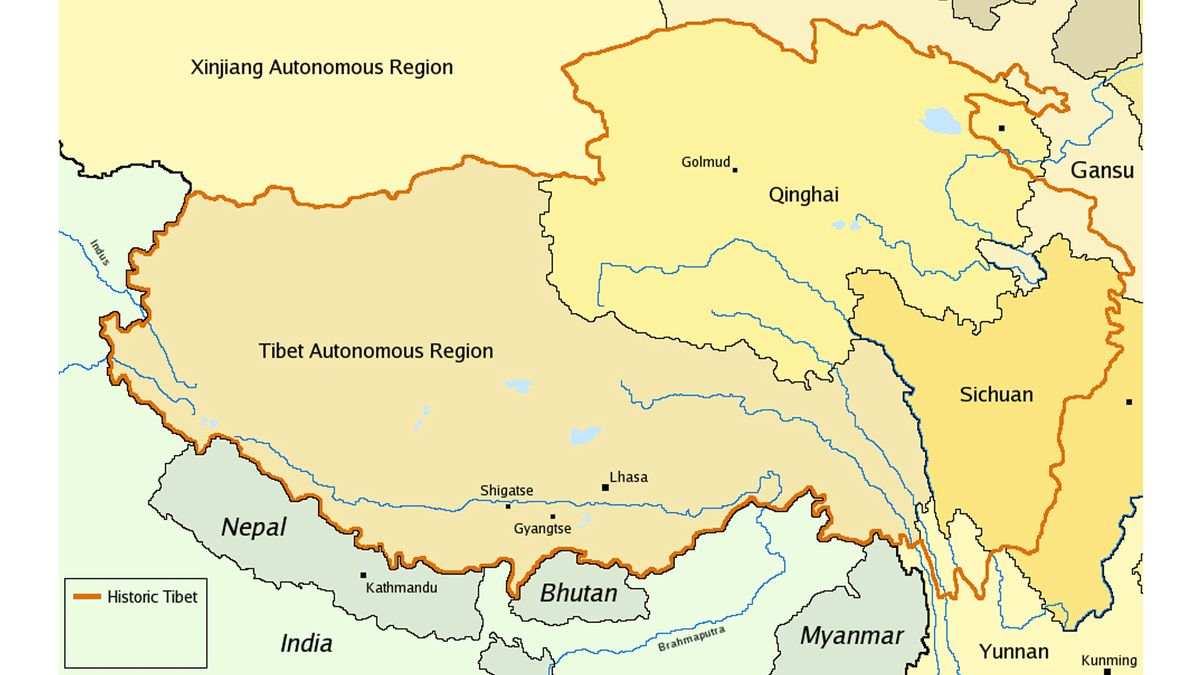
2. Right now China has that advantage, and India has the disadvantage. This is why Indo-China wars are always fought on Indian territory.
3. If Indian leaders had any geo-political sense these wars should have been fought in the Chinese territory in the provinces of Gansu and eastern Sichuan.
4. If India had ably succeeded the British in geo-political wisdom, these wars should at least have been fought in neutral territories of Tibet, Sinkiang, Qinghai and western Sichuan and not on India’s soil.
5. If we look at the map of China today, we see that original China is much smaller than its current expanse. The huge provinces of Sinkiang, Tibet, Qinghai are recent occupations
of China. So are huge provinces of Inner Mongolia and western Sichuan.
of China. So are huge provinces of Inner Mongolia and western Sichuan.
6. Tibet in fact is much bigger than the autonomous province of today. The entire province of Qinghai and western Sichuan is actually what was undivided Tibet. Yunnan in the south has also
remained independent for most of its history and also had some Indian influence.
remained independent for most of its history and also had some Indian influence.
7. Had India’s political leaders shown some geopolitical foresight, Sinkiang, Tibet, Qinghai, Western Sichuan and even Yunnan should have been either Indian territories or India’s spheres of influence. Had that come to pass, Indo-China wars would have been fought on Chinese soil.
8. Had that come to pass, Indian armies would have threatening great Chinese cities of Chongqing, Chengdu and with some ambition even the ancient Chinese capital of Xi’an.
9. India would have commanded all of the Himalayas and also the great Tibetan plateau along with a much bigger chunk of Central Asia and Indian armies then would be looking down on Chinese lands and great Chinese cities, threatening their very existence.
10. But this did not come to happen. Small mistakes in geopolitics and even a few years of neglect of what is happening inside, on and even beyond our political borders can result in disastrous consequences with long and sometimes final say in the fates of political nations.
11. Needless to say had India controlled or influenced these vast swathes of land in Central Asia and eastern Asia then it would have controlled Kailash Mansarovar and the origin of all great rivers of Asia including the Brahmaputra, the Mekong and the Indus.
12. India would have no problem of enemies controlling its waters as it has now.
13. Not only this, India would then also have controlled the origins of the two greatest of Chinese rivers, the Huang Ho (Yellow River) and the Yangtze, the world’s third largest river and the lifeline of entire China now.
14. It would also have controlled the headwaters of
the great river Mekong, the lifeline of South-east Asia.
the great river Mekong, the lifeline of South-east Asia.
15. The Mekong is named so because in South-east Asia it was once called another Ganga and Me + Kong is the distortion of the words Mother (Me) + Ganga (Kong).
16. This showed that once upon a time Indian rulers had great geopolitical sense of expanding in the East and we influenced their cultures by converting them to our Dharmic traditions.
17. Entire cities and rivers were named after the sacred concepts in India.
18. For in South-east Asia too we have cities like Ayutthaya (Ayodhya) and Bander Seri Begawan (Bandar Shri Bhagawan); countries like Burma (Brahma); rivers like the Mekong (Maa Ganga); and languages like Bahasa Malaysia and Bahasa Indonesia taken from Sanskrit ‘Bhasha’.
19. Needless to mention here are the countless Hindu temples like Angkor Wat in Cambodia, Prambanan in Indonesia and My Son in as far as Vietnam.
20. It pains to see that once upon a time before the great colonial age of the West, Indian rulers had the great sense to influence lands as far as Vietnam.
21. In that golden age of India, it was India which had circled China from all sides by influencing Dharma in Tibet and Mongolia in the west and north of China.
22. Also by influencing religion and politics in the province of Yunnan in the south of China (Dali worshipped gods inspired by Shiva in Hinduism) and by colonizing directly and converting the entire south-east Asian nations to Hinduism from Burma to Vietnam.
23. Unfortunately, it is China which has encircled India completely now: by occupying Tibet, Sinkiang and Yunnan; by making many south-east Asian nations from Burma to Laos its satellites; by befriending terrorist countries like Pakistan which are India’s enemies.
24. China is encashing the anti-Hindu sentiment of Islamic republics like Iran; by making ports and depots in countries like Sri Lanka and Burma.
25. Granted that in the medieval ages, India was controlled by the Islamic and then the British imperial powers and China was not.
26. But had India woken up in 1947 much of those advantages of China could have been easily reversed as China was very weak in
1950 with Christian rebellions and mass murder, opium wars and indirect Western colonialism.
1950 with Christian rebellions and mass murder, opium wars and indirect Western colonialism.
27. It had also just emerged from the devastating Japanese occupation of the Second World War and the ensuing Civil War between the nationalists and the communists in China.
28. Had India grabbed those first four years from 1947 to 1951, India could at least have taken Tibet and influenced Sinkiang and Yunnan. South-east Asia could have been an ongoing policy then.
29. Geopolitics like nature abhors vacuum. If one power does not move in to dominate the second tier powers then some other will. This is the situation of India is and has been.
30. Its reluctance to play the geopolitical game like it is played has cost it and the world very much for it has allowed more sinister powers like China to move in to fill the vacuum.
Things can still change for politics in China is very fragile.
Things can still change for politics in China is very fragile.
31. The stress which the Corona Virus pandemic has brought on and the built-up frustration in the ramshackle Chinese
political and social machinery can bring down the Chinese communist party in near future.
political and social machinery can bring down the Chinese communist party in near future.
32. That situation can be swung to India’s advantage if only India’s leaders and strategists are ready to take lessons from the past. And of course the first area that India should focus on is Central Asia.
33. Read on this series to know the curious history of Central Asia and how various great powers have gone to extreme lengths to control this land under the sky.
34. REFERENCES
1. Hopkirk, Peter. The Great Game: On Secret Service in High Asia. John Murray, 1996
2. Frankopan, Peter. The Silk Roads: A New History of the World. Bloomsbury, 2016
= = =
1. Hopkirk, Peter. The Great Game: On Secret Service in High Asia. John Murray, 1996
2. Frankopan, Peter. The Silk Roads: A New History of the World. Bloomsbury, 2016
= = =
Loading suggestions...