

Motor vehicles are one important industrial sector where Chinese exports are relatively modest.
The WSJ notes that this is changing, largely thanks to the global shift towards EVs: "China’s new-energy vehicle exports have more than doubled year-over-year"
1/
The WSJ notes that this is changing, largely thanks to the global shift towards EVs: "China’s new-energy vehicle exports have more than doubled year-over-year"
1/

The FT by contrast is arguing that foreign marks aim to reduce their dependence on China as a source of supply (for parts, but also for vehicles)
"Consequently, foreign manufacturers aim to make parts and cars inside China exclusively for use within the country"
2/
"Consequently, foreign manufacturers aim to make parts and cars inside China exclusively for use within the country"
2/

The FT article is framed around the forward looking intent of auto manufactures.
But this is still a case where some familiarity with the actual data is helpful.
China exports of finished autos (& for that matter auto parts) have soared since the start of the pandemic.
3/
But this is still a case where some familiarity with the actual data is helpful.
China exports of finished autos (& for that matter auto parts) have soared since the start of the pandemic.
3/

European governments have been quite vehement in objecting to the structure of the US EV subsidies in the inflation reduction act.
But the far bigger threat to the EU auto sector is the risk that European EV demand will be met by Chinese production!
4/
But the far bigger threat to the EU auto sector is the risk that European EV demand will be met by Chinese production!
4/
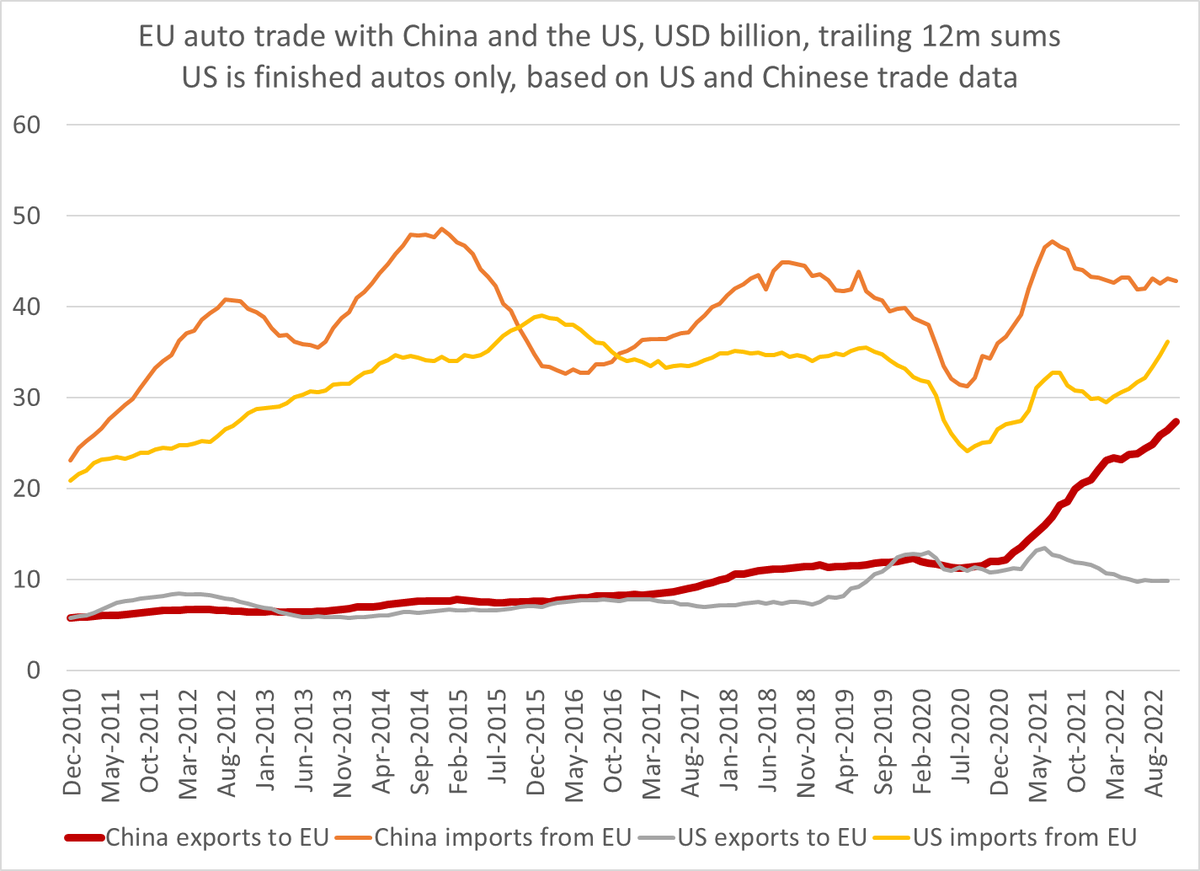
A lot of trade policy debates are driven by violations of principle (the US IRA discriminates in favor of North American production, at least for non-commercial vehicle sales) rather than more objective analysis of the data and the scale of the threat ...
5/
5/
As @adam_tooze argued last week, the future of the European auto industry will be determined far more by whether EU demand for EVs is met by EU production than by whether Mercedes and BMW EV sedans sold in the US qualify for the tax credit ...
6/
6/
And the trade data clearly shows that Chinese production to meet EU demand is growing fast -- as Chinese auto makers (and Tesla/ EU marks producing in China) are going out after years of development behind China's tariff and subsidy wall.
7/7
7/7
Background: China has a relatively high tariff on imported autos (compared to the US tariff on imported cars) and it effectively restricted access to its EV subsidies to cars made in China with a Chinese battery without putting that discrimination into a formal law.
EVs had to be qualified for the Chinese subsidies, and no car with a foreign battery ever qualified (to my knowledge). Absolutely discriminatory, but done in a way that made proving a violation of the global trade rules much harder ... and now China is an export power in EVs
Here is a link to the FT story, which is important as a statement of the intent of certain auto marks to reduce their parts dependence on China over time (in part no doubt b/c of the Trump tariffs vis a vis the US as well as future risks)
ft.com
ft.com
And here is a link to the WSJ column by @jackycwong, which documents China's emergence as a large exporter of EVs (and now a net exporter of autos and auto parts).
It is far more consistent with the actual current trade data than the FT story!
wsj.com
It is far more consistent with the actual current trade data than the FT story!
wsj.com
One small amendment -- China appears to have relaxed its informal requirement that only batteries made by Chinese firms could qualify for its EV subsidies in 2019, and LG now makes some batteries for Tesla's Shanghai facility in China.
wsj.com
wsj.com
and it seems that Tesla's model 3 (perhaps with the LG batteries, but perhaps with CATL batteries -- Tesla uses both in China) qualifies. "According to the 2020 policy, only passenger EVs costing less than RMB 300,000 (US$42,376) per unit are eligible "
china-briefing.com
china-briefing.com
Loading suggestions...