

For 45 seconds or so, I breathed (unnaturally) deep and fast. Until I started feeling a bit dizzy, and felt some tingling in my fingertips.
There’s a lesson about ABGs in the mechanisms of these consequences.
Let’s work backwards 🧵
There’s a lesson about ABGs in the mechanisms of these consequences.
Let’s work backwards 🧵
The tingling in my fingertips was from ionized hypocalcemia.
The dizziness may have been from that too, or from cerebral vasoconstriction, or both.
The dizziness may have been from that too, or from cerebral vasoconstriction, or both.
But the more proximate cause of both these physiologic changes was acute and likely profound alkalemia.
When I was hyperventilating, I probably increased my alveolar minute ventilation from the normal baseline of 5L/min to 15-20L/min.
With a fixed rate of CO2 production, the alveolar (and blood) pCO2 is inversely proportional to minute ventilation.
With a fixed rate of CO2 production, the alveolar (and blood) pCO2 is inversely proportional to minute ventilation.
So I breathed down my pCO2 to the low teens.
And my pH to 7.60? 7.70? Something ugly.
Enough to get symptomatic from the physiologic consequences described above.
And my pH to 7.60? 7.70? Something ugly.
Enough to get symptomatic from the physiologic consequences described above.
Frontal Cortex: 1
Pontine respiratory group: 0
Pontine respiratory group: 0
But by the time I finished the first tweet in the thread, my “symptoms” had resolved.
I also noticed that I (naturally) didn’t take another breath for 20 or 30 seconds.
My cortex was distracted by writing and my pons scored an equalizer.
I also noticed that I (naturally) didn’t take another breath for 20 or 30 seconds.
My cortex was distracted by writing and my pons scored an equalizer.
Helping my ABG quickly normalize again to pH 7.40 / pCO2 40
The lesson being.
The numbers on an ABGs can change minute to minute.
Whether you’re hyperventilating, or breath holding like in this study 👇🏼
The lesson being.
The numbers on an ABGs can change minute to minute.
Whether you’re hyperventilating, or breath holding like in this study 👇🏼
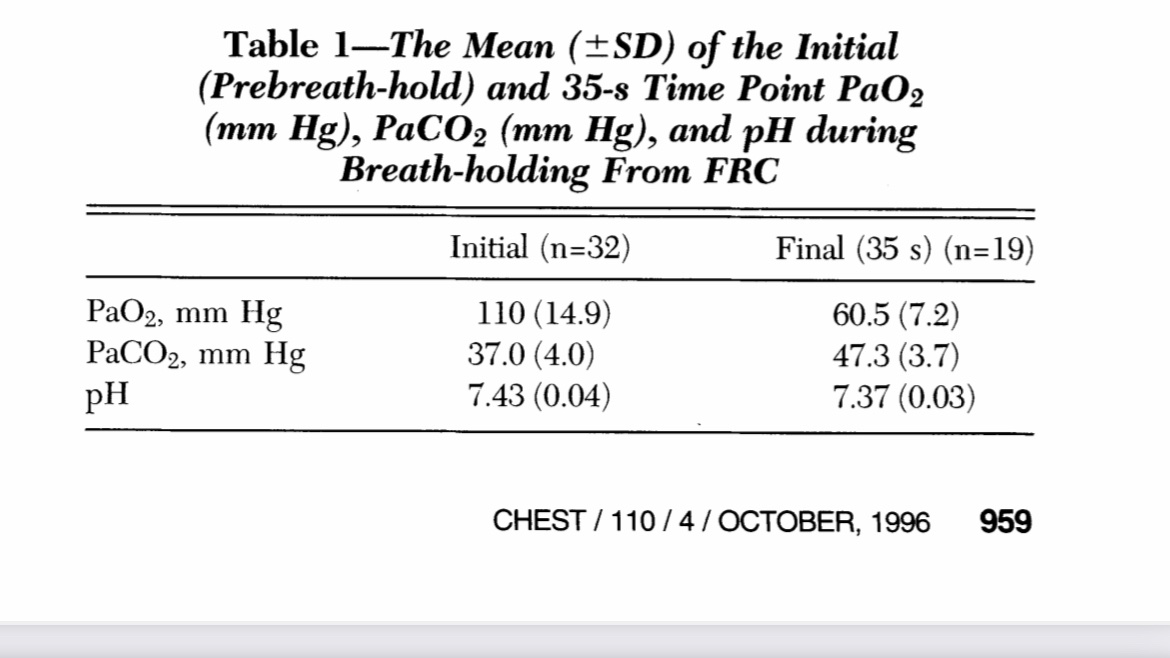
A patient might do either of those things (hyperventilate or breath hold) during the ABG.
Or there may be other short-term changes in respiratory physiology that affect ventilation, that are easy to neglect when answering a narrow question or (over)interpreting changes.
Or there may be other short-term changes in respiratory physiology that affect ventilation, that are easy to neglect when answering a narrow question or (over)interpreting changes.
Would love to hear some examples from #medtwitter of how to apply this caution.
Also have a ? for #pulmtwitter : why do we wait so long to recheck an ABG after starting bipap or adjusting vent settings.
I can think of a couple reasons but don’t know if they’re right… end 🧵
Also have a ? for #pulmtwitter : why do we wait so long to recheck an ABG after starting bipap or adjusting vent settings.
I can think of a couple reasons but don’t know if they’re right… end 🧵
Loading suggestions...