

Do you really need publications to get into a PhD program?
The short answer is NO.
1/ Selection committees want to assess your research potential and the ability to communicate science.
The short answer is NO.
1/ Selection committees want to assess your research potential and the ability to communicate science.
2/ While publications are an indication of this skill, they are not the only way you can showcase this.
You can do the following to show you have strong research skills.
You can do the following to show you have strong research skills.
3/ By volunteering in labs, doing internships and writing research proposals.
If you are seeking research experience, move beyond the perimeters of your own university, cold email professors from other labs (including abroad), asking them if you can volunteer in an.....
If you are seeking research experience, move beyond the perimeters of your own university, cold email professors from other labs (including abroad), asking them if you can volunteer in an.....
ongoing project. Take this opportunity even if it’s unpaid.
At this stage experience matters more than money.
At this stage experience matters more than money.
4/ You can contribute by reviewing literature, doing data analysis, editing, making images etc. for them.
Ask if they can let you co-author or will write you an LoR.
Ask if they can let you co-author or will write you an LoR.
5/ The professors you work with on your projects will write you letters of recommendation for your applications.
Make sure they highlight your research skills in the documents and mention any project that you’re involved in that may lead to a publication.
Make sure they highlight your research skills in the documents and mention any project that you’re involved in that may lead to a publication.
6/ How to showcase your presentation/science communication skills?
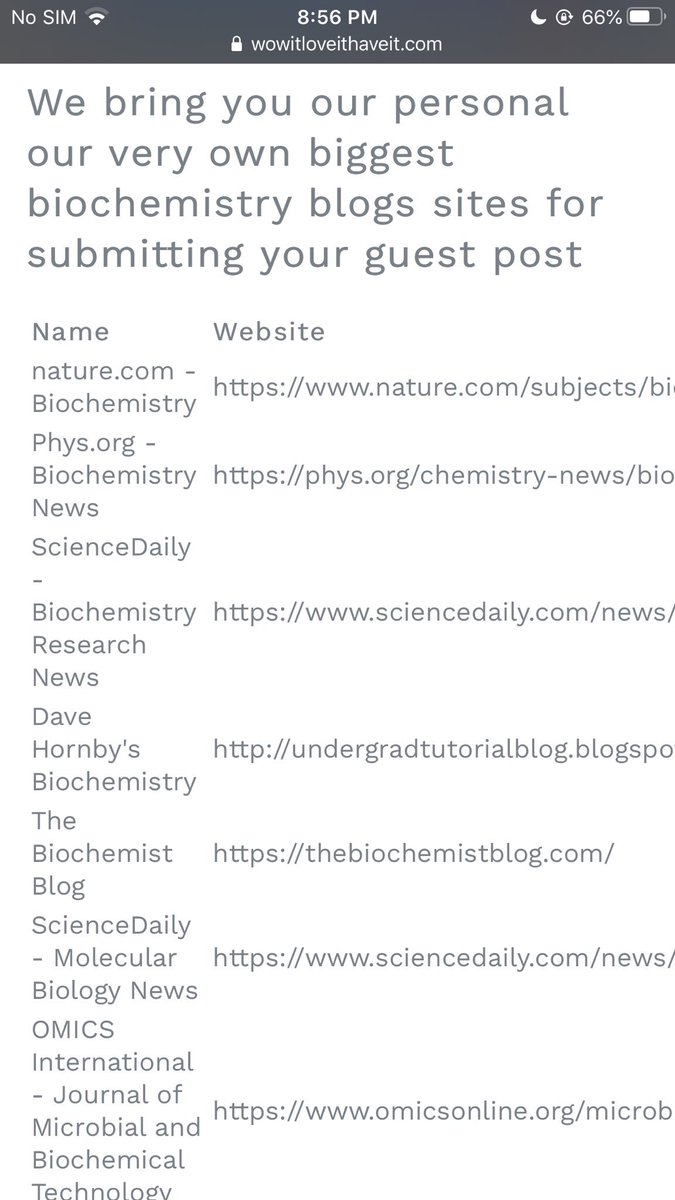
In case of no publication, show this skill by writing guest posts in famous blogs and websites of your subject.
For example, the Biochemist Blog invites guest posts from students.
In case of no publication, show this skill by writing guest posts in famous blogs and websites of your subject.
For example, the Biochemist Blog invites guest posts from students.
7/ Write posts on scientific concepts for social media platforms such as Twitter, Instagram, Quora, Reddit etc. and link these profiles to your CV.
Make science videos on YouTube etc.
Make science videos on YouTube etc.
8/ Reach out to diff school & universities to give a talk on your topic of expertise and kindly request them for a certificate of acknowledgement as a proof for your CV.
9/ Go for less demanding forms of articles such as: review papers, research insights, short commentaries.
They don’t always require you to conduct research in the lab, you may be able to write these articles by discussing a burning issue by citing relevant literature.
They don’t always require you to conduct research in the lab, you may be able to write these articles by discussing a burning issue by citing relevant literature.
10/ If you can find a mentor to guide this paper in your Uni, that would be a great thing (they can also write you an LoR).
But if you don’t find anyone within the uni, cold email to the authors whose work inspired you to write this paper.
But if you don’t find anyone within the uni, cold email to the authors whose work inspired you to write this paper.
11/ They will be glad to review your work and suggest changes or be a co-author with you in case they have time!
There’s no loss in asking for their help. Maybe they’ll be so impressed by your work that they might offer your a position in their own lab in the future.
There’s no loss in asking for their help. Maybe they’ll be so impressed by your work that they might offer your a position in their own lab in the future.
Remember that PUBLICATIONS are only one way to demonstrate strong research skills.
If you can’t get a pub, break these skills down into different activities (like above) and excel in individual areas to show your innovation and creativity!
All the best, stay tuned for more!
If you can’t get a pub, break these skills down into different activities (like above) and excel in individual areas to show your innovation and creativity!
All the best, stay tuned for more!
Loading suggestions...