

Tomorrow, Atlético Madrid play host to Barcelona in a huge clash for Diego Simeone & Xavi.
Both teams are in a heavy transitional period & both suffer from identity issues, albeit in somewhat different ways.
Here's a tactical preview of the clash. 🔥
│MEGA THREAD│
Both teams are in a heavy transitional period & both suffer from identity issues, albeit in somewhat different ways.
Here's a tactical preview of the clash. 🔥
│MEGA THREAD│

Barcelona are top of LaLiga and their hosts are trailing by 11 points, having also scored 11 goals fewer & conceded 8 more.
The table may not suggest it, but this is a big test for both sides: Barça have Real breathing down their neck & Atléti Top 4 to lose.
It's crunch time.
The table may not suggest it, but this is a big test for both sides: Barça have Real breathing down their neck & Atléti Top 4 to lose.
It's crunch time.
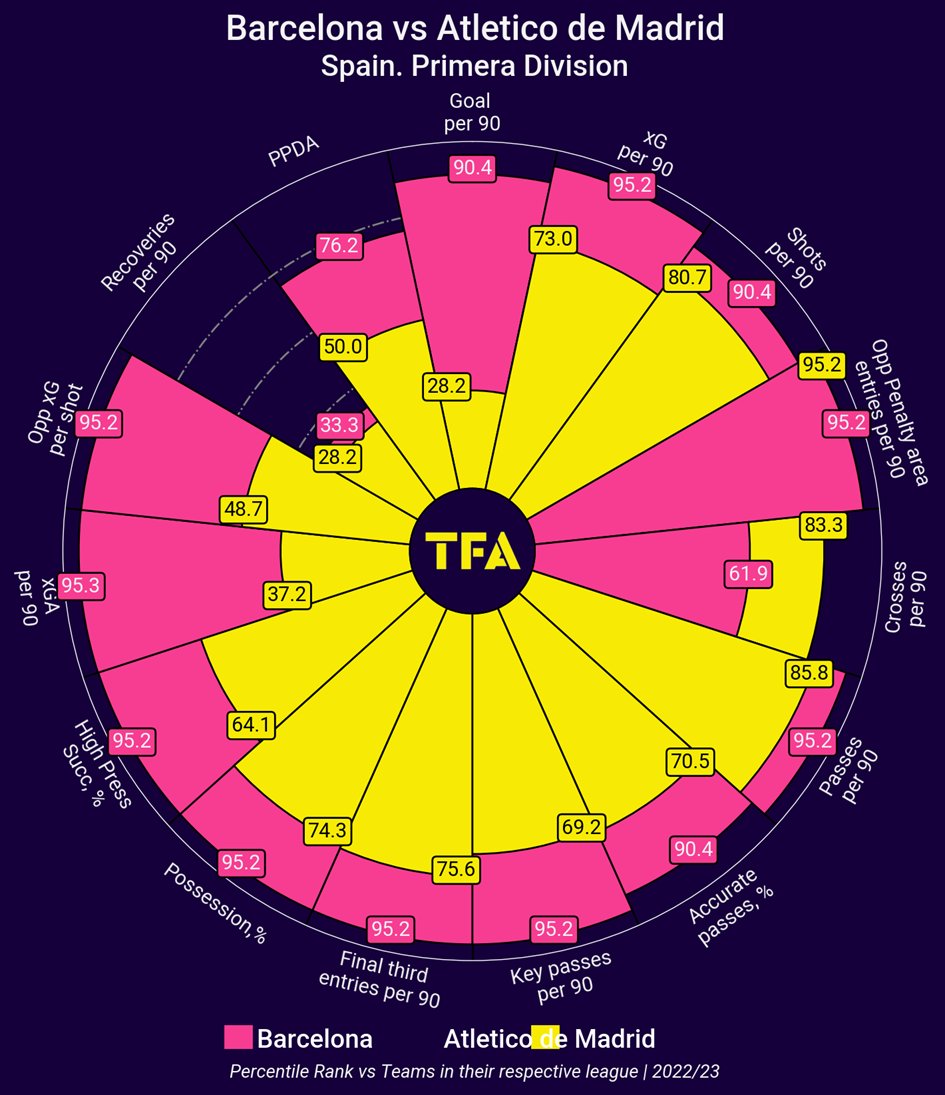
Before we move on to tactics, let's talk data.
The stats heavily favour the guests as Barcelona not only attack far better than Atlético but have also been a defensive juggernaut domestically.
Xavi's team is more stable, sturdy & with better cutting edge.
📊 via @TotalAnalysis
The stats heavily favour the guests as Barcelona not only attack far better than Atlético but have also been a defensive juggernaut domestically.
Xavi's team is more stable, sturdy & with better cutting edge.
📊 via @TotalAnalysis
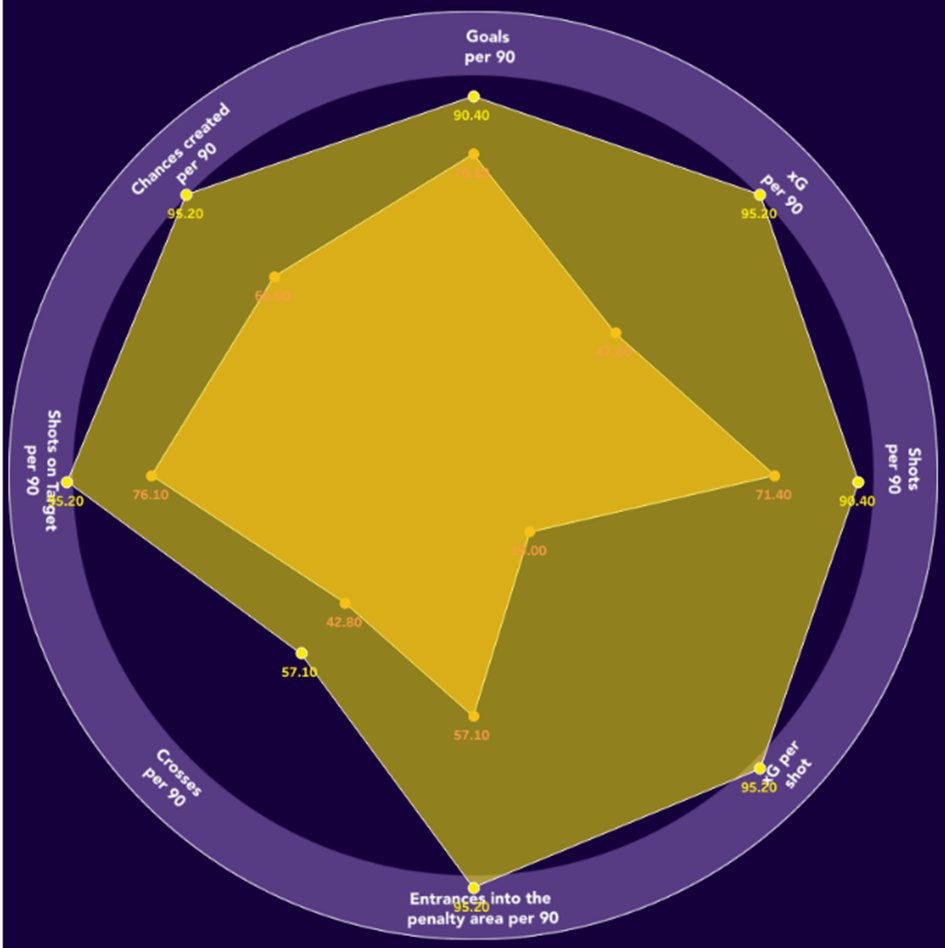
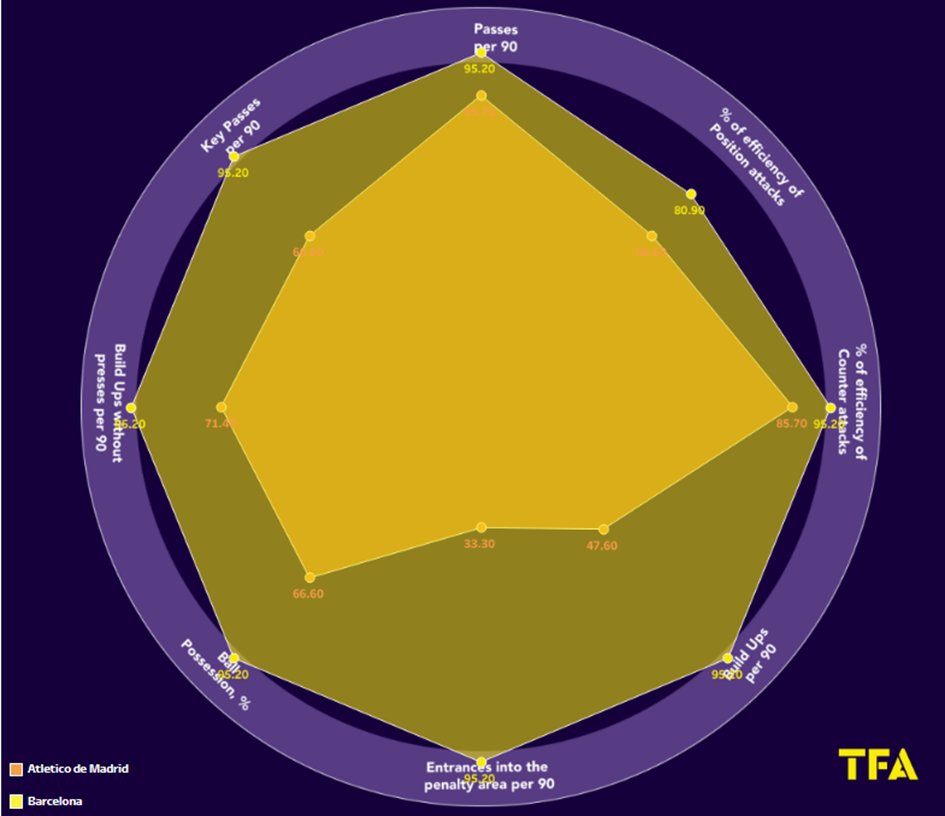
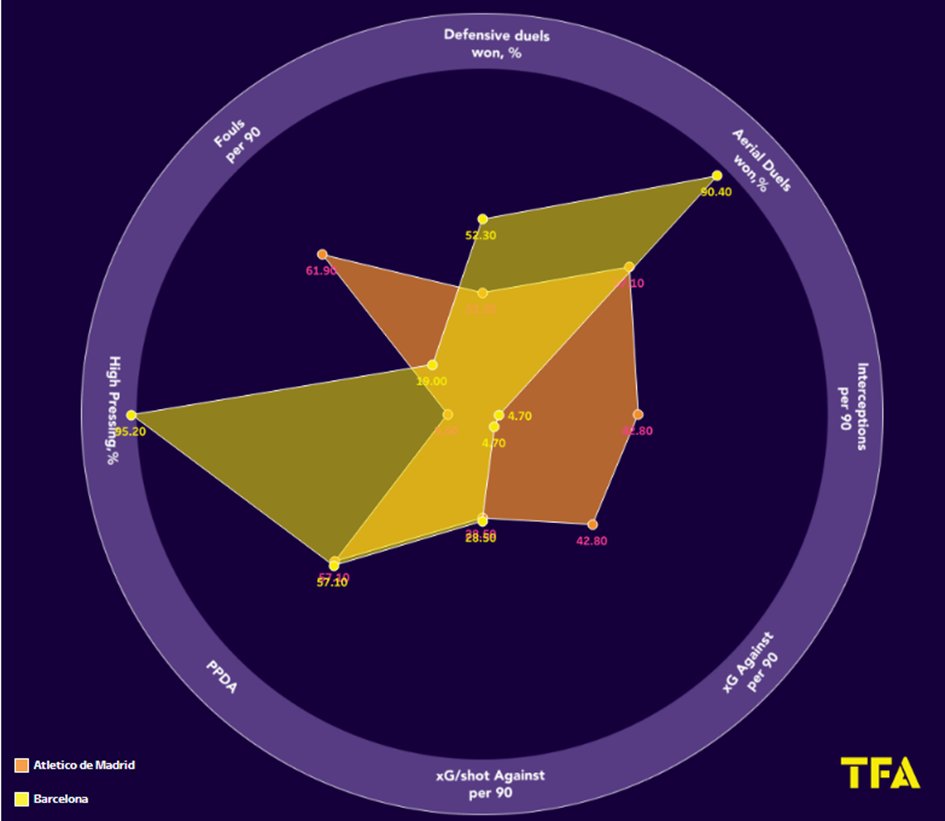
@TotalAnalysis Here are the graphs but broken down into three main segments:
• Attacking
• Passing
• Defending
Barcelona have an advantage in all 3 but the difference in style is visible when it comes to the last one, particularly in pressing.
PPDA* passes allowed per defensive action
• Attacking
• Passing
• Defending
Barcelona have an advantage in all 3 but the difference in style is visible when it comes to the last one, particularly in pressing.
PPDA* passes allowed per defensive action
@TotalAnalysis I've already alluded to both teams' transitional periods.
Both teams have historically had a clear identity but the tides are shifting. Simeone & Atlético are at a crossroads while Xavi & Barcelona are yet to gel fully.
This clash is symbolic of their struggles.
Both teams have historically had a clear identity but the tides are shifting. Simeone & Atlético are at a crossroads while Xavi & Barcelona are yet to gel fully.
This clash is symbolic of their struggles.
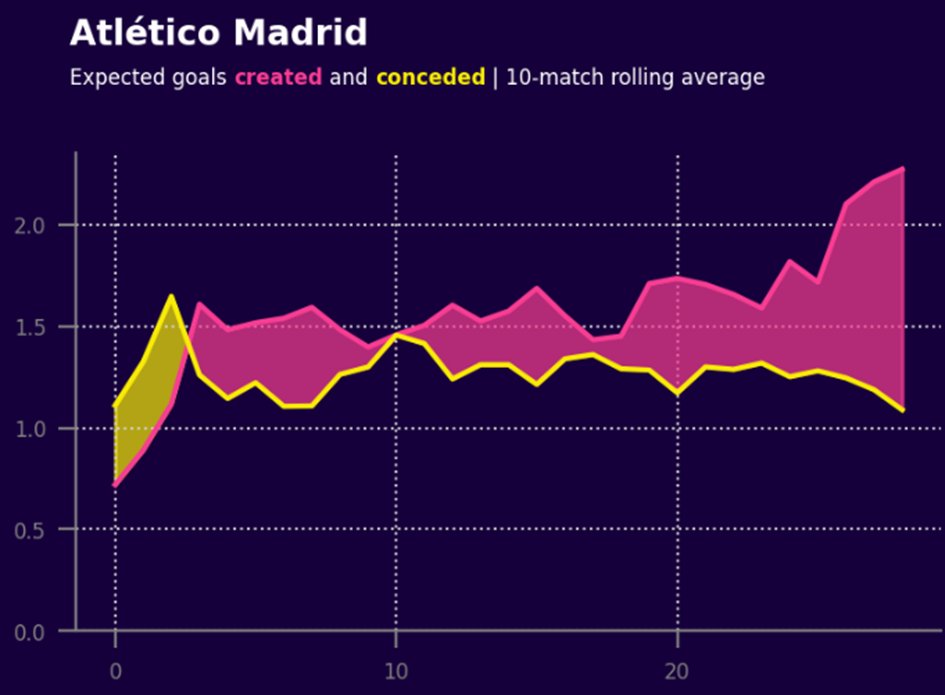
@TotalAnalysis Let's tackle Atlético Madrid first.
Their rolling expected goals for & against with a 10-game stamp confirm their turbulent campaign.
The Rojiblancos have averaged 1.74 xG for & 1.21 xG against across all comps in 22/23.
They get almost as good as they give, though.
Their rolling expected goals for & against with a 10-game stamp confirm their turbulent campaign.
The Rojiblancos have averaged 1.74 xG for & 1.21 xG against across all comps in 22/23.
They get almost as good as they give, though.
@TotalAnalysis The biggest shift is Simeone's choice to abandon the trademark 4-4-2 for a more complex & flexible 5-3-2.
I say flexible because this isn't set in stone. Far from it.
Atlético have generally swapped between the two throughout the season as results & personnel have fluctuated.
I say flexible because this isn't set in stone. Far from it.
Atlético have generally swapped between the two throughout the season as results & personnel have fluctuated.
@TotalAnalysis Wyscout state they prefer the 3-5-2 27% of the time, 4-4-2 20% of the time & a 5-3-2 19%, although the last & the first are just variations of the same structure.
The change, however, was largely caused by necessity rather than preference.
Quality & availability are key points.
The change, however, was largely caused by necessity rather than preference.
Quality & availability are key points.
@TotalAnalysis This 5-at-the-back off ball & 3-at-the-back on it are a way to compensate for the lack of quality and inconsistent availability.
With that structure, Atlético look to add an additional centre-back & a midfielder to solidify their first and second phase of play.
General setup 👇
With that structure, Atlético look to add an additional centre-back & a midfielder to solidify their first and second phase of play.
General setup 👇
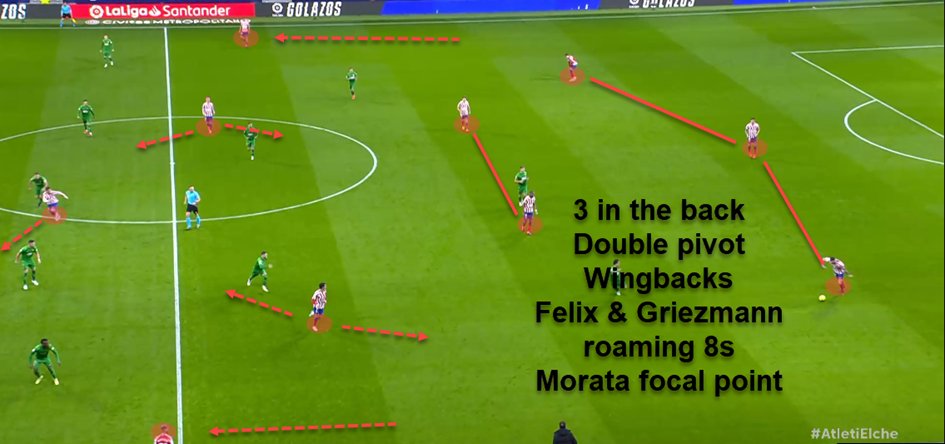
@TotalAnalysis In possession, they're looking for progression via the pivots & natural numerical superiority of the back three.
Simeone wants to be more ball-dominant in 22/23 but is bogged down by several factors:
• Oblak's distribution
• Lack of backline progressors
• Pivot inconsistency
Simeone wants to be more ball-dominant in 22/23 but is bogged down by several factors:
• Oblak's distribution
• Lack of backline progressors
• Pivot inconsistency
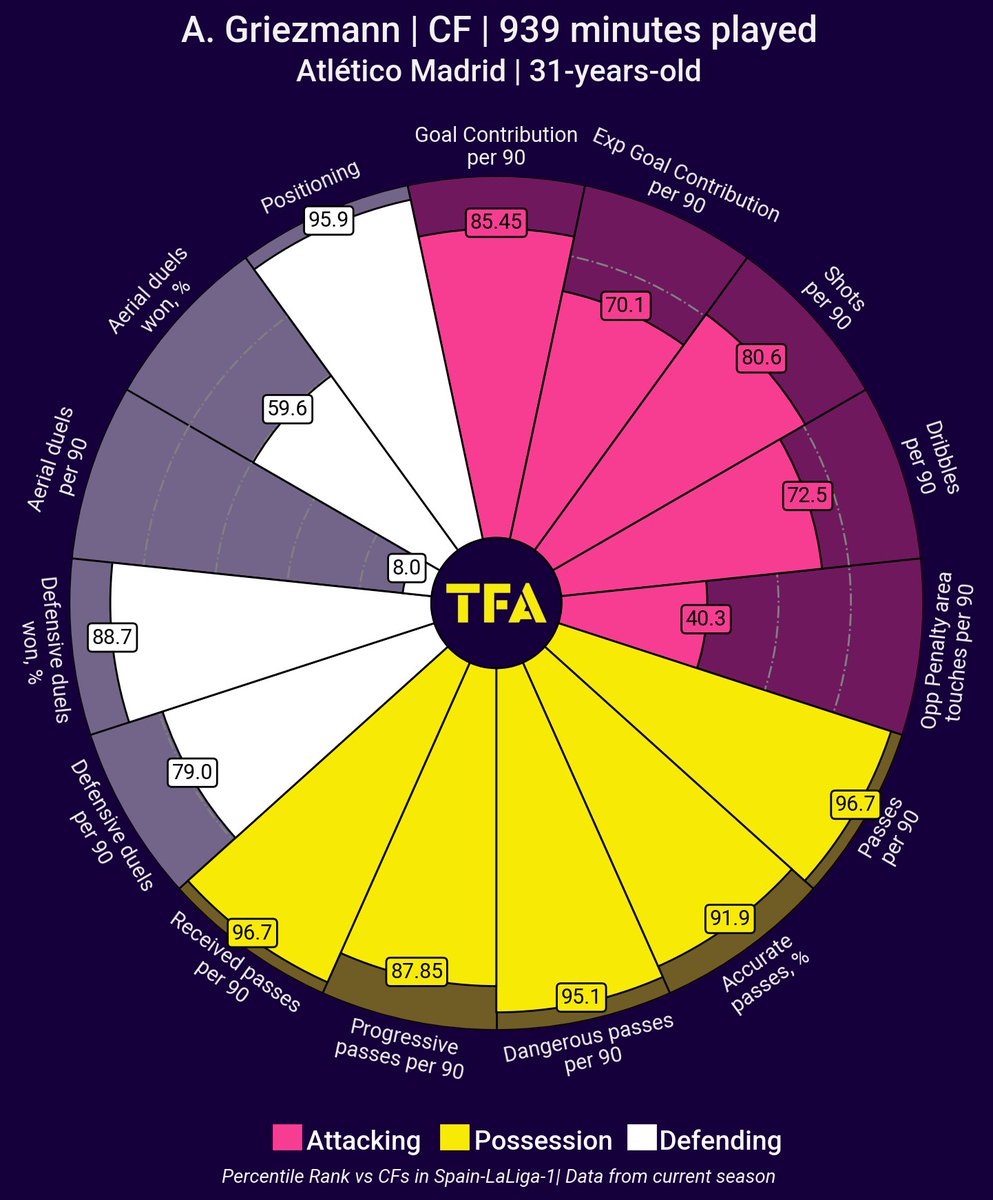
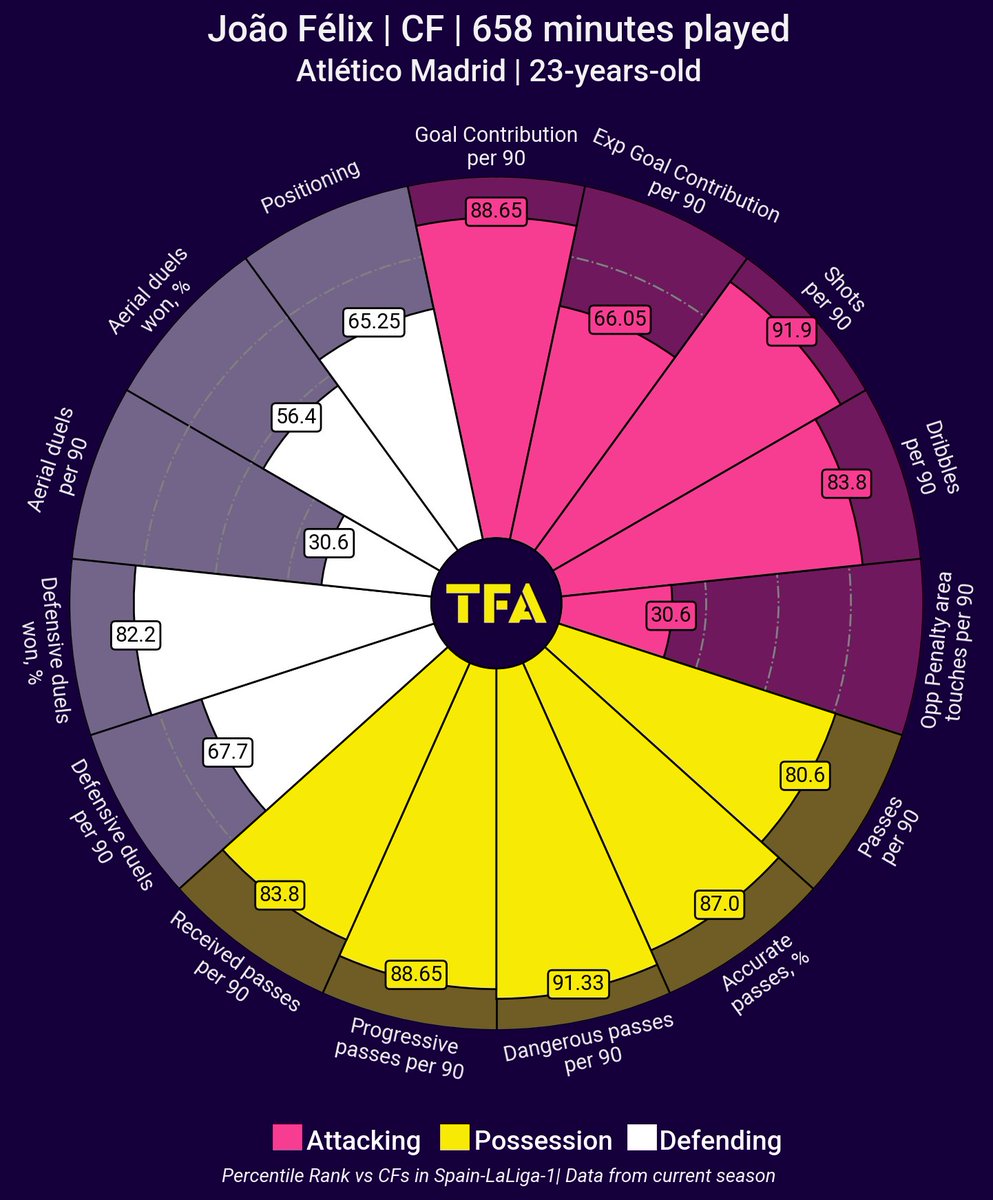
@TotalAnalysis As a result, the first & second phase are (overly) reliant on Antoine Griezmann & João Félix.
The duo are Rojiblancos' most creative & dangerous pieces and often assume the roles of floating 8s or interchanging 10s.
Both are key across all phases of play. 🔑
More later.
The duo are Rojiblancos' most creative & dangerous pieces and often assume the roles of floating 8s or interchanging 10s.
Both are key across all phases of play. 🔑
More later.
@TotalAnalysis The backline is still a point of interest.
Usually, we'd see something like Giménez - Savić - Hermoso but the latter is once again unavailable. This is big as he remains Atlético's most progressive centre-back.
In his stead, we can likely expect Reinildo. 🔄
Usually, we'd see something like Giménez - Savić - Hermoso but the latter is once again unavailable. This is big as he remains Atlético's most progressive centre-back.
In his stead, we can likely expect Reinildo. 🔄
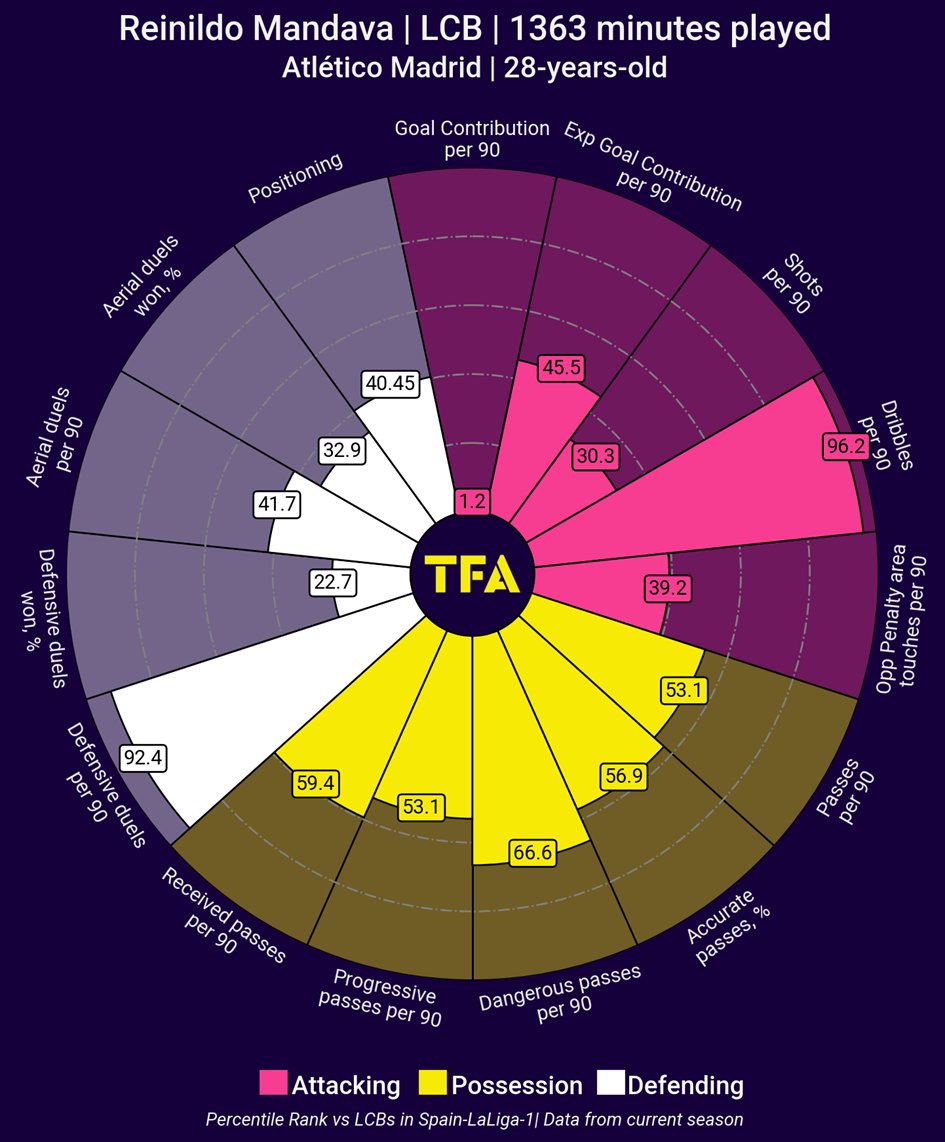
@TotalAnalysis Reinildo over Hermoso offers flexibility in shifting to a back 4 as he's more comfortable as a LB than his counterpart.
There's also an argument for his defensive solidity so Atlético aren't losing THAT much with the swap.
Hermoso is the distributor, Reinildo the connector.
There's also an argument for his defensive solidity so Atlético aren't losing THAT much with the swap.
Hermoso is the distributor, Reinildo the connector.
@TotalAnalysis In build-up, Atlético will heavily rely on getting the ball as safely from the backline which lacks technical quality.
Félix & Griezmann drift wide & drop to open passing lanes and then distribute the ball either directly to Morata (channel runner) or wingbacks who attack space.
Félix & Griezmann drift wide & drop to open passing lanes and then distribute the ball either directly to Morata (channel runner) or wingbacks who attack space.
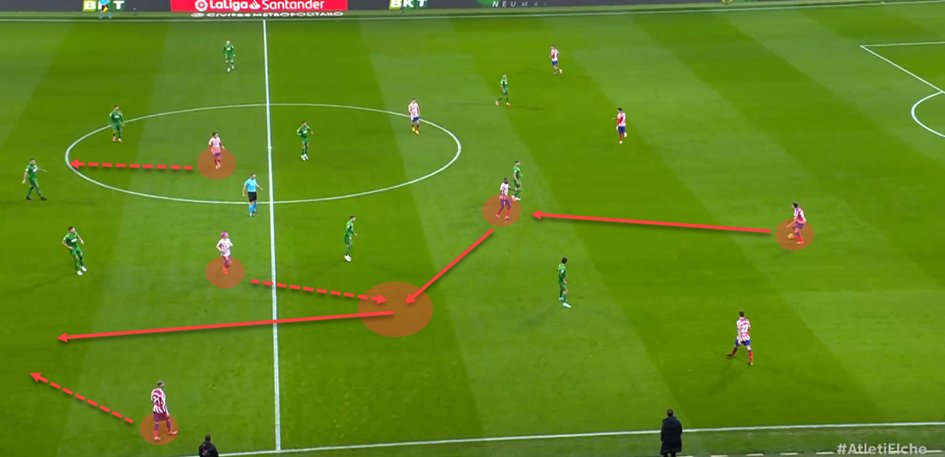
@TotalAnalysis If the lanes are not available, the duo will collect the ball directly from CBs but generally, the three-step procedure is CB - 6 - Griez/Félix.
If CB pushes up, pivot drifts wide, pushes WB higher & Félix becomes a SS (sometimes Griezmann will be the SS & Félix deeper).
If CB pushes up, pivot drifts wide, pushes WB higher & Félix becomes a SS (sometimes Griezmann will be the SS & Félix deeper).
@TotalAnalysis Interestingly, they have good principles to overload & progress but individual quality bogs them down.
CBs WILL go long for Morata or the WBs if a well-drilled block or press nullifies their build-up phase, which happens often.
Reinildo + Koke might help but the issue persists.
CBs WILL go long for Morata or the WBs if a well-drilled block or press nullifies their build-up phase, which happens often.
Reinildo + Koke might help but the issue persists.
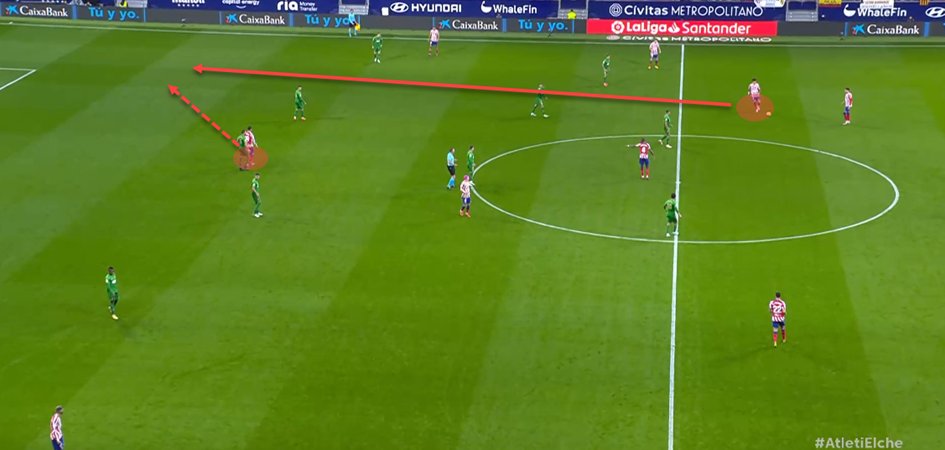
@TotalAnalysis Another option is to put Witsel in the backline, which has happened before and does aid the build-up.
However, in a game like this, it's unlikely he features as a CB. Still, it remains an option.
Again, when they hit a wall, they recycle & usually FBs deploy diagonals into FWs.
However, in a game like this, it's unlikely he features as a CB. Still, it remains an option.
Again, when they hit a wall, they recycle & usually FBs deploy diagonals into FWs.
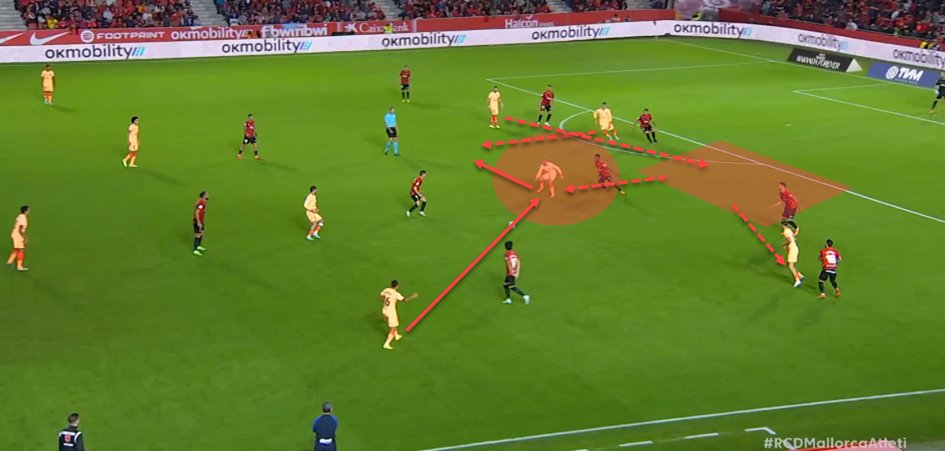
@TotalAnalysis The aim will be to find Griezmann or Félix in the pockets between the lines.
Their movement in particular is key for creating space. Morata + wingbacks can then attack those pockets with Griezmann and Félix serving as distributors again.
Good sequence here. 👇
Their movement in particular is key for creating space. Morata + wingbacks can then attack those pockets with Griezmann and Félix serving as distributors again.
Good sequence here. 👇
@TotalAnalysis The 4-4-2 doesn't make things much easier for progression – they suffer from similar issues, ie lack of quality on the ball.
As a result, pivots often have to drop to receive the ball and Atlético are again VERY vertical.
This is a big point: they don't sustain pressure well.
As a result, pivots often have to drop to receive the ball and Atlético are again VERY vertical.
This is a big point: they don't sustain pressure well.
@TotalAnalysis Griezmann and Llorente sometimes swap, allowing Griezmann to deploy wide deliveries and crosses from the right flank.
The wingbacks form a front three with Morata, midfield morphs into a trident with a 6 and two 8s, Griezmann assumes a WB role and deploys crosses.
As below 👇
The wingbacks form a front three with Morata, midfield morphs into a trident with a 6 and two 8s, Griezmann assumes a WB role and deploys crosses.
As below 👇
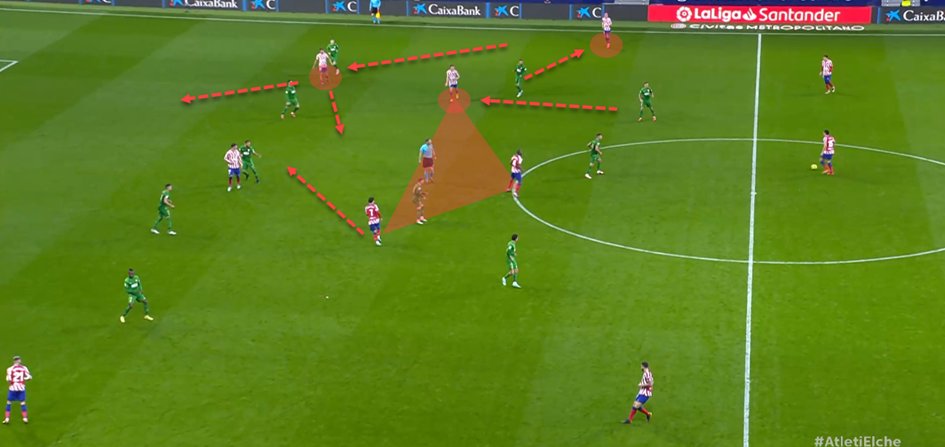
@TotalAnalysis With Molina, Griezmann may not go as wide as with Llorente but Molina doesn't play as centrally as Llorente in those sequences.
With Koke, Félix doesn't drop as deep & it's Koke + Griezmann that receive from the back with Felix staying up more.
Small but important tweaks.
With Koke, Félix doesn't drop as deep & it's Koke + Griezmann that receive from the back with Felix staying up more.
Small but important tweaks.
@TotalAnalysis But none of that solves the stable attacking structure issues.
Their attacks are vertical with quick sequences (mostly combination play between the trident of Griezmann, Félix & Morata + ejecting WBs).
If there isn't a clear avenue for attack, they'll reset and go back to CBs.
Their attacks are vertical with quick sequences (mostly combination play between the trident of Griezmann, Félix & Morata + ejecting WBs).
If there isn't a clear avenue for attack, they'll reset and go back to CBs.
@TotalAnalysis VS a high press Morata drops and acts as target man, Félix & Griez push up for layoffs.
Similar in transitions - Morata/Félix /Griezmann triangle is key:
• Griez usually deeper for distribution, other two runners
• WBs drop deep for build-up
• CBs will go long if pressed.
Similar in transitions - Morata/Félix /Griezmann triangle is key:
• Griez usually deeper for distribution, other two runners
• WBs drop deep for build-up
• CBs will go long if pressed.
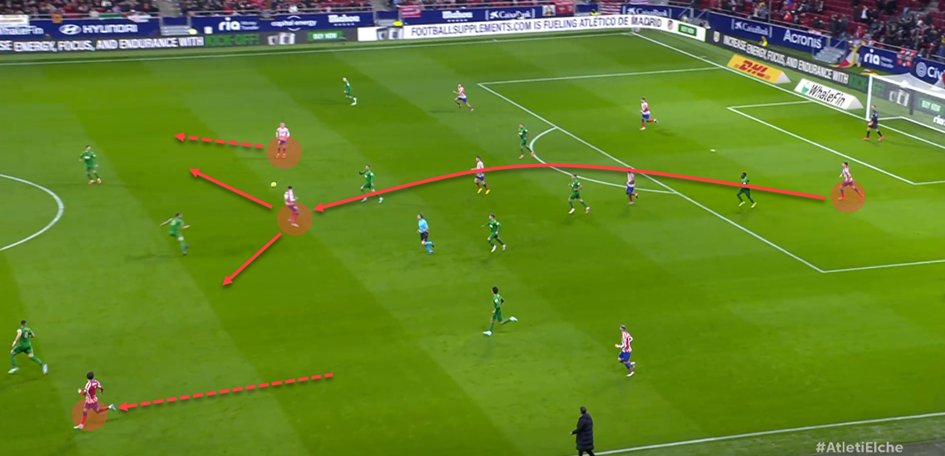
@TotalAnalysis We have to address the possibility of Llorente in old-school midfield-to-winger role & a big change of Morata dropping to the bench.
This is completely new for 22/23, which makes me think it's made specifically to counter Barcelona.
How so? 🤔
This is completely new for 22/23, which makes me think it's made specifically to counter Barcelona.
How so? 🤔
@TotalAnalysis Simeone is adding an additional outlet, some athleticism and someone to track Balde more vigorously.
Barrios also gets cover with Llorente & Atlético shift their focus on the wide areas in transitions rather than having a target-man down the middle.
It makes sense.
Barrios also gets cover with Llorente & Atlético shift their focus on the wide areas in transitions rather than having a target-man down the middle.
It makes sense.
@TotalAnalysis Koke over Kondogbia is also an interesting move by Simeone.
Both can be used to distribute but former more assured in stable phases of possession as well as short link-up play.
If Atlético pin Barcelona down, Koke is a better fit. Llorente compensates for Kondogbia's absence.
Both can be used to distribute but former more assured in stable phases of possession as well as short link-up play.
If Atlético pin Barcelona down, Koke is a better fit. Llorente compensates for Kondogbia's absence.
@TotalAnalysis Barcelona are likely to press high so playing through that will be key for Atlético.
Xavi's press is highly volatile & inconsistent so with Koke, Reinildo & Griezmann, the hosts can hope to play through it rather than over it as Barça lack compactness.
Xavi's press is highly volatile & inconsistent so with Koke, Reinildo & Griezmann, the hosts can hope to play through it rather than over it as Barça lack compactness.
@TotalAnalysis Let's turn to Atlético's defence for a second.
There are a number of possibilities as all of 5-3-2, 4-4-2, 5-4-1 or even a 6-man backline are possible. However, considering Barcelona's build-up tendencies, the structure below is likely.
5-4-1 to start but then morphing. 👇
There are a number of possibilities as all of 5-3-2, 4-4-2, 5-4-1 or even a 6-man backline are possible. However, considering Barcelona's build-up tendencies, the structure below is likely.
5-4-1 to start but then morphing. 👇
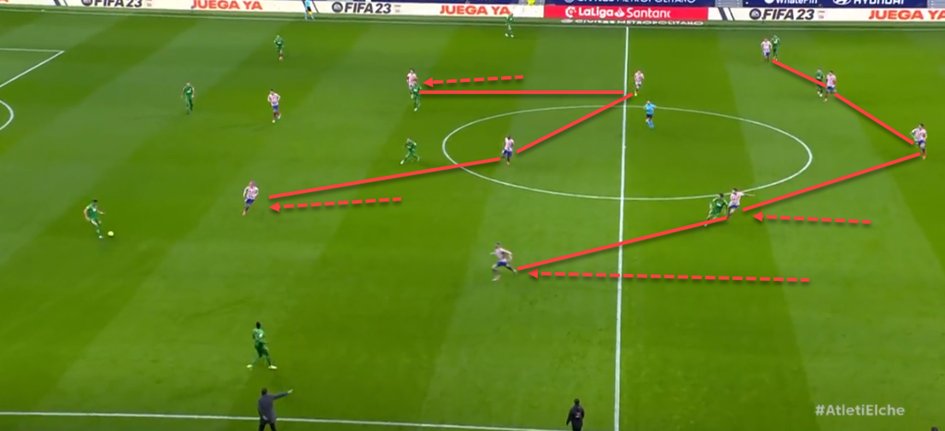
@TotalAnalysis The RCM often pushes up or wide and one forward might drop into midfield for cover if necessary.
In a mid-low block the priority is always congesting the centre and providing numerical cover to push the opponent wide.
They will aim to force Barcelona into crosses.
In a mid-low block the priority is always congesting the centre and providing numerical cover to push the opponent wide.
They will aim to force Barcelona into crosses.
@TotalAnalysis We've seen their high press in a previous image.
They are heavily man-marking oriented and can be aggressive off the ball, pushing wing-backs very high and wide CMs supporting central teammates.
Often, leaving the FBs open is a trap and will trigger the press too.
They are heavily man-marking oriented and can be aggressive off the ball, pushing wing-backs very high and wide CMs supporting central teammates.
Often, leaving the FBs open is a trap and will trigger the press too.
@TotalAnalysis Against a back two, likely to press in a 4-4-2 that morphs into a 4-3-3 if the opposition drop an additional player in the backline.
Similarly, WBs drop to form a 5-2-3/5-3-2 to double down on the wingers BUT they can be very narrow and susceptible to diagonal switches.
Similarly, WBs drop to form a 5-2-3/5-3-2 to double down on the wingers BUT they can be very narrow and susceptible to diagonal switches.
@TotalAnalysis The backline will follow interiors/strikers who drop and that's how Barcelona can isolate their wingers OR attack through the half-space once the gap is open.
High up, 4-4-2 with Morata tracking the ball/pressing the gk & Griezmann keeping one CM in the cover shadow.
High up, 4-4-2 with Morata tracking the ball/pressing the gk & Griezmann keeping one CM in the cover shadow.
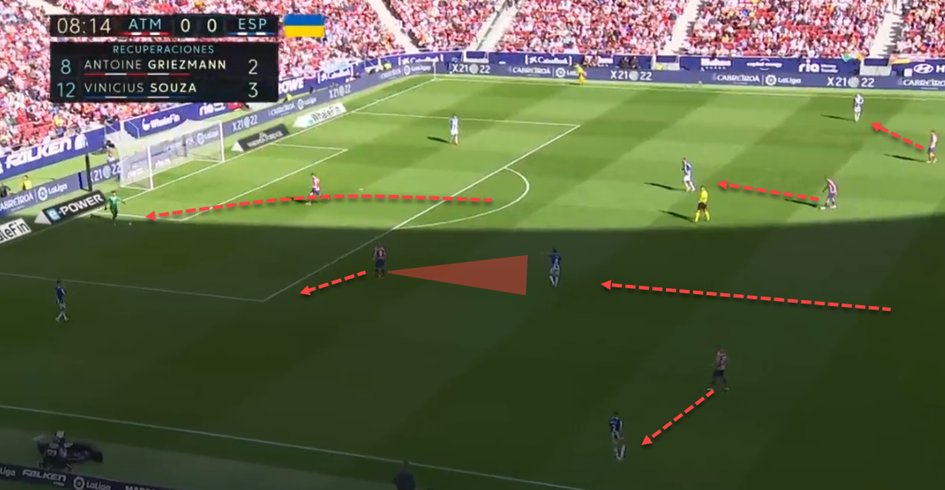
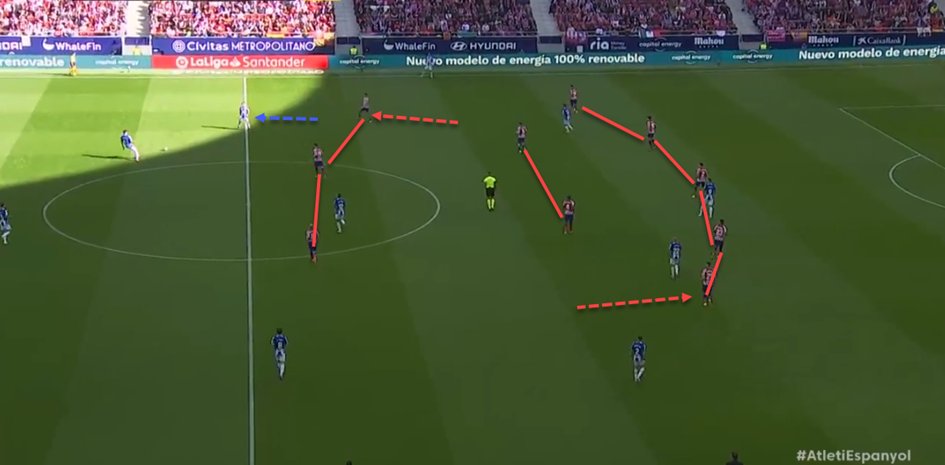
@TotalAnalysis When it comes to this specific matchup, the gist of the game is how well can Barcelona breach the 5-at-the-back structure and how well can Atlético transition from that into attack.
Whoever is more successful on their part will inevitably be more successful overall.
Whoever is more successful on their part will inevitably be more successful overall.
@TotalAnalysis I'm not going to spend much time on Barcelona's attack for now.
They've been excellent in Laliga and their rolling xG confirms as much: an average of 2.44 for and only 0.99 against.
The Catalans have kept their opponents VERY quiet in 22/23.
📈👇
They've been excellent in Laliga and their rolling xG confirms as much: an average of 2.44 for and only 0.99 against.
The Catalans have kept their opponents VERY quiet in 22/23.
📈👇
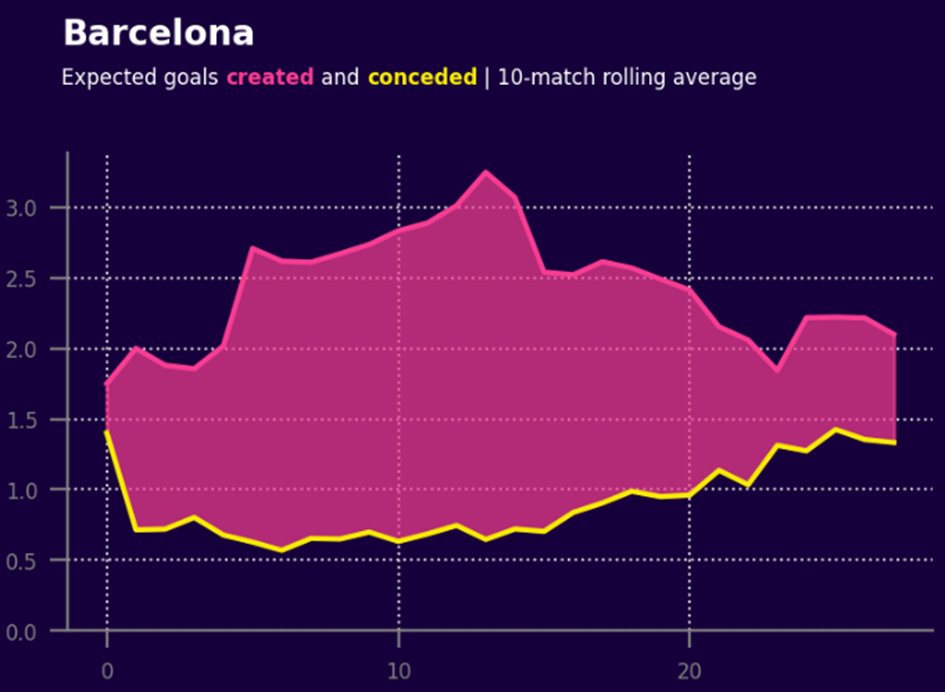
@TotalAnalysis We can assume they will follow a fairly common pattern of build-up with either the pivot dropping deeper or a full-back staying to form a three-in-the-back.
In that scenario, we can expect Simeone to deploy these two approaches in a high/mid-block:
In that scenario, we can expect Simeone to deploy these two approaches in a high/mid-block:
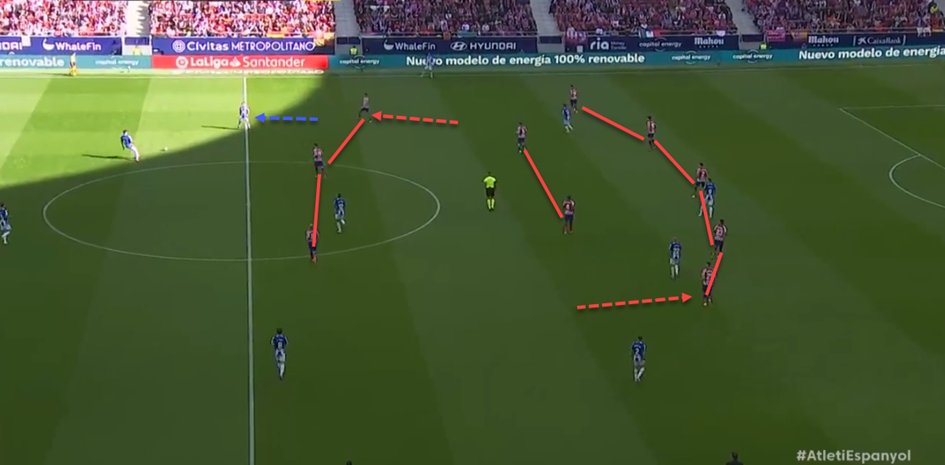
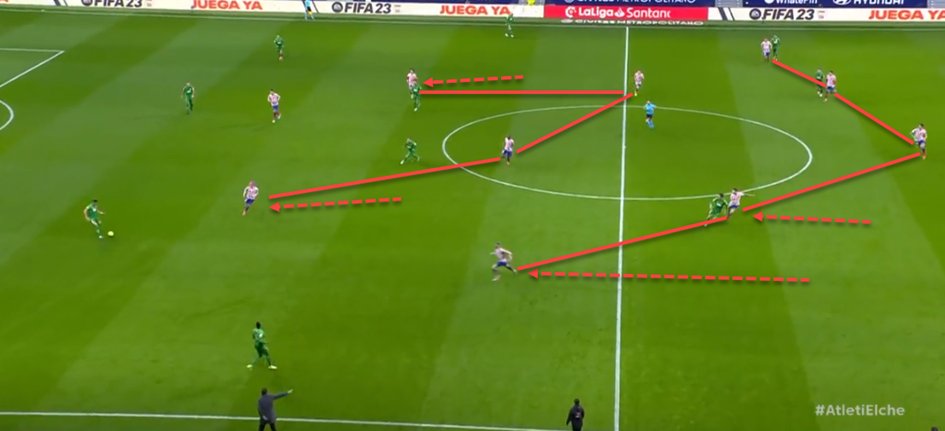
@TotalAnalysis However, Barcelona rely on wide isolations as their main chance-creation tool.
Having players like Ousmane Dembélé and Raphinha is their biggest weapon in the final third so Simeone will undoubtedly put emphasis on stopping them.
Barça's block unlocking:
Having players like Ousmane Dembélé and Raphinha is their biggest weapon in the final third so Simeone will undoubtedly put emphasis on stopping them.
Barça's block unlocking:
@TotalAnalysis Atlético Madrid's best bet is the 5atb system which has so far been Xavi's bane.
The natural ability of that structure to double-down the wide areas is what has brought Barcelona's opposition much joy, especially in Cup games.
Simeone should mimic Inter Milan.
The natural ability of that structure to double-down the wide areas is what has brought Barcelona's opposition much joy, especially in Cup games.
Simeone should mimic Inter Milan.
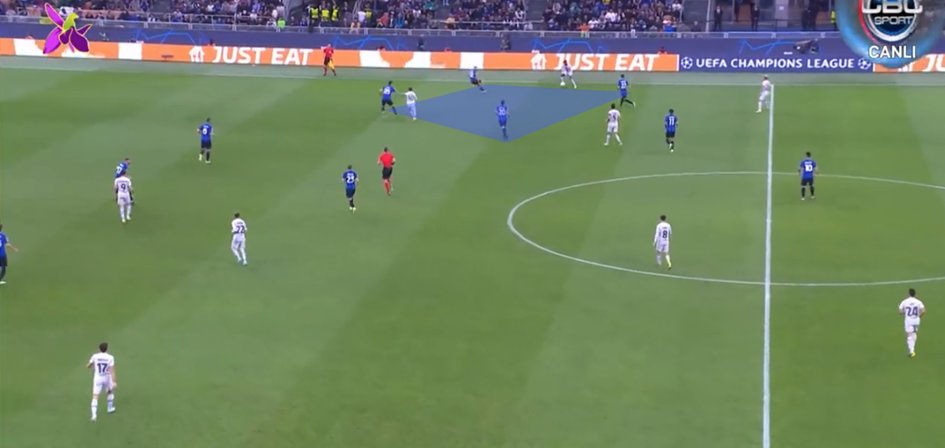
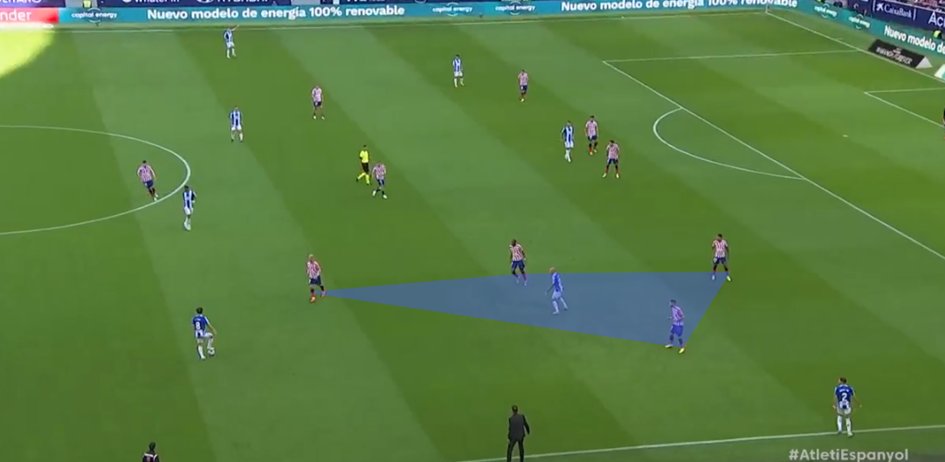
@TotalAnalysis Finally, I want to talk a little bit about breaking that 5-at-the-back system.
Barcelona have done so through quick recycling and the overload to isolate tactic. If executed properly, it works well.
But would it against a drilled Atlético team? Here are two approaches.
Barcelona have done so through quick recycling and the overload to isolate tactic. If executed properly, it works well.
But would it against a drilled Atlético team? Here are two approaches.
@TotalAnalysis Approach 1: Break down the block via dynamic superiority down the middle.
Here we need late arrivals and space penetrators. Our aim is to overload the second line & find depth. Overload the line of 3 & eject runners or carry the ball forward.
Wingers can eject interiors too.
Here we need late arrivals and space penetrators. Our aim is to overload the second line & find depth. Overload the line of 3 & eject runners or carry the ball forward.
Wingers can eject interiors too.
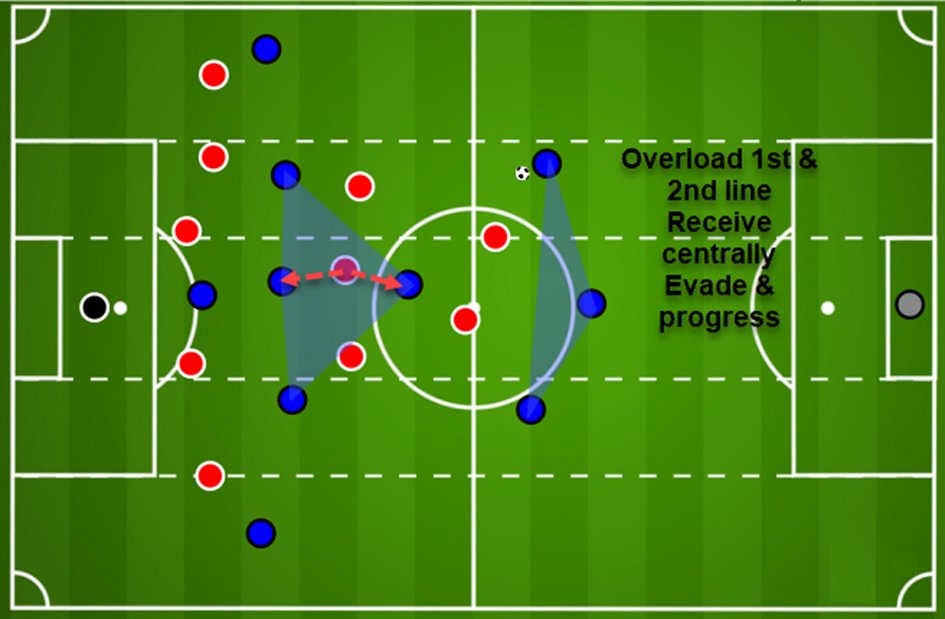
@TotalAnalysis This approach may be risky but it's possible if executed well.
However, it's crucial Barcelona have good receivers AND carriers between the lines. Pedri & Gavi would be key in this instance.
They need to receive under pressure, evade & progress + eject runners.
However, it's crucial Barcelona have good receivers AND carriers between the lines. Pedri & Gavi would be key in this instance.
They need to receive under pressure, evade & progress + eject runners.
@TotalAnalysis Interestingly, we've seen something similar in the second leg against Inter.
Barcelona deployed a similar 3-diamond-3 structure and found joy in progressing and threatening the box. The game ended 3:3 but they were better than given credit still.
Risky but rewarding? 🤔
Barcelona deployed a similar 3-diamond-3 structure and found joy in progressing and threatening the box. The game ended 3:3 but they were better than given credit still.
Risky but rewarding? 🤔
@TotalAnalysis Approach 2: Combat the 5-3-2 with its 3-2-5 mirror.
Overload the first line, pin the second line, overall 5v5 parity. BUT guarantee of progression because 3v2 and the pinning of 2nd line. Finally, 5v5 in the backline.
This requires superb tactical awareness.
Overload the first line, pin the second line, overall 5v5 parity. BUT guarantee of progression because 3v2 and the pinning of 2nd line. Finally, 5v5 in the backline.
This requires superb tactical awareness.
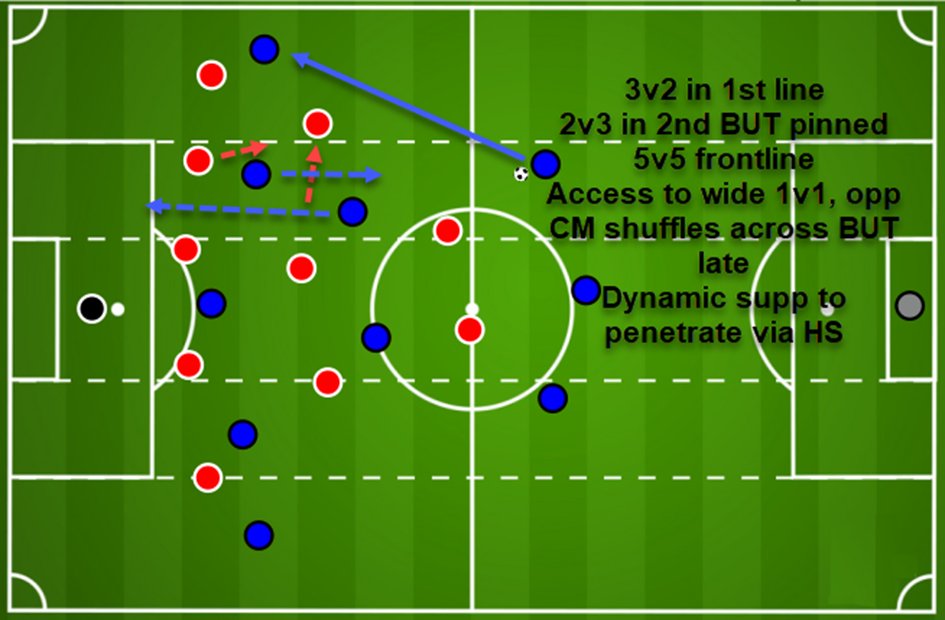
@TotalAnalysis The setup enables wide access as the opposition 2nd line of 3 CMs cannot mark the wide receivers in the 5v5 frontline because they are pinned.
If they do, they have to arrive late because they have to screen against the inside passes from the first line.
If they do, they have to arrive late because they have to screen against the inside passes from the first line.
@TotalAnalysis Once they shift wide, they empty the 2nd line on that side & you can have dynamic superiority through a late run from one of your midfielders in your 2nd line on the underlap (this is where half-space penetrators come into play again) or one of the wide CBs on the overlap.
@TotalAnalysis So this gives us: constant progression options, numerical superiority/parity in the last line & dynamic advantage to unbalance the last line.
Plus it enables control of the ball and the transition moment as much as possible, meaning you can sustain pressure consistently. 👌
Plus it enables control of the ball and the transition moment as much as possible, meaning you can sustain pressure consistently. 👌
@TotalAnalysis This, of course, is largely theoretical and remains to be seen how well-drilled a team like Xavi's Barcelona is in reality to confidently utilise such approaches.
TL;DR:
Barcelona have an advantage but the game comes down to beating the 5atb for FCB and transitions for ATM.
TL;DR:
Barcelona have an advantage but the game comes down to beating the 5atb for FCB and transitions for ATM.
@TotalAnalysis If you enjoyed this thread, please:
1. Follow me (@DKostanjsak) & BarcaFutbol (@BarcaFutbolLive) for more 🔥
2. Retweet the 1st tweet below to share this thread 🙏
1. Follow me (@DKostanjsak) & BarcaFutbol (@BarcaFutbolLive) for more 🔥
2. Retweet the 1st tweet below to share this thread 🙏
A huge thank you to both @samleveridge and @ashwinballal_ for their invaluable help.
Both of them are much bigger Atletico experts and I couldn't have done this without their assistance.
Follow them!
Thank you both 🔥
Both of them are much bigger Atletico experts and I couldn't have done this without their assistance.
Follow them!
Thank you both 🔥
Folks, if you've enjoyed this thread you'll surely enjoy what we're creating at @BarcaFutbolLive!
Subscribe for more Barça, analysis and football! It's completely FREE!
Link below 👇
barcafutbol.substack.com
Subscribe for more Barça, analysis and football! It's completely FREE!
Link below 👇
barcafutbol.substack.com
Loading suggestions...