

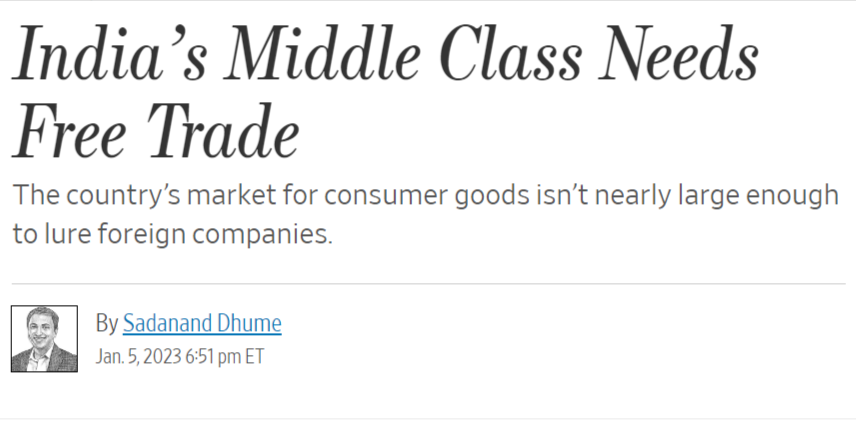
Some thoughts about Dhume's article. He gets a lot wrong. But imo criticism of his article is missing the most important issue.
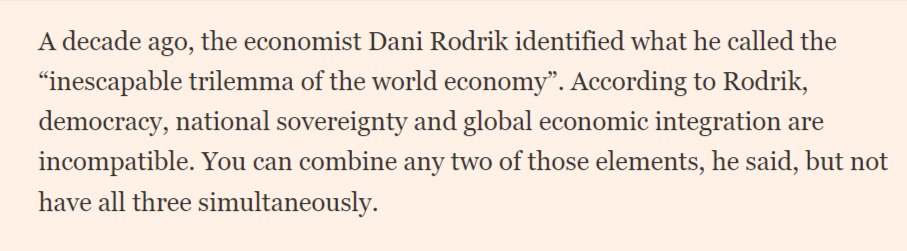
unfettered Free Trade is dead.
I am surprised Trump's victory didn't make this clear. It's a bargain fundamentally against democracy itself.
unfettered Free Trade is dead.
I am surprised Trump's victory didn't make this clear. It's a bargain fundamentally against democracy itself.
We were taught in college that comparative advantage - the basis of free trade - is some manna from heaven. Sometimes it is - mostly these days it's not.
Reality is that advantage is manufactured - particularly by industrial clustering. A strategy widely pursued in East Asia.
Reality is that advantage is manufactured - particularly by industrial clustering. A strategy widely pursued in East Asia.
Another reality is that nations impose certain costs upon themselves based on their democratic consensus. Whether it's environmental laws. Or worker's rights. Or the structure of healthcare. Or subsidizing local food production to keep farming viable.
To bypass these costs, by moving production to a region that doesn't have them - that is not comparative advantage. It's just finding a loophole.
imo - it took a while for voters, at large, to realize this basic conflict between democracy and globalization.
imo - it took a while for voters, at large, to realize this basic conflict between democracy and globalization.
These self-imposed costs are not limited to rich nations. India is too held together by striking bargains with different internal groups.
We may not have effective minimum wages or universal healthcare - but the price of raw milk must be kept remunerative (as an eg).
We may not have effective minimum wages or universal healthcare - but the price of raw milk must be kept remunerative (as an eg).
A lot of welfarism in India is disguised as price supports, regulations limiting competition, input subsidies, tariffs, and so on.
It's a society that's easily put into turbulence by trying to take them apart too fast. Given the farm protests, it's surprising this has to be said
It's a society that's easily put into turbulence by trying to take them apart too fast. Given the farm protests, it's surprising this has to be said
Unlike American voters who took years to figure out impact of globalization & who had cushion of social security etc. (and general belief in free markets) - Indian voters, many of whom, live hand-to-mouth, would instantly reject any trade agreements that damage their incomes.
So it's all good to say we should open up and embrace free trade and so on. Yes, of course, selling to richer nations is the easiest way to grow rich.
But how exactly - when the resulting bargain will be unacceptable to big swathes of your population?
But how exactly - when the resulting bargain will be unacceptable to big swathes of your population?
There are two ways to deal with this dissent:
- Muzzle it. Not possible in democracies - but doable in China
- Pay it off. Works if the FTAs generate immense amounts of new income.
But in a widely cited study - it was seen that FTA with ASEAN hurt us:
downtoearth.org.in
- Muzzle it. Not possible in democracies - but doable in China
- Pay it off. Works if the FTAs generate immense amounts of new income.
But in a widely cited study - it was seen that FTA with ASEAN hurt us:
downtoearth.org.in
The conclusion here is straightforward.
India can't strike FT bargains that hurt hundreds of millions of people - without it's industry first becoming competitive enough to take advantage of those FTAs.
India can't strike FT bargains that hurt hundreds of millions of people - without it's industry first becoming competitive enough to take advantage of those FTAs.
(As an aside - we are ultra-competitive in exporting people - but no other country wants that as part of FTAs 🤣)
Or we have to strike FT bargains, perhaps bilaterally, that work for us.
Or we have to strike FT bargains, perhaps bilaterally, that work for us.
Seen in this light - it is clear not only that we can't participate FTAs unconditionally - but that the focus needs to be on making local industry competitive first as a pre-requisite.
To put it simply: Dhume is investigating the wrong end of the stick.
To put it simply: Dhume is investigating the wrong end of the stick.
To that end - while deregulation, infrastructure, skilling etc are all important - the other big lever we have is Economies of Scale.
Protectionism to bootstrap local industry so it hits economies of scale - that then makes it globally competitive (in spite of our other handicaps) makes a lot of sense.
This thread does a good job of covering the history of this strategy:
This thread does a good job of covering the history of this strategy:
Dhume completely misses this point.
That while a 65M middle class may not be a huge market - but it's certainly large enough to hit economies of scale to birth globally competitive companies. Plus we will keep growing ourselves.
That while a 65M middle class may not be a huge market - but it's certainly large enough to hit economies of scale to birth globally competitive companies. Plus we will keep growing ourselves.
eg: growing up in fiercely protectionist 80s India - one of the stories I am familiar with is the auto components industry. Today we are world leaders in many categories of component exports - because super-high tariffs forced a local supply chain.
auto.economictimes.indiatimes.com
auto.economictimes.indiatimes.com
Import substitution has another important benefit. It allows us to import what we simply cannot produce. And technological inputs are critical to productivity.
Today we r importing hundreds of Airbuses/Boeings without breaking a sweat. Pak is closing markets at 8:30pm
Today we r importing hundreds of Airbuses/Boeings without breaking a sweat. Pak is closing markets at 8:30pm
The arguments here don't even factor in the national security concerns we have viz-a-viz China. And we aren't the only ones - even the US continues to impose high tariffs on many sectors for national security reasons. (Steel for example)
None of this absolves the Indian Govt. of the need to pursue genuine reform - to remove the shackles that hamper our competitiveness. It would be far better to focus on that.
There are too many examples of continuing rot here. RBIs complicated FEMA rules ..
There are too many examples of continuing rot here. RBIs complicated FEMA rules ..
inability to move capital freely. the tax dept. being as delinquent & regressive as it has ever been. Lack of labor, judicial reforms. Industrialization with workers living in urban slums.
There is much to write about.
There is much to write about.
Another thing that's apparent is that the GoI has no focus on sunshine industries. New industries have the least protectionist barriers globally. Our success with exports was in software - a relatively new industry at that time.
But faced with something new - the GoI's natural reaction is to shut things down while some bureaucratic bullock cart produces a position paper.
We had drones banned for years while DJI took over the world market. While China jumped into EVs, AI & Solar - we were sleeping.
We had drones banned for years while DJI took over the world market. While China jumped into EVs, AI & Solar - we were sleeping.
An interesting criticism of GoI's PLI schemes is that they are all backward-looking.
Similarly - remote working is now the vogue - but what has GoI done to facilitate remote working contracts for Indians? We are stuck with same PE laws and rules around no ESOPs for contractors.
Similarly - remote working is now the vogue - but what has GoI done to facilitate remote working contracts for Indians? We are stuck with same PE laws and rules around no ESOPs for contractors.
Free trade vs. protectionism, role of ind. strategy etc are interesting discussions. Doesn't help when charge for FT is led by (what can only be called as) buffoonery. That draws ridicule, instead of discussion. @WSJ pls find better advocates for FT:
Loading suggestions...