

With a combined market share of 40%, it brings enormous opportunities when you skill yourself in both Python and JavaScript.
Here's how I did it in a quick time:
Here's how I did it in a quick time:
⬘ First, I skilled myself in one language (JavaScript).
⬗ Once I became familiar, I decided to learn the other one (Python).
⬙ While learning Python, I compared its syntax with JavaScript's to quickly learn it.
This whole method really paid off. Let's have some samples.
⬗ Once I became familiar, I decided to learn the other one (Python).
⬙ While learning Python, I compared its syntax with JavaScript's to quickly learn it.
This whole method really paid off. Let's have some samples.
➊ Variables
➀ Variable Naming
➁ Variable Declaration
➂ Variable Assignment
➀ Variable Naming
➁ Variable Declaration
➂ Variable Assignment
➊.➀ Variable Naming
⬘ Python and JavaScript are almost similar in variable naming conventions except that JavaScript allows $ in variable names.
⬙ Python has a convention of using snake_case while JavaScript prefers camelCase naming.
⬘ Python and JavaScript are almost similar in variable naming conventions except that JavaScript allows $ in variable names.
⬙ Python has a convention of using snake_case while JavaScript prefers camelCase naming.

➊.➁ Variable Declaration
⬘ Python doesn't have any syntax to declare a variable while JavaScript has 3 keywords.
⬗ Type Declaration: Python introduced it in v3.5, but doesn't enforce it. JavaScript doesn't have any.
⬙ Both allow changing the variable type dynamically.
⬘ Python doesn't have any syntax to declare a variable while JavaScript has 3 keywords.
⬗ Type Declaration: Python introduced it in v3.5, but doesn't enforce it. JavaScript doesn't have any.
⬙ Both allow changing the variable type dynamically.

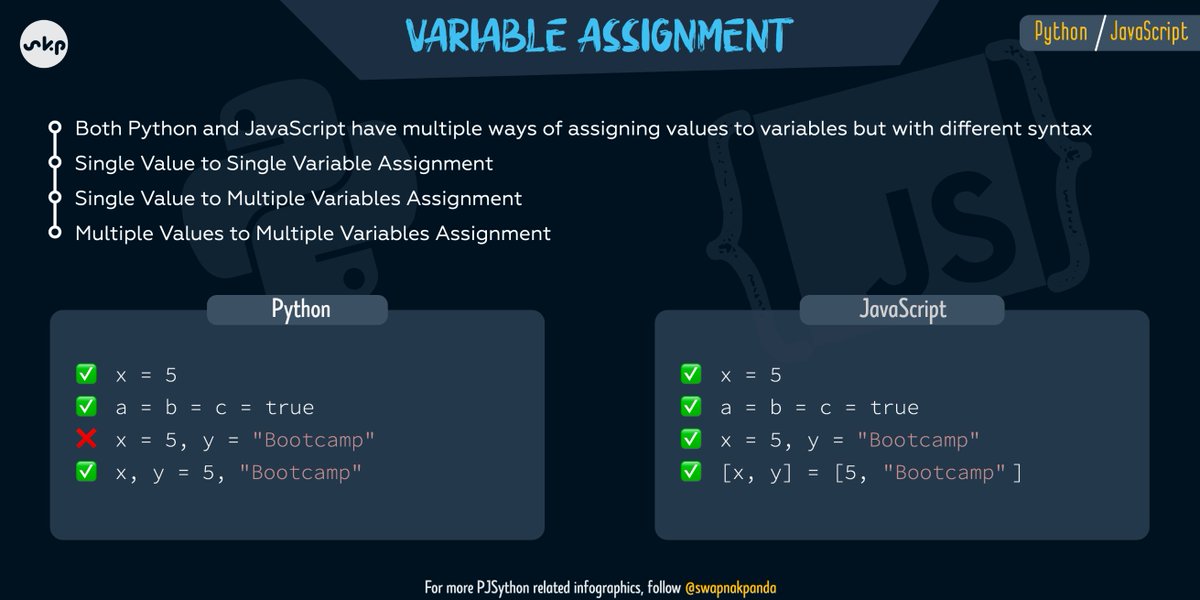
➊.➂ Variable Assignment
Both Python and JavaScript have multiple syntaxes for assigning values to variables.
Both Python and JavaScript have multiple syntaxes for assigning values to variables.
➋ Data Types
➀ Built-In Data Types
➁ Finding Type
➂ Checking Instance Type
➃ Type Casting
➀ Built-In Data Types
➁ Finding Type
➂ Checking Instance Type
➃ Type Casting
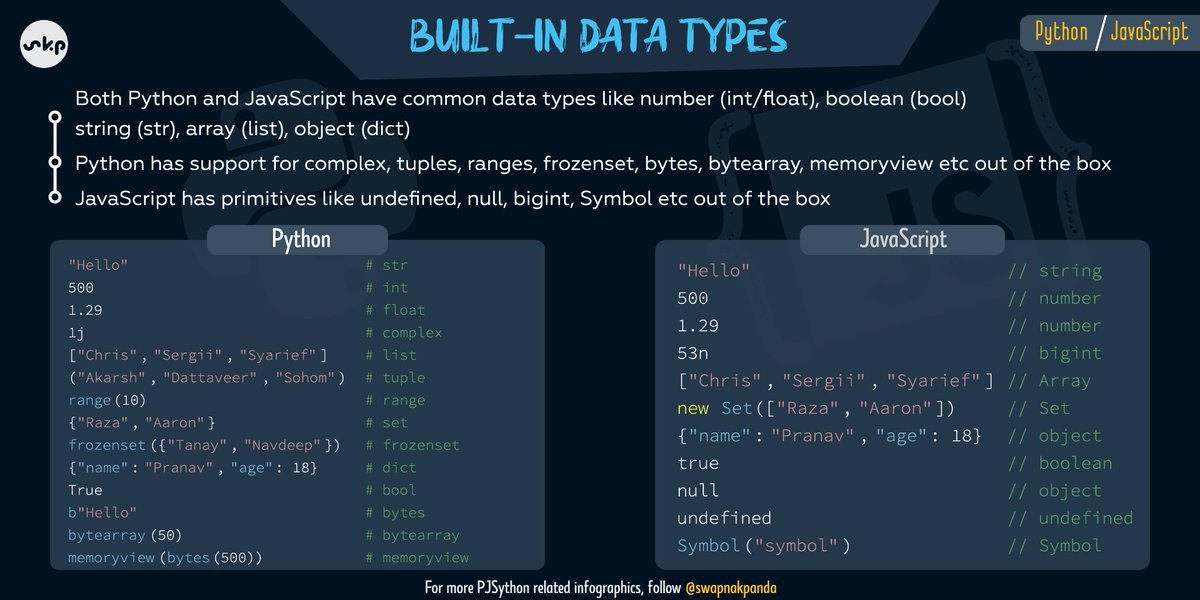
➋.➀ Built-In Data Types
⬘ Both Python and JavaScript provide some common data types.
⬙ Each has its own set of unique featured data types.
⬘ Both Python and JavaScript provide some common data types.
⬙ Each has its own set of unique featured data types.
➋.➁ Finding Type
⬘ As both Python and JavaScript are dynamically typed, finding the type of a variable at runtime is a common practice.
Both provide a way to do this.
⬘ As both Python and JavaScript are dynamically typed, finding the type of a variable at runtime is a common practice.
Both provide a way to do this.

➋.➂ Checking Instance Type
⬘ On some occasions, we need to check if a variable is of a particular type or not.
Both Python and JavaScript have options to do this.
⬘ On some occasions, we need to check if a variable is of a particular type or not.
Both Python and JavaScript have options to do this.

➋.➃ Type Casting
⬘ Data sometimes come in different formats and need to be converted to appropriate types at run-time.
Both Python and JavaScript support typecasting.
⬘ Data sometimes come in different formats and need to be converted to appropriate types at run-time.
Both Python and JavaScript support typecasting.

➌ Operators
➀ Arithmetic Operators
➁ Comparison Operators
➂ Logical Operators
➃ Bitwise Operators
➄ Assignment Operators
➅ Ternary Operator
➆ Membership Operators
➇ Type Checking Operators
➈ Operator Overloading
➀ Arithmetic Operators
➁ Comparison Operators
➂ Logical Operators
➃ Bitwise Operators
➄ Assignment Operators
➅ Ternary Operator
➆ Membership Operators
➇ Type Checking Operators
➈ Operator Overloading
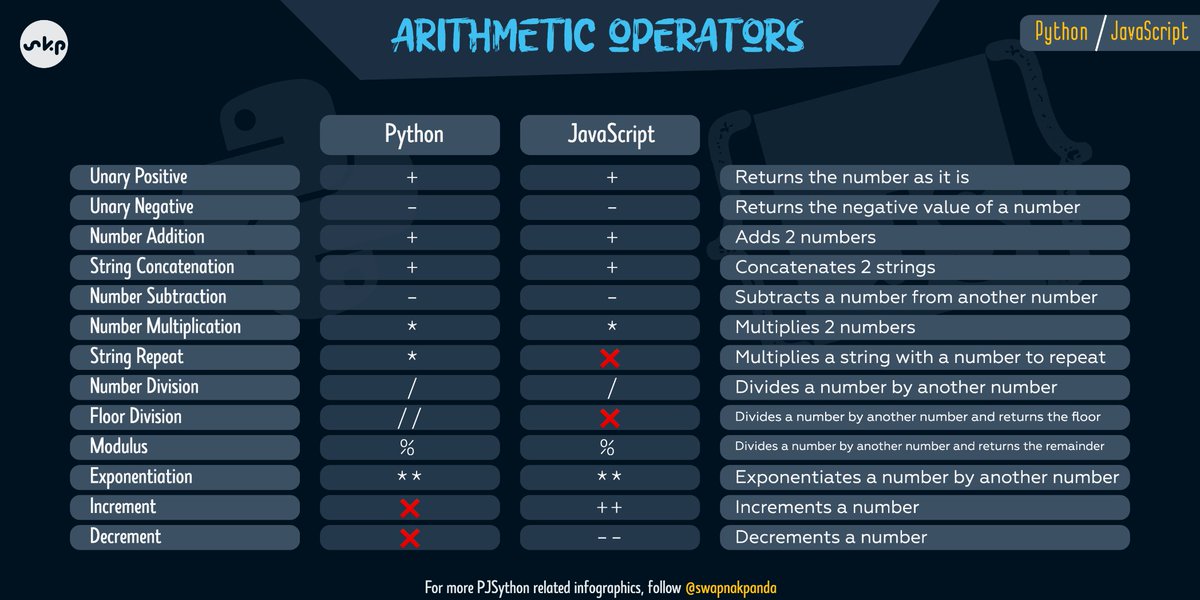
➌.➀ Arithmetic Operators
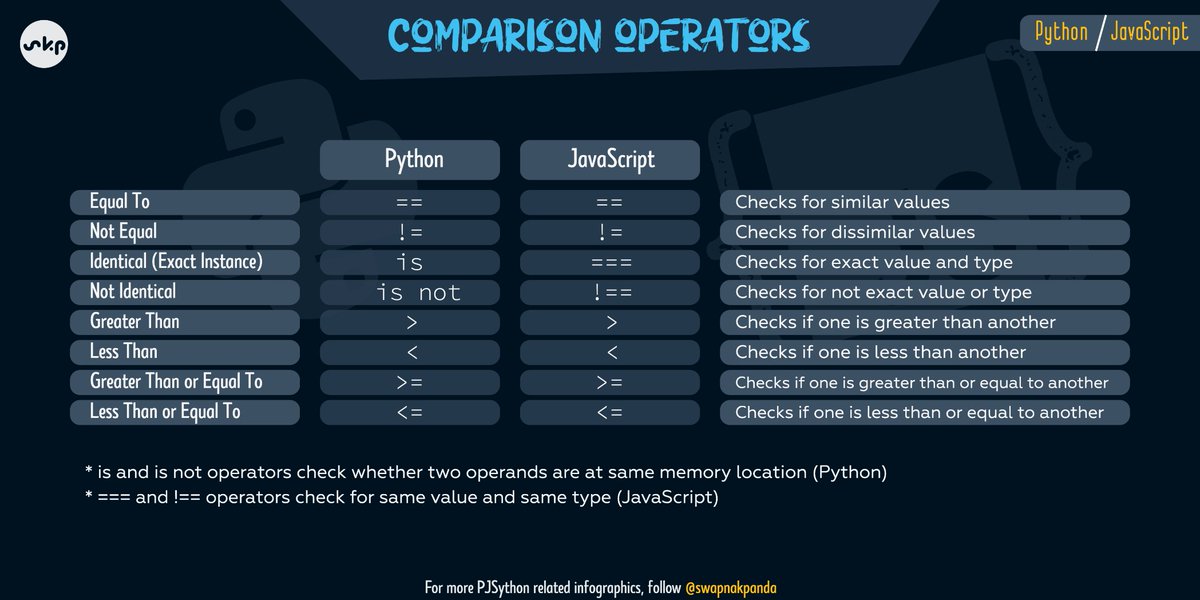
➌.➁ Comparison Operators
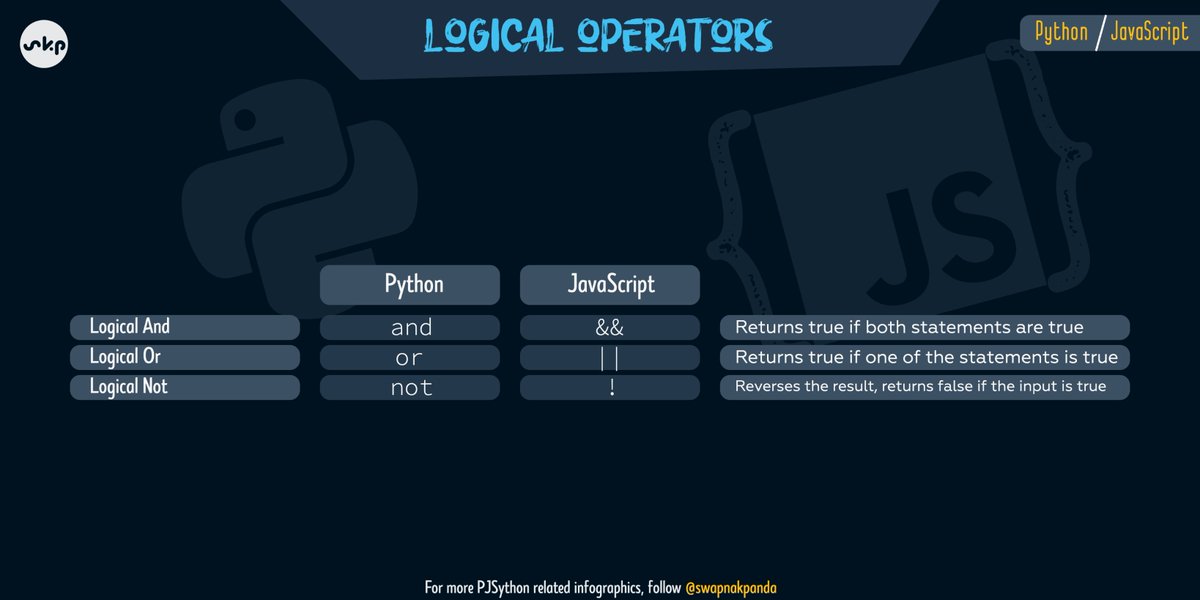
➌.➂ Logical Operators
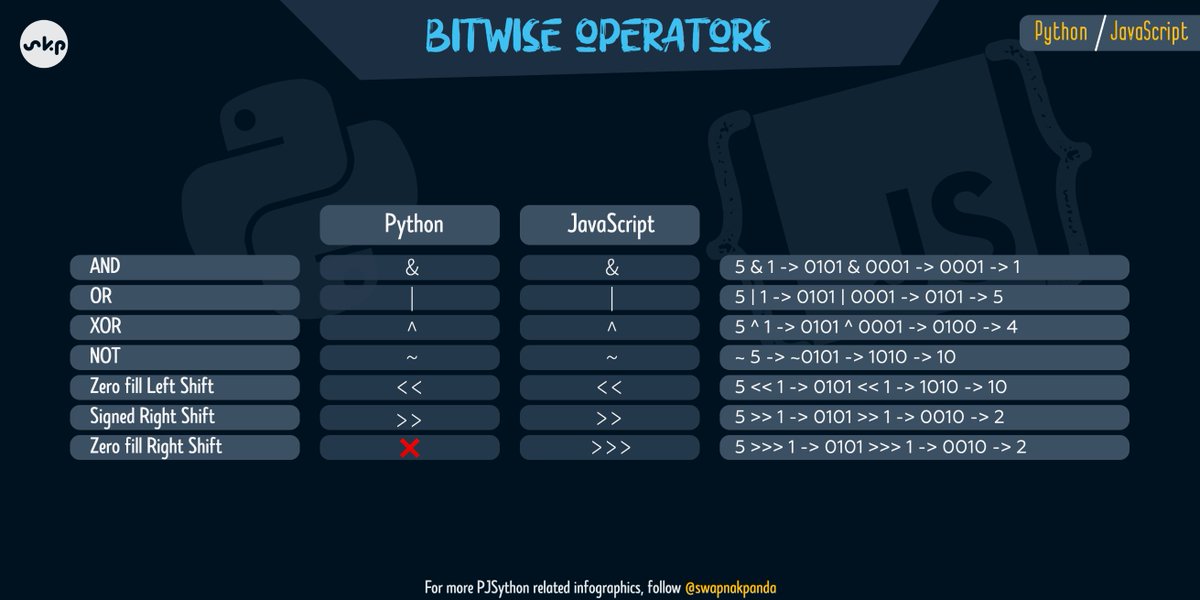
➌.➃ Bitwise Operators
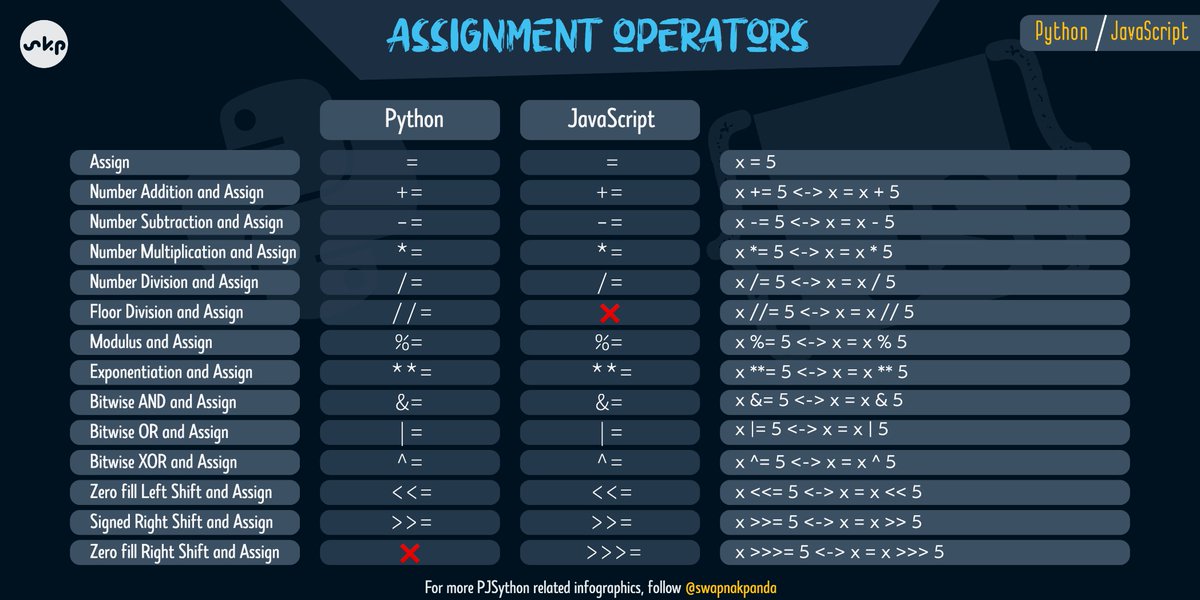
➌.➄ Assignment Operators
➌.➅ Ternary Operator
⬘ JavaScript has a ternary operator ?:
⇥ x > 5 ? 2 : 4
⬙ Though Python doesn't have any such operator, it has similar functionality.
⇥ 2 if x > 5 else 4
⬘ JavaScript has a ternary operator ?:
⇥ x > 5 ? 2 : 4
⬙ Though Python doesn't have any such operator, it has similar functionality.
⇥ 2 if x > 5 else 4
➌.➆ Membership Operators
⬘ Python provides 2 membership operators ("in" and "not in") that check whether an element exists in a sequence (list, tuple, etc).
⬙ JavaScript has an "in" operator which is used inside for..in loop and for object property checks.
⬘ Python provides 2 membership operators ("in" and "not in") that check whether an element exists in a sequence (list, tuple, etc).
⬙ JavaScript has an "in" operator which is used inside for..in loop and for object property checks.
➌.➇ Type Checking Operators
⬘ JavaScript provides 2 type checking operators (typeof and instanceof). It's discussed in ➋.➁ & ➋.➂.
⬙ Python doesn't have any equivalent operators. But it provides 2 functions to do these. type() and isinstance()
⬘ JavaScript provides 2 type checking operators (typeof and instanceof). It's discussed in ➋.➁ & ➋.➂.
⬙ Python doesn't have any equivalent operators. But it provides 2 functions to do these. type() and isinstance()
➌.➈ Operator Overloading
⬘ Python allows operator overloading. Python doesn’t do type conversion during evaluation.
⬙ JavaScript doesn’t have support for operator overloading. It auto-converts the operands to the required type during evaluation.
⬘ Python allows operator overloading. Python doesn’t do type conversion during evaluation.
⬙ JavaScript doesn’t have support for operator overloading. It auto-converts the operands to the required type during evaluation.
🚥 Disclaimer
I have tried to show a way of learning multiple languages at the same time by comparing their syntax.
I have tried to show a way of learning multiple languages at the same time by comparing their syntax.
Hey 👋
I am a Tech Educator and, Writer from India 🇮🇳
I am sharing Tutorials, Practice Questions, Project Ideas, Roadmaps on Python, JavaScript, DSA, and Databases.
➟ To never miss anything, Follow Me ✅
➟ RT the below tweet to share in your circle.
I am a Tech Educator and, Writer from India 🇮🇳
I am sharing Tutorials, Practice Questions, Project Ideas, Roadmaps on Python, JavaScript, DSA, and Databases.
➟ To never miss anything, Follow Me ✅
➟ RT the below tweet to share in your circle.
Loading suggestions...