

Slack is one of the FASTEST growing startups in the world!
In just,
- ONE day => 8000 users
- 2 weeks => 15000 users
- 8 months => $1B valuation!
It was acquired by Salesforce for $27.7B and in 2021 it made $902M in revenue!
Here's the SECRET to Slack's astronomical growth 🧵
In just,
- ONE day => 8000 users
- 2 weeks => 15000 users
- 8 months => $1B valuation!
It was acquired by Salesforce for $27.7B and in 2021 it made $902M in revenue!
Here's the SECRET to Slack's astronomical growth 🧵
Structure:
1. How Butterfield recycled a game to buildd Slack?
2. Slack's astronomical growth numbers!
3. The vision of the pre-launch MEMO
4. Zero to $27B => How Slack hacked its way to VIRALITY?
5. Closing Thoughts
1. How Butterfield recycled a game to buildd Slack?
2. Slack's astronomical growth numbers!
3. The vision of the pre-launch MEMO
4. Zero to $27B => How Slack hacked its way to VIRALITY?
5. Closing Thoughts
1/ How Butterfield recycled a game to buildd Slack?
Steward Butterfield, Slack's co-founder, never intended to buildd an instant messaging platform.
In fact, he was hell-bent on creating a non-combat game called Glitch!
But, things didn't go the way he wanted.
(contd.)
Steward Butterfield, Slack's co-founder, never intended to buildd an instant messaging platform.
In fact, he was hell-bent on creating a non-combat game called Glitch!
But, things didn't go the way he wanted.
(contd.)
At his first attempt:
- Butterfield failed to raise funds for the game
- So, he recycled its image-sharing feature to buildd Flickr
- Flickr blew up and was acquired by Yahoo for ~$25M
Still, Butterfield didn't give up. After Flickr, he went back to finishing the game.
(contd.)
- Butterfield failed to raise funds for the game
- So, he recycled its image-sharing feature to buildd Flickr
- Flickr blew up and was acquired by Yahoo for ~$25M
Still, Butterfield didn't give up. After Flickr, he went back to finishing the game.
(contd.)
Soon enough, he realised that Glitch won't take off.
An instant messaging feature was already part of Glitch. Plus, there was no good team chat app out there.
So, he recycled an almost non-usable game's contemporary feature and gave birth to a $27B company, that is Slack!
An instant messaging feature was already part of Glitch. Plus, there was no good team chat app out there.
So, he recycled an almost non-usable game's contemporary feature and gave birth to a $27B company, that is Slack!
2/ Slack's astronomical growth
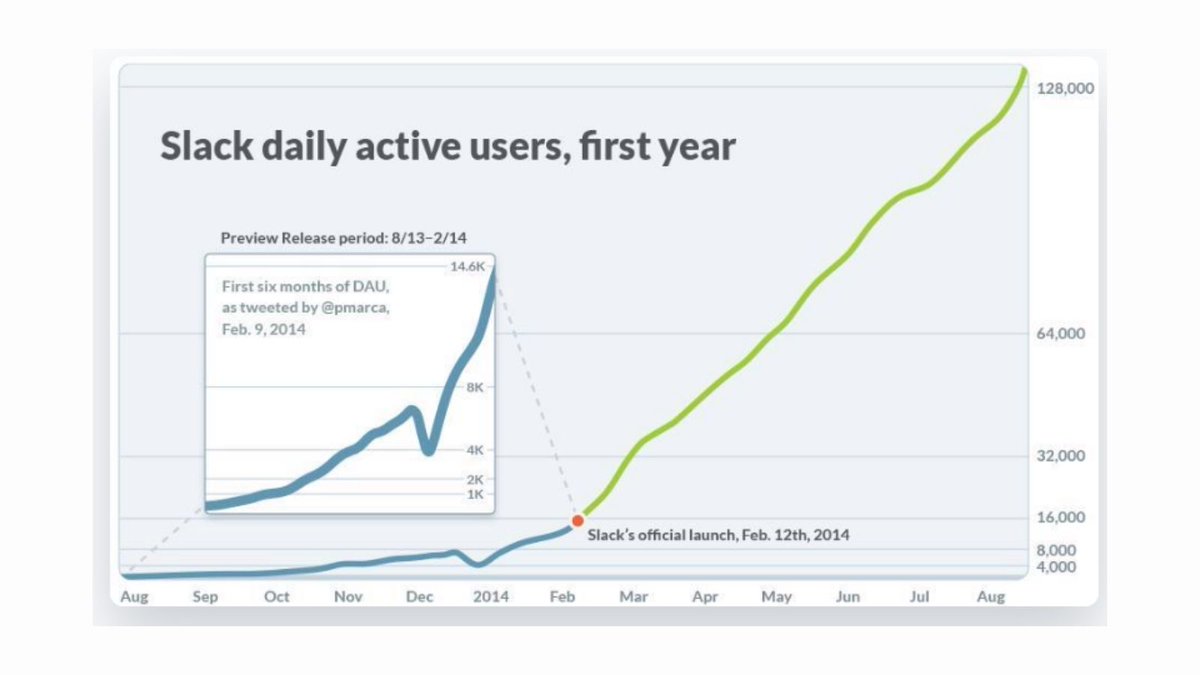
Right from the bat, Slack witnessed growth numbers that were rarely seen for any tech company in the 2010s.
1. Within just 24 hours of its launch, Slack gained 8000 users
2. 2 weeks => 15k users
3. It raised $1.4B in funding
(contd.)
Right from the bat, Slack witnessed growth numbers that were rarely seen for any tech company in the 2010s.
1. Within just 24 hours of its launch, Slack gained 8000 users
2. 2 weeks => 15k users
3. It raised $1.4B in funding
(contd.)
4. It was acquired by Salesforce for $27.7B in 2021
5. They generated a revenue of $902M and made a profit of $231M with almost 10M+ active users!
But, how did they grow so quickly?
Well, the recipe for Slack's success lies in its go-to-market strategy. Let's explore it below.
5. They generated a revenue of $902M and made a profit of $231M with almost 10M+ active users!
But, how did they grow so quickly?
Well, the recipe for Slack's success lies in its go-to-market strategy. Let's explore it below.
3/ The vision of the pre-launch MEMO
Before the 2013 launch, Butterfield wrote a memo defining Slack's vision with crystal clarity!
He lays out 4 main points:
Before the 2013 launch, Butterfield wrote a memo defining Slack's vision with crystal clarity!
He lays out 4 main points:
1) Buildd something people want
He says:
➝ We have something people want...
➝ But, most people have no idea that they want Slack
So, their main goal was to understand what people think they want and then translate the value of Slack into those terms!
(contd.)
He says:
➝ We have something people want...
➝ But, most people have no idea that they want Slack
So, their main goal was to understand what people think they want and then translate the value of Slack into those terms!
(contd.)
2) "Marketing from Both Ends"
Now, they could've just claimed to meet all the user needs. But, it was important for customers to actually witness their needs being met by Slack.
So, they needed to do 2 things
A) Give what people want
B) Communicate this effectively
(contd.)
Now, they could've just claimed to meet all the user needs. But, it was important for customers to actually witness their needs being met by Slack.
So, they needed to do 2 things
A) Give what people want
B) Communicate this effectively
(contd.)
3) Sell the innovation, not the product
This is the typical "we don't sell saddles here" argument.
Slack was not selling a group chat app but it was selling an entirely new paradigm of how teams communicate.
And, their marketing efforts needed to highlight that.
(contd.)
This is the typical "we don't sell saddles here" argument.
Slack was not selling a group chat app but it was selling an entirely new paradigm of how teams communicate.
And, their marketing efforts needed to highlight that.
(contd.)
4) Who do we want our customers to become?
Lastly, think about what you want your customers to become.
In Slack's case,
a. they wanted their customers to be more relaxed and productive
b. they wanted them to communicate interpersonally, 1-on-1 and with a team effectively.
Lastly, think about what you want your customers to become.
In Slack's case,
a. they wanted their customers to be more relaxed and productive
b. they wanted them to communicate interpersonally, 1-on-1 and with a team effectively.
4/ How Slack hacked VIRALITY?
Based on the memo, Slack needed to do the following:
1. Understand what customers need
2. Align the product with these needs
3. Communicate this with the users
4. Keep the feedback loop going
5. Add more users to the testing cycle
(contd.)
Based on the memo, Slack needed to do the following:
1. Understand what customers need
2. Align the product with these needs
3. Communicate this with the users
4. Keep the feedback loop going
5. Add more users to the testing cycle
(contd.)
Here's how this strategy looks
A. Distribution is Key
End of 2012 => Team starts polishing Slack
March 2013 => They start using the product internally
Now they needed more teams to try Slack. So, they "begged and cajoled" their friends in other companies to try Slack.
(contd)
A. Distribution is Key
End of 2012 => Team starts polishing Slack
March 2013 => They start using the product internally
Now they needed more teams to try Slack. So, they "begged and cajoled" their friends in other companies to try Slack.
(contd)
The idea was to have different teams try Slack to get feedback so they could understand if Slack was compatible with the team or not.
Most of their early distribution happened this way.
This was hard because the concept of a team chat app was non-existent back then.
(contd.)
Most of their early distribution happened this way.
This was hard because the concept of a team chat app was non-existent back then.
(contd.)
B. Transformation through User Feedback
Quickly they learned that their product worked very differently as team size changes.
As the team increased from a few members to 120 people, Slack's team made observations of the common bottlenecks.
This turned into a pattern.
(contd.)
Quickly they learned that their product worked very differently as team size changes.
As the team increased from a few members to 120 people, Slack's team made observations of the common bottlenecks.
This turned into a pattern.
(contd.)
They progressively increased the team size to see how the product works.
Once, the product worked fairly well, they rolled out their preview release.
In just a day, 8k people signed up!
The increase in users ultimately meant more customer feedback and more iteration.
(contd)
Once, the product worked fairly well, they rolled out their preview release.
In just a day, 8k people signed up!
The increase in users ultimately meant more customer feedback and more iteration.
(contd)
The beauty of this strategy was quite simple.
The folks at silicon valley are a highly talkative bunch who love networking.
So, if they love Slack, it wouldn't take long for them to spread the word. That's how Slack's "Word of Mouth" engine started churning!
(contd.)
The folks at silicon valley are a highly talkative bunch who love networking.
So, if they love Slack, it wouldn't take long for them to spread the word. That's how Slack's "Word of Mouth" engine started churning!
(contd.)
C. Formal, Sluggish Emails are Over!
As they kept iterating, Slack slowly evolved into a virtual workspace with different users and channels.
Butterfield firmly believed in this Paul Buchheit's quote — "If your product is great, it doesn't have to be good".
(contd.)
As they kept iterating, Slack slowly evolved into a virtual workspace with different users and channels.
Butterfield firmly believed in this Paul Buchheit's quote — "If your product is great, it doesn't have to be good".
(contd.)
So, they narrowed down 3 core features that Slack would be known for:
a. Search — Imagine trying to find an important conversation in the huge number of threads in Gmail. Now imagine doing the same on a Slack channel.
(contd.)
a. Search — Imagine trying to find an important conversation in the huge number of threads in Gmail. Now imagine doing the same on a Slack channel.
(contd.)
b. Synchronization — Every time you switch devices, you can pick off Slack at the point you left it. This is called "leave-state synchronization".
c. Sharing (file) — Pick and paste images, and drag-drop files - you can share almost everything on Slack.
(contd.)
c. Sharing (file) — Pick and paste images, and drag-drop files - you can share almost everything on Slack.
(contd.)
D. Use socials to spread the LOVE
Slack was officially launched in Feb 2014
Now, Slack's growth was word-of-mouth driven from the very beginning.
This worked because people are more likely to check out a product if their friend recommends it something.
(contd.)
Slack was officially launched in Feb 2014
Now, Slack's growth was word-of-mouth driven from the very beginning.
This worked because people are more likely to check out a product if their friend recommends it something.
(contd.)
They needed to replicate the word-of-mouth strategy but at scale. And, Twitter was perfect for this because:
1. Most professionals chose to hang out on Twitter
2. An individual can reach only 4-5 people. But, a tweet can be seen by thousands at a time.
(contd.)
1. Most professionals chose to hang out on Twitter
2. An individual can reach only 4-5 people. But, a tweet can be seen by thousands at a time.
(contd.)
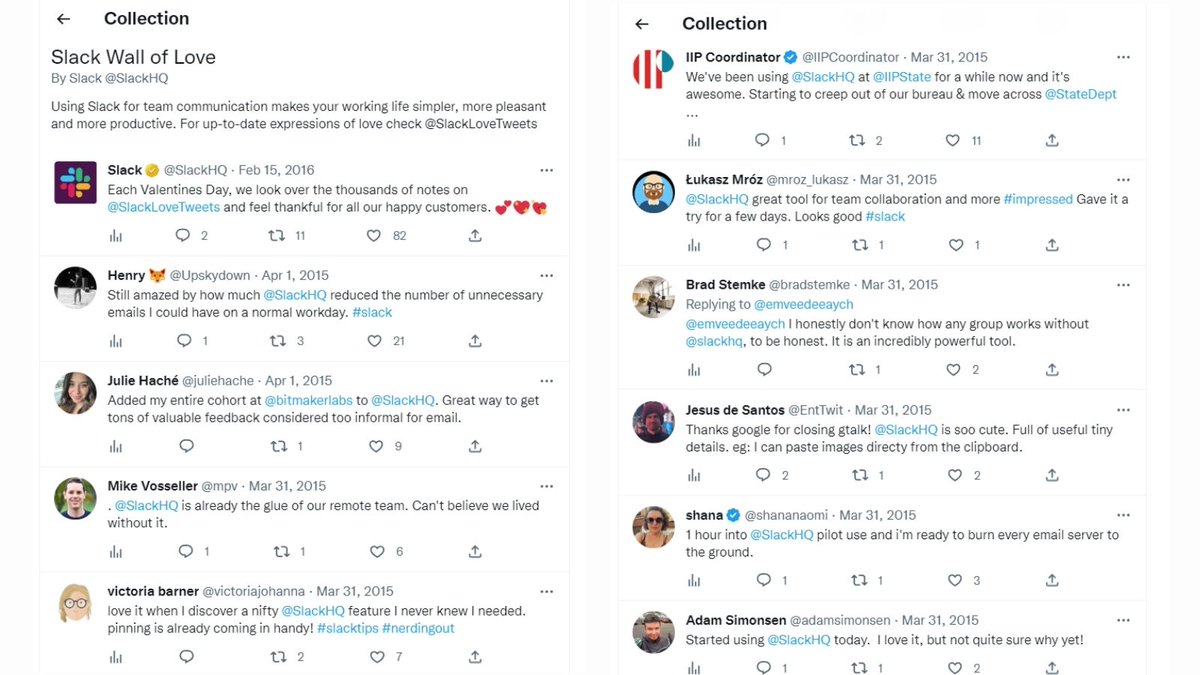
So, Slack's team created the Twitter Wall of LOVE which blew up. The wall received up to 10k/mo tweets!
But, why did this work?
Slack had already created an incrementally improved product with the initial feedback. So, new users quickly fell in love with the app.
(contd.)
But, why did this work?
Slack had already created an incrementally improved product with the initial feedback. So, new users quickly fell in love with the app.
(contd.)
E. The Viral User Acquisition loop
So, the first phase of distribution and marketing was done. Slack had to now focus on continuous user acquisition
Now, Slack's users were not individuals but an entire team. This was both good and bad for Slack.
(contd.)
So, the first phase of distribution and marketing was done. Slack had to now focus on continuous user acquisition
Now, Slack's users were not individuals but an entire team. This was both good and bad for Slack.
(contd.)
Good ➝ By converting 1 user, they could reach an entire team.
Bad ➝ Every user needs to like Slack or the whole team switches.
Slack created a viral acquisition loop:
- Users sign up
- Users invite more friends
- Friends sign up
Slack's DAU automatically increases
(contd.)
Bad ➝ Every user needs to like Slack or the whole team switches.
Slack created a viral acquisition loop:
- Users sign up
- Users invite more friends
- Friends sign up
Slack's DAU automatically increases
(contd.)
This means that every time Slack adds a member to its network, more members will come along, naturally improving visibility.
Also, on average Slack's users spend ~10 hrs/day on the app.
So, people are bound to share the app with their friends and colleagues.
(contd.)
Also, on average Slack's users spend ~10 hrs/day on the app.
So, people are bound to share the app with their friends and colleagues.
(contd.)
Slack also continuously pushes users to add more team members immediately when they join with in-app prompts.
Now, this takes care of the "good" argument. But, what about the "bad" argument?
(contd.)
Now, this takes care of the "good" argument. But, what about the "bad" argument?
(contd.)
F. From Happy customers to Paying users
In the end, Slack relies completely on keeping its customers happy.
They show they care by replying to every feedback message, intricately documenting every little query and incorporating the lessons learned in the product.
(contd.)
In the end, Slack relies completely on keeping its customers happy.
They show they care by replying to every feedback message, intricately documenting every little query and incorporating the lessons learned in the product.
(contd.)
The Slack app is designed such that individual users get their own personal views.
So even when they can see the work happening across channels, they are mainly only concerned with communication that's relevant to them.
Slack's onboarding process is also just 3 steps!
(contd)
So even when they can see the work happening across channels, they are mainly only concerned with communication that's relevant to them.
Slack's onboarding process is also just 3 steps!
(contd)
But, the story doesn't end here. No doubt Slack adds value, but it also has to create value and for that, they need paying customers.
It does this via its Freemium model:
1. Small teams can enjoy Slack for free.
2. But, as teams evolve, they start paying for superior features
It does this via its Freemium model:
1. Small teams can enjoy Slack for free.
2. But, as teams evolve, they start paying for superior features
6/ Closing Thoughts
Slack obviously works on other marketing channels like SEO, paid ads, and podcast sponsorships.
But even today, ~95% of their traffic comes directly to their site.
That's a huge testament to Slack's incredibly strong word-of-mouth marketing game.
(contd)
Slack obviously works on other marketing channels like SEO, paid ads, and podcast sponsorships.
But even today, ~95% of their traffic comes directly to their site.
That's a huge testament to Slack's incredibly strong word-of-mouth marketing game.
(contd)
Ultimately, there is definitely a method to Slack's genius:
A. Get every relevant user to try your product
B. Take every little feedback seriously
C. Iterate till you weed out all the bottlenecks
A. Get every relevant user to try your product
B. Take every little feedback seriously
C. Iterate till you weed out all the bottlenecks
D. Make sure your users bring more users
E. Becoming an indispensable product so teams have no choice but to buy the paid version.
And, that is how you buildd a $27B company with little to NO marketing :)
E. Becoming an indispensable product so teams have no choice but to buy the paid version.
And, that is how you buildd a $27B company with little to NO marketing :)
If you liked what you read,
- Give us a follow
- Retweet the first tweet :)
- Give us a follow
- Retweet the first tweet :)
Loading suggestions...