

How to use Ernest Hemingway's Iceberg Theory to master the art of storytelling:

Ernest Hemingway is known for being one of the greatest authors of all-time.
His short stories transcended knowledge at the time, and he created works that are still studied today.
And he used the Iceberg Theory to catapult himself to success.
So, what is it?
His short stories transcended knowledge at the time, and he created works that are still studied today.
And he used the Iceberg Theory to catapult himself to success.
So, what is it?
Imagine an iceberg.
What we see above the surface is only a tiny fraction of what there actually is.
Yet, we don't need to see all of it to appreciate its beauty and sheer power in nature.
What we see above the surface is only a tiny fraction of what there actually is.
Yet, we don't need to see all of it to appreciate its beauty and sheer power in nature.
Writing is a lot like this.
Ever read a book or sales page and just thought 'God, this is just details and details and details...'
That's exactly the point.
Ever read a book or sales page and just thought 'God, this is just details and details and details...'
That's exactly the point.
The best writers know that the best things are left unsaid.
Instead of trying to drown your reader in details, focus on what you can leave out of your writing instead.
Let's look at an extreme example:
Instead of trying to drown your reader in details, focus on what you can leave out of your writing instead.
Let's look at an extreme example:
Hemingway was once asked to write a story in 6 words.
He came up with this:
"For sale: baby shoes, never worn."
He came up with this:
"For sale: baby shoes, never worn."
In just one sentence, you understand the context of the situation.
Nowhere does it mention losing a young child.
We gain the emotion and context required by extrapolating.
Nowhere does it mention losing a young child.
We gain the emotion and context required by extrapolating.
@jimkwik recently posted a tweet asking for a story in 3 words.
I gave my best shot with the tweet below...
I gave my best shot with the tweet below...
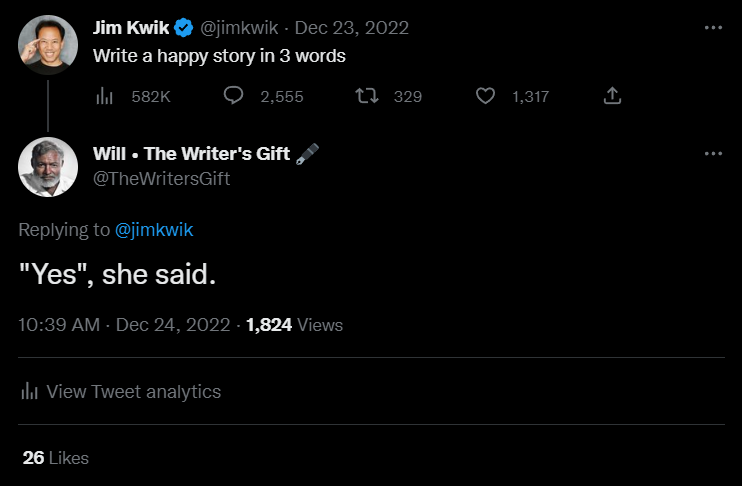
@jimkwik Just reading these words, you know the situation I'm inferring immediately.
I didn't have to describe the scenario around me or what the people were wearing.
It's not important.
I didn't have to describe the scenario around me or what the people were wearing.
It's not important.
@jimkwik So, how can you start to use the Iceberg Theory?
A couple of pointers:
A couple of pointers:
@jimkwik 1) Understand your story inside out
By understanding the narrative you're trying to convey, you don't need to waste time defining details.
You will know exactly what the reader wants to hear.
By understanding the narrative you're trying to convey, you don't need to waste time defining details.
You will know exactly what the reader wants to hear.
@jimkwik 2) Recognise universal details in life
Don't say how the police were waiting outside the dark, abandoned 1950s factory.
Talk about how the red and blue lights bounced off the rusted furnace.
Don't say how the police were waiting outside the dark, abandoned 1950s factory.
Talk about how the red and blue lights bounced off the rusted furnace.
@jimkwik 3) What they see vs what they don't
The audience sees:
- Plot
- Narrative
- Characters
- Dialogue
What they don't see:
- Thoughts
- Feelings
- Symbolism
- Subtext
Focus on the top 4 and infer the bottom 4 through these.
The audience sees:
- Plot
- Narrative
- Characters
- Dialogue
What they don't see:
- Thoughts
- Feelings
- Symbolism
- Subtext
Focus on the top 4 and infer the bottom 4 through these.
@jimkwik Understanding this theory takes practice.
But you'll become an infinitely better writer because of it.
I'm going to leave you with this quote from Ernest himself:
But you'll become an infinitely better writer because of it.
I'm going to leave you with this quote from Ernest himself:
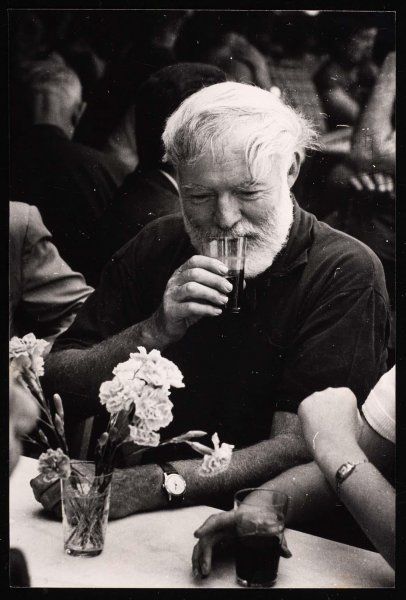
@jimkwik "If a writer of prose knows enough of what he is writing about he may omit things that he knows and the reader, if the writer is writing truly enough, will have a feeling of those things as strongly as though the writer had stated them."
@jimkwik Thanks for reading.
If you enjoyed this one, follow me @TheWritersGift
If you want to help the thread along, follow the link below to the first tweet and RT
Have a great day, gang.
If you enjoyed this one, follow me @TheWritersGift
If you want to help the thread along, follow the link below to the first tweet and RT
Have a great day, gang.
@jimkwik Struggling to write content that gets engagement? Not converting your readers into followers?
I've written a FREE 10-step guide to help you solve this exact problem.
Grab it here: thewritersgift.gumroad.com
I've written a FREE 10-step guide to help you solve this exact problem.
Grab it here: thewritersgift.gumroad.com
Loading suggestions...