

World War II was the last inter-imperialist war.
Those who believe we are currently seeing, or will soon see, a new inter-imperialist war are mistaken. If we ever do, it won't be soon.
A thread about decolonization, the USSR's errors, and the US-Japan conflict. 🧵
Those who believe we are currently seeing, or will soon see, a new inter-imperialist war are mistaken. If we ever do, it won't be soon.
A thread about decolonization, the USSR's errors, and the US-Japan conflict. 🧵
Before you can understand inter-imperialist conflict you need to know the difference between colonialism and neocolonialism from the imperialist's perspective.
The most crucial point: empires prefer neocolonies, because a neocolony is MORE PROFITABLE than a direct colony.
The most crucial point: empires prefer neocolonies, because a neocolony is MORE PROFITABLE than a direct colony.
In 1991, Professor Giovanni Arrighi modeled the economic performance of the Global South by measuring their gross national product per capita in proportion to the imperial core’s.
He found that after decolonization, the income gap was wider than EVER.
newleftreview.org
He found that after decolonization, the income gap was wider than EVER.
newleftreview.org

Due to length I didn't go into detail about colonialism vs neocolonialism in this earlier thread. I realize I should have explained why and how the western empires switched to neocolonialism. The answer isn't obvious.
(Again I apologize for the length of this thread. It will be a few dozen tweets.)
Nkrumah is essential here. He considered neocolonialism to be the worst form of imperialism:
marxists.org
Nkrumah is essential here. He considered neocolonialism to be the worst form of imperialism:
marxists.org
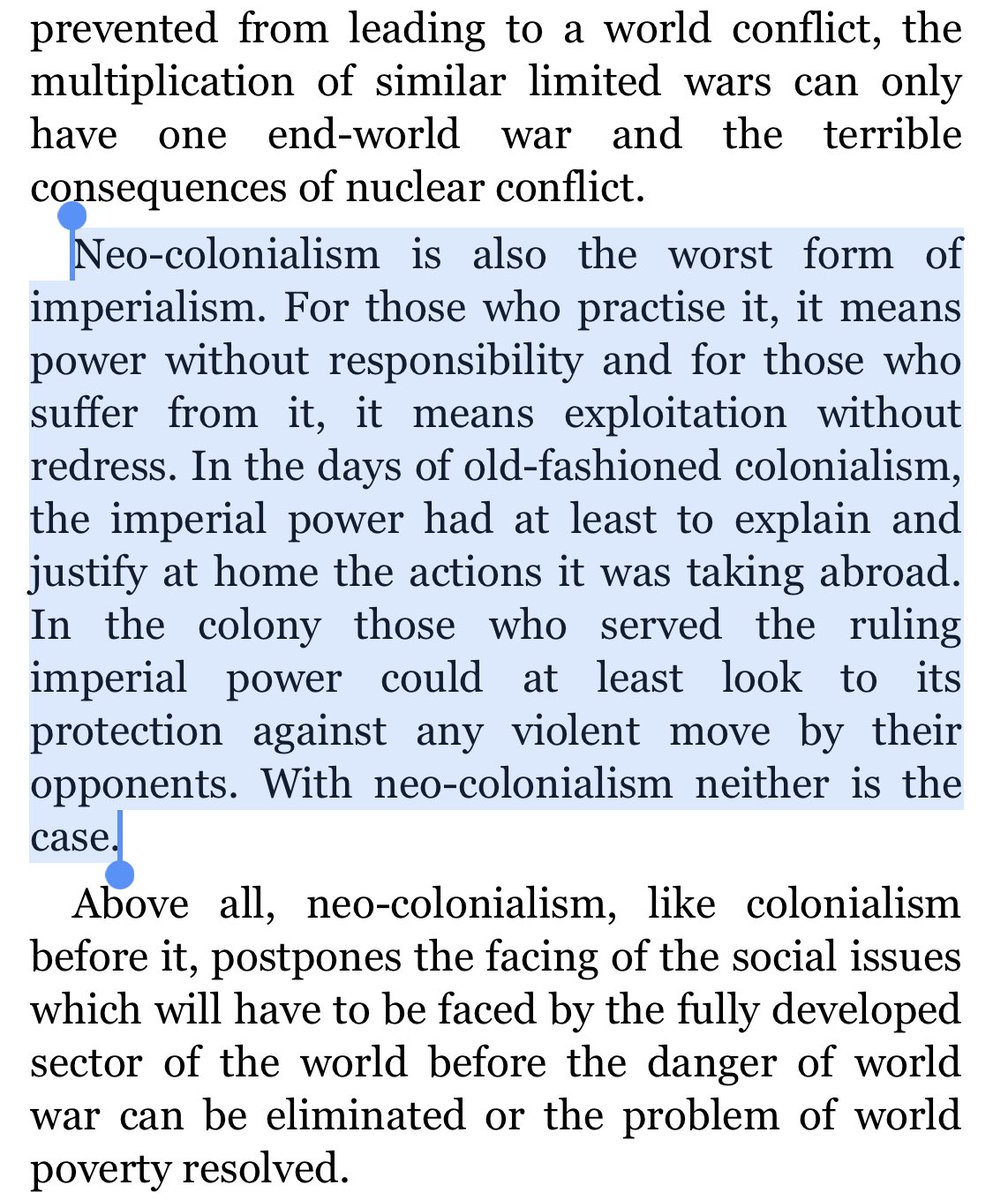
An empire can absorb all profit extracted from a direct colony. But a direct colony is also expensive. It needs a bureaucracy, and must constantly subdue insurrections. That costs money.
Even more importantly, the colonial power must defend its colony from rivals.
Even more importantly, the colonial power must defend its colony from rivals.
If you're a capitalist, you're always looking for ways to lower expenditures and increase income. If it turns out to be cheaper to turn your colony into a neocolony, you'll do it.
The trouble is, if you do, another empire can easily take it over.
The trouble is, if you do, another empire can easily take it over.
The capitalist class therefore faces a kind of prisoner's dilemma. If they all cooperate, they can SHARE a neocolony. The total size of the pie increases...but you only get a slice. Only if neocolonialism were UNIVERSAL is that slice bigger than what you'd otherwise get.
The Soviet Union's rise finally solved this conundrum. It was a competing social and economic order, and it promised to help oppressed peoples of the world throw off the shackles of colonialism.
This was an existential crisis for the capitalist class. So they HAD to cooperate.
This was an existential crisis for the capitalist class. So they HAD to cooperate.
In 1916, Lenin believed that inter-imperialist alliances could only be temporary. The trouble is, this take didn't factor in his OWN success in later creating the USSR!
After World War II, the USSR became a superpower, stronger than ever before.
Suddenly, the western empires found that it was becoming as hard to maintain direct colonies during the Cold War as it was to maintain neocolonies before it.
Suddenly, the western empires found that it was becoming as hard to maintain direct colonies during the Cold War as it was to maintain neocolonies before it.
Portugal was probably the biggest holdout to decolonization, so its stubbornness is a case study. It tried to maintain its direct colonies as long as it possibly could.
Here's a map of the Portugeuse empire in 1950:
Here's a map of the Portugeuse empire in 1950:
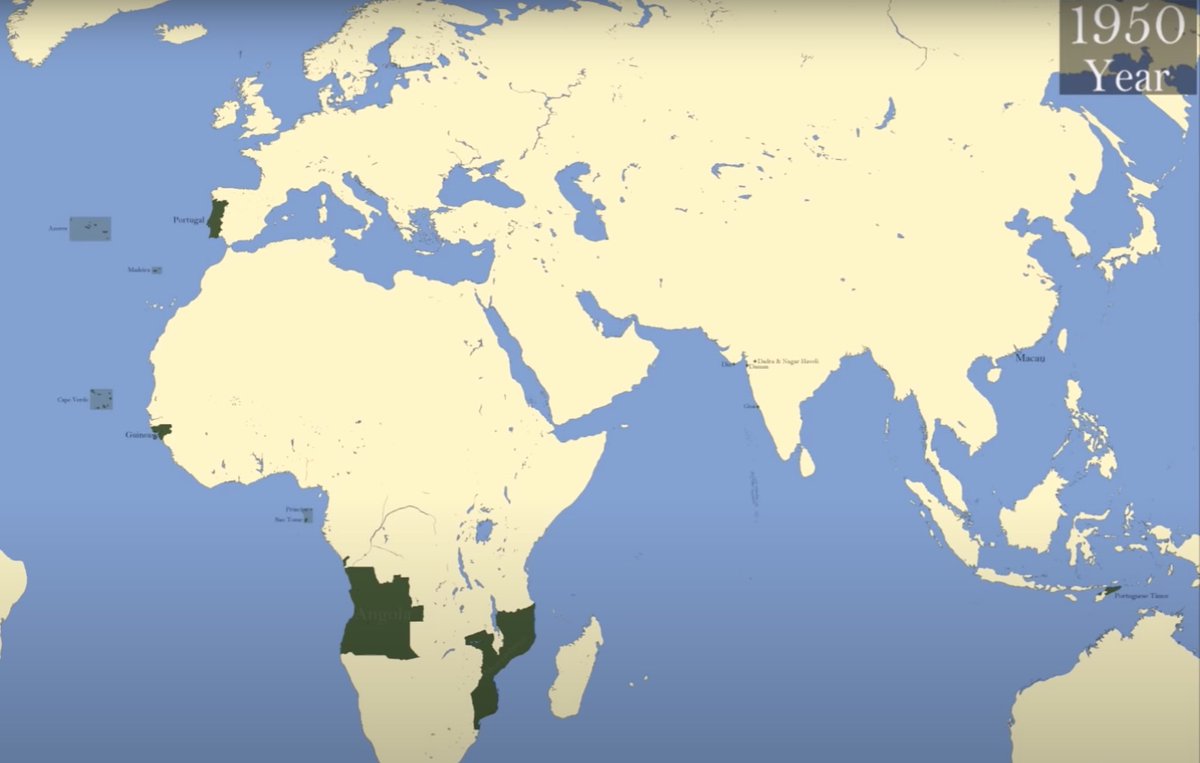
In 1961, India seized Goa. The Soviet Union supported insurrections in Angola and Mozambique, which became Marxist-Leninist states. In 1974 there was a revolution in Portugal itself. Its capitalist class lost every single colony, for good.
The Soviet Union had always benefited from inter-imperialist war. World War I led to its existence; World War II led to a vast expansion of its influence. Between them, it played defense, making huge sacrifices to avoid becoming a target.
If inter-imperialist war was INEVITABLE, why not simply wait until the next one?
And so the Soviet Union adopted the strategy of "peaceful coexistence". It fought against the western empires only by proxy (and too timidly even then, in many cases), in Angola, Vietnam, &c.
And so the Soviet Union adopted the strategy of "peaceful coexistence". It fought against the western empires only by proxy (and too timidly even then, in many cases), in Angola, Vietnam, &c.
This proved to be a long wait. The inter-imperialist alliance outlived the Soviet Union.
After it fell, western empires didn't reclaim their colonies. The new imperialism continued to cooperate to exploit the world through neocolonialism, because this yielded the most profit.
After it fell, western empires didn't reclaim their colonies. The new imperialism continued to cooperate to exploit the world through neocolonialism, because this yielded the most profit.
The PRC seemed to make the same error. Even as the USSR dissolved, it saw the US-Japan rivalry to be all-important. Wang Huning, now a senior Politburo member, wrote in 1991 that "Japan's aggressive katana has been pointed directly at the United States."
archive.org
archive.org
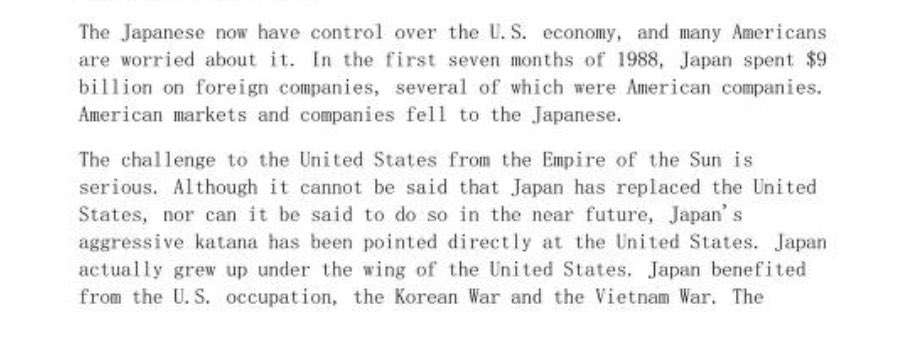
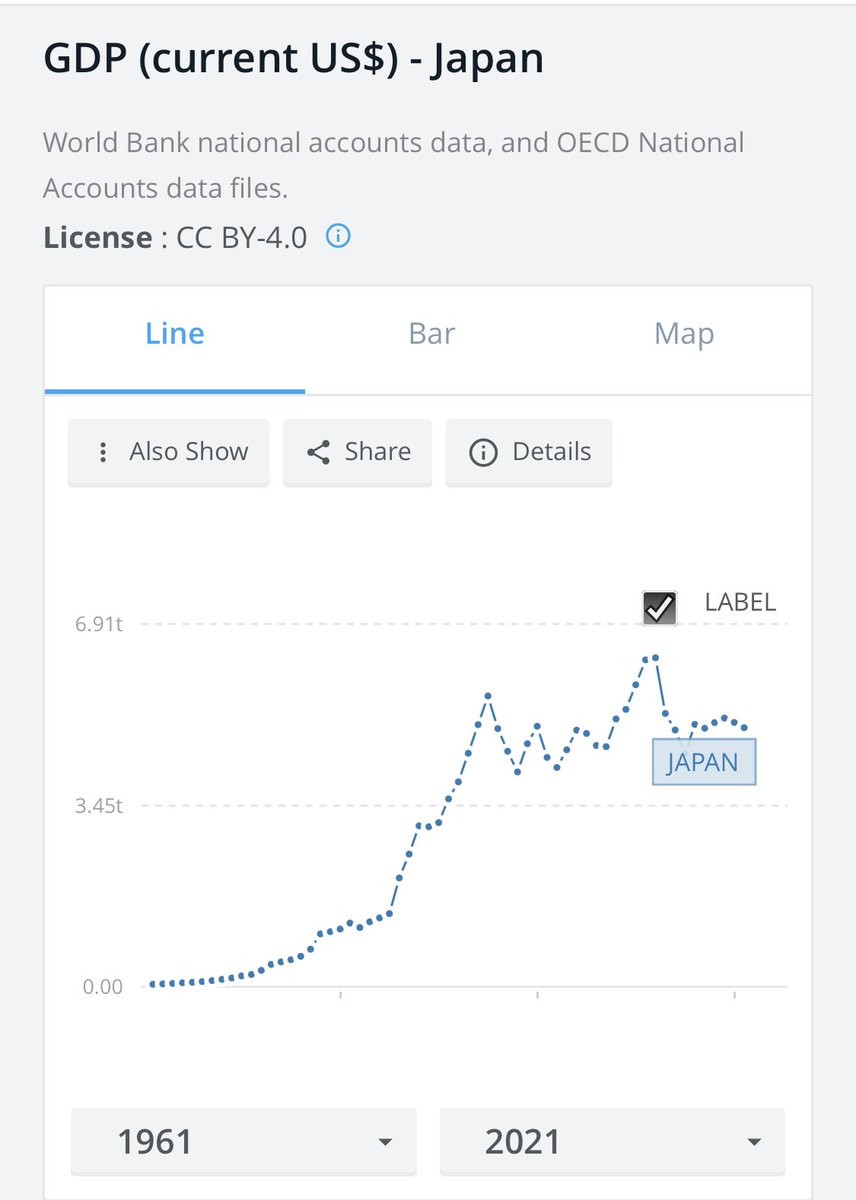
But within a year, the Japanese stock market crashed. In the mid-90s, Japan's GDP growth plummeted. It’s stagnant to this day, limping along at under 3% per year. What some called the "Lost Decade" is now called the "Lost 30 Years". What happened?
data.worldbank.org
data.worldbank.org
Economists generally consider the Plaza Accord of 1985—in which the second-tier empires (Japan, Germany, France, and the UK), agreed to appreciate their currencies against the dollar—to be a strong contributing factor in Japan’s asset price bubble.
The Accord was ostensibly designed to balance trade by protecting domestic US manufacturing, which was being undersold by cheap Japanese goods; as the Japanese yen strengthened, these goods became more expensive, allowing US industry to compete.
In the first quarter of 1986, Japanese companies began losing ground in the US market, threatening to send Japan into recession; to prevent it, the Bank of Japan increased lending by cutting short-term interest rates, leading to severe inflation of real estate prices.
Germany appreciated the deutschmark at the same time, and did not experience such a disastrous bubble. Another, unique provision of the Accord targeted Japanese real estate, obliging its government to increase private investment in mortgage credit markets.
g8.utoronto.ca
g8.utoronto.ca
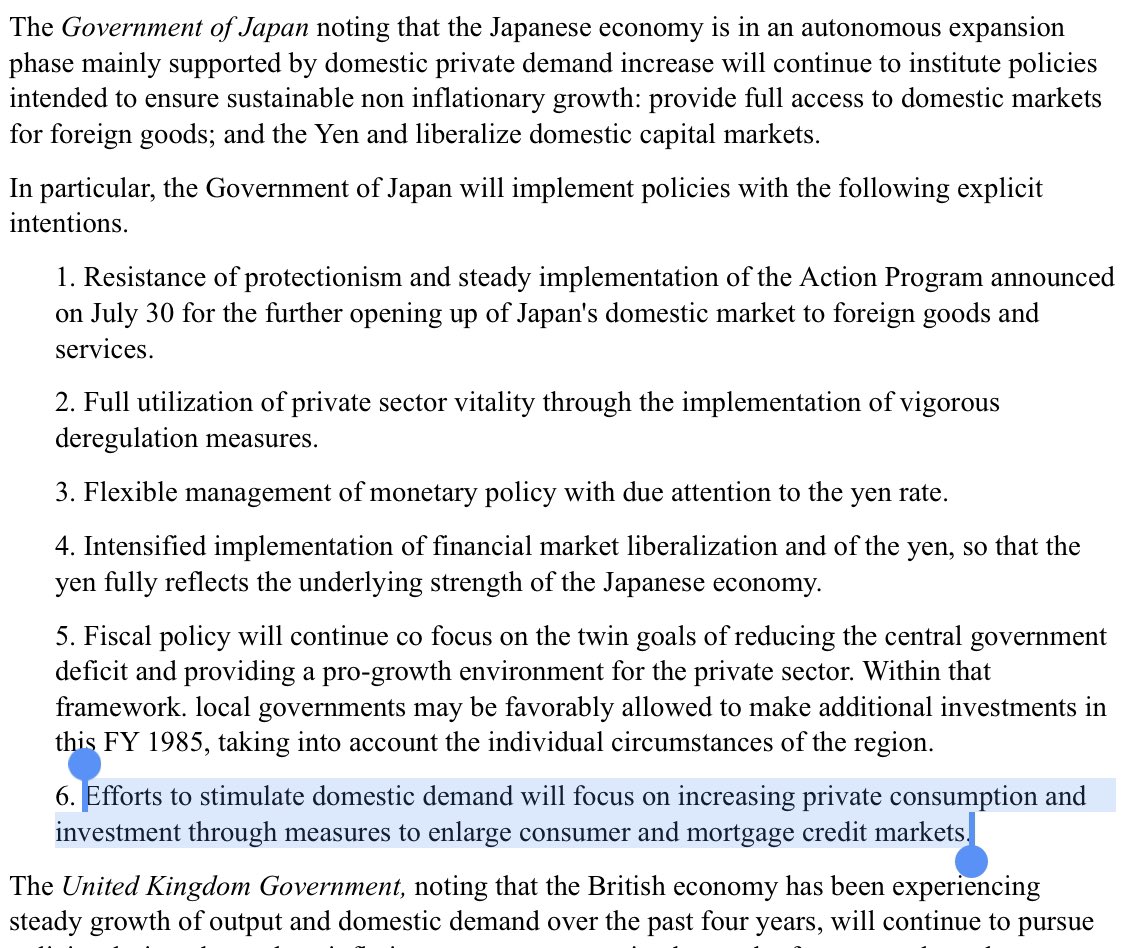
During the US-Japan trade war, Japanese companies found the deck stacked against them. “With increasing regularity,” said the NYTimes in 1992, “American companies are demanding, and winning, large royalty payments from Japanese companies for the use of patented technology.”
Hundreds of millions of dollars in profit, accumulated over years from the blood and sweat of wage-labor exploitation via the infamously harsh Japanese work ethic, were wiped out in instants as US courts sided with US capitalists almost every time.
In April, Sega was shaken down for $33 million by an LA jury; later two Japanese camera companies were made to pay Honeywell nearly $200 million. According to the BOJ, domestic corporations paid over $3 billion more in royalties than they received in 1991.
nytimes.com
nytimes.com
US arrogance regarding Japan reached new heights. In 1994, the NYTimes revealed that the CIA and State Dept had paid millions to the right-wing Liberal Democratic Party during the Cold War, financing half a century of LDP control of Japanese politics.
nytimes.com
nytimes.com
The LDP's monopoly on power was briefly broken by the Democratic Party of Japan in 2009. The new Prime Minister, Yukio Hatoyama, pledged to close just one US Marine Corps airbase in Okinawa.
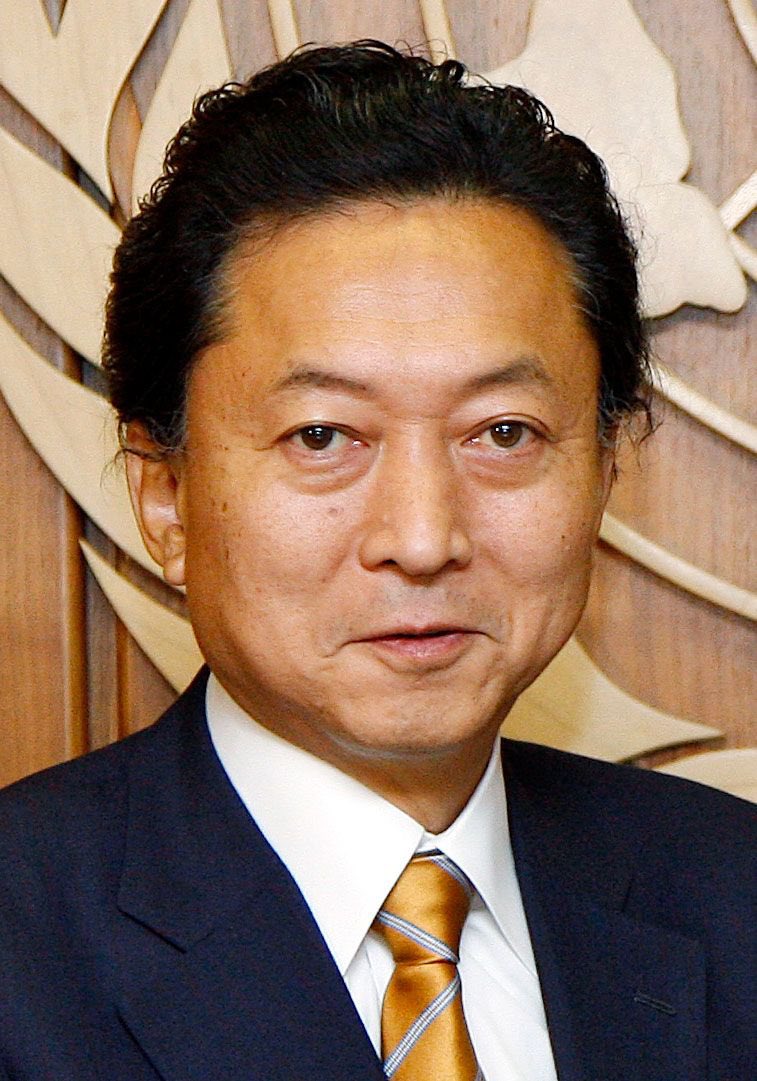
That base is still open. President Obama refused to even meet with Hatoyama to negotiate. He was forced, over the phone, to back down. After under a year in office, he resigned in disgrace. The LDP won the next election in a landslide. DPJ ceased to exist.
reuters.com
reuters.com
Japan still hosts over 50,000 US troops, an occupation the Japanese govt pays for, to the tune of $1 billion a year. The great “inter-imperialist conflict” of the post-WW2 era resembled nothing so much as the United States pointing a gun at an unarmed man.
asia.nikkei.com
asia.nikkei.com
I've seen the idea floating around that the Russia-Ukraine conflict is an inter-imperialist war. I can't agree.
First of all, even if Russia were an empire, Ukraine certainly isn't, so the Russian intervention in Ukraine is still a proxy war, not an inter-imperialist one.
First of all, even if Russia were an empire, Ukraine certainly isn't, so the Russian intervention in Ukraine is still a proxy war, not an inter-imperialist one.
Second, I don't see how anyone can claim that Russia is an empire with a straight face.
I don't care if you agree with Lenin's definition of imperialism or not. Empires at ANY stage of history exploit. They TAKE. They don't just make war, they PROFIT from war.
Russia...hasn't.
I don't care if you agree with Lenin's definition of imperialism or not. Empires at ANY stage of history exploit. They TAKE. They don't just make war, they PROFIT from war.
Russia...hasn't.
The Russian Federation has expanded by 50,000 square miles...or less than 0.008% of its land area. Meanwhile its GDP shrank, its manufacturing declined, and the Russian ruling class hemorrhaged wealth.
forbes.com
forbes.com
Out of Russia's latest and greatest military SUCCESS, in Syria, has come...nothing.
The natural resources of Syria are still under the control of the United States, not Russia.
middleeastmonitor.com
The natural resources of Syria are still under the control of the United States, not Russia.
middleeastmonitor.com
Russia can barely even profit from its closest NEIGHBOR. Kazakhstan has the world's second-longest border with Russia; yet Chevron and ExxonMobil have 75% ownership of its largest oil field.
LukArco owns...5%.
Not much of an empire.
jpt.spe.org
LukArco owns...5%.
Not much of an empire.
jpt.spe.org
Today, Germany's position is somewhat similar to Japan's. Chancellor Scholz became the first G7 leader to visit China since the pandemic, and wrote an op-ed saying they didn't want to “decouple”.
He even used the phrase “multipolar world”!
politico.eu
He even used the phrase “multipolar world”!
politico.eu
Right now, the energy crisis and US protectionist policies are working to deindustrialize Germany. German multinational BASF, the world's largest producer of chemicals, announced it would permanently shrink European operations.
economist.com
economist.com
That's not in Germany's interest. But they can’t do a thing about it besides write op-eds. 40,000 US troops are in Germany, out of 100,000 in Europe total, nearly half of them deployed in 2022.
The knife at Europe's throat has not been sharper since 1991.
cnn.com
The knife at Europe's throat has not been sharper since 1991.
cnn.com
In 2017, a report published by the US Army War College advised a “wider and more flexible military force” that would allow “US decision-makers” to influence other countries through “the implied promise of unacceptable consequences”.
web.archive.org
web.archive.org
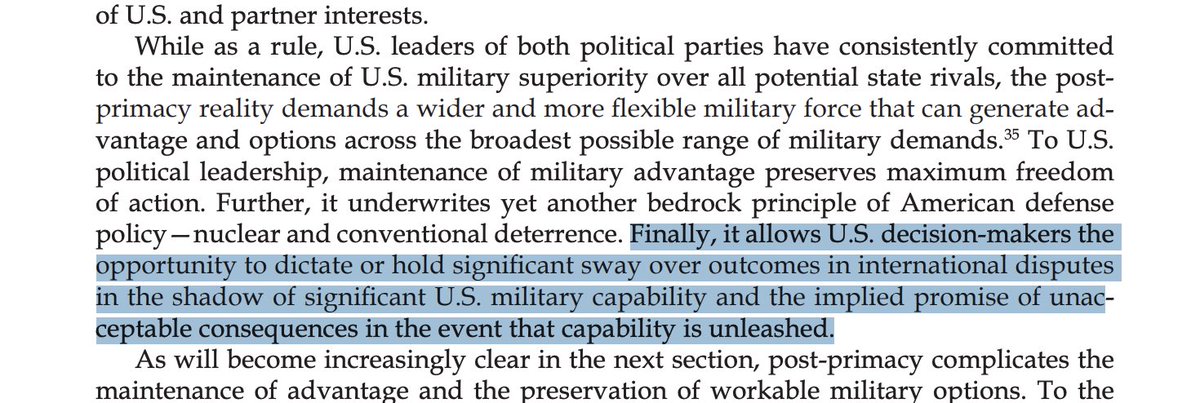
The inter-imperialist alliance is not one of equal partners. The United States is its unchallengeable leader, and holds ultimate sway over its subordinates. Whether it will ever fracture in the future is impossible to predict, but today it shows no signs of doing so.
Thanks to @RihitoPhysicist for advising me re: Japanese politics. Any mistakes are my own.
Some further notes.
If you think Russia’s an empire, the burden of proof is on YOU. You must show at LEAST that it exploits other countries. It must GAIN, in some significant way. Intent doesn’t matter; a wannabe empire is not an empire. It’s a wannabe.
If you think Russia’s an empire, the burden of proof is on YOU. You must show at LEAST that it exploits other countries. It must GAIN, in some significant way. Intent doesn’t matter; a wannabe empire is not an empire. It’s a wannabe.
That is a necessary but insufficient condition, but it’s the lowest possible bar since it is common to all definitions of imperialism that I know of. Imperialism doesn’t just mean “anything that’s bad”.
Several critics are starting from the assumption that Russia is an empire, which is a logical error. That’s what’s in question. It’s not a given. Using the assumption that Russia is an empire to prove that Russia is an empire is question-begging.
A few people commented that WW2 was not actually an inter-imperialist war since it was mostly fought by the USSR.
I think that’s a fair point, but obviously it did encompass smaller inter-imperialist wars.
I think that’s a fair point, but obviously it did encompass smaller inter-imperialist wars.
Regarding the Plaza Accord, if you’ve an interest, check out this longer and much more detailed thread:
A brief addendum.
Loading suggestions...