

1/N
This is a thread on how ancient Hindu & Jain Indian mathematicians approached the study of mensurations of quadrilaterals & cyclic quadrilaterals.
This is a thread on how ancient Hindu & Jain Indian mathematicians approached the study of mensurations of quadrilaterals & cyclic quadrilaterals.
2/N
Specifically we are going to trace the events surrounding quadrilateral, cyclic quadrilateral & its diagonals analyzed by Indian mathematicians as recorded in texts such as Śulbasūtras, Brāhmasphuṭasiddhānta, Gaṇitasārasaṅgraha, Līlāvatī etc.
Specifically we are going to trace the events surrounding quadrilateral, cyclic quadrilateral & its diagonals analyzed by Indian mathematicians as recorded in texts such as Śulbasūtras, Brāhmasphuṭasiddhānta, Gaṇitasārasaṅgraha, Līlāvatī etc.
3/N
A cyclic quadrilateral is a quadrilateral that can be inscribed in a circle. Four points A, B, C, and D are called concylic if they all lie on the same circle
A cyclic quadrilateral is a quadrilateral that can be inscribed in a circle. Four points A, B, C, and D are called concylic if they all lie on the same circle

4/N
An examination of the earliest known geometry in India, Vedic geometry, involves a study of the Śulbasūtras, conservatively dated as recorded no later than 800 BCE, though they certainly contain knowledge from earlier times.
An examination of the earliest known geometry in India, Vedic geometry, involves a study of the Śulbasūtras, conservatively dated as recorded no later than 800 BCE, though they certainly contain knowledge from earlier times.
5/N
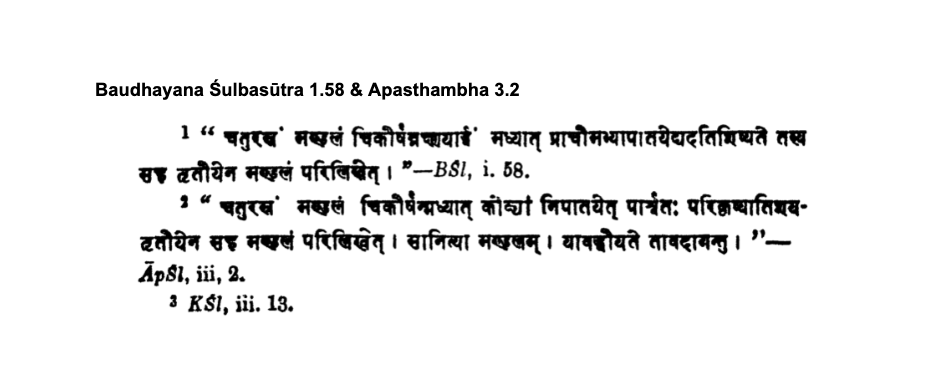
The first indirect reference to a cyclic square is mentioned in Baudhayana Śulbasūtra 1.58 in the context of transforming a square or finding a circle area is approximately close to that of a given square
The first indirect reference to a cyclic square is mentioned in Baudhayana Śulbasūtra 1.58 in the context of transforming a square or finding a circle area is approximately close to that of a given square
6/N
The same method is also provided by Apasthambha (3. 2) and Katyayana Śulbasūtra (3.13). The sutras are attached in the image
The same method is also provided by Apasthambha (3. 2) and Katyayana Śulbasūtra (3.13). The sutras are attached in the image
7/N
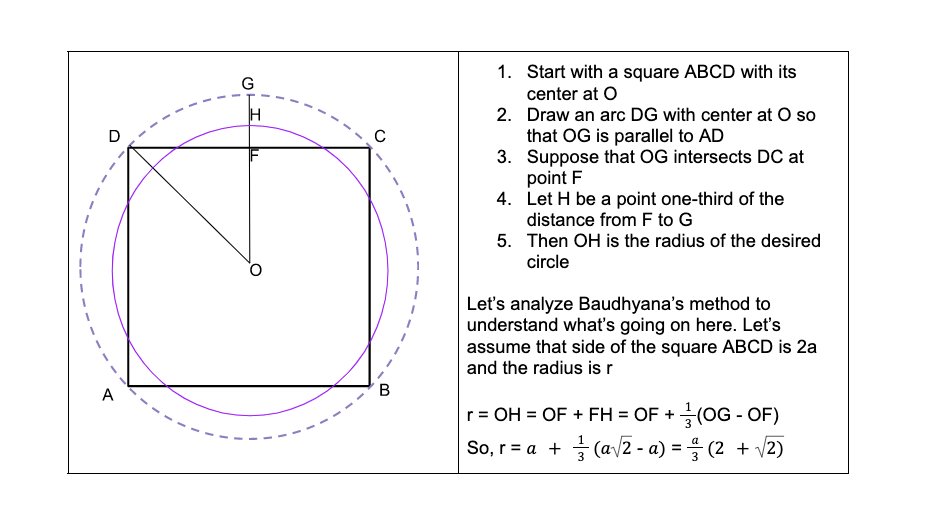
Baudhayana Śulbasūtra 1.58 prescribes a recipe on how to geometrically transform a square to a circle with approximate equal area. In the process, an intermediate reference to a cyclic square comes up. The details are given with modern notation below
Baudhayana Śulbasūtra 1.58 prescribes a recipe on how to geometrically transform a square to a circle with approximate equal area. In the process, an intermediate reference to a cyclic square comes up. The details are given with modern notation below
8/N
Brahmagupta, a genius Indian Hindu astronomer & mathematician authored two treatises in Sanskrit, Brāhmasphuṭasiddhānta & Khaṇḍakhdyaka no later than 620 AD. Brāhmasphuṭasiddhānta was translated into Arabic about 770 AD & had a major impact on Islamic mathematics.
Brahmagupta, a genius Indian Hindu astronomer & mathematician authored two treatises in Sanskrit, Brāhmasphuṭasiddhānta & Khaṇḍakhdyaka no later than 620 AD. Brāhmasphuṭasiddhānta was translated into Arabic about 770 AD & had a major impact on Islamic mathematics.
9/N
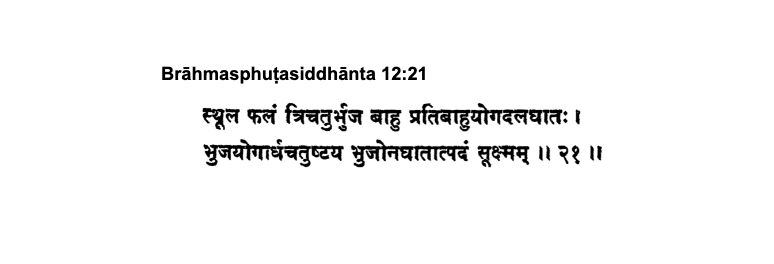
In Brāhmasphuṭasiddhānta 12.21, Brahmagupta provides a formula for area of a cyclic quadrilateral
In Brāhmasphuṭasiddhānta 12.21, Brahmagupta provides a formula for area of a cyclic quadrilateral
10/N
Brāhmasphuṭasiddhānta, 12.21
The gross area of a cyclic quadrilateral is the product of half the sums of the opposite sides; the exact area is the square root of the product of four sets of half the sum of the sides respectively diminished by sides.
Brāhmasphuṭasiddhānta, 12.21
The gross area of a cyclic quadrilateral is the product of half the sums of the opposite sides; the exact area is the square root of the product of four sets of half the sum of the sides respectively diminished by sides.
11/N
Brāhmasphuṭasiddhānta Sutra 12.21 says the area A of a cyclic quadrilateral with sides a, b, c and d, whereas S is half of the perimeter of the cyclic quadrilateral is given as shown below
A =Square Root of [ (S-a)(S-b)(S-c)(S-d) ]
Brāhmasphuṭasiddhānta Sutra 12.21 says the area A of a cyclic quadrilateral with sides a, b, c and d, whereas S is half of the perimeter of the cyclic quadrilateral is given as shown below
A =Square Root of [ (S-a)(S-b)(S-c)(S-d) ]
12/N
Some modern scholars have erroneously interpreted त्रिचतुर्भुज (trichaturbhuja) in the above sutra as referring to the sutra being applicable to triangles and quadrilaterals (independently).
Some modern scholars have erroneously interpreted त्रिचतुर्भुज (trichaturbhuja) in the above sutra as referring to the sutra being applicable to triangles and quadrilaterals (independently).
13/N
The term त्रिचतुर्भुज was used by Brahmagupta to refer to a cyclic quadrilateral (and not triangle and/or quadrilateral by itself).
The term त्रिचतुर्भुज was used by Brahmagupta to refer to a cyclic quadrilateral (and not triangle and/or quadrilateral by itself).
14/N
Other than Sutra 12.21, the only other place where the term त्रिचतुर्भुज occurs in Brāhmasphuṭasiddhānta, is in sutra 12.27. There the result involved is stated first for a triangle, separately, and then for a त्रिचतुर्भुज.
Other than Sutra 12.21, the only other place where the term त्रिचतुर्भुज occurs in Brāhmasphuṭasiddhānta, is in sutra 12.27. There the result involved is stated first for a triangle, separately, and then for a त्रिचतुर्भुज.
15/N
This clearly indicates that the term त्रिचतुर्भुज is used independently to refer to a cyclic quadrilateral by Brahmagupta in Brāhmasphuṭasiddhānta
This clearly indicates that the term त्रिचतुर्भुज is used independently to refer to a cyclic quadrilateral by Brahmagupta in Brāhmasphuṭasiddhānta
16/N
Brahmagupta while pursuing his study of triangles dealt with the circumcircle, described in particular a formula for the circum-radius, and considered quadrilaterals formed by the triangle and a point on the circumcircle, which motivated the term त्रिचतुर्भुज.
Brahmagupta while pursuing his study of triangles dealt with the circumcircle, described in particular a formula for the circum-radius, and considered quadrilaterals formed by the triangle and a point on the circumcircle, which motivated the term त्रिचतुर्भुज.
17/N
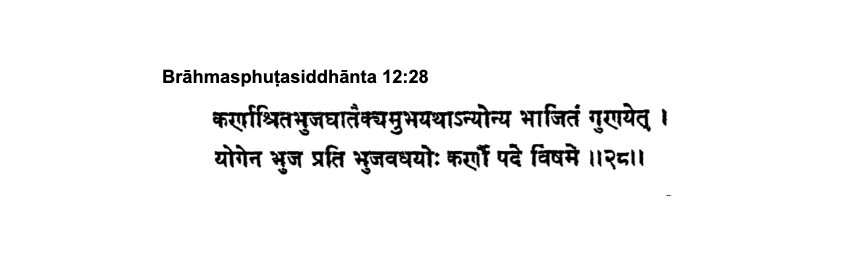
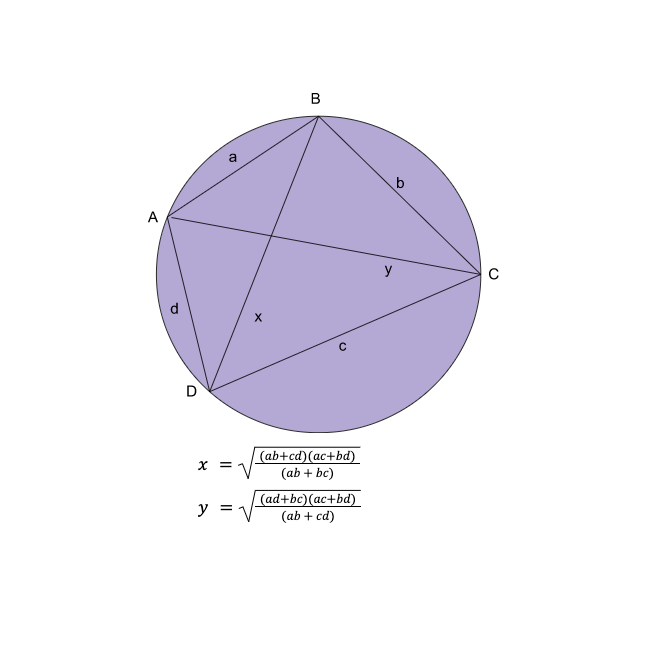
Brahmagupta also provides the mechanism to find out the diagonals of a cyclic quadrilateral in Brāhmasphuṭasiddhānta 12.28
Brahmagupta also provides the mechanism to find out the diagonals of a cyclic quadrilateral in Brāhmasphuṭasiddhānta 12.28
18/N
Brāhmasphuṭasiddhānta 12.28
The sums of the products of the sides about both the diagonals should be divided by each other and multiplied by the sum of the products of the opposite sides. The square roots of the quotients are the diagonals in visama quadrilateral.
Brāhmasphuṭasiddhānta 12.28
The sums of the products of the sides about both the diagonals should be divided by each other and multiplied by the sum of the products of the opposite sides. The square roots of the quotients are the diagonals in visama quadrilateral.
19/N
In contemporary notations, we can describe Brāhmasphuṭasiddhānta: 12.28 as shown below
In contemporary notations, we can describe Brāhmasphuṭasiddhānta: 12.28 as shown below
20/N
A 3rd significant contribution by Brahmagupta for cyclic quadrilateral is a method on how to get a rational cyclic quadrilateral, which is to multiply the sides of two rational right triangles by each other's hypotenuse & use them as the sides of the quadrilateral.
A 3rd significant contribution by Brahmagupta for cyclic quadrilateral is a method on how to get a rational cyclic quadrilateral, which is to multiply the sides of two rational right triangles by each other's hypotenuse & use them as the sides of the quadrilateral.
21/N
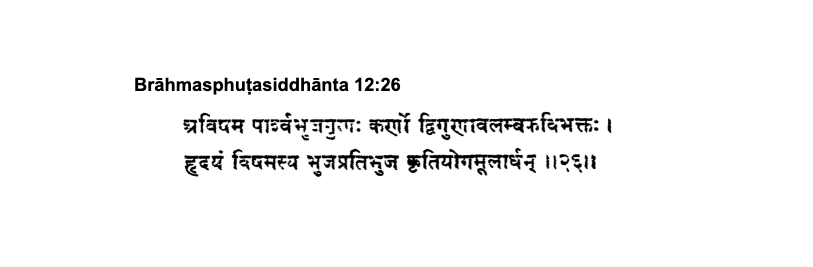
Brāhmasphuṭasiddhānta 12:26
The circum-radius of a visama quadrilateral is half the square root of the sum of the squares of opposite sides
Brāhmasphuṭasiddhānta 12:26
The circum-radius of a visama quadrilateral is half the square root of the sum of the squares of opposite sides
22/N
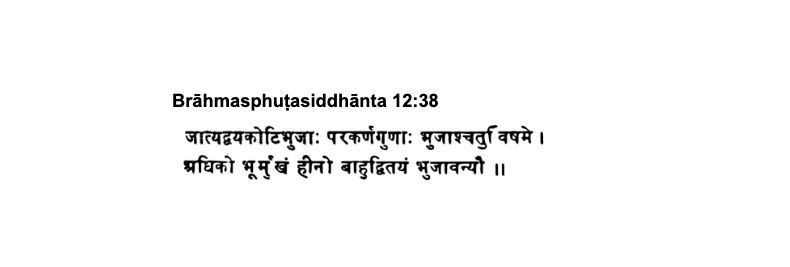
Brahmgupta gives specific direction for forming the rational quadrilateral in Brāhmasphuṭasiddhānta 12.38
Brahmgupta gives specific direction for forming the rational quadrilateral in Brāhmasphuṭasiddhānta 12.38
23/N
“The kotis and bhujas of two jatyas multiplied by each other's hypotenuse are the four sides in a visama quadrilateral. The longest is the base, the least the face and the remaining two sides the flanks”
“The kotis and bhujas of two jatyas multiplied by each other's hypotenuse are the four sides in a visama quadrilateral. The longest is the base, the least the face and the remaining two sides the flanks”
24/N
In the post-Brahmagupta period, there has been a rich legacy of analysis for geometrical mensurations of cyclic quadrilateral by the Indian mathematicians.
In the post-Brahmagupta period, there has been a rich legacy of analysis for geometrical mensurations of cyclic quadrilateral by the Indian mathematicians.
25/N
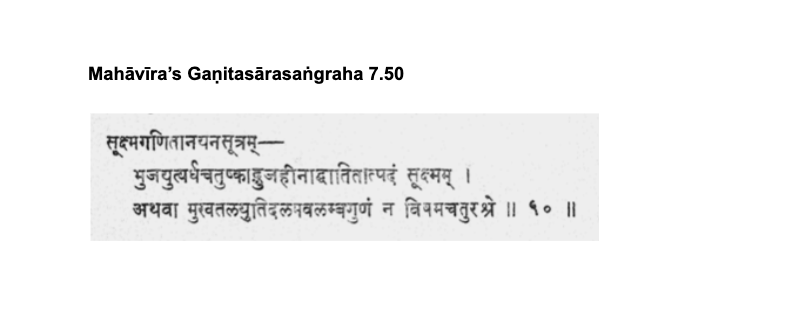
The brilliant Indian Jaina mathematician Mahāvīra (no later than 800 CE) also provides area of a cyclic quadrilateral in Gaṇitasārasaṅgraha 7.50 much along the line of what is mentioned in Brāhmasphuṭasiddhānta (continued..)
The brilliant Indian Jaina mathematician Mahāvīra (no later than 800 CE) also provides area of a cyclic quadrilateral in Gaṇitasārasaṅgraha 7.50 much along the line of what is mentioned in Brāhmasphuṭasiddhānta (continued..)
26/N
Gaṇitasārasaṅgraha 7.50
Four quantities represented (respectively) by half the sum of the sides as diminished by (each of) the sides (taken in order) are multiplied together and the square root (of the product so obtained) gives the minutely accurate measure
Gaṇitasārasaṅgraha 7.50
Four quantities represented (respectively) by half the sum of the sides as diminished by (each of) the sides (taken in order) are multiplied together and the square root (of the product so obtained) gives the minutely accurate measure
27/N
The second half of the above mentioned verse is the usual formula for the area of a trapezium, as the product of the perpendicular height with half the sum of the base and the opposite side, mentioning also a caveat that it does not hold for a viṣamacaturasra
The second half of the above mentioned verse is the usual formula for the area of a trapezium, as the product of the perpendicular height with half the sum of the base and the opposite side, mentioning also a caveat that it does not hold for a viṣamacaturasra
28/N
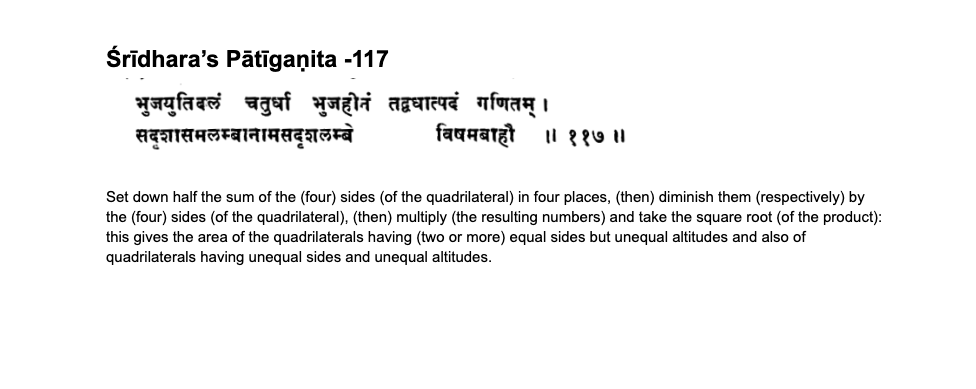
In his seminal book Pātīgaṇita, the Hindu mathematician Śrīdhara (no later than 870 CE) also gives a formula for area of a quadrilateral which is very similar to what was mentioned in Brahmagupta’s Brāhmasphuṭasiddhānta
In his seminal book Pātīgaṇita, the Hindu mathematician Śrīdhara (no later than 870 CE) also gives a formula for area of a quadrilateral which is very similar to what was mentioned in Brahmagupta’s Brāhmasphuṭasiddhānta
29/N
Thus Śrīdhara seems to have given the formula for the area of any general quadrilateral. He did not specifically mention the applicability for a cyclic quadrilateral.
Thus Śrīdhara seems to have given the formula for the area of any general quadrilateral. He did not specifically mention the applicability for a cyclic quadrilateral.
30/N
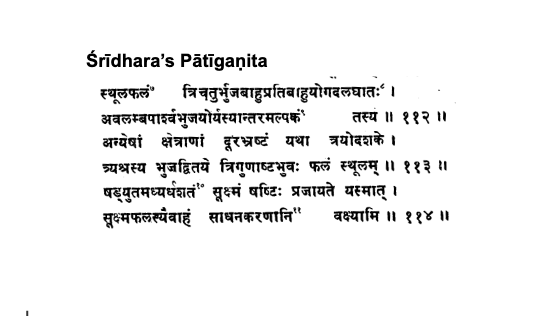
Śrīdhara makes an assumption that the above formula is for all general quadrilaterals and then proceeds to mildly criticize its accuracy.
Śrīdhara makes an assumption that the above formula is for all general quadrilaterals and then proceeds to mildly criticize its accuracy.
31/N
Śrīdhara says - “But this result is only true for those quadrilaterals where the difference between altitude and flank sides is small. In case these conditions are not met, the result would not be correct”
Śrīdhara says - “But this result is only true for those quadrilaterals where the difference between altitude and flank sides is small. In case these conditions are not met, the result would not be correct”
32/N
The genius Hindu mathematician Bhaskaracharya II also provides the same method for computing the area of a quadrilateral (no later than 1114 CE)
The genius Hindu mathematician Bhaskaracharya II also provides the same method for computing the area of a quadrilateral (no later than 1114 CE)
33/N
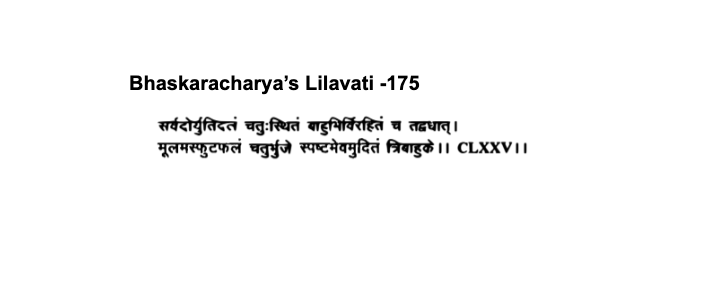
In his groundbreaking work "Lilavati", Bhaskara mentions in sutra 175: From half the sum of all the (four) sides subtract each side separately and take their product. Square-root of this product is an imprecise area of quadrilateral.
In his groundbreaking work "Lilavati", Bhaskara mentions in sutra 175: From half the sum of all the (four) sides subtract each side separately and take their product. Square-root of this product is an imprecise area of quadrilateral.
34/N
However Bhaskara also perhaps makes an assumption (erroneously) that this method was prescribed by Brahmagupta for a general purpose quadrilateral. He does not seem to specify that the original intent of Brahmagupta’s method was ONLY meant for a cyclic quadrilateral.
However Bhaskara also perhaps makes an assumption (erroneously) that this method was prescribed by Brahmagupta for a general purpose quadrilateral. He does not seem to specify that the original intent of Brahmagupta’s method was ONLY meant for a cyclic quadrilateral.
35/N
Bhaskara then goes on to criticize Brahmagupta’s (correct) method which was meant for cyclic quadrilaterals based on the assumption that the method was meant for all types of quadrilaterals.
Bhaskara then goes on to criticize Brahmagupta’s (correct) method which was meant for cyclic quadrilaterals based on the assumption that the method was meant for all types of quadrilaterals.
36/N
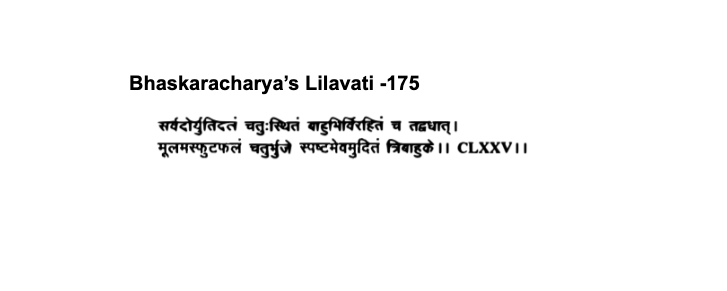
Lilavati 177: Formula for the area of a quadrilateral is not accurate. This is so because the lengths of its diagonals are indeterminate. So how can we get an accurate value? Ancient mathematicians had fixed some values for the diagonals but they are not valid in all cases
Lilavati 177: Formula for the area of a quadrilateral is not accurate. This is so because the lengths of its diagonals are indeterminate. So how can we get an accurate value? Ancient mathematicians had fixed some values for the diagonals but they are not valid in all cases
37/N
However cyclic quadrilaterals make a comeback in Indian mathematics once again in Narayana Pandita’s work in the 14th century.
However cyclic quadrilaterals make a comeback in Indian mathematics once again in Narayana Pandita’s work in the 14th century.
38/N
Narayana Pandita was born in Uttar Pradesh, India about 1340 and known for three important texts on mathematics: Ganita Kaumudi. Bijganita Vatamsa and Karma Pradipika.
Narayana Pandita was born in Uttar Pradesh, India about 1340 and known for three important texts on mathematics: Ganita Kaumudi. Bijganita Vatamsa and Karma Pradipika.
39/N
Narayana Pandita honors Brahmagupta’s original work by literally citing the same formula for computation of area for cyclic quadrilateral in his work Ganita Kaumudi.
Narayana Pandita honors Brahmagupta’s original work by literally citing the same formula for computation of area for cyclic quadrilateral in his work Ganita Kaumudi.
40/N
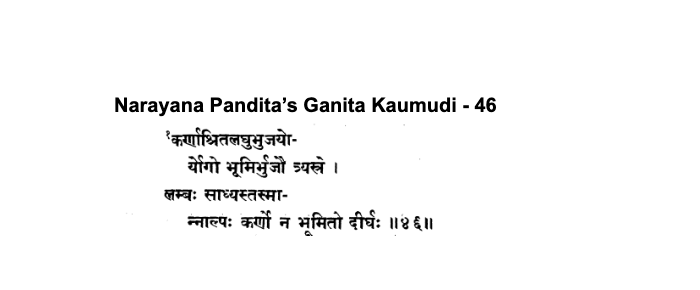
Ganita Kaumudi - 46: Divide the sum of the products of the sides about both the diagonals by each other. Multiply the quotients by the sum of the products of opposite sides. Square roots of the products are the diagonals in a quadrilateral.
Ganita Kaumudi - 46: Divide the sum of the products of the sides about both the diagonals by each other. Multiply the quotients by the sum of the products of opposite sides. Square roots of the products are the diagonals in a quadrilateral.
41/N
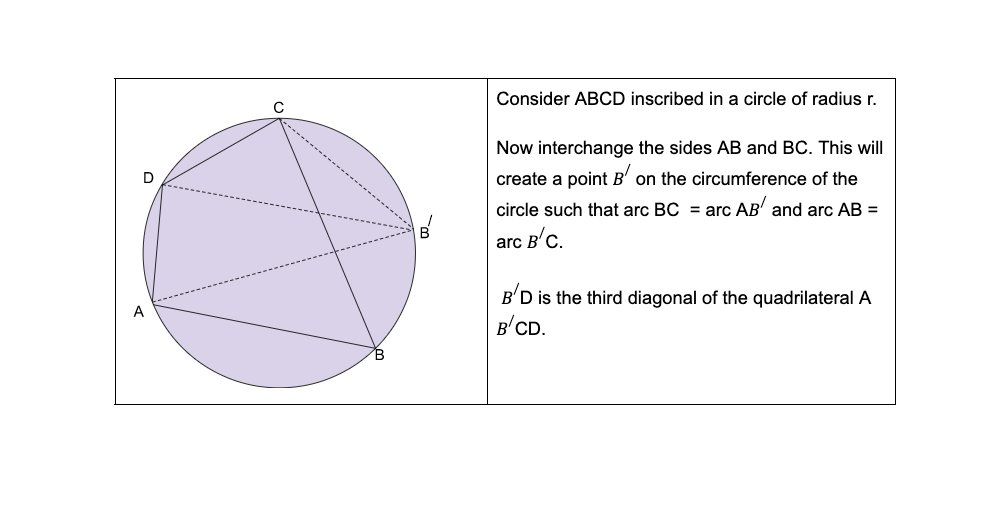
Ganita Kaumudi 48 can be described using modern notation as below
Ganita Kaumudi 48 can be described using modern notation as below
42/N
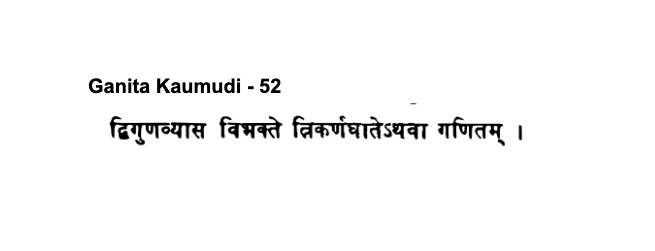
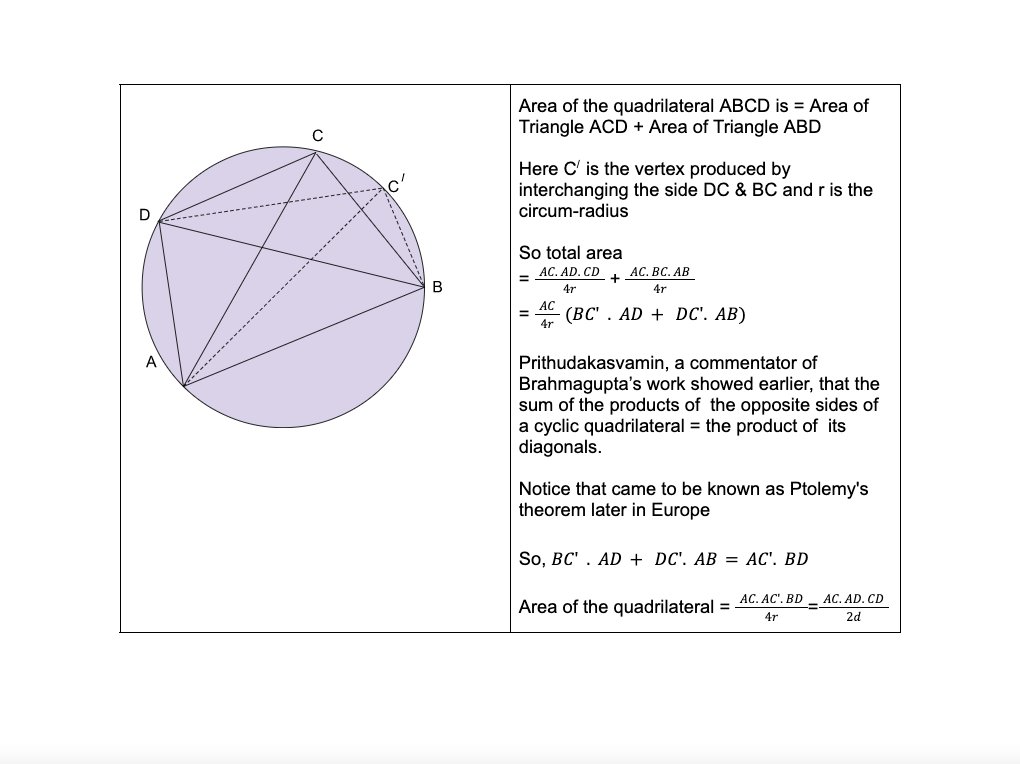
Narayana Pandita then provides another method for computing the area of a cyclic quadrilateral then in terms of these three diagonals. When the product of the three diagonals is divided by twice the circum-diameter, we get the area
Narayana Pandita then provides another method for computing the area of a cyclic quadrilateral then in terms of these three diagonals. When the product of the three diagonals is divided by twice the circum-diameter, we get the area
43/N
Ganita Kaumudi 52 is described using modern notation in the attached image below
Ganita Kaumudi 52 is described using modern notation in the attached image below
44/N
A proof of Brahmagupta’s method for finding area of cyclic quadrilateral is given by the Indian Hindu mathematician Jyeṣṭhadeva (c. 1500 – c. 1575), in his seminal work Yuktibhāṣā.
A proof of Brahmagupta’s method for finding area of cyclic quadrilateral is given by the Indian Hindu mathematician Jyeṣṭhadeva (c. 1500 – c. 1575), in his seminal work Yuktibhāṣā.
45/N
European scholars claim that Brahmagupta's method to find the area of a cyclic quadrilateral was “rediscovered” by Dutch Mathematician Willebrord Snellius in 1619 A.D.
European scholars claim that Brahmagupta's method to find the area of a cyclic quadrilateral was “rediscovered” by Dutch Mathematician Willebrord Snellius in 1619 A.D.
46/N
Snellius claimed it as his own invention. He wrote “we have a very elegant theorem of this kind' and then referred to it as “this new little theorem of mine'”
Snellius claimed it as his own invention. He wrote “we have a very elegant theorem of this kind' and then referred to it as “this new little theorem of mine'”
48/N
However any reference to a proof is absent in Snellius’s work, which makes it likely that Snellius did not have one.
However any reference to a proof is absent in Snellius’s work, which makes it likely that Snellius did not have one.
49/N
Was the method to compute area of a cyclic quadrilateral “rediscovered” by Willebrord Snellius or did he just steal the idea from Brahmagupta without proper attribution ? Let’s trace how Brahmagupta’s work reached Europe.
Was the method to compute area of a cyclic quadrilateral “rediscovered” by Willebrord Snellius or did he just steal the idea from Brahmagupta without proper attribution ? Let’s trace how Brahmagupta’s work reached Europe.
50/N
In about 770 AD, Muhammad ibn Ibrahim al-Fazari was a Muslim philosopher, mathematician. Along with Yaʿqūb ibn Ṭāriq he helped translate the Indian astronomical text by Brahmagupta, the Brāhmasphuṭasiddhānta, into Arabic as Az-Zīj ‛alā Sinī al-‛Arab. or the Sindhind.
In about 770 AD, Muhammad ibn Ibrahim al-Fazari was a Muslim philosopher, mathematician. Along with Yaʿqūb ibn Ṭāriq he helped translate the Indian astronomical text by Brahmagupta, the Brāhmasphuṭasiddhānta, into Arabic as Az-Zīj ‛alā Sinī al-‛Arab. or the Sindhind.
51/N
al-Fazari’s Arabic translation of the original Brāhmasphuṭasiddhānta was the vehicle by means of which the Hindu numerals & Hindu mathematics were transmitted from India to Islamic world (continued)
al-Fazari’s Arabic translation of the original Brāhmasphuṭasiddhānta was the vehicle by means of which the Hindu numerals & Hindu mathematics were transmitted from India to Islamic world (continued)
52/N
The famous Arabic scholar al-Khwarizm (780-850 AD) is known to have made use of this translation of Brāhmasphuṭasiddhānta.
The famous Arabic scholar al-Khwarizm (780-850 AD) is known to have made use of this translation of Brāhmasphuṭasiddhānta.
53/N
Around 825 CE, al-Khwarizmi wrote the manuscript, al-Jam’ wa al-Tafriq bi Hisab al-Hind,
translated as “The Book of Addition and Subtraction According to the Hindu Calculation”
Around 825 CE, al-Khwarizmi wrote the manuscript, al-Jam’ wa al-Tafriq bi Hisab al-Hind,
translated as “The Book of Addition and Subtraction According to the Hindu Calculation”
54/N
Latin translations of al-Jam’ wa al-Tafriq bi Hisab al-Hind known as Algorithmi De Numero Indorum was composed in Spain around the 11th century
Latin translations of al-Jam’ wa al-Tafriq bi Hisab al-Hind known as Algorithmi De Numero Indorum was composed in Spain around the 11th century
55/N
“Algorithmi De Numero Indorum” played a crucial role in introducing the Indian geometry, mathematics and the corresponding computational methods into Europe.
“Algorithmi De Numero Indorum” played a crucial role in introducing the Indian geometry, mathematics and the corresponding computational methods into Europe.
56/N
So it is very likely that Willebrord Snellius had access to Brahmagupta’s work via the Latin translation by the time he started working on the cyclic quadrilateral problem.
So it is very likely that Willebrord Snellius had access to Brahmagupta’s work via the Latin translation by the time he started working on the cyclic quadrilateral problem.
57/N
It took Europeans about 1000 years to even reproduce what ancient Indians discovered regarding mensuration of cyclic quadrilaterals.
It took Europeans about 1000 years to even reproduce what ancient Indians discovered regarding mensuration of cyclic quadrilaterals.
58/N
The brilliant discovery of mensurations of cyclic quadrilateral by the ancient Indian mathematicians has applications of various domains even today - including differential calculus, astronomy and computational geometry.
The brilliant discovery of mensurations of cyclic quadrilateral by the ancient Indian mathematicians has applications of various domains even today - including differential calculus, astronomy and computational geometry.
59/N
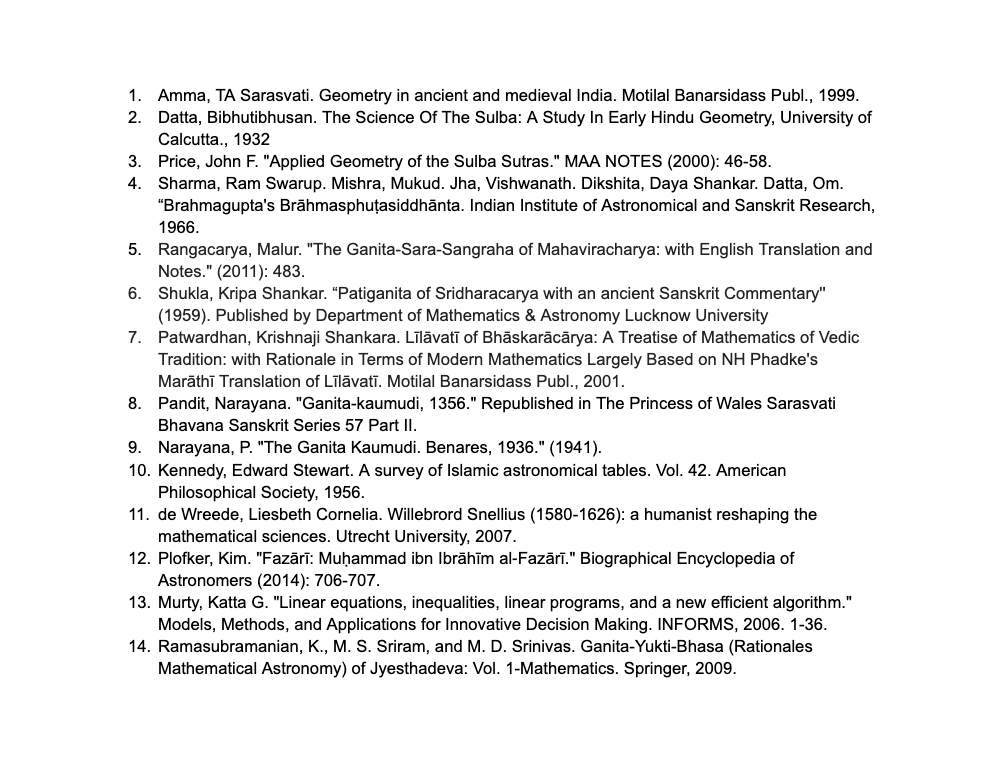
References
References
Loading suggestions...