

For decades, experts have been calling attn to risks to globalization. Econ integration is fragile, they argued, b/c politics could undo the transnat'l effort to make markets ever more efficient. They were right to focus on politics but largely missed the security angle. Why? A🧵
Globalization (as we knew it) is being reshaped. Intensifying great power competition between the US & China paired with war in Europe are driving this trend. Decoupling, friendshoring, nearshoring, export controls, sanctions. These are signs of the times. 3/
Go back a few yrs, & you'll find similar pieces warning about threats to globalization, e.g. this 2017 WSJ piece. & yet, the threats mentioned here aren't int'l security concerns, but rather domestic politics. Rising inequality driving a populist revolt 4/ wsj.com
Now you might say, "Well, this is a media piece. They follow trends & the populist threat to globalization was hot in 2017." This is true, but the idea that domestic politics, pitting the losers of globalization against the winners, was long the dominant scholarly view, too. 5/
Scholars like Stiglitz ("Globalization and its Discontents") & Rodrik ("Has Globalization Gone Too Far?") are prominent examples here. Rising inequality in the global south + declining wages & deindustrialization in the north, could upend the integrationist project 6/
Meanwhile, ever shrinking "policy space" for gov'ts (Friedman's "Golden Straitjacket") meant that democracies were less & less responsive to those hurt by globalization. And don't forget about leftist activist threats to integration (1999 WTO ministerial conference, anyone?) 7/
Globalization was tenuous b/c it was incompatible w/ democratic politics. A backlash was brewing. 2016 (Trump/Brexit) confirmed that. &, in fairness, there was some truth to the domestic story. & yet, today, it seems clear that domestic issues weren't the main threat after all 8/
Instead, in 2023, it is growing mistrust between the US & its allies, on one side, & China w/ various US-skeptic nations, on the other. It's a new Western strategy of economic containment targeting China. It's the growing use of economic sanctions. It's war & fear of war. 9/
Deterioration in *int'l* politics (in "int'l order", if you prefer) appears to be doing more to reshape/retrench world trade, investment, & financial flows. The "high politics" of int'l security, not domestic distributional struggles, is the greatest threat to disintegration. 10/
How did most prognosticators miss this? (I say most, b/c I'm sure someone was talking about the security topic; but it wasn't the dominant narrative.) Why was there so much attention on domestic battles & so little on the potential for int'l relations to upend integration? 11/
It's as if everyone was warning of the 1930s when, perhaps, the greatest risk was another 1914. So, again, why was the security threat missed? I'm not sure. But I think part of the reason is the lack of dialogue between econ/IPE and security studies. 12/
For example, in my own field (IPE), most work over the past 30-years has been laser focused on how int'l economic policy is the product of *domestic* political battles between winners/losers of globalization. There was little room for engagement w/ security issues. 13/
& yet, on the security side, many pundits & scholars were warning of increasingly adversarial US-China relations & the potential for Russia to use energy as a weapon against Europe...in the 2000s-10s.
Economy folks either mostly dismissed such things, or weren't paying attn. 14/
Economy folks either mostly dismissed such things, or weren't paying attn. 14/

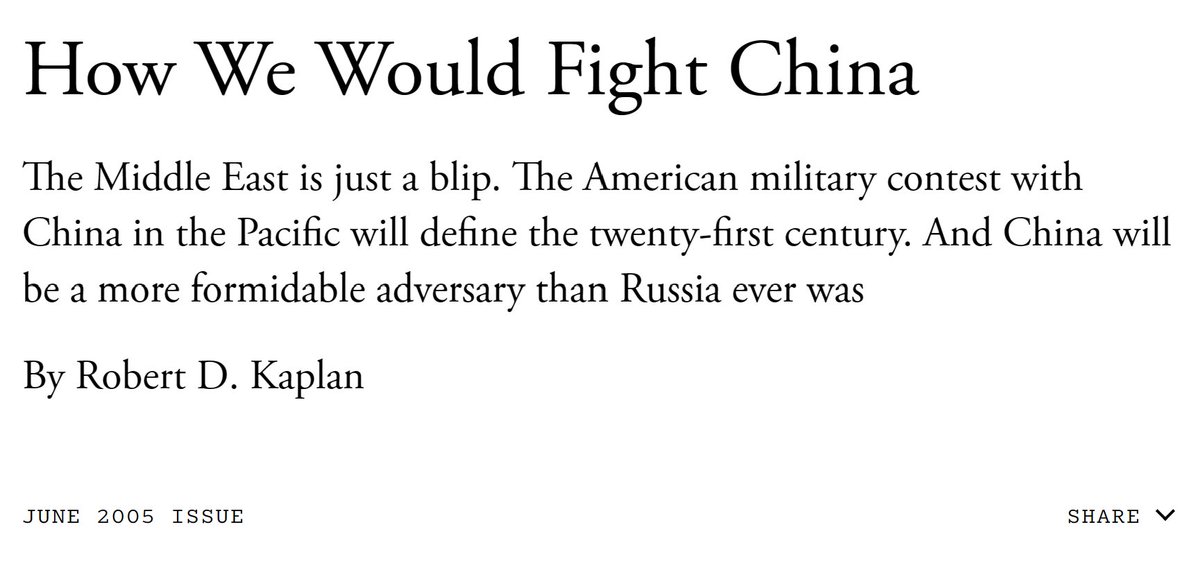
To be clear, I would put myself in this latter group. It was not until the last several years that I started to grasp the extent to which "strategic" considerations would impact the global economic integrationist project. So what are the lessons here? 15/
I think the big one is that academic stovepipes--operating solely from within one narrow subfield--leads to blind spots.
I'll end with this: I hope in ten years' time, we look back at this moment & see that much of the handwringing about decoupling was oversold. 16/
I'll end with this: I hope in ten years' time, we look back at this moment & see that much of the handwringing about decoupling was oversold. 16/
Reports of globalization's death have been exaggerated before, & that may be happening again. But if this is the start of a real reorganization & retrenchment in econ globalization, it's safe to say most of us underestimated the potential for int'l politics to drive change. 17/
I'll close by inviting you to share with me those scholars & pundits who *were* sounding alarm bells about security & globalization ten, fifteen, twenty years ago. I'm sure there were some & they deserve some attention for that.
FIN.
FIN.
Attaching this here: The U.S. Bet to Bring Chips Home wsj.com
Loading suggestions...