

1. The Pamirs and the Fate of Xinxiang and Ladakh: A Pivotal Region in British-Russian Rivalry in Central Asia
In the pre-colonial days, the rulers who ruled the cities of Central Asia scarcely cared about borders but only about major towns.
In the pre-colonial days, the rulers who ruled the cities of Central Asia scarcely cared about borders but only about major towns.

2. Borders became meaningless in mountainous regions like the Pamir Mountains which lay between Russian controlled cities of Central and British influenced areas of Afghanistan and India.
3. Then in 1873 Russia suddenly climbed down in its claims on Afghanistan and recognized that Afghanistan’s domains ran well into the Pamir Mountains. They were actually creating this smoke screen for their moves on Khiva.
4. But nevertheless this was a great victory for the British who always wanted to create a great ring of buffer states around India:
5. “Lord Mayo was convinced that India’s best defence lay, not in forward policies or military adventures, but in the establishment of a chain of buffer states friendly to Britain around its vast and thinly guarded frontiers.” (Hopkirk 337)
6. Though Russia had recognized Afghanistan as British area of influence and Badakshan and Wakhan as Afghanistan’s territory but nobody quite knew where these borders lay in the snowy reaches of the great mountains.
7. British officers disguised as explorers like George Hayward and various Hindu men disguised as Buddhist pilgrims were constantly on the prowl in central Asia, often at great
personal risk, mapping these regions.
personal risk, mapping these regions.
8. Mapping the Pamirs and assigning a border of Afghanistan had become even more important as momentous events were unfolding in Central Asia.
9. Yakub Beg a fanatical Muslim ruler in Xinxiang had risen against its Chinese masters and had overthrown the Chinese and massacred all the non-Muslim Han Chinese residing in Xinxiang.
10. He was now the most powerful independent ruler in Central Asia as all important Central Asian cities had one by one fallen against the armies of Russia, except Khiva Khanate and Yakub Beg’s new Islamic revolutionary kingdom of Kashgaria and what is now roughly Xinxiang.
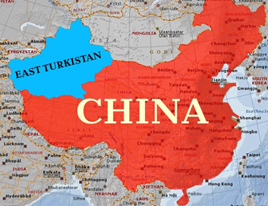
11. Its capital was the legendary city of Kashgar.
Yakub Beg was a wily politician and he was entertaining both the British and the Russians, trying to look for a better trade and defense deal.
Yakub Beg was a wily politician and he was entertaining both the British and the Russians, trying to look for a better trade and defense deal.
12. But the Russians were a formidable enemy for any Central Asian Muslim ruler and this soon became apparent. Russia had climbed down in its claims on Afghanistan because it had been planning more annexations in Central Asia.
13. In 1873, it invaded and occupied Khiva, one of the most formidable Central Asian garrison cities. And then in 1875, the city of Khokand too fell.
14. The Russian Empire in Central Asia was now immense and in a matter of just ten years they had managed to occupy Tashkent, Bokhara, Samarkand, Khiva and Khokand.
15. “…the Russians, in a period of just ten years, had annexed a territory half the size of the United States, and erected a defensive barrier across Central Asia stretching from the Caucasus in the west to Khokand and Kuldja in the east.”
(Hopkirk 353)
(Hopkirk 353)
16. The greatest fear in London and Calcutta in the British circles was now this that Russia would next annex the Xinxiang kingdom of Yakub Beg and that would directly give them access to Ladakh, the only place in Central Asia where, Russian army could directly invade India.
17. The British moved quickly to secure the situation. They knew that losing Xinxiang to the enemy would mean endangering the borders of India.
18. Sadly though, after independence, Indian leaders did not give any thought to this and first they let Xinxiang being re-annexed by the Chinese and then they let the Chinese also occupy Ladakh from where the Chinese now again and again threaten to invade India.
19. In Nehru’s infamous words, ‘not a blade of grass grows there in Aksai Chin’. He meant that losing Aksai Chin was no great deal as it was virtually useless. The British rulers who created India’s modern geopolitical policies and borders would have vehemently begged to differ.
20. Alarmed with the Russian takeover of most of Central Asia, Britain had also been sending espionage and survey missions in Central Asia. It all came down to the Pamirs.
21. Afghanistan was secure for the British now and the Shah was also in an uneasy but a friendly relationship with Britain.
22. The only way the Russian Army could now invade India was through the Pamirs, as it had already controlled all the garrison cities in the north Pamirs in what is now Tajikistan.
23. The Pamirs are a vast plateau crisscrossed by mountains and broad valleys but there are no trees or human habitations here.
24. The British expedition led by Lieutenant Colonel Thomas Cordon reported that the Pamirs were far from impenetrable and the Russian Army would be able to cross the Pamirs and from there into Dardistan and Kashmir and finally into mainland India.
25. The most vulnerable passes were the Baroghil and the Ishkaman, just about a hundred miles or so north of Gilgit.
Gilgit-Baltistan was found to be of extreme importance. Anyone whole controlled the passes of Gilgit-Baltistan actually controlled the northern passage to India.
Gilgit-Baltistan was found to be of extreme importance. Anyone whole controlled the passes of Gilgit-Baltistan actually controlled the northern passage to India.
26. The British understood this but the leaders of independent India sadly did not pay heed to this and lost the region promptly to Pakistan, thereby losing the geopolitical advantage.
27. When all other important garrison cities of Central Asia had fallen to Russia, it was very important for the British to actually foster the friendship of Yakub Beg, the ruler of Kashgaria or modern Xinxiang. They promptly went about to accomplish that.
28. On the other hand, it was important to chart the final map of Afghanistan in the Pamirs (Badakshan and Wakhan corridor). The British found to their horror that the Pamir Mountains actually ran just fifty kilometers short of the borders of the Kashgaria kingdom of Yakub Beg.
29. This meant that there was a 50 km stretch of free territory between the Wakhan Corridor of Afghanistan and Kashgaria or what is now Xinxiang.
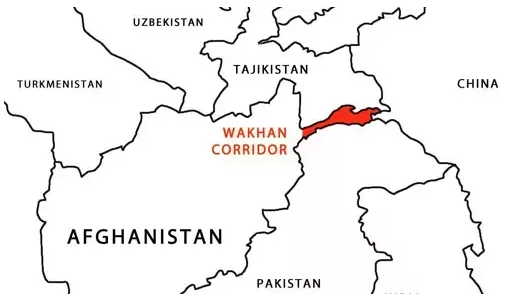
30. As soon as the Russian explorers and generals would realize this they would try to annex this 50 kilometers stretch which would bring the armies of the two Great Game players face to face on an actual border.
31. Meeting of the actual borders of Tsarist Russia and British India was the worst nightmare of British policy makers. They set about to prevent such an outcome.
32. In the west, it was the Bolan Pass and the garrison city of Quetta which would be used by any invading army. In 1875 Baluchistan was a free province and was neither a part of British India nor that of Afghanistan.
33. However, in order to strengthen India’s borders
the British managed to strike a treaty with the Khan of Baluchistan. In return of pacifying some rebels the Khan leased in perpetuity the Bolan Pass and the city of Quetta to India.
the British managed to strike a treaty with the Khan of Baluchistan. In return of pacifying some rebels the Khan leased in perpetuity the Bolan Pass and the city of Quetta to India.
34. Thus securing India’s western borders Britain then went about deciding the final borders of Afghanistan, the north-western buffer state of India.
35. References
Hopkirk, Peter. The Great Game: On Secret Service in High Asia. John Murray, 2006.
Hopkirk, Peter. Trespassers on the Roof of the World: The Race for Lhasa. John Murray, 2006.
Hopkirk, Peter. The Great Game: On Secret Service in High Asia. John Murray, 2006.
Hopkirk, Peter. Trespassers on the Roof of the World: The Race for Lhasa. John Murray, 2006.
36. Keay, John. When Men and Mountains Meet. Archon, 1982.
Skrine, F. H. and Ross, E. D. The Heart of Asia: A History of Russian Turkestan and the Central Asian Khanates. Oxford University Press, 1992.
Skrine, F. H. and Ross, E. D. The Heart of Asia: A History of Russian Turkestan and the Central Asian Khanates. Oxford University Press, 1992.
Loading suggestions...