

SEO Case Study in the Loans Niche
This website ranks for over 1 million keywords and generates hundreds of affiliate leads each month.
It's been 2.5 years now since I launched this website.
This thread will be my longest thread so far.
🧵 Here's the full journey:
This website ranks for over 1 million keywords and generates hundreds of affiliate leads each month.
It's been 2.5 years now since I launched this website.
This thread will be my longest thread so far.
🧵 Here's the full journey:

Disclaimer: I can't go through all the variables in this case study, and traffic alone means nothing if you can't monetize it smartly.
It is extremely difficult to achieve 110K organic monthly traffic for a finance website.
Unless you know what you're doing.
It is extremely difficult to achieve 110K organic monthly traffic for a finance website.
Unless you know what you're doing.
The reason I started this site is my background in finance.
I was also writing for other finance websites, so I have a legit personal brand.
In the first 6 months, we were publishing between 20-25 posts a month.
I was also writing for other finance websites, so I have a legit personal brand.
In the first 6 months, we were publishing between 20-25 posts a month.
That's why I had to spend more time editing the majority of it afterward.
After that, we slowed down the process to 15 posts a month for quality purposes.
After that, we slowed down the process to 15 posts a month for quality purposes.
We had to slow down because we had problems with writers.
From writers using AI content to dealing with plagiarism, so I had to fire a lot of writers for that.
Say what you want about AI, but using it for the whole content process is just a bad idea for this niche.
From writers using AI content to dealing with plagiarism, so I had to fire a lot of writers for that.
Say what you want about AI, but using it for the whole content process is just a bad idea for this niche.
The publishing frequency went to 10 new posts and updating 15 posts a month.
Given our problems with writers, I did the following to maintain the current frequency:
-Sourced industry-experts' opinions from HARO, Qwoted, and Terkel.
-Employed banking fresh graduates.
Given our problems with writers, I did the following to maintain the current frequency:
-Sourced industry-experts' opinions from HARO, Qwoted, and Terkel.
-Employed banking fresh graduates.
I was mainly targeting zero-volume keywords, except the pillar pages, as it's more competitive.
We tested and found the patterns between the SERPs which we ranked in high positions.
We have more chance to rank in queries that have little to non-convincing PAAs (People Also Ask)
We tested and found the patterns between the SERPs which we ranked in high positions.
We have more chance to rank in queries that have little to non-convincing PAAs (People Also Ask)
Likewise, we linked a huge number of silos to the pillar page of each cluster.
I didn't link back to all the silos to avoid dividing PageRank. (theoretically).
Unless there is a context for that.
So the center of each cluster was the product review pages.
I didn't link back to all the silos to avoid dividing PageRank. (theoretically).
Unless there is a context for that.
So the center of each cluster was the product review pages.
I employed the sidebar to show the most relevant articles based on tags.
@freshbooks and other big brands inspired me with this move.
It's also a legitimate way to show the most related entities for each group of articles.
@freshbooks and other big brands inspired me with this move.
It's also a legitimate way to show the most related entities for each group of articles.
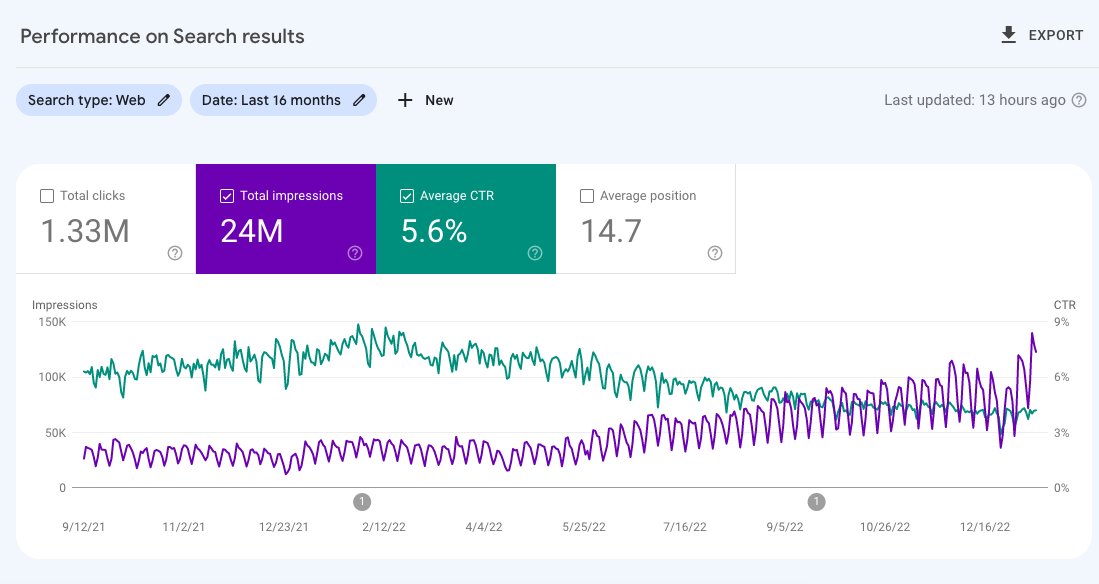
CTR decreased as impressions increased, and clicks are still consistent.
Because it's likely Google considered the website a helpful source for this category, so we ranked in irrelevant SERPs.
Because it's likely Google considered the website a helpful source for this category, so we ranked in irrelevant SERPs.
After the first seven months, I had built a significant number of PR links.
I reach out to relevant journalists myself with interesting stories and trends.
I've used public/Gov data to construct stories and promote it on different channels.
I reach out to relevant journalists myself with interesting stories and trends.
I've used public/Gov data to construct stories and promote it on different channels.
We've used the following channels to promote the PR stories:
-Email.
-Social media.
-Twitter outreach.
We were doing between 1-2 PR campaigns each week.
How did we get the budget for that?
I was doing the PR activities myself as a hobby, so we hadn't to spend a dollar.
-Email.
-Social media.
-Twitter outreach.
We were doing between 1-2 PR campaigns each week.
How did we get the budget for that?
I was doing the PR activities myself as a hobby, so we hadn't to spend a dollar.
I tried domain transfer, but it didn't seem to work, so I stuck with PR.
The best part of all this is that the team consists of only 1 writer.
She's a recent graduate from a relevant background, so she was looking to build her personal brand.
The best part of all this is that the team consists of only 1 writer.
She's a recent graduate from a relevant background, so she was looking to build her personal brand.
Along the way, I built good relationships with some journalists.
So they reach out in case they're going to write about a relevant article.
DR wasn't really my target, as I was looking to build a brand.
So they reach out in case they're going to write about a relevant article.
DR wasn't really my target, as I was looking to build a brand.
I was hunting featured snippets, as it was a good way to get more clicks out of the SERP.
Also, Google is likely to not choose an answer from a source unless it's trustworthy.
It's a concept called "knowledge-based trust."
Also, Google is likely to not choose an answer from a source unless it's trustworthy.
It's a concept called "knowledge-based trust."
The only mistake was in the internal links.
We were adding at least 7 internal links in each article.
It was too much, so we had to go back with a more relevant strategy.
I categorized links based on relevance into 3 groups:
-Must link.
-Should link.
-Preferable link.
We were adding at least 7 internal links in each article.
It was too much, so we had to go back with a more relevant strategy.
I categorized links based on relevance into 3 groups:
-Must link.
-Should link.
-Preferable link.
Big brands like @Investopedia inspired the website in terms of the cluster's structure, information flow, and branding.
I didn't cover definitions because it didn't make sense.
It's too good for entities and topical coverage, though.
I didn't cover definitions because it didn't make sense.
It's too good for entities and topical coverage, though.
I made calculators to be an online asset for the brand.
When the user provides it with an input, it recommends certain banks based on the input.
We did not make it for any SEO purpose, as the competition was tough.
But again, it's a good brand asset.
When the user provides it with an input, it recommends certain banks based on the input.
We did not make it for any SEO purpose, as the competition was tough.
But again, it's a good brand asset.
As the homepage gets the most juice from the PR links I've built.
I've utilized it to link to the pillar pages, calculators, and custom categories.
So links are flowing smoothly.
I've utilized it to link to the pillar pages, calculators, and custom categories.
So links are flowing smoothly.
The second year of this website has had the most traffic (and money).
Why?
Because we adapted a more data-driven approach and got other value propositions to use against competitors.
Here's what we did:
Why?
Because we adapted a more data-driven approach and got other value propositions to use against competitors.
Here's what we did:
We started by getting the zero-click pages.
Then group these pages based on impressions as the following:
-The page needs a huge edits and updates if it has more than 100 impressions.
-The page needs to be consolidated/repurposed if it has less than 100 impressions.
Then group these pages based on impressions as the following:
-The page needs a huge edits and updates if it has more than 100 impressions.
-The page needs to be consolidated/repurposed if it has less than 100 impressions.
I'm against removing pages just because it doesn't have any SEO value.
Even though it's important for flowing internal links between relevant pages.
After that we did some analysis on the website's topics to get a more insightful view.
Even though it's important for flowing internal links between relevant pages.
After that we did some analysis on the website's topics to get a more insightful view.
We did tests on the website design to see how users are flowing and interacting with affiliate links.
We've used heatmaps receding to compare how the user is interacting with different themes along the time.
We've used heatmaps receding to compare how the user is interacting with different themes along the time.
I've used a good deal of tools in this project but these what I could remember for now:
-Google Search Console.
-Google Analytics.
-Microsoft Clarity.
-Python notebooks.
-Screaming Frog.
-SEMrush.
-Google Sheets (We replaced it with Airtable now)
-Google Search Console.
-Google Analytics.
-Microsoft Clarity.
-Python notebooks.
-Screaming Frog.
-SEMrush.
-Google Sheets (We replaced it with Airtable now)
There is a huge effort went into this website, that's why it succeeds.
We did that effort to:
-Know what actions are working, so we can double down on.
-Specify the activities that could bring us down to avoid it.
We did that effort to:
-Know what actions are working, so we can double down on.
-Specify the activities that could bring us down to avoid it.
The budget wasn't that huge because I was doing all of that by myself with the help of my VA,
I've validated a good deal of theories and ideas to form my own view.
I truly love SEO. The best thing about it is its tendency to integrate with different areas and subjects.
I've validated a good deal of theories and ideas to form my own view.
I truly love SEO. The best thing about it is its tendency to integrate with different areas and subjects.
Loading suggestions...