

The Photo in Football and the False Promise of Objectivity (A SHORT THREAD).
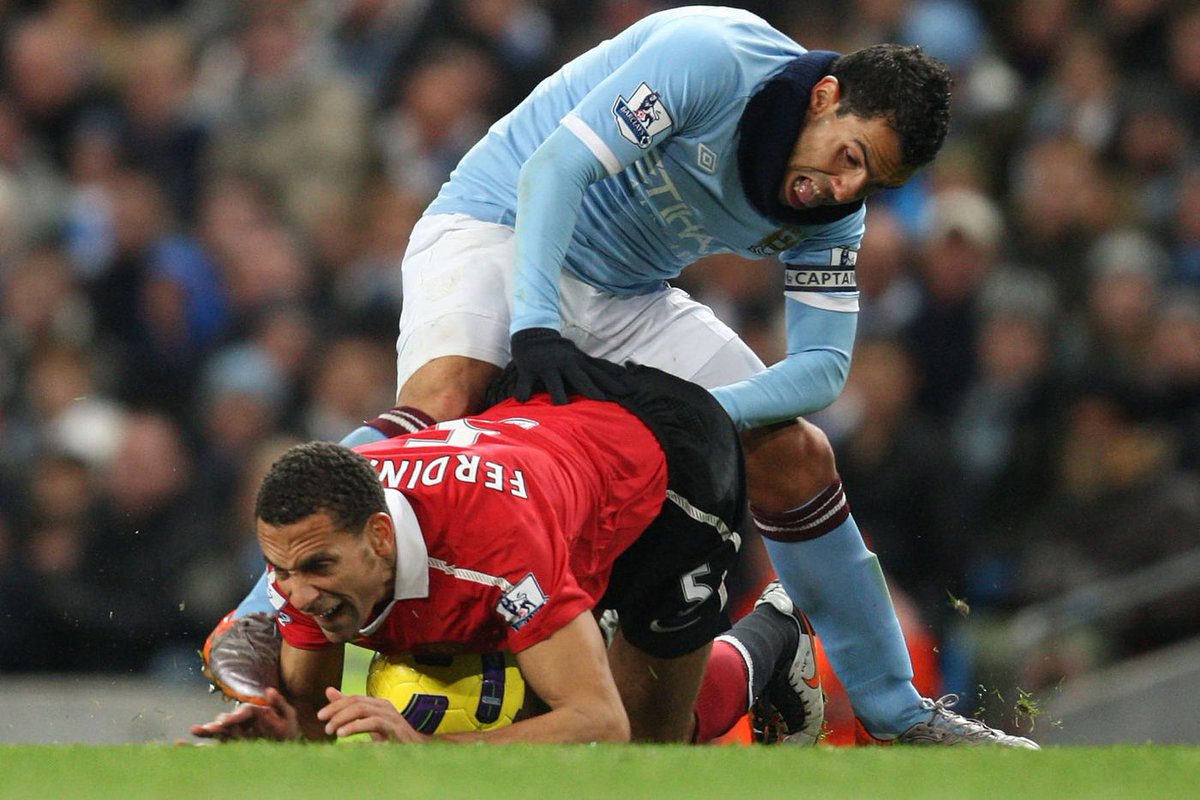
I wanted to problematise the use of photos in football analysis. To challenge what is sometimes an implicit assumption made by us all that photos are able to represent an objective reality, a belief rooted in a positivist view of analysis.
Broadly, positivism can be defined as the the view that there is an objective reality. The role of the analyst is therefore to get as close as possible to understanding that objective reality, using empirical tools and rational thought processes. The analyst is therefore...
...independent from their object of study; their job is to make sense of it *in itself*.
A post-positivist view, however, would reject the above claim. It would not resign itself to definitional rigidity but would make a conscious effort to frame the photo in one or several...
A post-positivist view, however, would reject the above claim. It would not resign itself to definitional rigidity but would make a conscious effort to frame the photo in one or several...
...milieus (a cultural milieu, a social milieu, a spatial milieu, a temporal milieu, etc.).
So, how does this relate to photos themselves? In an epistemological context (how we think about photos, what we consciously/subconsciously consider their uses to be), we come to...
So, how does this relate to photos themselves? In an epistemological context (how we think about photos, what we consciously/subconsciously consider their uses to be), we come to...
...a problem of representation. We more often than not consider photos be mirrors of the real world, having captured a moment in time, and thus 'contain' the entire truth. But this is problematic. In Lewis Hine's words, 'while photographs may not lie, liars may photograph'.
When looking at photos in analysis, we should consider who took them, who is using them and for what purpose. In doing so, we place the photo in several milieus and cease to think of it as an independent source of truth in itself. Its evidential import arises...
...upon consideration of (infinite) context, not simply from its being a photo.
This brings us nicely to the next problem: that of time/temporality. While this is a more specific ontological comment photos, it is one that is particular to their use in...
This brings us nicely to the next problem: that of time/temporality. While this is a more specific ontological comment photos, it is one that is particular to their use in...
...football analysis. Photos are themselves 2D images, containing static, fixed points. The image is still but reality is not. Intuitively, this should raise some questions. Football is a game of movement (temporal, physical, and the like). At no point, therefore, does...
...time actually 'stop'. The present is ever-moving; it ceases to exist as soon as we have the chance to reflect on it, by its very nature. Time, therefore, has an enduring quality to it - a successive feature that cannot be understood as a series of fixed moments but as a whole.
I'll use F*bregas' assist vs Burnley as an example. If we are to freeze the video as Fabregas lets go of the ball (in doing so, producing a photo), we see an image that we might feel is intuitively incomplete, and rightly so.
What the photo *cannot* capture is the successive qualities of the move; F*bregas' altered stride before reception, Schurrle's arched run in contrast to the relative static-ness of the Burnley block. In essence, the photo is unable to distinguish the players it captures...
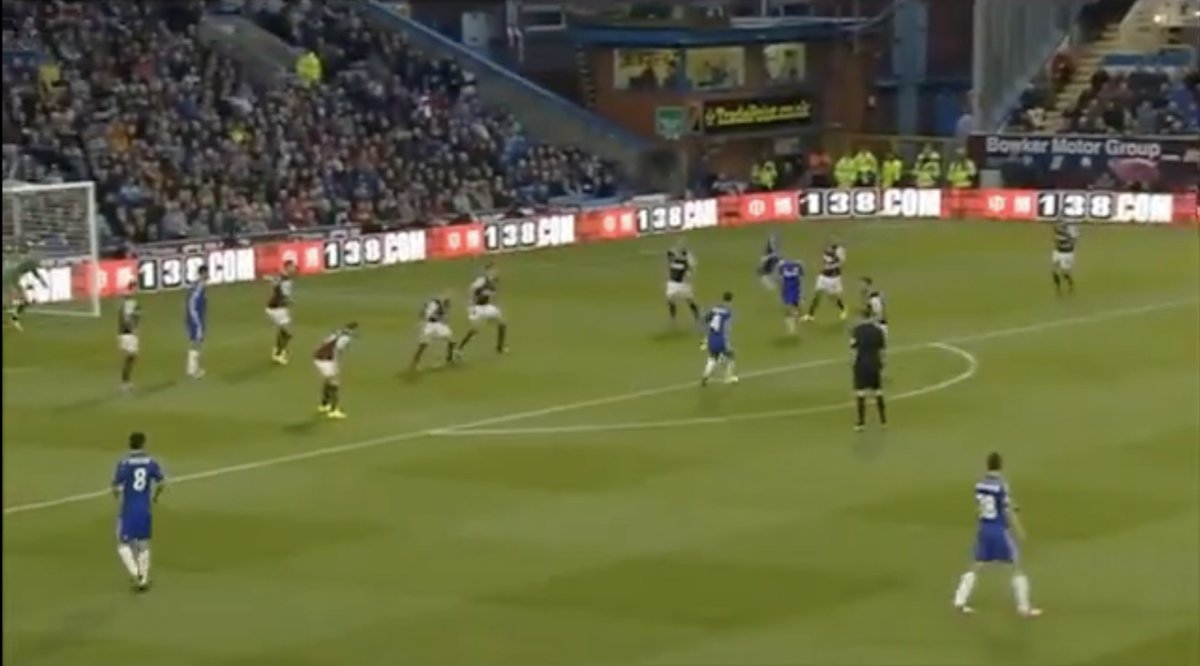
...from marked dots on a football drawing board.
My aim has been to problematise the use of photos in football analysis. This should ask more questions than it answers, though immediate accessible alternatives might be conceived of (long GIFs, short videos).
My aim has been to problematise the use of photos in football analysis. This should ask more questions than it answers, though immediate accessible alternatives might be conceived of (long GIFs, short videos).
In a wider context, by extension, I am also problematising the positivist conceptions of analysis/the analyst. In football, just as in life, there is no objective truth, nor are there methodological tools that suddenly arbitrarily reveal it.
In football analysis, we ought to move forward by self-scrutinising: to be conscious of our methods, our goals, our biases, our filters that make up an analytical identity. These facets don't hinder us from getting at a hidden truth, they help us paint a moving one.
Loading suggestions...