

IKEA’s founder says, “Hungry people buy less”.
So, IKEA started selling food to keep people hooked at the stores!
Today,
- 30% of people visit IKEA only for food and,
- IKEA food makes ~$2.5 billion in revenue!
Learn IKEA’s genius marketing strategy for your business 🧵
So, IKEA started selling food to keep people hooked at the stores!
Today,
- 30% of people visit IKEA only for food and,
- IKEA food makes ~$2.5 billion in revenue!
Learn IKEA’s genius marketing strategy for your business 🧵
Structure:
1. Does IKEA really sell a lot of food?
2. So, what's the impact of the food business on IKEA's furniture sales?
3. What's so special about IKEA's food?
4. Finally, where is IKEA going with this move?
1. Does IKEA really sell a lot of food?
2. So, what's the impact of the food business on IKEA's furniture sales?
3. What's so special about IKEA's food?
4. Finally, where is IKEA going with this move?
1/ Does IKEA really sell a lot of food?
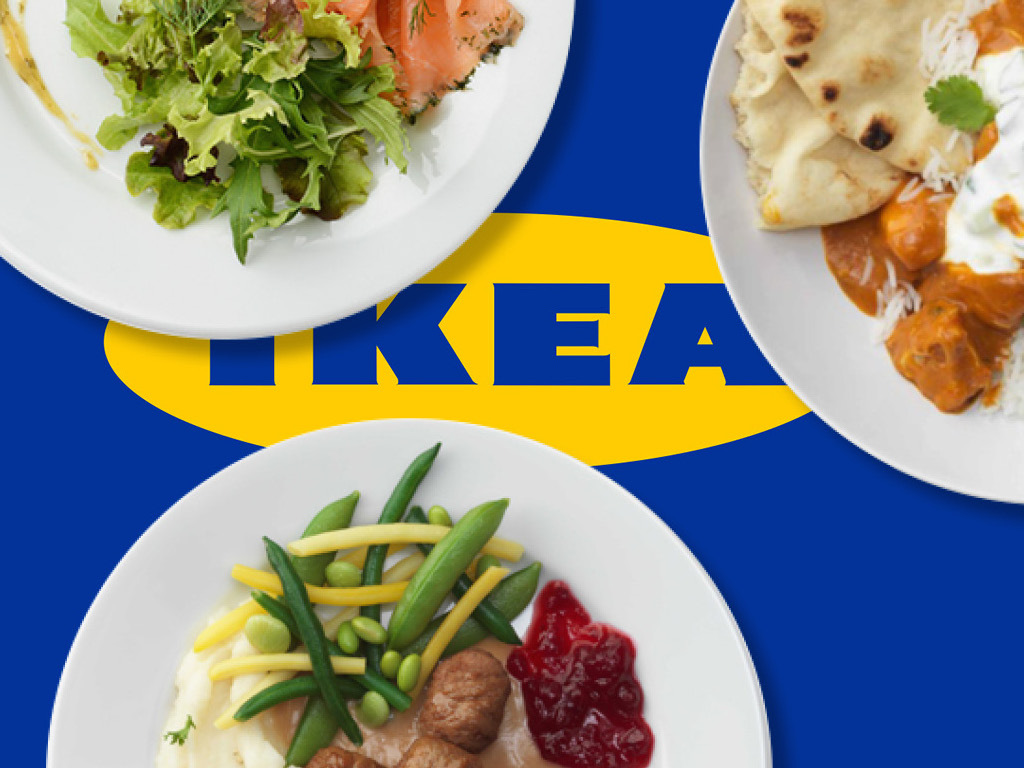
Yes! IKEA's food business across various bistros, cafes, and restaurants makes a whopping ~$2.5B in sales annually!
That's 6% of their total revenue, which has been growing at 8% since 2016.
But, why does IKEA even sell food?
(contd.)
Yes! IKEA's food business across various bistros, cafes, and restaurants makes a whopping ~$2.5B in sales annually!
That's 6% of their total revenue, which has been growing at 8% since 2016.
But, why does IKEA even sell food?
(contd.)
IKEA's food business wasn't a random fluke, but a well-thought-out strategy to drive furniture sales.
You see, IKEA stores are HUGE.
So, they are usually located in the city outskirts, far from where regular restaurants are located.
(contd.)
You see, IKEA stores are HUGE.
So, they are usually located in the city outskirts, far from where regular restaurants are located.
(contd.)
So, the initial idea was to provide food in the store itself, so people would hang around longer without having to go outside for a snack.
IKEA's founder, Ingvar Kamprad, very succinctly makes the point, "Hungry customers buy less".
(contd.)
IKEA's founder, Ingvar Kamprad, very succinctly makes the point, "Hungry customers buy less".
(contd.)
Now, these food stores were not intended to be profit centres.
The idea was to lure in customers with low-priced, tasty meals that would in turn result in
1. More number of visitors, and
2. Extend the time the shoppers spend in the store leading to big-ticket purchases.
The idea was to lure in customers with low-priced, tasty meals that would in turn result in
1. More number of visitors, and
2. Extend the time the shoppers spend in the store leading to big-ticket purchases.
2/ What's the impact of the food business on IKEA's furniture sales?
Example ⇒ IKEA's Hyderabad restaurant and store
First, let's find out the number of visitors who come to IKEA primarily to eat food.
(contd.)
Example ⇒ IKEA's Hyderabad restaurant and store
First, let's find out the number of visitors who come to IKEA primarily to eat food.
(contd.)
1. IKEA Hyderabad has:
Seats ⇒ 1000
Operating hours ⇒ 9:30 AM to 8:30 PM = 11 hours
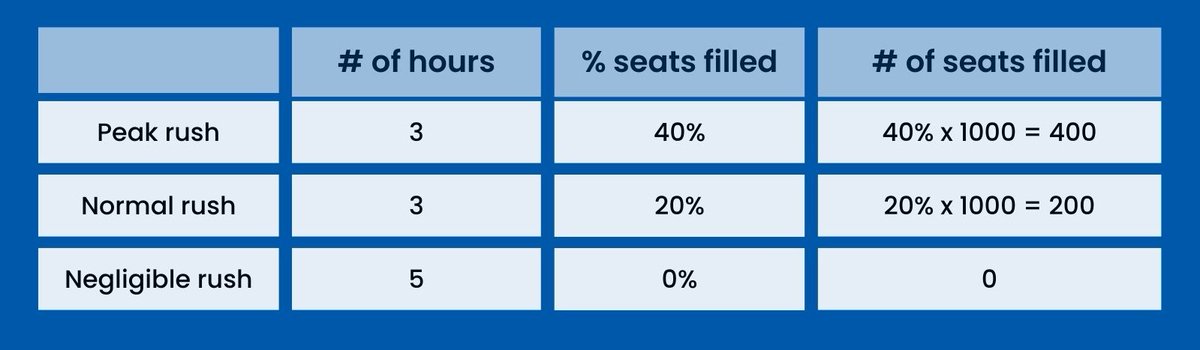
2. Let's conservatively assume that, the restaurant has negligible rush for 5 hours and peak and normal rush for 3 hours each.
% seats filled
Peak rush ⇒ 40%
Normal rush ⇒ 20%
(contd.)
Seats ⇒ 1000
Operating hours ⇒ 9:30 AM to 8:30 PM = 11 hours
2. Let's conservatively assume that, the restaurant has negligible rush for 5 hours and peak and normal rush for 3 hours each.
% seats filled
Peak rush ⇒ 40%
Normal rush ⇒ 20%
(contd.)
3. So, the total number of daily visitors to the restaurants
= # of hours x # of seats filled
= 3 x 400 + 3 x 200 = 1800
4. Assuming the restaurant runs for 350 days in a year (leaving out national holidays)
# of visitors annually = 1800 x 350 = 630,000
(contd.)
= # of hours x # of seats filled
= 3 x 400 + 3 x 200 = 1800
4. Assuming the restaurant runs for 350 days in a year (leaving out national holidays)
# of visitors annually = 1800 x 350 = 630,000
(contd.)
5. Now, the IKEA Hyderabad store had ~2 million visitors in 2019-20.
So, 630,000/2,000,000 x 100 = ~32% of visitors came to the store for food!
In fact, IKEA learned a while back that ~30% of their visitors across the world come to the stores to primarily get food.
(contd.)
So, 630,000/2,000,000 x 100 = ~32% of visitors came to the store for food!
In fact, IKEA learned a while back that ~30% of their visitors across the world come to the stores to primarily get food.
(contd.)
So, out of the 775 million visitors to all IKEA stores in 2021, 775 x 30% = ~233 million people primarily came to eat.
But, how many of these people who primarily come to eat also buy furniture?
Well, let's figure it out.
(contd.)
But, how many of these people who primarily come to eat also buy furniture?
Well, let's figure it out.
(contd.)
1. Let's say the average order value (AOV) for furniture at IKEA is INR 5000.
We’ve taken a conservative assumption based on IKEA’s competitor — Pepperfry. It has an AOV of
Online = INR 7000
Offline = INR 32000
2. IKEA's Hyderabad store revenue = INR 566 Cr in 2019-20.
(contd)
We’ve taken a conservative assumption based on IKEA’s competitor — Pepperfry. It has an AOV of
Online = INR 7000
Offline = INR 32000
2. IKEA's Hyderabad store revenue = INR 566 Cr in 2019-20.
(contd)
3. Let's consider 3 scenarios where 10%, 20% and 30% of visitors who came to eat food at IKEA end up buying furniture.
So furniture sales =
A) 10% ⇒ 630,000 x 10% x 5000 = INR 31.5 crores
% revenue = 31.5 / 566 = 5.6%
(contd.)
So furniture sales =
A) 10% ⇒ 630,000 x 10% x 5000 = INR 31.5 crores
% revenue = 31.5 / 566 = 5.6%
(contd.)
B) 20% ⇒ 630,000 x 20% x 5000 = INR 63 crores
% revenue = 63 / 566 = 11.1%
C) 30% ⇒ 630,000 x 30% x 5000 = INR 94.5 crores
% revenue = 94.5 / 566 = 16.7%
So, IKEA’s food business is able to drive ~5-15% of its furniture sales!
% revenue = 63 / 566 = 11.1%
C) 30% ⇒ 630,000 x 30% x 5000 = INR 94.5 crores
% revenue = 94.5 / 566 = 16.7%
So, IKEA’s food business is able to drive ~5-15% of its furniture sales!
3/ But, what's so special about IKEA's food?
IKEA opened its first self-service cafeteria in 1958 with only coffee and cold dishes.
Since then it serves not just hot snacks and a la carte dishes but also offers packaged, frozen and refrigerated dishes & beverages.
(contd.)
IKEA opened its first self-service cafeteria in 1958 with only coffee and cold dishes.
Since then it serves not just hot snacks and a la carte dishes but also offers packaged, frozen and refrigerated dishes & beverages.
(contd.)
But, about half of the items on IKEA's menu are Scandinavian.
IKEA food rose to its stardom for its meatballs, lingonberry jam, and salmon.
It is estimated that IKEA sells around one billion meatballs per year!
(contd.)
IKEA food rose to its stardom for its meatballs, lingonberry jam, and salmon.
It is estimated that IKEA sells around one billion meatballs per year!
(contd.)
Of course, many items on the menu are customized as per the demographics of the store.
For instance, you can eat spiced chicken curry and rice at the Hyderabad store.
On top of this, IKEA's food is very easy-on-the-wallet and tasty!
(contd.)
For instance, you can eat spiced chicken curry and rice at the Hyderabad store.
On top of this, IKEA's food is very easy-on-the-wallet and tasty!
(contd.)
Consider these examples
IKEA ⇒ Whole English breakfast
Price ⇒ $4.99
Macdonald's ⇒ Big Mac meal
Price ⇒ $5.99
In IKEA Hyderabad,
2 pieces of samosa ⇒ Rs 30
Vegetable biryani ⇒ Rs 150
That's half the usual price for these items even at a pocket-friendly restaurant.
IKEA ⇒ Whole English breakfast
Price ⇒ $4.99
Macdonald's ⇒ Big Mac meal
Price ⇒ $5.99
In IKEA Hyderabad,
2 pieces of samosa ⇒ Rs 30
Vegetable biryani ⇒ Rs 150
That's half the usual price for these items even at a pocket-friendly restaurant.
4/ Where is IKEA going with this?
The roaring success of the food business prompted IKEA to try several standalone pop-ups in 2017, in major cities like London, Paris, and Oslo.
However, in 2018, IKEA said that no long-term decision was taken on this matter.
(contd.)
The roaring success of the food business prompted IKEA to try several standalone pop-ups in 2017, in major cities like London, Paris, and Oslo.
However, in 2018, IKEA said that no long-term decision was taken on this matter.
(contd.)
IKEA's external innovation lab, Space IO, is in the process of creating healthy, plant-based and sustainable food options – “fast food of the future”.
But, this is limited to culinary research and is not on IKEA’s menu. At least for now.
But, this is limited to culinary research and is not on IKEA’s menu. At least for now.
IKEA’s restaurants are an integral part of its business and are here to stay.
Whether the company takes it to the next level of its promised potential – we will have to wait and watch.
Whether the company takes it to the next level of its promised potential – we will have to wait and watch.
If you liked what you read,
Give us a follow
Retweet the first tweet :)
Give us a follow
Retweet the first tweet :)
Loading suggestions...