

China's new foreign minister Qin Gang wants to build stronger ties with Saudi Arabia and set up a China-Gulf free trade zone "as soon as possible", according to a ministry statement published late on Monday.
reuters.com
reuters.com
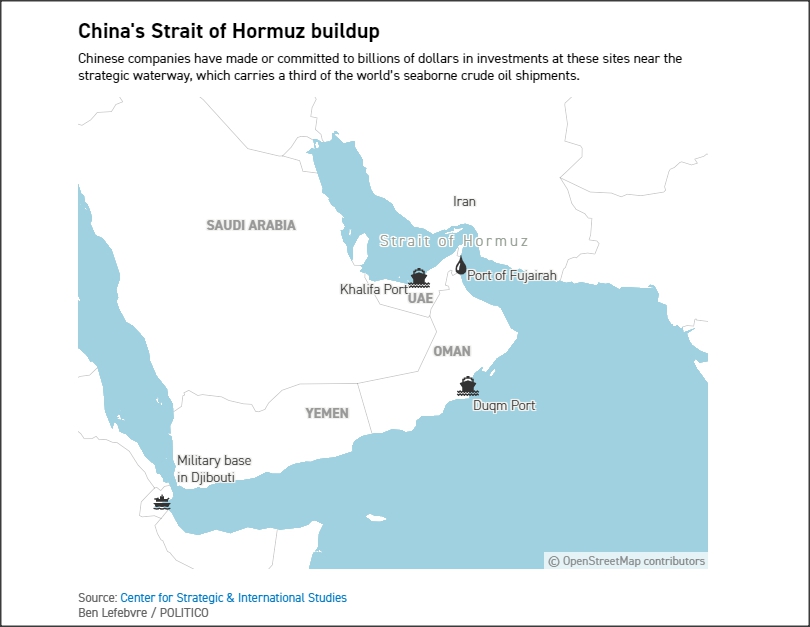
Having a direct PLA presence on the Strait of Hormuz would set off alarm bells among American energy security experts.
politico.com
politico.com
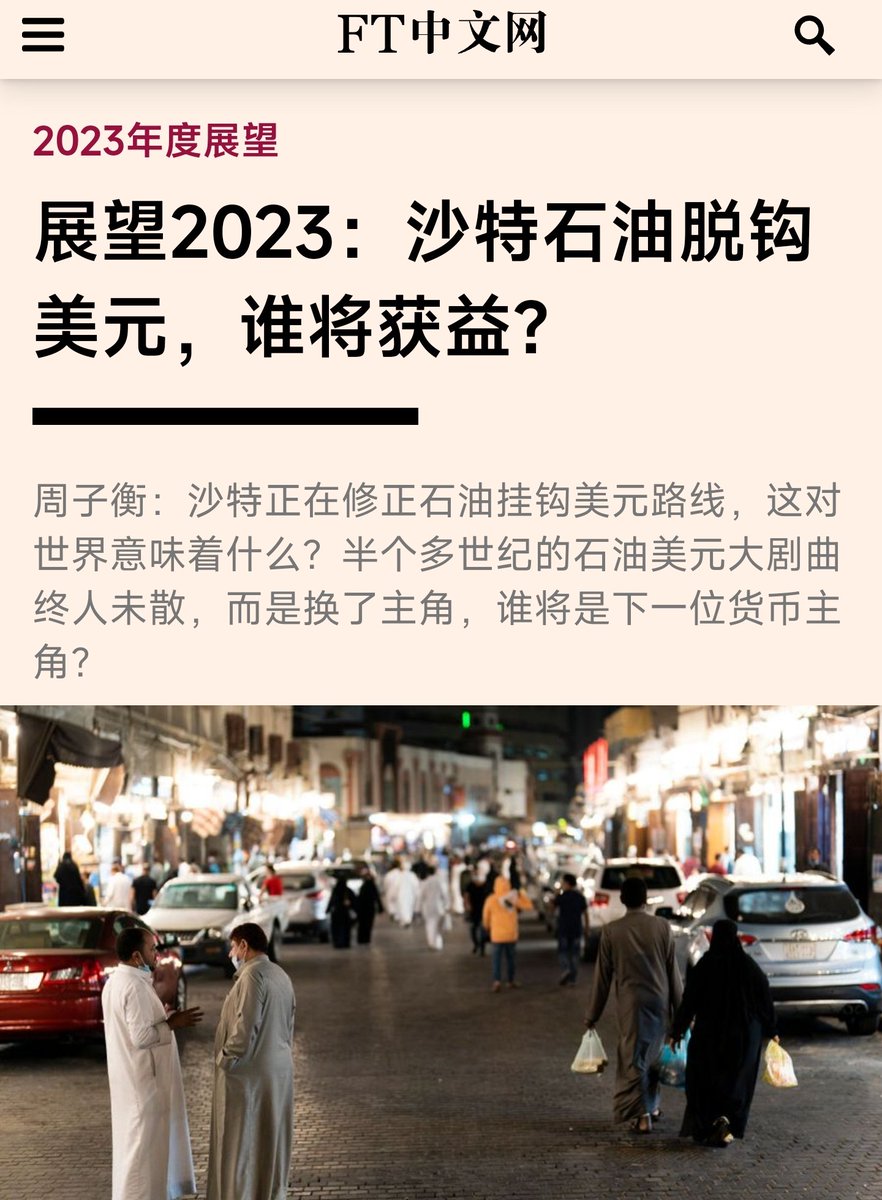
The petrodollar is coming to an end, as far as Saudi Arabia is concerned. But it's still a far fetch for petroyuan.
ftchinese.com
ftchinese.com
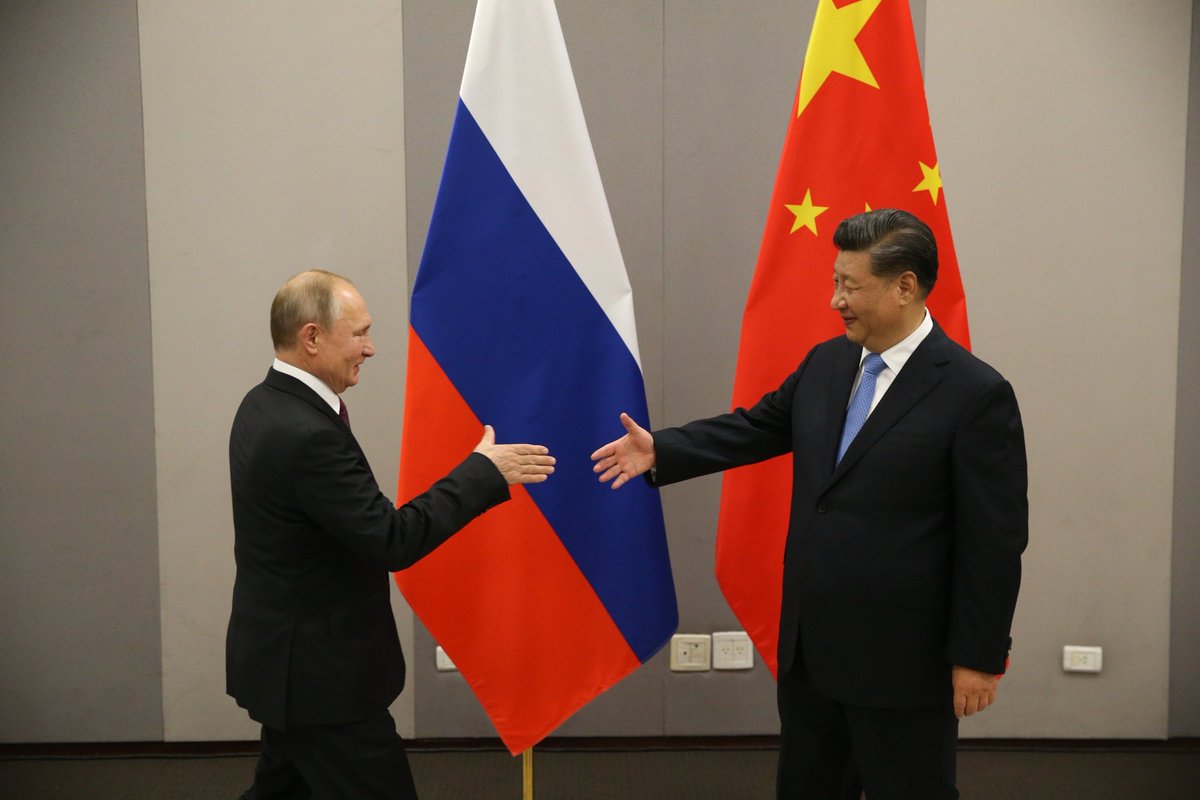
As Western countries froze Russia's currency reserves and shunned its oil, Moscow embraced Asia as an alternative crude market and surpassed Saudi Arabia last year as China's top oil supplier.
The Federal Reserve's aggressive monetary tightening campaign sent the dollar soaring last year. Because oil deals are largely priced in dollars, a rising greenback makes oil contracts more expensive.
The recycling of petrodollars by oil-rich nations into emerging markets such as Mexico, Brazil, Argentina, Zaire, Turkey and others by US commercial banks from the late 1970s onwards led to several emerging market debt crises.
Some 40% of proven oil reserves belonging to OPEC+ members is owned by Russia, Iran and Venezuela – all of whom are selling to China at major discounts, and all of whom are on board with Beijing’s petro-yuan plan.
India’s love for discounted Russia oil is widening its trade deficit with Moscow and the casualty is their much-touted rupee trade plan.
Russian banks do not want excess rupee piling up, they said.
bloomberg.com
Russian banks do not want excess rupee piling up, they said.
bloomberg.com
Slow progress in the rupee trade with Russia could add to pressure on the local currency which slipped the most against the dollar among emerging Asian currencies in the past 12 months.
Wow...
Russia is now the biggest supplier of crude oil to India overtaking Iraq and Saudi Arabia.
In December, Delhi bought 1.2 million barrels of crude from Russia every day — a whopping 33 times more than a year earlier.
Russia is now the biggest supplier of crude oil to India overtaking Iraq and Saudi Arabia.
In December, Delhi bought 1.2 million barrels of crude from Russia every day — a whopping 33 times more than a year earlier.

Russia initially agreed to resuscitate the Cold War-era ‘rupee–rouble’ trade mechanism, which would help it bypass sanctions.
But in practice Russia is still reluctant due to its burgeoning trade imbalance with India, instead asking for payment in euros or UAE dirhams.
But in practice Russia is still reluctant due to its burgeoning trade imbalance with India, instead asking for payment in euros or UAE dirhams.
India has also been trying to reduce its oil dependency on the Gulf region to avoid geopolitical repercussions if the Muslim Gulf states were to use oil as a strategic weapon.
In 1998, when Nawaz Sharif was considering conducting a nuclear test in response to India’s Pokhran II nuclear tests, Saudi Arabia reportedly promised 50,000 barrels of oil per day to help Islamabad weather any potential sanctions.
India refiners prefer to pay in the United Arab Emirates dirham, which is pegged to the dollar, as payment in roubles is also difficult because there is no set rate for the Russian currency.
Reliance Industries, the largest firm in India by market value, and BPCL, are two Indian refiners that use dirhams to pay for some shipments of Russian petroleum to avoid Western sanctions.
The West is looking the other way because India is meeting the West’s twin goals of crimping Moscow’s energy revenue while preventing an oil supply shock.
“They are aware that Indian and Chinese refiners can earn bigger margins by buying discounted Russian crude and exporting products at market prices. They’re fine with that.”
When Russian crude is processed into fuels in a country outside of the bloc such as India, the refined products can be delivered into the EU because they’re not deemed to be of Russian origin.
The currency the Indian refiners use varies from cargo to cargo, depending on traders' preferences.
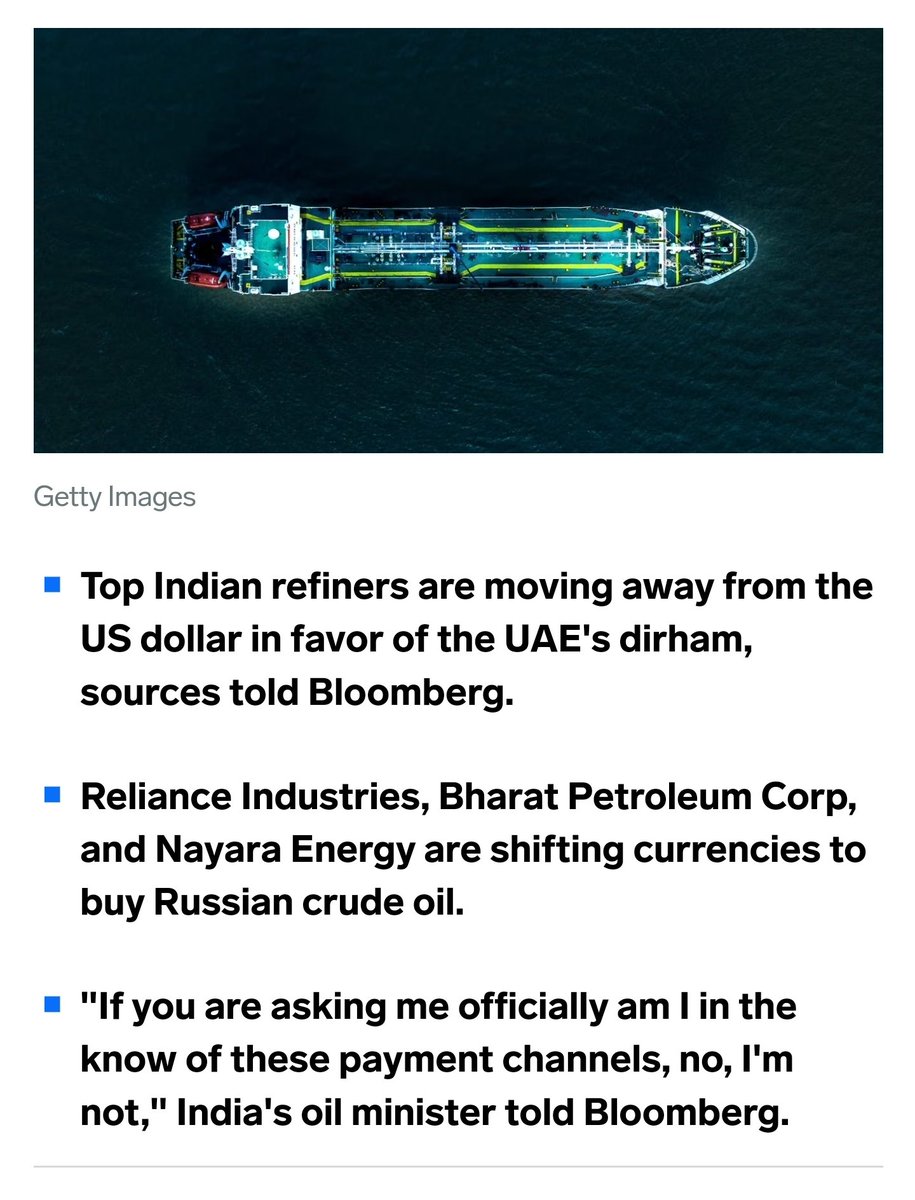
Using the dollar-pegged dirham gives both Russia and India a relatively secure and stable alternative. Still, most oil deals are still denominated in greenbacks.
Saving in yuan also involves huge convertibility risks as G7 sanctions prevent Russia from converting yuan into hard currencies in offshore markets.

Heavy exposure to the yuan also raises the risk of financial contagion if the macroeconomic situation in China deteriorates.
China indeed is likely to remain Russia's single largest trade partner for the foreseeable future. Bilateral trade rose 30% last year to $190 billion.
To support de-dollarization, all large systemically important Russian banks now offer yuan deposit accounts for retail customers.
The creation of necessary financial infrastructure to facilitate greater use of the yuan in the domestic economy and in bilateral trade flows will take time.
More than anything else, Xi wants to be the great leader who makes China a global power to rival the U.S.
If the yuan becomes a major global clearing and reserve currency, it will be evidence to the Chinese people that China has arrived.
If the yuan becomes a major global clearing and reserve currency, it will be evidence to the Chinese people that China has arrived.
Until recently, there was little reason for governments to experiment outside the trusted and reliable dollar. Even U.S. frenemies and adversaries continued to use the dollar begrudgingly from a position of convenience or inertia.
This golden opportunity has not been lost on China. After securing his third term as president, Xi made courting the Middle East one of his most important priorities. Meanwhile, the U.S. relationship with Saudi Arabia is approaching its nadir.
Despite fist fights between Indian and Chinese soldiers at their disputed border, a number of Indian firms have begun using the yuan to buy commodities.
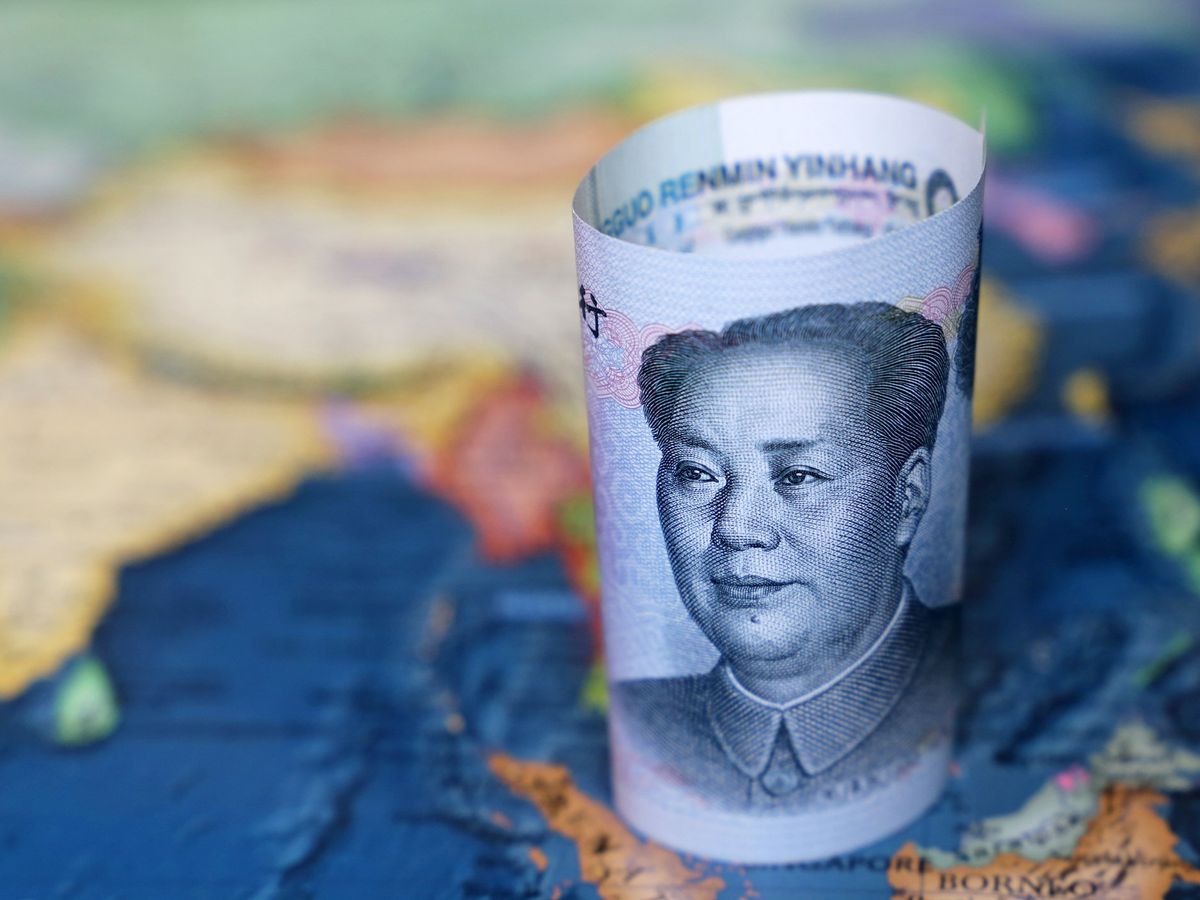
The dollar is the dominant clearing currency today precisely because, after World War II, the U.S. was the world’s factory, supplying depleted European allies with much-needed manufactured goods. Needless to say, the U.S. demanded payments in dollars.
From the early days of the war, there was a campaign to stop European oil companies buying Russian crude. After that, most publicly owned companies shunned it, but privately held oil traders jumped at the opportunity.
carnegieendowment.org
carnegieendowment.org
The foreign-registered trading arms of Lukoil and Rosneft would buy the Russian crude from Lukoil or Rosneft, deliver it to the respective refineries for processing, receive a basket of oil products labeled as EU-origin that could then be sold unencumbered on European markets.
Russia's oil sector tax system put in place in 2001–2003 was designed to fight transfer pricing and shifting revenue to foreign subsidiaries of the oil companies by relying on an independent and observable indicator of the crude value: the international oil price.
Lukoil is selling its Sicilian refinery, but keeping its Dutch, Romanian, and Bulgarian assets. Coincidentally, Bulgaria got an exemption from the EU embargo, and is allowed to import Russian crude until the end of 2024.
Russian exports of discounted crude and fuel oil to China meanwhile have jumped to record levels as the re-opening of the world’s biggest energy importer gathers pace after the dismantling of Covid Zero.
bloomberg.com
bloomberg.com
China’s private refiners have been buying more straight-run fuel oil since late-2022 due to attractive prices, said Mia Geng, an analyst at industry consultant FGE.
Roubini is cautiously bullish on the Indian rupee.

Over time, anything is possible?
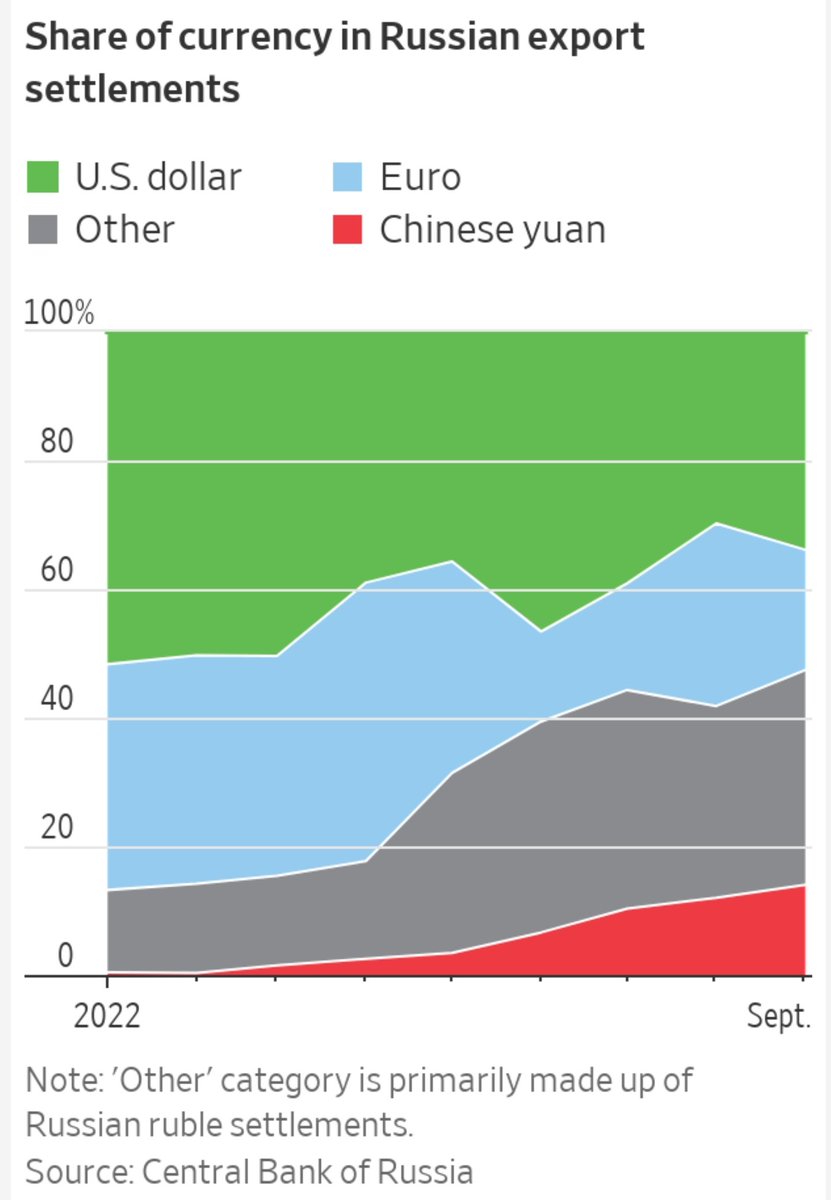
Nikkei: Russia is increasingly relying on the ruble and the yuan for cross-border payments, financing and more about a year since it invaded Ukraine, with Western sanctions limiting access to the dollar and euro.
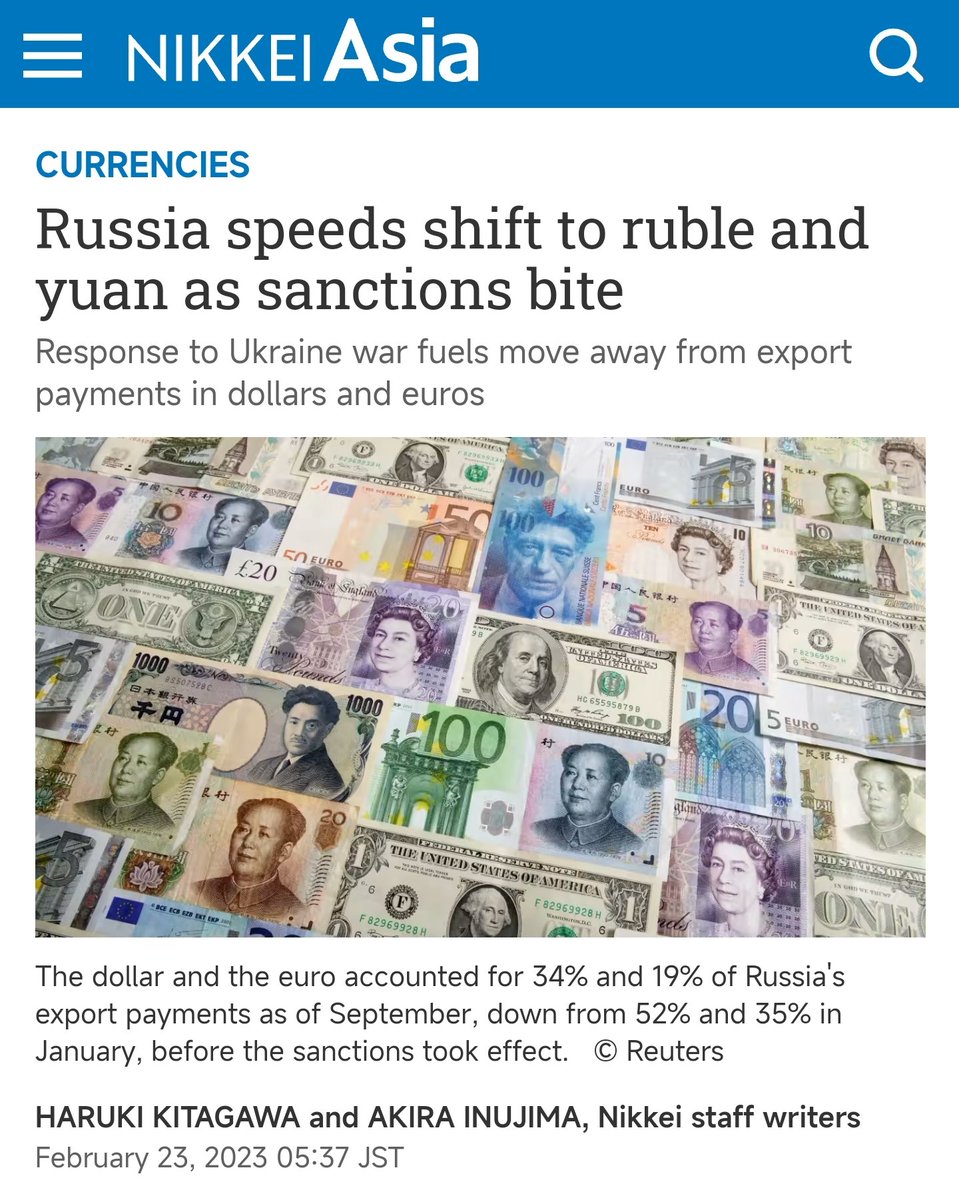
The dollar and the euro accounted for 34% and 19% of Russia's export payments as of September, according to its central bank — down from 52% and 35% in January, before the sanctions took effect.
Some European importers are now also paying in rubles. European sanctions on Russian oil have fueled a rise in exports to Asia, further accelerating a shift toward the yuan.
Foreign investors, previously responsible for 10% or so of Russian government bond transactions, have almost fully exited the market.
#Iraq says it plans to pay for private sector imports from China in yuan in order to inject foreign currency into the financial system and help ease pressure on the dinar.
bloomberg.com
bloomberg.com
The UAE and India have been working on boosting non-oil commerce in rupees and Saudi Arabia’s finance minister has recently said the kingdom is open to trade in currencies other than the dollar.
Iraq, OPEC’s second-largest producer, has been stepping up efforts to stabilize the dinar after revaluing it earlier this month. It has experienced dollar shortages after coming under pressure from the US to limit the flow of money into neighboring Iran.
This is happening as countries weigh up the US currency for global trade and forge deeper economic ties with emerging powers in Asia. China’s been pushing the yuan’s use in transactions with major energy and commodity exporters.
But Middle East officials are quick to say that the dollar will continue to remain the currency of choice for energy, and spell out the downsides of moving more of their trade into other currencies.
India's GDP probably rose 4.7% last quarter from a year ago, according to a median estimate of economists in a Bloomberg survey. That will be the slowest quarterly performance since the 4.09% expansion in Q1 of last year.
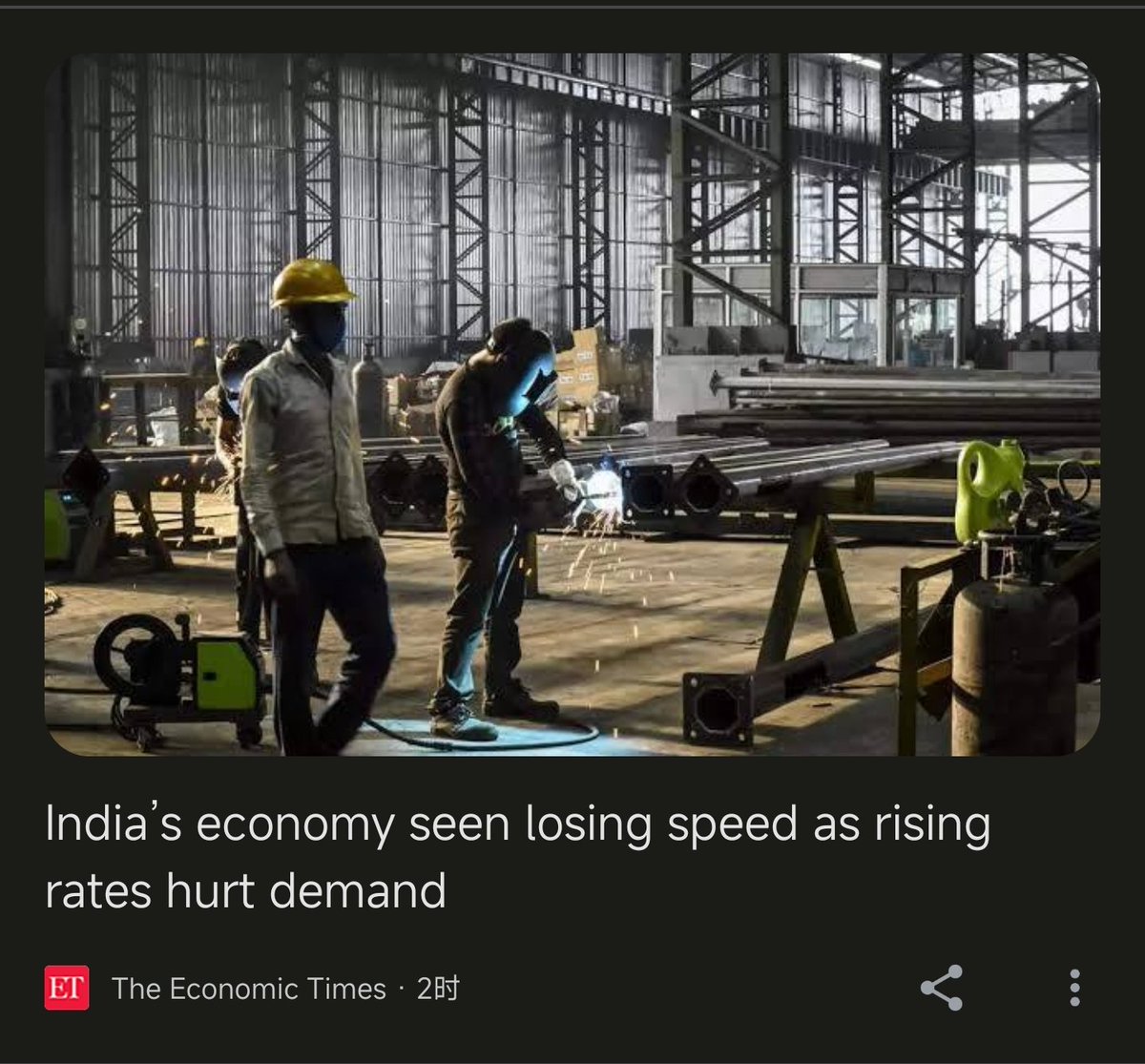
Waning consumption, which accounts for 60% of GDP, risks hurting growth in Asia’s third-largest economy, as borrowing costs rise.
Russia Turns to China's Yuan in Effort to Ditch the Dollar - The Wall Street Journal wsj.com
Moscow has jettisoned concerns about giving China too much leverage over its economy, said Alexander Gabuev, a senior fellow at the Carnegie Endowment for International Peace.
“Now it’s the only rational choice for Russia and for Putin,” Mr. Gabuev said.
“Now it’s the only rational choice for Russia and for Putin,” Mr. Gabuev said.
A spox for the Russian Ministry of Finance said the yuan is “taking an increasingly important role” in its sovereign-wealth fund, which doubled the share of yuan it can hold to 60% in December. The ministry started selling yuan in January to plug its widening budget deficit.
Households are warming up to the yuan. Nearly 50 financial institutions offer yuan savings accounts.
Russian financial blogger and consultant Olga Gogaladze, who has more than 2 million Instagram followers, in October published a guide to the yuan after being inundated with questions about the currency last year.
China launched a cross-border payments system known as CIPS in 2015 that has been billed as an eventual competitor to the 50-year-old SWIFT network. But its system hasn’t yet been widely adopted by other countries.
Loading suggestions...