

I really enjoyed most recent chartbook from @adam_tooze --
Made me realize how much depth is lost when Adam's thoughts are squeezed into an FT column.
adamtooze.substack.com
Made me realize how much depth is lost when Adam's thoughts are squeezed into an FT column.
adamtooze.substack.com
This, from Tooze's FT column, resonated with me ...
for fairly obvious reasons I hope.
for fairly obvious reasons I hope.

I am after all fundamentally an empiricist. My stock in trade is to find big claims that aren't actually backed by the data. When numbers and narrative conflict, I usually go with the numbers.
And the numbers on "globalization", at least as it relates to China, are clear --
China's economy reglobalized (asymmetrically) after the pandemic (China's exports are up v its GDP and way up v WGDP) even as the policy discussion shifted to what is often called "deglobalization"
China's economy reglobalized (asymmetrically) after the pandemic (China's exports are up v its GDP and way up v WGDP) even as the policy discussion shifted to what is often called "deglobalization"
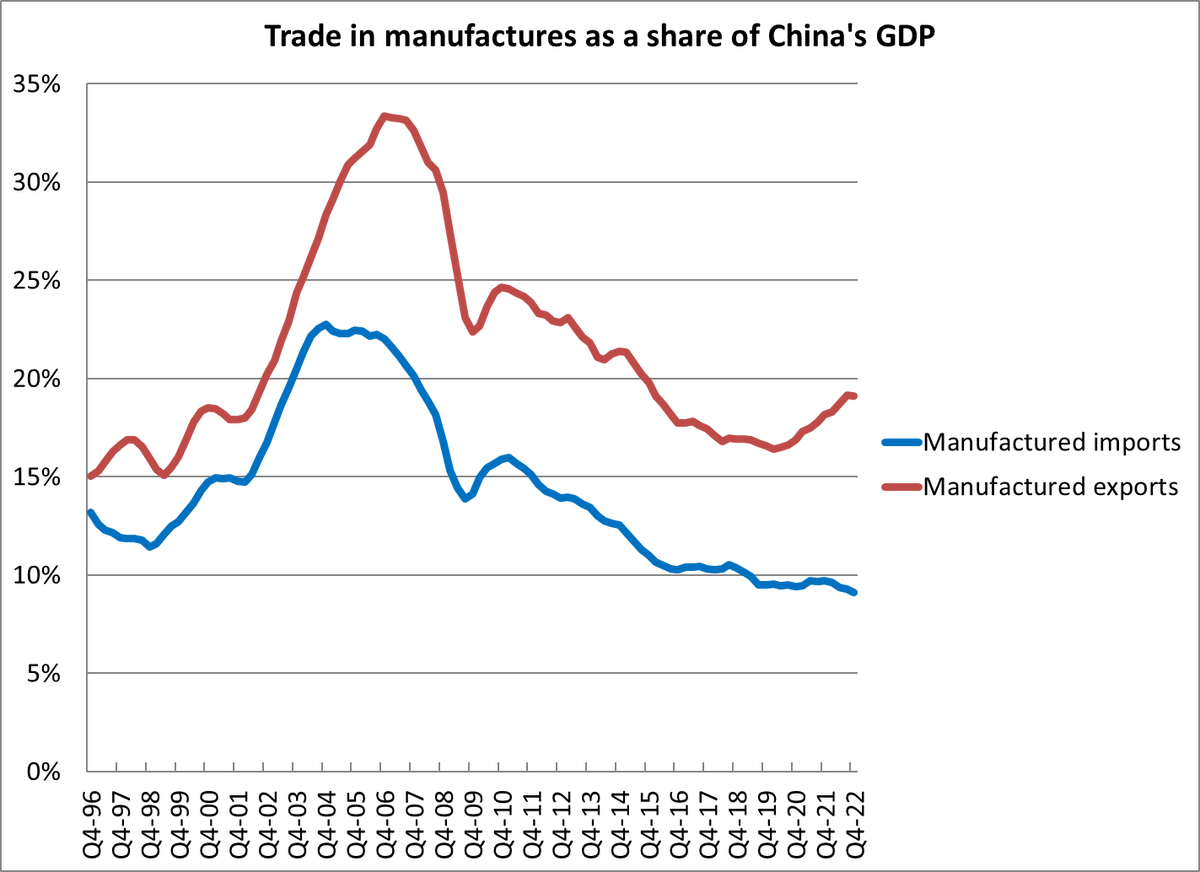
Gaps between rhetoric and reality are important -- it would be a profound error if policy makers around the world acted is if China's role in global manufacturing has already diminished, or if Chinese policy makers didn't realize that they rely more than 5ys ago on global demand
I am not a fan of analytically sloppy talking points to to speak, which sometimes gets me into trouble (I should never edit USG talking points on Ireland, for example)
But Adam Tooze is anything but analytically sloppy -- his essay captures a set of very real tensions.
But Adam Tooze is anything but analytically sloppy -- his essay captures a set of very real tensions.
I am also quite vested in the realization of the Biden Administration's policy goals -- and they do imply rather profound shifts in international economics (the US isn't keen for the rather large shift its its share of high tech exports for example to continue).
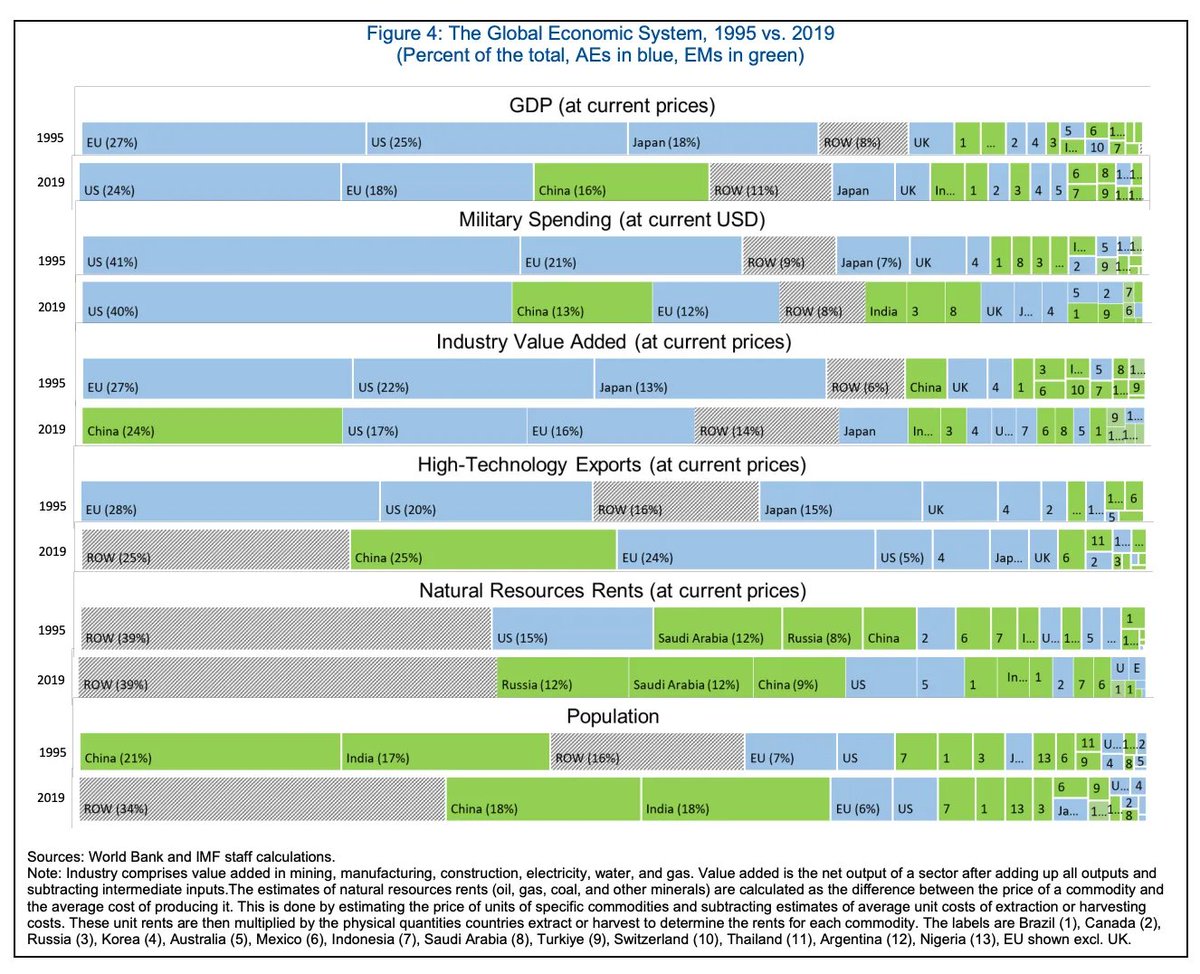
Securing the IP profits from design and marketing while offshoring the actual manufacturing and in some cases the technical engineering and in nearly all cases the taxable profit :) does not quite cut it in an era market by concerns about supply chain resilience & security ...
the empiricist in me would resolve the tension that Adam highlights by noting that the likely effect of actual Biden Administration policies on most measures of globalization will be modest ...
that is in part b/c the Biden Administration didn't have the votes (to my great disappointment) to end the component of globalization that has fundamentally been spurred by multinational tax avoidance ...
and it is in part because the world is complex and simply adopting measure that don't quite fit into the old pro-globalization matrix (or into a strict interpretation of the WTO's rules) doesn't necessarily mean the end of globalization.
the EV provisions in the Inflation Reduction Act for example are much more about avoiding a new China shock and an intensification of globalization (if EV manufacturing were to move to China like electronics manufacturing) than ending regional trade ...
And most of the semiconductors produced in fabs that the US and the EU will now subsidize will still be exported and feed into the Asian electronics supply chain (whether in China, SE Asia or India) without much more radical policies than those that have now been implemented ...
But fundamentally it is just a great, thought provoking essay -- in the classic tradition of great essays.
Highly recommended.
adamtooze.substack.com
Highly recommended.
adamtooze.substack.com
p.s. Twitter's algo does seem to be a bit degraded right now. By any reasonable measure it should have brought Tooze's essay to my attention much earlier today ... something is off
Loading suggestions...