

ChatGPT is everywhere and everyone is using it.
But most academics don't know how to use it *smartly.*
Here's how to use ChatGPT intelligently (and ethically) for academic purposes:
But most academics don't know how to use it *smartly.*
Here's how to use ChatGPT intelligently (and ethically) for academic purposes:
What do I mean by using ChatGPT intelligently?
Most people use it to create *content.*
ChatGPT uses a prediction model, so the content will always be predictable.
This is NOT an intelligent use of ChatGPT.
Most people use it to create *content.*
ChatGPT uses a prediction model, so the content will always be predictable.
This is NOT an intelligent use of ChatGPT.
Instead, use ChatGPT to create *structure.*
Example👇
Example👇
1. Outline for a research/seminar paper
Example prompt:
Topic: Pakistan-US relations during last 20 years
Context: Graduate seminar at School of Advanced International Studies
Requirement: Outline for a seminar paper with research questions
Language: Academic
Tone: Formal
Example prompt:
Topic: Pakistan-US relations during last 20 years
Context: Graduate seminar at School of Advanced International Studies
Requirement: Outline for a seminar paper with research questions
Language: Academic
Tone: Formal

ChatGPT has created a useful outline with topics and subtopics.
It has given you a *structure.*
Don't use the exact headings, although in this case some are quite helpful.
Use this structure to get started on your paper.
Modify it to according to your requirements.
It has given you a *structure.*
Don't use the exact headings, although in this case some are quite helpful.
Use this structure to get started on your paper.
Modify it to according to your requirements.
2. Brainstorm research questions
Example prompt:
Topic: How Hans Christian Andersen's stories are read in South Asia
Context: Hans Christian Andersen as World Literature
Requirement: Generate ten research questions for a journal article
Language: Academic
Tone: Formal
Example prompt:
Topic: How Hans Christian Andersen's stories are read in South Asia
Context: Hans Christian Andersen as World Literature
Requirement: Generate ten research questions for a journal article
Language: Academic
Tone: Formal

Questions 4, 5, 7, and 10 are quite useful for the kind of project I am currently doing.
I'll use these questions to structure my project, but I'll not use these exact sentences.
Instead, I will prepare answers to these questions.
I'll use these questions to structure my project, but I'll not use these exact sentences.
Instead, I will prepare answers to these questions.
3. Draft a personal statement for a scholarship/graduate school
Example prompt:
Topic: Personal statement of a working-class woman from small-town Pakistan
Context: Fulbright scholarship for a Master's in International Relations
Language: Accessible
Example prompt:
Topic: Personal statement of a working-class woman from small-town Pakistan
Context: Fulbright scholarship for a Master's in International Relations
Language: Accessible

ChatGPT has created a personal statement with 5 paragraphs:
1. Personal background
2. Educational background
3. Why you're applying for a Fulbright
4. Future goals
5. Wrap up
Use this structure to tell your own story and you will have a decent draft of your personal statement.
1. Personal background
2. Educational background
3. Why you're applying for a Fulbright
4. Future goals
5. Wrap up
Use this structure to tell your own story and you will have a decent draft of your personal statement.
4. Interview preparation
Example prompt:
Topic: Interview for a Fulbright scholarship
Context: PhD in Microbiology
Requirement: Generate ten questions interviewers are likely to ask
Example prompt:
Topic: Interview for a Fulbright scholarship
Context: PhD in Microbiology
Requirement: Generate ten questions interviewers are likely to ask
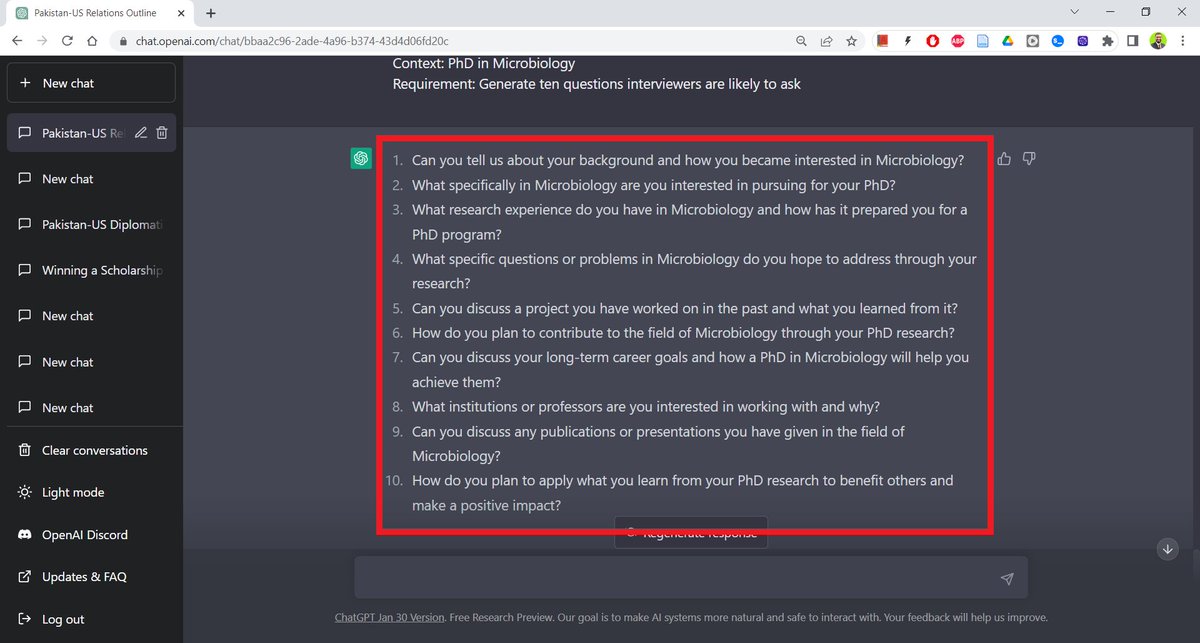
From personal experience, I was asked 7 questions in my interview that were along the lines suggested by ChatGPT.
Write answers to these questions.
Rehearse them a few times and you'll all set for your interview.
Write answers to these questions.
Rehearse them a few times and you'll all set for your interview.
5. Presentation preparation
Example prompt:
Topic: Academic writing for non-native speakers
Context: Presentation at the University of Southern Denmark
Requirement: Break down of presentation
Language: Accessible
Tone: Formal
Example prompt:
Topic: Academic writing for non-native speakers
Context: Presentation at the University of Southern Denmark
Requirement: Break down of presentation
Language: Accessible
Tone: Formal

Chat GPT has given me a detailed break down, which is quite useful.
If I were to give a presentation, I will modify these section/sub-section headings slightly and write my own content.
If I were to give a presentation, I will modify these section/sub-section headings slightly and write my own content.
Combine
ChatGPT's artificial intelligence
with
Your own natural intelligence
and you'll be unstoppable — Porsche with no brakes 😀
ChatGPT's artificial intelligence
with
Your own natural intelligence
and you'll be unstoppable — Porsche with no brakes 😀
Found this thread useful?
1. Scroll to the top and press the "Like" button on the first tweet.
2. Follow me @MushtaqBilalPhD for more threads on how to smartly use AI for academic purposes.
1. Scroll to the top and press the "Like" button on the first tweet.
2. Follow me @MushtaqBilalPhD for more threads on how to smartly use AI for academic purposes.
If you want more tips on how to use ChatGPT intelligently and ethically, sign up below for my free newsletter, "Keep Writing"
keepwriting.beehiiv.com
keepwriting.beehiiv.com

@dobsonstephen @ProfVershinina The reason someone like can't make it to Oxford or Cambridge is not because we are any less capable.
It's because we don't have the resources and when compared to those with access to resources, admission committees assume we don't have the *ability.*
It's because we don't have the resources and when compared to those with access to resources, admission committees assume we don't have the *ability.*
Folks, when you subscribe to my newsletter, please look in your promotions folder for a confirmation email.
Gmail filters newsletters to promotions by default. Drag it to your primary folder so you don't miss it.
Gmail filters newsletters to promotions by default. Drag it to your primary folder so you don't miss it.
Loading suggestions...