

If you invest in foreign stocks, then you must understand implication of changes in TCS (Tax Collected at Source) brought in Budget 2023.
Here's a simple thread to highlight the same. Read on 🧵👇
Here's a simple thread to highlight the same. Read on 🧵👇

Before we understand what TCS (Tax Collected at source) is and how it works let us first understand few basic concepts.
Let us start with the concept of Financial Year.
Let us start with the concept of Financial Year.
What is a Financial Year?
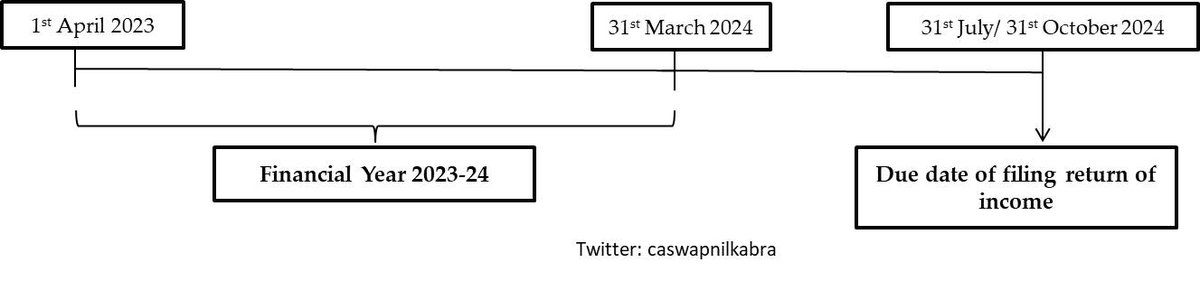
Financial year is a 12 months period which starts from 1st April and ends on 31st March of the next year. FY23-24 shall start on 1st April 2023 and end on 31st March 2024.
During this budget 2023, there were multiple changes brought for the FY 23-24.
Financial year is a 12 months period which starts from 1st April and ends on 31st March of the next year. FY23-24 shall start on 1st April 2023 and end on 31st March 2024.
During this budget 2023, there were multiple changes brought for the FY 23-24.
Basically, every year the budget brings in changes for the upcoming financial year.
Hence, income tax is an ever changing subject and one needs to constantly keep up with the amendments to understand it better.
Hence, income tax is an ever changing subject and one needs to constantly keep up with the amendments to understand it better.
Another important concept to understand here is the due date of filing income tax return.
For FY 23-24, a person needs to calculate the income during this time frame and file his return of income before 31st July 2024.
For FY 23-24, a person needs to calculate the income during this time frame and file his return of income before 31st July 2024.
To put it in simple way, one gets approximately 4 months to calculate the income for FY23-24 and do the taxes and pay the amount to the government.
In some complicated cases where tax audit is applicable or in case of companies, the due date is 31st October (7 months time from the end of FY).
What is income tax and how is payment of income tax done?
Income tax is a direct tax on your income. And this can be paid in the following ways:
🔸Advance Tax
🔸TDS
🔸TCS
🔸Self-Assessment Tax
Income tax is a direct tax on your income. And this can be paid in the following ways:
🔸Advance Tax
🔸TDS
🔸TCS
🔸Self-Assessment Tax
Advance Tax is applicable to those assessess whose income tax liability during the year exceeds Rs.10,000.
As the name (advance) suggests, It has to be paid during the financial year itself (before 31st March 2024 for FY 23-24).
As the name (advance) suggests, It has to be paid during the financial year itself (before 31st March 2024 for FY 23-24).
TDS is Tax deducted at source.
Essentially, the payer of income deducts the tax amount and pays the net amount to the payee.
For ex: Employer will deduct the tax and pay net proceeds to the employee.
Essentially, the payer of income deducts the tax amount and pays the net amount to the payee.
For ex: Employer will deduct the tax and pay net proceeds to the employee.
If your income tax liability for the financial year cannot be adjusted through Advance tax, TDS and TCS, you can pay balance tax by way of self-assessment tax just by filing the challan in the bank.
Now let us address the elephant in the room. What is TCS? And how it works?
TCS is tax collected at source. The seller of goods or services has to collect the tax from the buyer as per the applicable rates. This may sound like GST but it is not so. TCS is a sort of income tax.
TCS is tax collected at source. The seller of goods or services has to collect the tax from the buyer as per the applicable rates. This may sound like GST but it is not so. TCS is a sort of income tax.
Before the budget 2023, TCS of 5% was applicable on foreign outward remittances above INR 7 lakhs.
To say, if you wanted to buy US stocks, you obviously have to convert INR into USD.
To say, if you wanted to buy US stocks, you obviously have to convert INR into USD.
However, earlier, if the amount of your remittance exceeded 7 lakh, only in that case the bank was required to deduct TCS at 5%.
For example: Someone wanting to convert 10 lakh Indian Rupee into US Dollar, the bank would deduct 5% of 3 lakh which translates to 60k. This 60k is TCS.
But now, after the amendment in Budget 2023, Tax Collection at Source (TCS) for foreign outward remittance under Liberalised Remittance Scheme (LRS) (other than for Education and medical purpose) of 20% shall apply from July 1, 2023.
So, if someone now wants to convert 10 lakh INR into USD for buying US stocks, the bank will deduct TCS at 20% on 10 lakh.
So, you will effectively get only 8 lakh for investing and balance 2 lakh shall be TCS amount collected by bank and paid to the government as income tax.
So, you will effectively get only 8 lakh for investing and balance 2 lakh shall be TCS amount collected by bank and paid to the government as income tax.
This amount of TCS can be claimed in the income tax return.
Suppose your income tax liability for FY23-24 arrives at Rs. 5 lakh. Now, you have to pay just Rs.3 lakh as you can claim credit of TCS of Rs. 2 lakh.
Suppose your income tax liability for FY23-24 arrives at Rs. 5 lakh. Now, you have to pay just Rs.3 lakh as you can claim credit of TCS of Rs. 2 lakh.
For someone who pays substantially large amount of advance tax, this amendment means a little.
For example, in above case, if income tax liability of a person arrives at Rs.5 lakh, he needs to pay the entire amount in advance to the government.
For example, in above case, if income tax liability of a person arrives at Rs.5 lakh, he needs to pay the entire amount in advance to the government.
Now, as TCS of Rs.2 lakh is already paid, he needs to adjust the Advance tax and pay just Rs.3 lakh instead of Rs. 5 lakh.
To put in simple words, excess amount paid in the form of TCS because of the amendment can be adjusted by paying less amount of Advance Tax.
To put in simple words, excess amount paid in the form of TCS because of the amendment can be adjusted by paying less amount of Advance Tax.
However, for others, this amendment would mean blockage of 20% of capital for more than 1 year till the time he gets refund or pays the income tax as the case may be.
The TCS is applicable only of foreign outward remittances, i.e only when you are converting INR into USD for investing abroad.
If you have sold your US stocks and want to get back the USD into INR, TCS won't apply here.
If you have sold your US stocks and want to get back the USD into INR, TCS won't apply here.
If you think this thread added value, then do retweet this for larger reach.
I intend to keep this thread open for adding things as required.
Cheers 😎
I intend to keep this thread open for adding things as required.
Cheers 😎
A correction:
TCS amount in this tweet translates to 15k and not 60k 🥲
TCS amount in this tweet translates to 15k and not 60k 🥲
TCS is only on foreign outward remittances when you buy US stocks directly.
Mutual Funds and ETFs are not covered here.
Hence, those investing in US stocks via MF or ETF need not worry.
Mutual Funds and ETFs are not covered here.
Hence, those investing in US stocks via MF or ETF need not worry.
Loading suggestions...