

My podcast has 1.5 million downloads. It's won awards and is even part of the @HubSpot Podcast Network.
...but that podcast has also been the hardest platform for me to grow.
If I had to start over, here's what I'd do: 🧵
...but that podcast has also been the hardest platform for me to grow.
If I had to start over, here's what I'd do: 🧵
1. Find a cohost
Podcasters often play a role of "friend" to the listener. It's comforting to spend time with a friend every week!
It's even EASIER to feel like a friend when there are TWO familiar voices speaking to each other (as friends).
Cohosts are just fun to listen to.
Podcasters often play a role of "friend" to the listener. It's comforting to spend time with a friend every week!
It's even EASIER to feel like a friend when there are TWO familiar voices speaking to each other (as friends).
Cohosts are just fun to listen to.
2. Design a unique premise
The average podcast listener listens to about 7 different podcasts.
That sounds like a lot – but it isn't.
To be in the heavy rotation, you need a REALLY good show – and you probably can't compete on budget.
The solution is a truly unique premise.
The average podcast listener listens to about 7 different podcasts.
That sounds like a lot – but it isn't.
To be in the heavy rotation, you need a REALLY good show – and you probably can't compete on budget.
The solution is a truly unique premise.
3. Skip the interviews
The interview format is one of the most competitive formats. It depends on either HUGE names or a *ton* of listener trust.
In the beginning, it's hard to have either.
Instead, I'd base my format around a curious/knowledgeable cohost + a unique premise.
The interview format is one of the most competitive formats. It depends on either HUGE names or a *ton* of listener trust.
In the beginning, it's hard to have either.
Instead, I'd base my format around a curious/knowledgeable cohost + a unique premise.
4. Err on the side of being short
The hardest battle is getting a potential listener to click "play" the first time.
The shorter your typical episode, the smaller the ask for someone to give it a shot.
Think less than 15 minutes – even <10.
Shorter shows = faster growth.
The hardest battle is getting a potential listener to click "play" the first time.
The shorter your typical episode, the smaller the ask for someone to give it a shot.
Think less than 15 minutes – even <10.
Shorter shows = faster growth.
5. Publish less frequently
The reason shows publish weekly or even multiple times per week is because when you sell ads, more episodes = more $$$.
In the beginning, you probably won't be selling ads.
So you can publish less frequently until it feels easy to ramp up.
The reason shows publish weekly or even multiple times per week is because when you sell ads, more episodes = more $$$.
In the beginning, you probably won't be selling ads.
So you can publish less frequently until it feels easy to ramp up.
6. Plan to be video-first
YouTube is a HUGE opportunity. And rumor has it they have big podcasting plans.
Even if that rumor is overblown, putting episodes on YouTube gives them a MUCH longer shelf-life *and* natural discoverability.
It's hard to go from audio → video later.
YouTube is a HUGE opportunity. And rumor has it they have big podcasting plans.
Even if that rumor is overblown, putting episodes on YouTube gives them a MUCH longer shelf-life *and* natural discoverability.
It's hard to go from audio → video later.
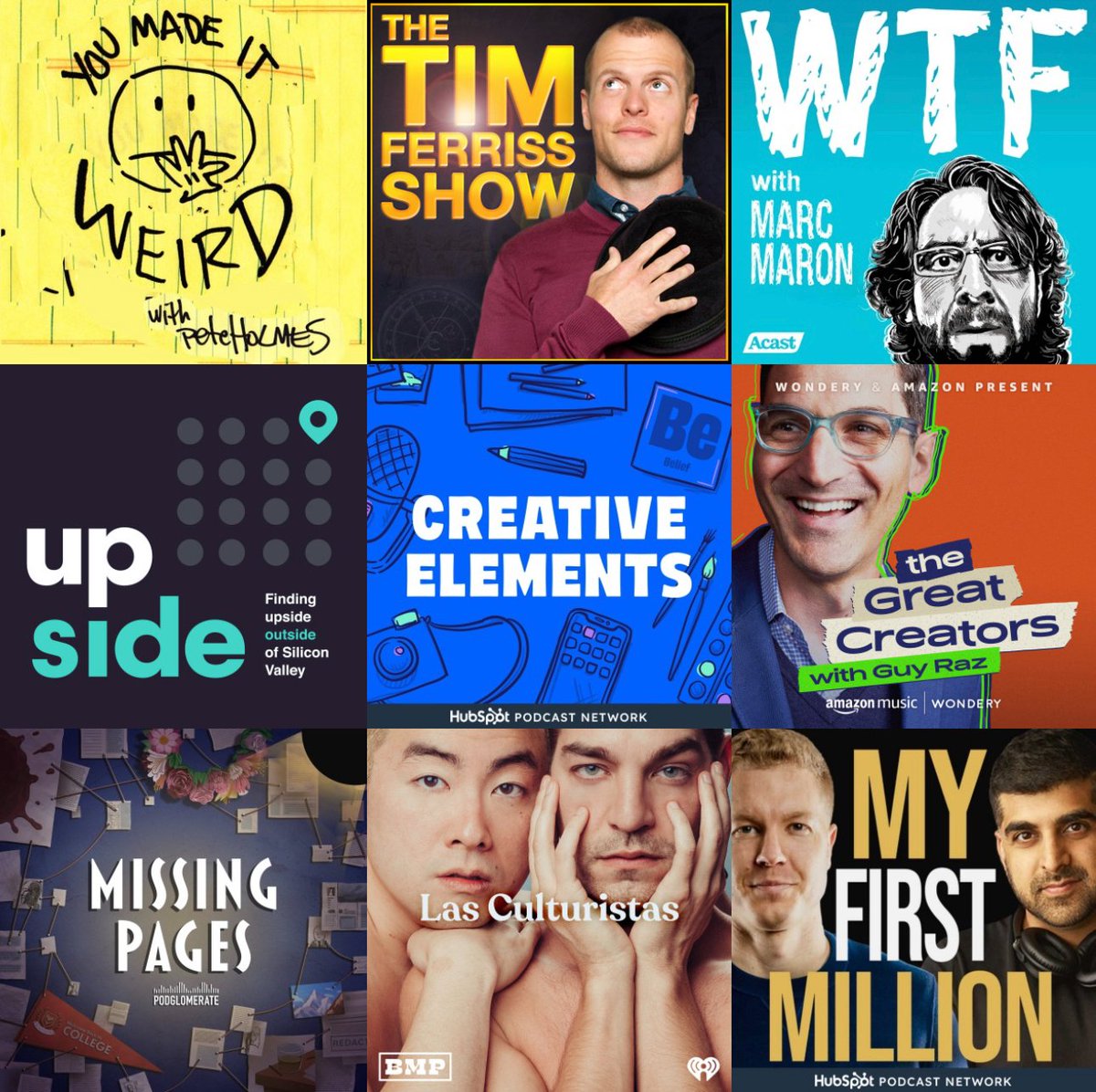
7. Create GREAT artwork
Podcast artwork is seen as very small in most places. You want it to be visually appealing (quickly).
Emphasize the name of the show – that's what is memorable and referrable.
Which artwork (and show title) catches your eye first?
Podcast artwork is seen as very small in most places. You want it to be visually appealing (quickly).
Emphasize the name of the show – that's what is memorable and referrable.
Which artwork (and show title) catches your eye first?
8. Hire an audio engineer
In the audio medium, your audio quality is PARAMOUNT.
Odds are, you didn't train to be an audio engineer. So don't waste your time trying to make your own audio sound good – just hire someone who can do it quickly.
It's much cheaper in the long run.
In the audio medium, your audio quality is PARAMOUNT.
Odds are, you didn't train to be an audio engineer. So don't waste your time trying to make your own audio sound good – just hire someone who can do it quickly.
It's much cheaper in the long run.
9. Form a listener identity
Some of the biggest shows build an identity for their listeners.
They form a *community.*
Pete Holmes calls his listeners "Weirdos." Marc Maron calls his listeners "What The Fuckers." Alex Hormozi has "Mozination."
Help give your listeners a name.
Some of the biggest shows build an identity for their listeners.
They form a *community.*
Pete Holmes calls his listeners "Weirdos." Marc Maron calls his listeners "What The Fuckers." Alex Hormozi has "Mozination."
Help give your listeners a name.
10. Plan for ads from the start
Even though you likely won't sell ads in the beginning, you can still create ad spots for your own internal promotion.
Shout out your newsletter, a product, or your YouTube channel.
Get listeners used to taking short breaks for future sponsors.
Even though you likely won't sell ads in the beginning, you can still create ad spots for your own internal promotion.
Shout out your newsletter, a product, or your YouTube channel.
Get listeners used to taking short breaks for future sponsors.
11. Join (or form) a network
I've been lucky to work with podcast networks from the beginning and it has had a HUGE positive impact on marketing the show.
Join a network that is home to other shows with a similar ideal audience.
Cross-promote each other.
I've been lucky to work with podcast networks from the beginning and it has had a HUGE positive impact on marketing the show.
Join a network that is home to other shows with a similar ideal audience.
Cross-promote each other.
12. Add a CTA to every episode
Every episode is an opportunity to drive those listeners to some action – following you on Twitter, subscribing to your newsletter, etc.
In the beginning, that may feel pointless (because few will be listening).
Over time, those CTAs add up.
Every episode is an opportunity to drive those listeners to some action – following you on Twitter, subscribing to your newsletter, etc.
In the beginning, that may feel pointless (because few will be listening).
Over time, those CTAs add up.
13. Recognize podcasting for what it is
Podcasting is *not* a quick way to build an audience. It may not even be a SLOW way to build an audience!
Podcasting is a great way to deepen trust with your existing audience. It really can accelerate relationships very quickly.
Podcasting is *not* a quick way to build an audience. It may not even be a SLOW way to build an audience!
Podcasting is a great way to deepen trust with your existing audience. It really can accelerate relationships very quickly.
14. Plan for the long-term (or pass on this entirely)
You won't see quick results with podcasting. That's why most podcasters "podfade" after about seven episodes.
If you're not willing to do this for years, consider not doing it at all.
You won't see quick results with podcasting. That's why most podcasters "podfade" after about seven episodes.
If you're not willing to do this for years, consider not doing it at all.
That's it! Happy podcasting, my friend. If you have any questions, just hit comment.
And if you enjoyed this thread:
1. Follow me for more advice on becoming a smarter creator
2. RT the tweet below to share it with your friends ⬇️
And if you enjoyed this thread:
1. Follow me for more advice on becoming a smarter creator
2. RT the tweet below to share it with your friends ⬇️
@HubSpot If you like tweets like this, you would love my newsletter, Creator Science!
Each week I dig into the science of what makes today's top creators successful. By learning from their example, you'll grow faster too.
Join 17K+ subscribers here: sparklp.co
Each week I dig into the science of what makes today's top creators successful. By learning from their example, you'll grow faster too.
Join 17K+ subscribers here: sparklp.co
Loading suggestions...