

(1/17)
About:
HAL was incorporated in 1964 by the amalgamation of Hindustan Aircraft Limited & Aeronautics India Limited.
It is a ‘Navratna’ company & GOI holds majority stake of 75.15% in the company while 5.01% was held by the Life Insurance Corporation of India.
About:
HAL was incorporated in 1964 by the amalgamation of Hindustan Aircraft Limited & Aeronautics India Limited.
It is a ‘Navratna’ company & GOI holds majority stake of 75.15% in the company while 5.01% was held by the Life Insurance Corporation of India.
(2/17)
Industry Overview:
The Defense sector is expected to grow in 2023. Due to continued global geopolitical conflicts, many
countries may significantly increase Defense budgets and remain committed to strengthening their military capabilities.
Industry Overview:
The Defense sector is expected to grow in 2023. Due to continued global geopolitical conflicts, many
countries may significantly increase Defense budgets and remain committed to strengthening their military capabilities.
(3/17)
Indian A&D:
The Indian A&D Industry is dominated by Defence sector.
Therefore Defence projects, policies and funding by GOI play crucial role in development of A&D industry in India
India is at 3rd position in world in terms of military spending with $64billion in 2022.
Indian A&D:
The Indian A&D Industry is dominated by Defence sector.
Therefore Defence projects, policies and funding by GOI play crucial role in development of A&D industry in India
India is at 3rd position in world in terms of military spending with $64billion in 2022.
(4/17)
In the recent years significant impetus has been given by the
GOI to develop and strengthen the A&D Industry in
the country.
Significant thrust has been given to the indigenisation of Defence
equipment under “Aatmnirbhar Bharat” movement to reduce
Defence import bill.
In the recent years significant impetus has been given by the
GOI to develop and strengthen the A&D Industry in
the country.
Significant thrust has been given to the indigenisation of Defence
equipment under “Aatmnirbhar Bharat” movement to reduce
Defence import bill.
(5/17)
HAL Organisation Structure:
HAL has 20 Production Divisions and 10 R&D Centres co-located with the Production Divisions. These Divisions / R&D Centres are located at nine geographic
locations in seven states across the country.
HAL Organisation Structure:
HAL has 20 Production Divisions and 10 R&D Centres co-located with the Production Divisions. These Divisions / R&D Centres are located at nine geographic
locations in seven states across the country.
(6/17)
Company Strategy:
• Diversify into civil market for both manufacturing and MRO opportunities
• Enhance indigenisation
• Expand operations globally through collaborations with global partners
• Focus on increasing operational efficiencies by adapting latest tech.
Company Strategy:
• Diversify into civil market for both manufacturing and MRO opportunities
• Enhance indigenisation
• Expand operations globally through collaborations with global partners
• Focus on increasing operational efficiencies by adapting latest tech.
(7/17)
• Exploring global market & export opportunities
• Enhance customer satisfaction & improved quality of products & services
• Strategic product development to bring out right products for their customers at right time
• Exploring global market & export opportunities
• Enhance customer satisfaction & improved quality of products & services
• Strategic product development to bring out right products for their customers at right time
(8/17)
Key Strengths:
• Trusted partner of Indian Defence Forces for providing support to aging fleets.
• They cater a large spectrum of aerospace business like R&D, Production & MRO of the Fixed-wing Aircraft, Rotary-wing Aircraft,
Aero-engines, LRUs & airborne systems.
Key Strengths:
• Trusted partner of Indian Defence Forces for providing support to aging fleets.
• They cater a large spectrum of aerospace business like R&D, Production & MRO of the Fixed-wing Aircraft, Rotary-wing Aircraft,
Aero-engines, LRUs & airborne systems.
(9/17)
• Stable revenue visibility:
It is expected to remain robust as HAL undertakes the repair and maintenance work of aircraft manufactured by it
for its entire life as well as for aircraft manufactured by others for which it has built infrastructure across the country.
• Stable revenue visibility:
It is expected to remain robust as HAL undertakes the repair and maintenance work of aircraft manufactured by it
for its entire life as well as for aircraft manufactured by others for which it has built infrastructure across the country.
(10/17)
• Margin Protection:
Given the significantly long tenure of its contracts, HAL enters into variable price contracts with its customers, which have escalation clauses for increase in cost including forex fluctuation on
procurement & YoY escalation built-in the pricing.
• Margin Protection:
Given the significantly long tenure of its contracts, HAL enters into variable price contracts with its customers, which have escalation clauses for increase in cost including forex fluctuation on
procurement & YoY escalation built-in the pricing.
(11/17)
• Improvement in the operating cycle & continued low reliance on debt:
Timely realisation of dues has resulted in continued low reliance on debt. Debtor days is down from 191 in FY20 to 69 in FY22
Resulted in the overall gearing ratio of almost nil as on March 31,22.
• Improvement in the operating cycle & continued low reliance on debt:
Timely realisation of dues has resulted in continued low reliance on debt. Debtor days is down from 191 in FY20 to 69 in FY22
Resulted in the overall gearing ratio of almost nil as on March 31,22.
(12/17)
Weakness:
Limited Exports:
HAL derives majority of its revenues from the Indian defence sector. Accordingly, continuous flow of orders from defence segment which in turn is dependent upon defence budget is critical for the company’s prospects.
Weakness:
Limited Exports:
HAL derives majority of its revenues from the Indian defence sector. Accordingly, continuous flow of orders from defence segment which in turn is dependent upon defence budget is critical for the company’s prospects.
(13/17)
• Increasing private sector participation:
Due to relaxation in FDI guidelines, there has been increase in alliance & collaboration between foreign OEMs & Indian private companies
coupled with govt thrust on private participation will lead to increasing competition.
• Increasing private sector participation:
Due to relaxation in FDI guidelines, there has been increase in alliance & collaboration between foreign OEMs & Indian private companies
coupled with govt thrust on private participation will lead to increasing competition.
(14/17)
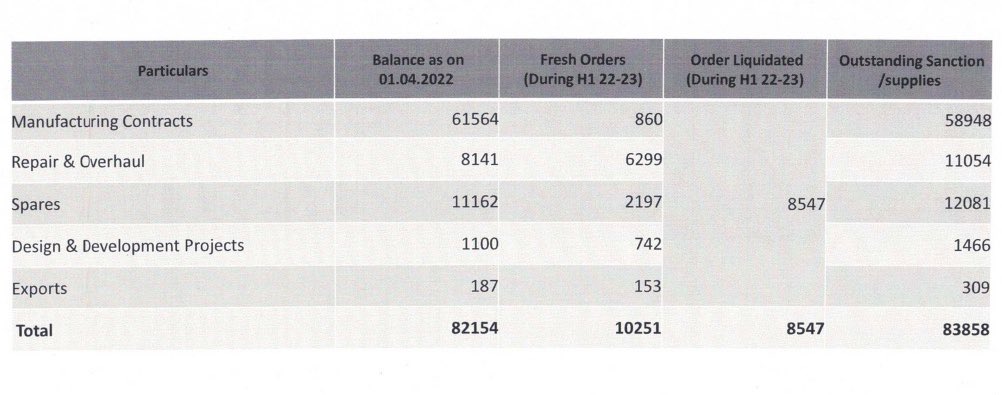
• Order book Status:
• Order book Status:
(15/17)
Financial Performance QoQ
• Revenue up from ₹5145cr in Q2 to ₹5666cr in Q3
• OPM down from 31% to 17%
• NPAT down from 1209cr to 1154cr
Financial Performance QoQ
• Revenue up from ₹5145cr in Q2 to ₹5666cr in Q3
• OPM down from 31% to 17%
• NPAT down from 1209cr to 1154cr
(16/17)
Key Numbers and Ratios:
• Market Cap : ₹ 80,753 Cr.
• Stock P/E: 13.3
• RoCE: 30.5%
• RoE: 29.4%
• PEG: 0.93
• Price to Sales: 3.11
• Int Coverage: 140
• NPM: 20.7%
• D/E: 0.00
Key Numbers and Ratios:
• Market Cap : ₹ 80,753 Cr.
• Stock P/E: 13.3
• RoCE: 30.5%
• RoE: 29.4%
• PEG: 0.93
• Price to Sales: 3.11
• Int Coverage: 140
• NPM: 20.7%
• D/E: 0.00
(17/17)
Conclusion:
We are seeing a flat to downward trend in the budget allocation for defence as a % of GDP since 2018. However, HAL is also witnessing higher order book flow, due to govts policy of import substitution.
@caniravkaria @chartmojo @kuttrapali26
Conclusion:
We are seeing a flat to downward trend in the budget allocation for defence as a % of GDP since 2018. However, HAL is also witnessing higher order book flow, due to govts policy of import substitution.
@caniravkaria @chartmojo @kuttrapali26
Loading suggestions...