

Barcelona are flying high at the top of La Liga thanks to Xavi Hernández. His tactical system represent that of the absolute elites - Juego de Posición, an inverted fullback, narrow wide forwards in the press.
Below, I break down Barca's *NEW* system in forensic detail.
THREAD!
Below, I break down Barca's *NEW* system in forensic detail.
THREAD!
Xavi's Barcelona are a very fluid team who operate in a variety of shapes depending on the phase of play. They start in a 4-2-4 from goal kicks with Frenkie de Jong dropping deep alongside Busquets in the #6 with Pedri high as a situational split striker alongside Lewandowski.
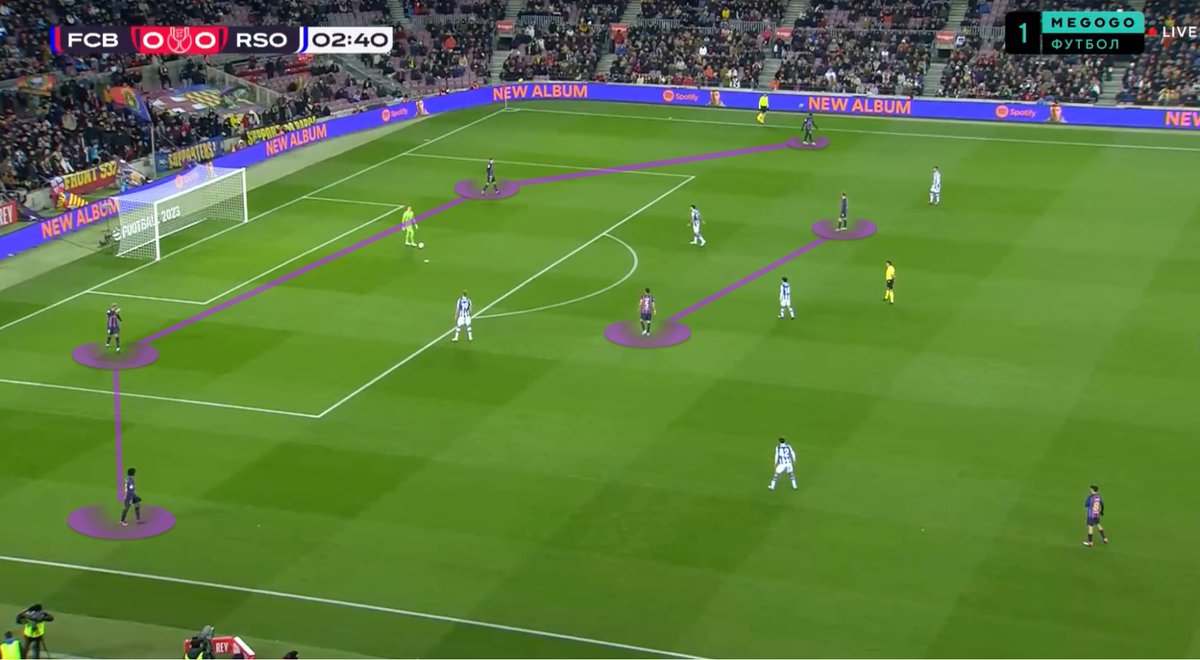
This build-up structure is one the likes of Pep Guardiola or Antonio Conte often use to great effect, and that's because each key area of the pitch is occupied whilst Frenkie dropping deep enables players in the build-up to be in close proximity to limit mistakes where possible.
However, it's a shape that can often be matched up against with relative ease, and this is where ter Stegen has the quality to step into defence to create an overload for Barca.
The German has his critics, but nobody can deny that he is elite distributor.
The German has his critics, but nobody can deny that he is elite distributor.

When Barca progress play out from the first phase they transition into their traditional 4-3-3 shape with their most prevalent XI of late being ter Stegen; Koundé, Araujo, Christensen, Balde; Busquets, Pedri, De Jong; Dembélé, Lewandowski, Gavi.
The quality is off the charts.
The quality is off the charts.

A 4-3-3 shape is a difficult one to execute because although the positional play is good in theory as each key area of the pitch is occupied, the distances between the players are often large. As such, to effectively play it, the technical quality *MUST* be elite.
Barca's is.
Barca's is.
The team is elite technically. Koundé, Araujo, and Christensen are all comfortable dribbling under pressure and breaking lines with their passing, Balde can turn fluidly in any direction and has excellent close control dribbling, FDJ, Pedri, Busquets, & Gavi speak for themselves.
The inclusion of Gavi in the front 3, though, is something "new" for Xavi's Barca, and the idea behind it is centered around technical control.
Barca previously played with two of Dembélé, Raphinha, Ferran, or Fati, but they have taken a more conservative approach lately.
Barca previously played with two of Dembélé, Raphinha, Ferran, or Fati, but they have taken a more conservative approach lately.
Direct profiles on the wings results in a direct attack for a possession based team, but that in itself is counterintuitive as the entire purpose of technical teams is to dominate games with the ball.
However, if there's lots of turnovers due to directness, that's not possible.
However, if there's lots of turnovers due to directness, that's not possible.
This is why Gavi has come into the XI on the left hand-side of Barca's front 3 - he is a technical phenom, and it means Barca are more likely to control games through passing and pushing the opposition back before counterpressing high.
Here, in particular, is where they excel.
Here, in particular, is where they excel.
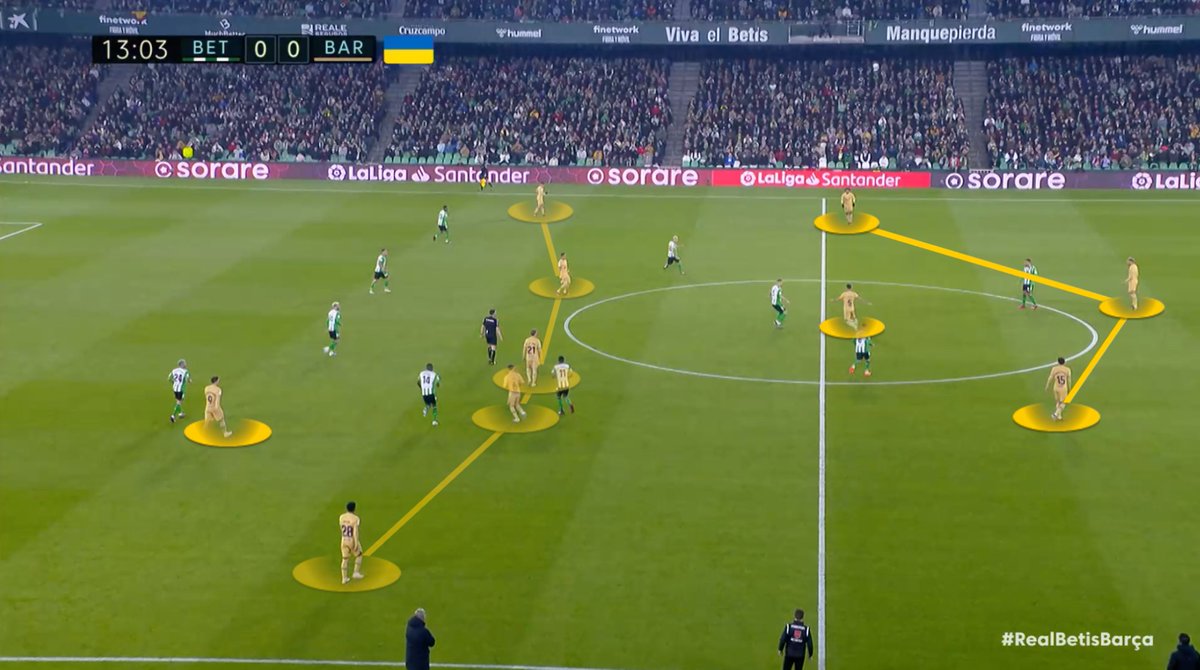
As Gavi isn't a direct winger akin to Ferran, Ansu, or Raphinha, he tucks inside into the left half space where Balde, Jordi Alba, or Marcos Alonso push high and wide on the outside so the team shape begins to resemble a 3-2-5 in attack, akin to how Pep used Cancelo and Foden.

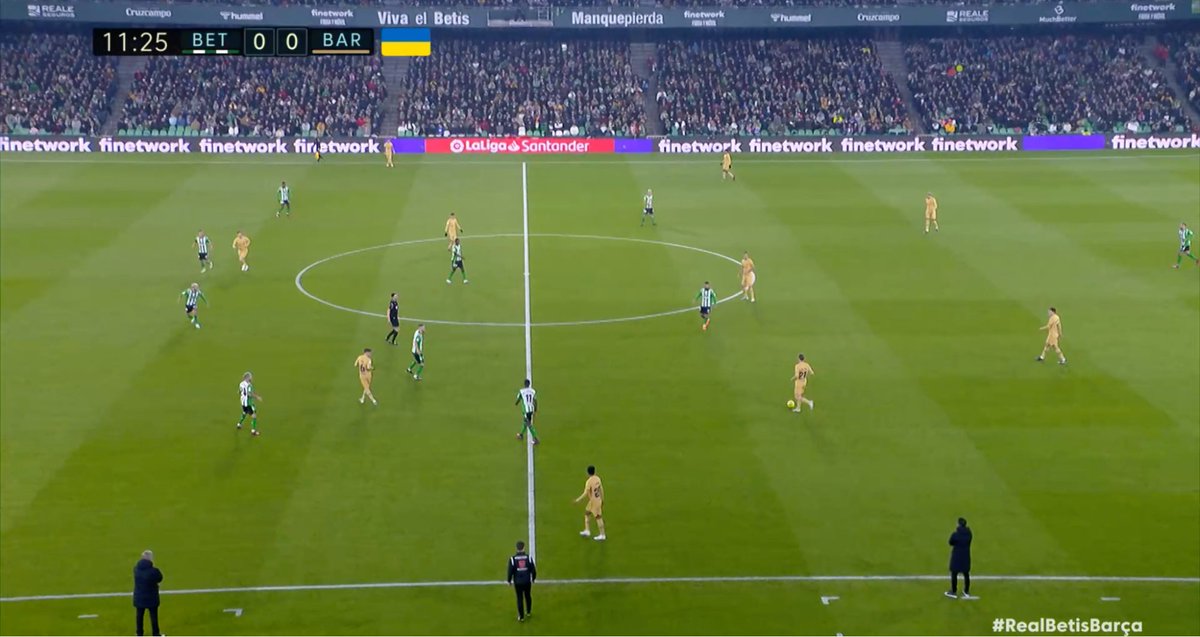
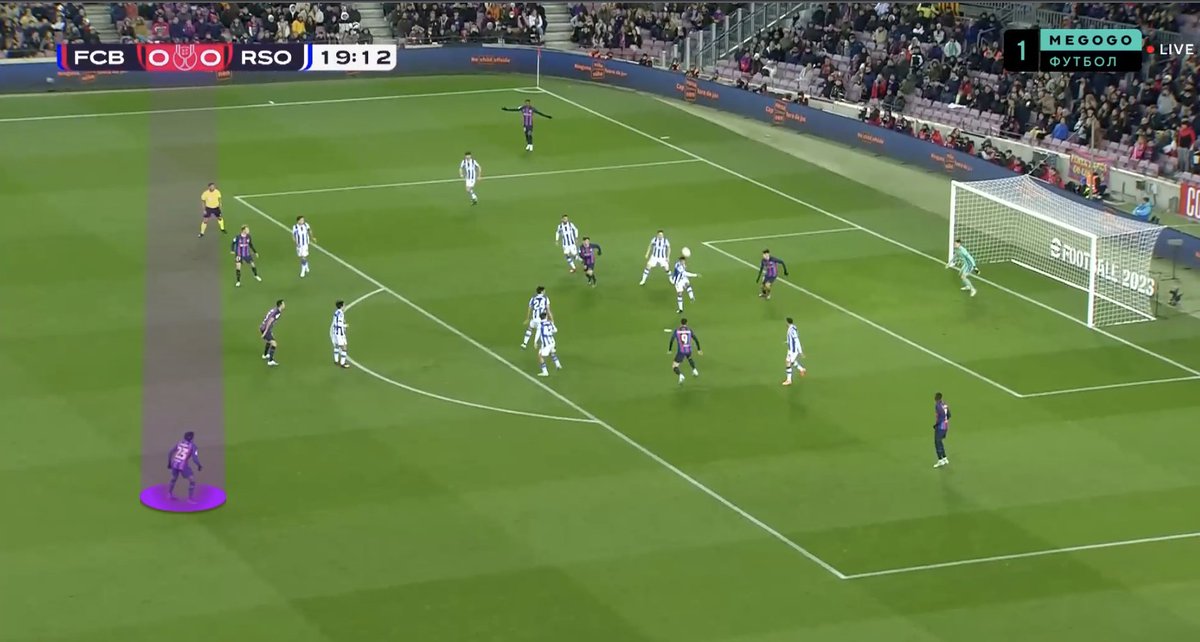
Further back, Koundé inverts into the back 3 ala Kyle Walker at City or Ben White at Arsenal & Frenkie de Jong primarily stays deep alongside Busquets in the double pivot, just like Gundogan, Bernardo, or Xhaka do when each respective team tasks their left back to hold the width.
The structure in these instances is so good because each key area of the pitch is occupied - both wings, both half spaces between the lines, the #9, and 5 players are in central areas behind the ball for transitions.
Lots of teams play this way, but Barca have unique traits.
Lots of teams play this way, but Barca have unique traits.
Conte's Spurs, for example, attack in a 3-2-5 shape, but they do so with two wingbacks. Barca do it with one wingback (primarily Balde) and one of the best isolation players in the sport in Ousmane Dembélé.
The fact that they are fluid within that is also a difference maker.
The fact that they are fluid within that is also a difference maker.
Teams with inverted fullbacks are so difficult to prepare to play against, especially when they're as good as Barca are technically, because they operate within a variety of shapes. Conte's teams start in a 4-2-4 and transition into a 3-2-5 in possession.
Xavi's are more fluid.
Xavi's are more fluid.
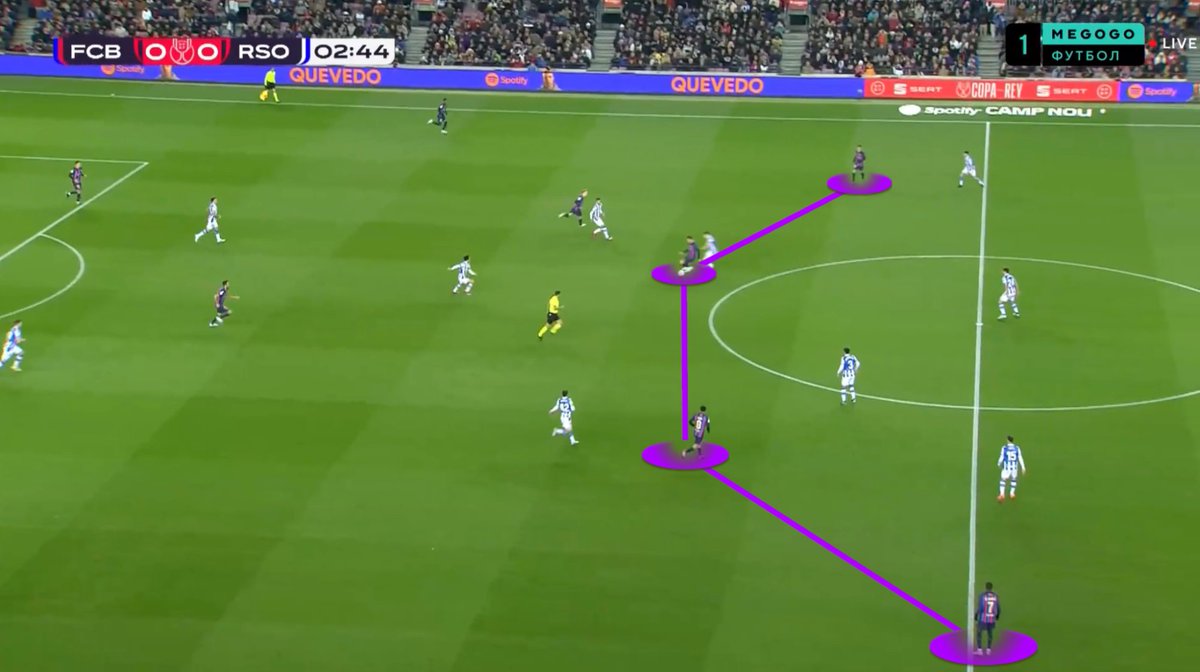
Barca transition from a 4-2-4 to a 4-3-3 to a 3-2-5 & even into a 3-1-6 at times in the final 3rd when Frenkie de Jong joins the attack (image 1).
However, even when de Jong does join the attack the inverted Koundé is present alongside Busquets to maintain compactness (image 2)!
However, even when de Jong does join the attack the inverted Koundé is present alongside Busquets to maintain compactness (image 2)!
The on-ball structure really is special.
Then, out of possession, Xavi's men transition into an aggressive 4-4-1-1 high press as opposed to a passive 5-4-1 which teams who utilise a 3-2-5 in possession shape often use.
This means they get effective pressure on the ball.
Then, out of possession, Xavi's men transition into an aggressive 4-4-1-1 high press as opposed to a passive 5-4-1 which teams who utilise a 3-2-5 in possession shape often use.
This means they get effective pressure on the ball.
Xavi's Barca press really well in their latest shape.
Pedri joins the front 2 alongside Lewandowski and the two alternate between marking the ball-side centre back & the opposition #6. They force the opposition to one side before the far side winger inverts to collapse the play.
Pedri joins the front 2 alongside Lewandowski and the two alternate between marking the ball-side centre back & the opposition #6. They force the opposition to one side before the far side winger inverts to collapse the play.
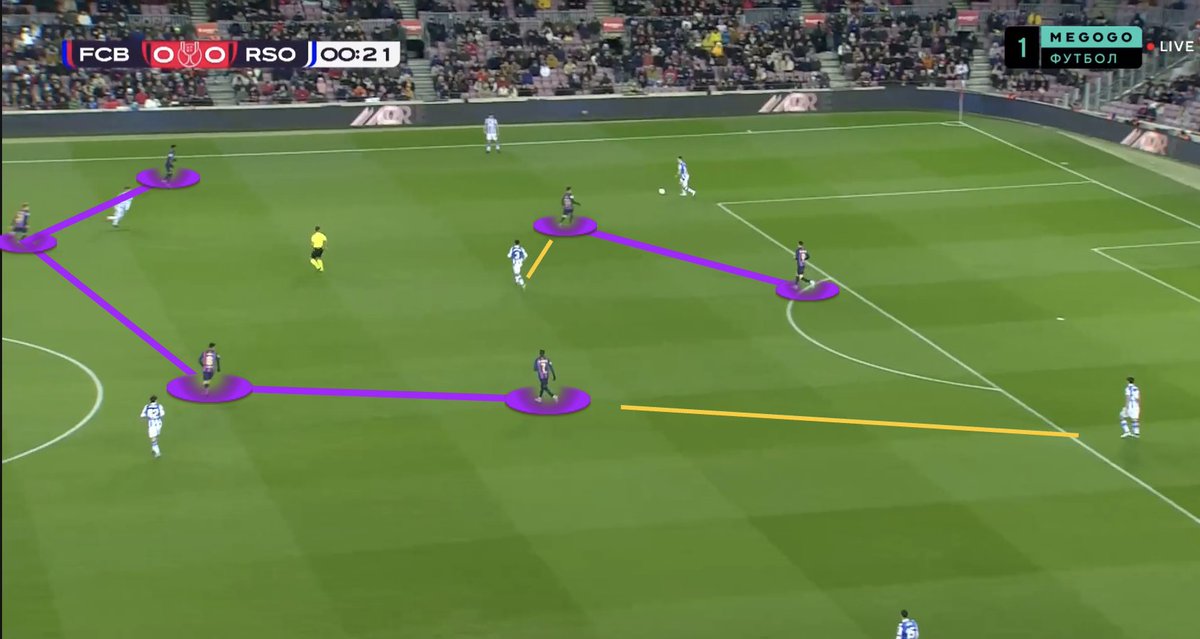
That latter point is a crucial one to consider. Teams who don't invert their wide players when pressing often give the opposition centre backs too much time in possession.
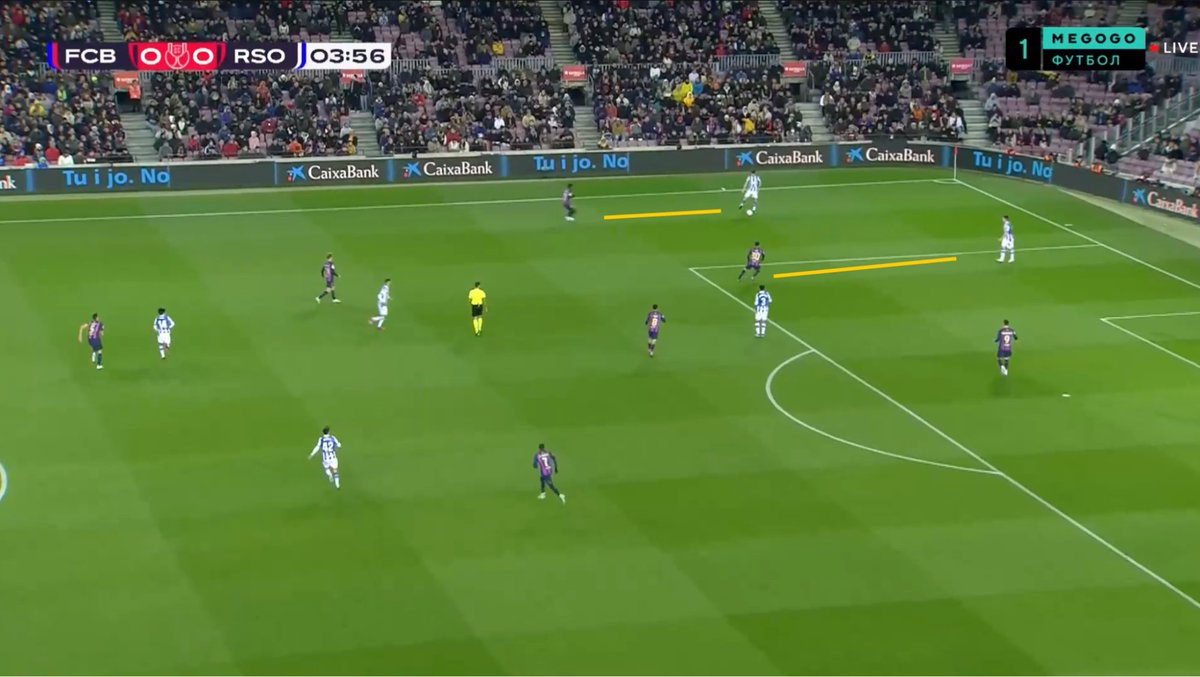
The elites invert their wide players to press alongside the front 2 with the fullback backing them up.
The elites invert their wide players to press alongside the front 2 with the fullback backing them up.
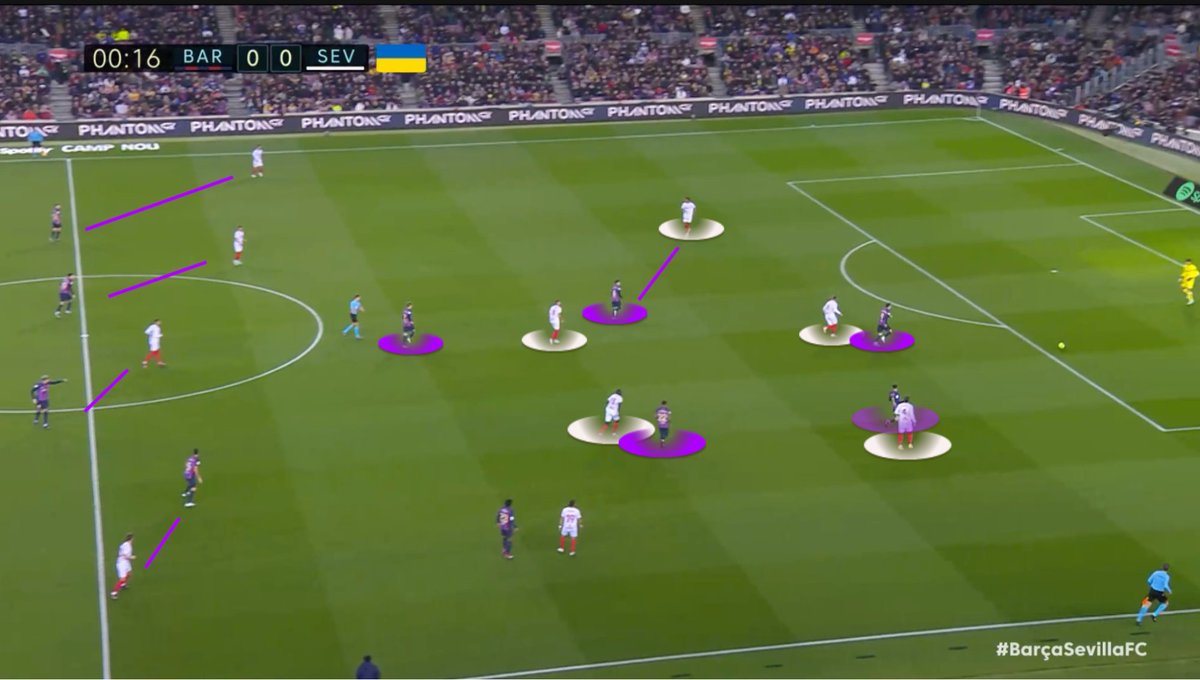
See the below image for an example.
Gavi inverts to press the ball-side centre back after play is circulated past Lewandowski. Balde then pushes aggressively up the pitch to press the ball-side fullback with Christensen (out of shot) shifting across to mark the ball-side winger.
Gavi inverts to press the ball-side centre back after play is circulated past Lewandowski. Balde then pushes aggressively up the pitch to press the ball-side fullback with Christensen (out of shot) shifting across to mark the ball-side winger.
They also adapt accordingly against a back 3. The wide players invert onto the outside centre backs, the advanced #8's mark the opposition pivot, Busquets marshals those between the lines, the defenders man-mark the opposition wingbacks and forwards who drop deep to receive.
Barca are a team that look to dominate games through pressing and passing, so they rarely spend time defending deep within a low block, but it's clear they're good enough as a collective to have that mindset. There is absolutely no denying that they're a very special team.
Xavi's structure is superb, but the quality within it is similarly outstanding.
Gavi and Pedri are technical guru's in all phases of play who probe & playmake like few in the sport, Dembélé can kill you in 1v1's, Lewandowski is one of the most ruthless forwards in the sport...
Gavi and Pedri are technical guru's in all phases of play who probe & playmake like few in the sport, Dembélé can kill you in 1v1's, Lewandowski is one of the most ruthless forwards in the sport...
That in tandem with the fact that their overall structure and technical quality within that is elite with a deep squad & gamechangers who can make a difference off the bench is a wild combination.
However, all is not completely well at Camp Nou. The collective have some issues.
However, all is not completely well at Camp Nou. The collective have some issues.
First of all, Barca were knocked out of the Champions League by Inter and Bayern, much of that being a result of Barca losing to Inter once and drawing 3-3 with them the second time. However, context in this game is crucial.
The entirety of their current back four didn't play.
The entirety of their current back four didn't play.
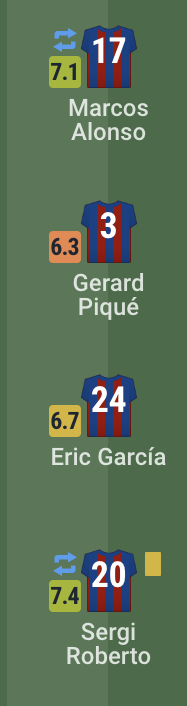
Koundé, Christensen, and Araujo were all unavailable through injury, and it was through individual errors from Pique and Garcia that saw Inter draw 3-3 with Barca at Camp Nou. Then, in the away leg, Barca were denied of a clear penalty which ultimately saw them lose the game.
Those instances were undeniably costly and are largely why Barca were knocked out of the Champions League.
The club also conducted a vast amount of business in the summer months so Xavi was still 'putting it all together' on the pitch.
Their league form showcases it was a blip.
The club also conducted a vast amount of business in the summer months so Xavi was still 'putting it all together' on the pitch.
Their league form showcases it was a blip.
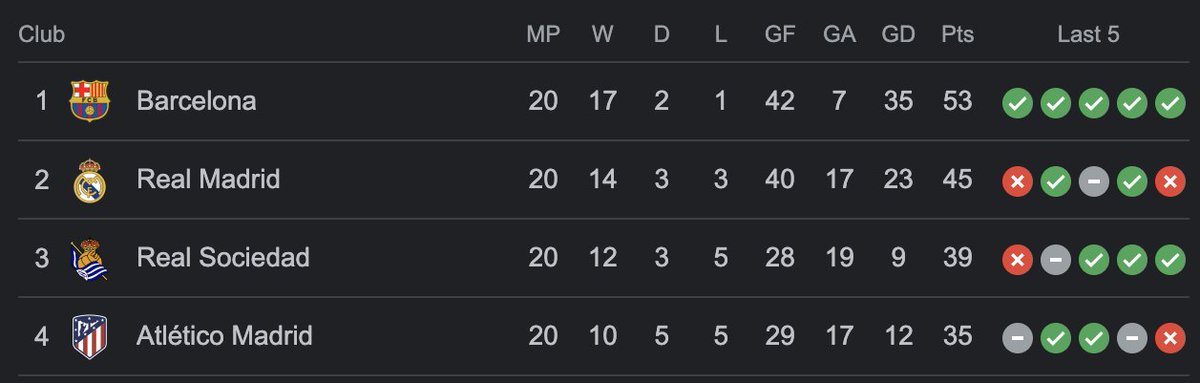
Barca have won 17 out of 20 games in the league & only lost 1, whilst only conceding 7 goals in that time period & scoring the most amount of goals in the league. That right there is a long-term indication of a special team.
However, as I said, they do have collective frailties.
However, as I said, they do have collective frailties.
Busquets is a legend of the game and still the best technical #6 in the sport in my opinion, but he badly lacks athleticism, and for a team like Barca who often utilise a 3-1-6 shape in attack, that can be an issue as he's left defending large spaces in transition by himself.
Koundé is often present in transition because of his inversions into midfield, but his role isn't linear in the sense that he isn't always present in midfield as he operates at fullback in the 4-3-3/4-2-4 whilst also having license to overlap, so Busquets can become isolated.
That fluidity is present in a lot of Barca's games. Gavi and Pedri are often drawn towards the ball & Xavi gives the pair license to drop into deeper phases where they see fit, but this can mean Barca lack a reliable presence between the lines & sometimes they attack with just 4.
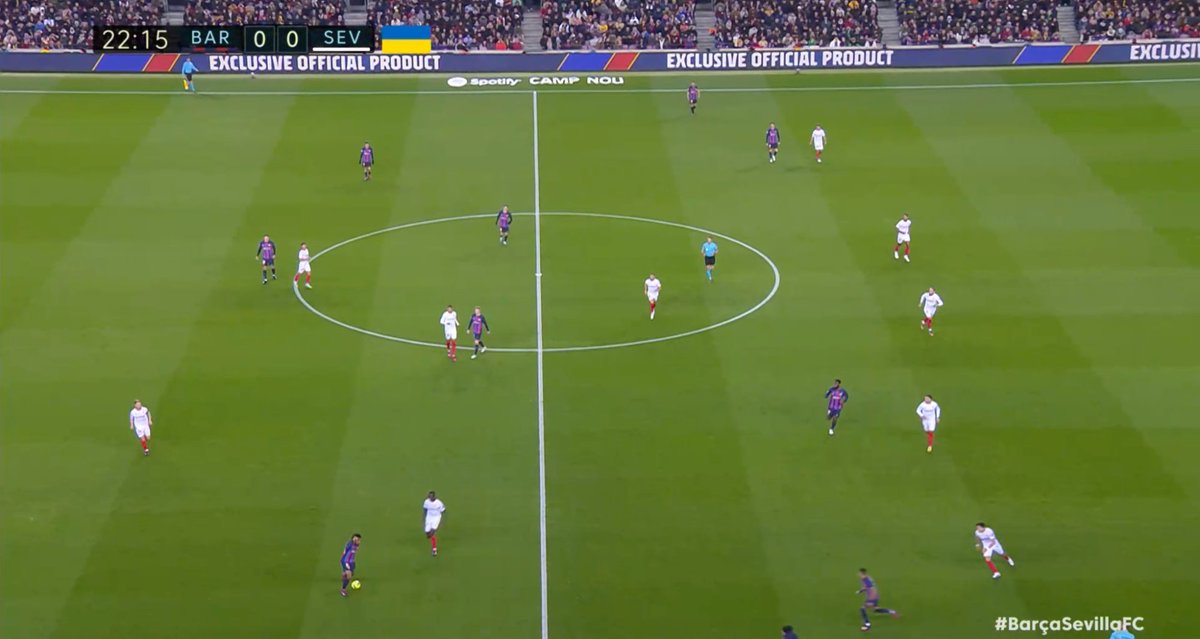
Sometimes that general fluid approach can see the teams original structure become disjointed in both defensive transition & when trying to break the opposition down.
The consequence of this is that when Barca need control, sometimes the positioning of their group is unreliable.
The consequence of this is that when Barca need control, sometimes the positioning of their group is unreliable.
The reason why Arsenal, for example, are likely the best team in the world right now is because Arteta implements all of the elite facets of tactical play that Xavi has implemented, except with an extra touch of rigidity, which makes everything more reliable for the players.
When they receive under pressure, they know where there teammates will be, so can often operate on instinct, whereas that isn't always the case for Xavi's Barca, and against teams who have technical quality, outlets, & can press well, their overall control can become disjointed.
Also, with Busquets currently injured, it looks like Barca will likely have to play Frenkie de Jong in the #6 & although he is undeniably a good solution in that area of the pitch, it means Xavi will likely bring Kessié into the XI who doesn't fit in with the quality of the side.
Kessié is a guy who does lots of things to a good standard but isn't close to the level of technical quality Barca require to play their style. He's okay in possession, but more so in a double pivot and in a transition-based team. His profile is totally different to Barca's #8's.
However, despite these issues, there's no denying Xavi is building something really exciting at Barca. The in-possession structure (outside of the fluidity within it) is elite, and the off-ball structure is similarly special and it's why their defensive record is so good.
Xavi possesses all of the traits of a truly elite coach. His tenure at Barca hasn't been flawless, but it's absolutely clear that he possesses all of the tactical and squad building qualities to compete with the absolute elites in the sport.
*HE* is largely why Barca are back.
*HE* is largely why Barca are back.
Barca haven't been this good tactically since Luis Enrique was in charge. That's a testament to the quality of Xavi.
He's actually quite similar to Erik ten Hag as both coach similar styles of football, and they implement it to an elite standard.
Next Thursday will be wild 🟣🔴
He's actually quite similar to Erik ten Hag as both coach similar styles of football, and they implement it to an elite standard.
Next Thursday will be wild 🟣🔴
Loading suggestions...