

The product death cycle is a terrible trap.
Many PMs forget about the "Why" and become waiters.
To please everyone, a typical waiter collects and waterfalls all "feature requirements" to the team.🧵
Many PMs forget about the "Why" and become waiters.
To please everyone, a typical waiter collects and waterfalls all "feature requirements" to the team.🧵
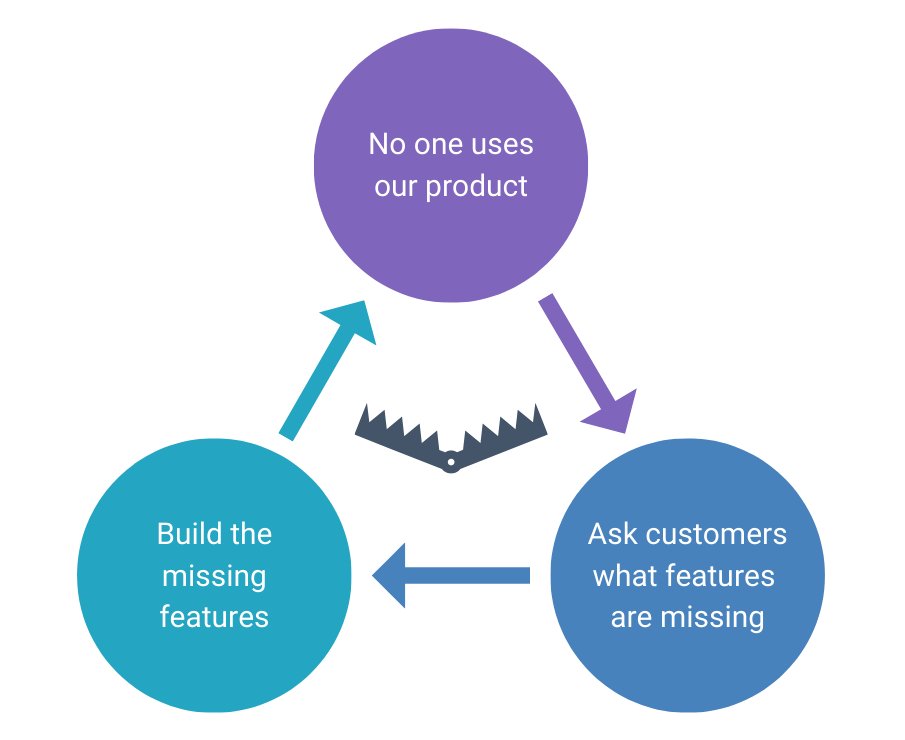
But no matter how much the team delivers, it gets only worse. Features shipped in a hurry do not solve anyone's problems and do not drive the expected business results.
The feature factory.
Fortunately, you can prevent or escape that trap.
The feature factory.
Fortunately, you can prevent or escape that trap.
Try this:
1. Respect your vision and strategy
2. Do not let your customers design solutions
3. Test your ideas with MVPs and prototypes
4. Push back on things that are handed down
Now in detail:
1. Respect your vision and strategy
2. Do not let your customers design solutions
3. Test your ideas with MVPs and prototypes
4. Push back on things that are handed down
Now in detail:
1. Respect your vision and strategy
Ask yourself:
- Why are you building this product?
- Where do you want to be in 2-5 years?
- For whom are you building it?
- What's the unique value of your product?
- How is it aligned with the company's vision and strategy?
Ask yourself:
- Why are you building this product?
- Where do you want to be in 2-5 years?
- For whom are you building it?
- What's the unique value of your product?
- How is it aligned with the company's vision and strategy?
- What are the key tradeoffs?
- What are the customer jobs?
- How will it create value for the business?
- How can you get there?
Recommended books:
- Business Model Generation by @AlexOsterwalder
- Plating to Win by @RogerLMartin
- What are the customer jobs?
- How will it create value for the business?
- How can you get there?
Recommended books:
- Business Model Generation by @AlexOsterwalder
- Plating to Win by @RogerLMartin
2. Do not let your customers design solutions
Focus on understanding their problems, needs, and desires in-depth. Interview them regularly, map opportunities, and brainstorm possible solutions.
Make sure the designer and engineers are included.
Focus on understanding their problems, needs, and desires in-depth. Interview them regularly, map opportunities, and brainstorm possible solutions.
Make sure the designer and engineers are included.
This will let you build a shared understanding and stay open to different perspectives. In particular, the best ideas often come from engineers.
Recommended books:
- Continuous Discovery Habits by @ttorres
- The Mom Test by @robfitz
- Escaping the Build Trap by @lissijean
Recommended books:
- Continuous Discovery Habits by @ttorres
- The Mom Test by @robfitz
- Escaping the Build Trap by @lissijean
3. Test your ideas with MVPs and prototypes
Learning by delivering is expensive. Run small experiments in a front-of-funnel to validate ideas in the cheapest and the fastest possible way before selecting them for implementation.
Learning by delivering is expensive. Run small experiments in a front-of-funnel to validate ideas in the cheapest and the fastest possible way before selecting them for implementation.
Key risks you need to tackle:
- Value. Will our customers desire\love it?
- Usability. Will they be able to use it?
- Viability. Can different parts of our business support it?
- Feasibility. Is it possible?
- Ethic. Should we do it?
- Value. Will our customers desire\love it?
- Usability. Will they be able to use it?
- Viability. Can different parts of our business support it?
- Feasibility. Is it possible?
- Ethic. Should we do it?
Recommended books:
- Inspired by @cagan
- The Lean Product Playbook by @danolsen
- Testing Business Ideas by @AlexOsterwalder and @davidjbland
- Inspired by @cagan
- The Lean Product Playbook by @danolsen
- Testing Business Ideas by @AlexOsterwalder and @davidjbland
4. Push back on things that are handed down
Respect your stakeholders, but don't let their authority influence what is important. Question solutions and push back on things that are handed down to you.
Respect your stakeholders, but don't let their authority influence what is important. Question solutions and push back on things that are handed down to you.
"A person's success in life can usually be measured by the number of uncomfortable conversations he or she is willing to have" - @tferriss
Recommended books:
- Influence Without Authority by Allan Cohen and David Bradford
- The 7 Habits of Highly Effective People by @StephenMRCovey
- Influence Without Authority by Allan Cohen and David Bradford
- The 7 Habits of Highly Effective People by @StephenMRCovey
Credits: the product death cycle was described by @davidjbland
That's a wrap!
If you liked this:
1. Follow me @PawelHuryn for more of these
2. RT the tweet below to share it with your audience:
That's a wrap!
If you liked this:
1. Follow me @PawelHuryn for more of these
2. RT the tweet below to share it with your audience:
Loading suggestions...