

Pep Guardiola vs Mikel Arteta, master vs apprentice, Arsenal vs City..
The two tactical geniuses sit side by side at the top of the Premier League & go head to head this Wednesday to decide the *TITLE*. Below, I break the tactical battle down.
Here we go...
COLLOSAL-THREAD! 🚨
The two tactical geniuses sit side by side at the top of the Premier League & go head to head this Wednesday to decide the *TITLE*. Below, I break the tactical battle down.
Here we go...
COLLOSAL-THREAD! 🚨
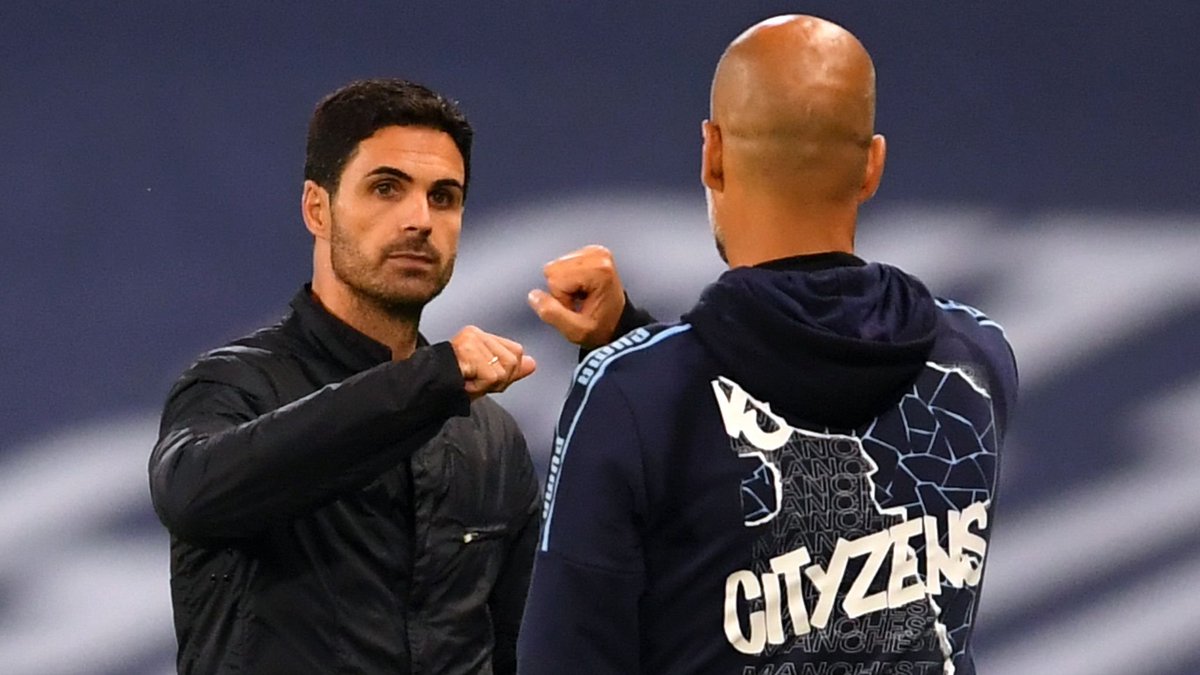
Arteta's Arsenal are largely set in stone relative to how they play, but Arteta changed Arsenal's pressing structure against City in the FA Cup by implementing a man-to-man pressing approach across the park.
It was ultra-compact and City often failed to play through it.
It was ultra-compact and City often failed to play through it.

It's easier to match-up to press from opposition goal kicks because the team building out from the back are 'set' positionally, but Arsenal were also able to match up effectively when City had the ball in settled play and often forced them backwards due to their compactness.
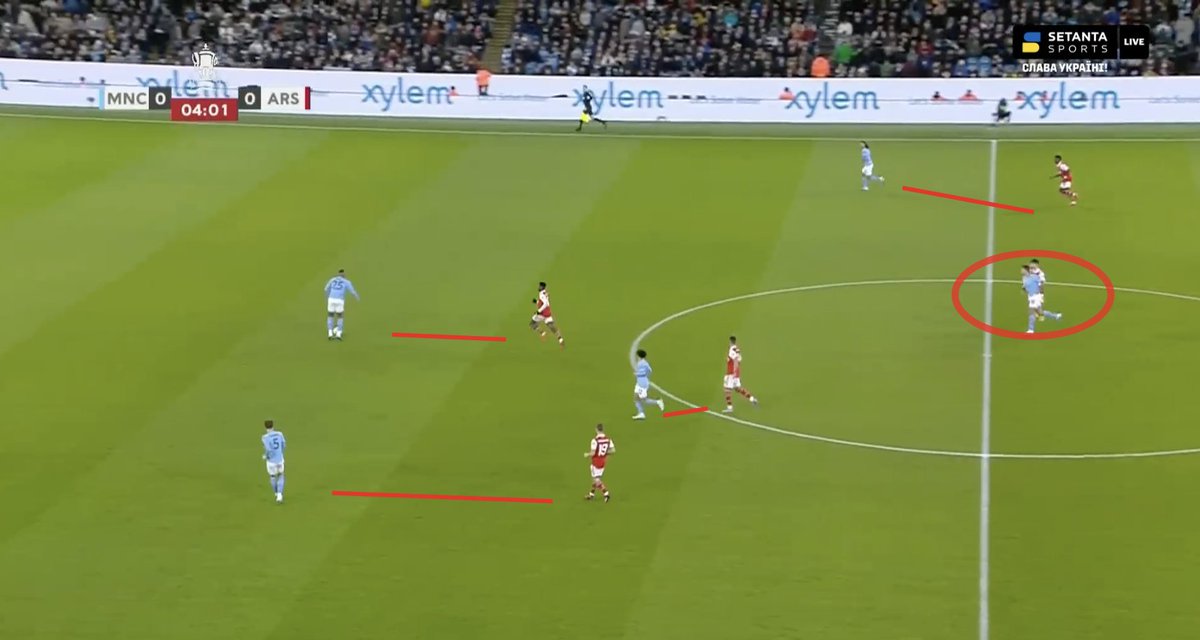
Arsenal were able to match up so effectively due to the rigidity in City's play.
City are typically known for their fluid build-up thanks to their inverted fullbacks, but Rico Lewis often started central & stayed there which resulted in City being more predictable in their play.
City are typically known for their fluid build-up thanks to their inverted fullbacks, but Rico Lewis often started central & stayed there which resulted in City being more predictable in their play.
Against Villa, Pep played Bernardo Silva as the inverted fullback (yes, you read that right) & he was very much so similar to Rico Lewis in the sense that he rarely occupied the left back area so City's build-up typically resembled a 3-2 shape as opposed to a 4-3-3 turned 3-2-5.
In the cup tie, Xhaka pressed Rico Lewis in the #6 in City's 3-2 build-up and Arsenal simply matched up elsewhere.
Nketiah pressed the middle centre back, Saka and Trossard inverted to press the outside centre backs, and Arsenal's advanced #8's man-marked City's double pivot.
Nketiah pressed the middle centre back, Saka and Trossard inverted to press the outside centre backs, and Arsenal's advanced #8's man-marked City's double pivot.
Then, behind that initial line of pressing, Arsenal were aggressive to match up with City's attackers on the wings (Tierney-Mahrez, Tomiyasu-Grealish) and those dropping between the lines where Haaland often isolated Holding, & Partey/Gabriel communicated to manage KDB/Gundogan.
This man-to-man approach across the park resulted in Ortega going long to play 'over' Arsenal's compact press. De Zerbi's Brighton actually implemented the same approach against Pep's City, & that long ball approach worked thanks to Haaland's physicality.

Holding did a better job of managing Haaland than Dunk did in the above situation, but he was booked very early on, committed a number of fouls in between, & Arteta had to hook him at half-time because of the clear danger of him getting sent off because of how aggressive he was.
Saliba is a better match-up to deal with Haaland than Holding is on paper, but he hasn't been in optimal form lately with Calvert-Lewin and Ivan Toney dominating him in duels in consecutive games, so if Arteta does opt for that approach, it is a risky one because of that.
However, Mikel has to weigh up the pro's and the con's of each situation:
1) stop City at the source and negate their ability to build play from goal kicks, from deep within their own half, and within settled midfield situations,
OR
2) leave Saliba in a 1v1 with Haaland.
1) stop City at the source and negate their ability to build play from goal kicks, from deep within their own half, and within settled midfield situations,
OR
2) leave Saliba in a 1v1 with Haaland.
The 1st solution is one that would enable Arsenal to exert more control on the game than the latter, even if the risk is present for Haaland to break free from Saliba off the back of a long ball from Ederson who has the quality to set him free.
However, there's another approach.
However, there's another approach.
Arsenal don't typically press in a man-to-man system. In fact, the way they press is actually the same way City press. They typically press in a 4-4-1-1 block before inverting the wide midfielder onto a centre back, & City often build play in the 2-1 build-up shape as seen below.
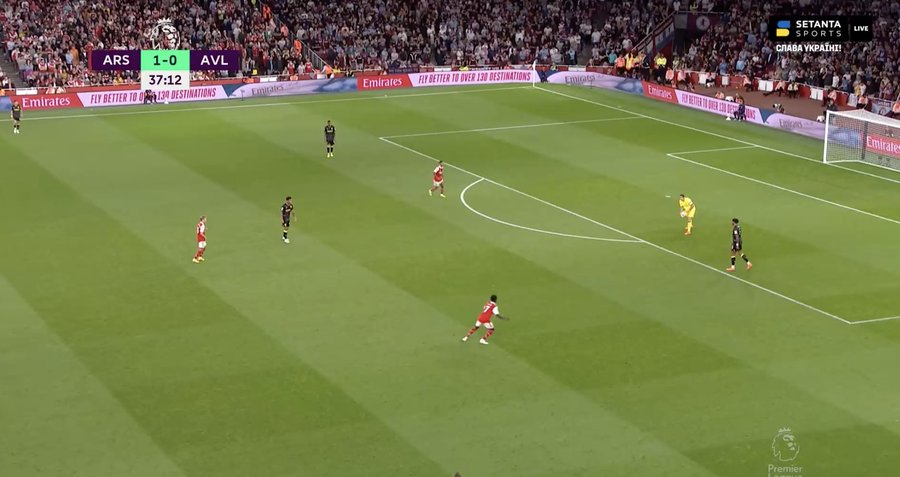
If Arsenal decide to press in a zonal manner then the emphasis from City's perspective will be to play out from the back with more regularity as opposed to playing direct balls towards Haaland.
This is easier to achieve (albeit still very tough) as they can manipulate the press.
This is easier to achieve (albeit still very tough) as they can manipulate the press.
When Arsenal's wide forwards come inside to press the centre back they have to time it appropriately.
If they don't the fullback on their respective side won't be able to back up the press by pressing the opposition fullback (see Martinelli below).
If they don't the fullback on their respective side won't be able to back up the press by pressing the opposition fullback (see Martinelli below).

Should the timing of the rotations between the fullback and winger be off, City can build play out from the back & directly exploit Arsenal after A) exploiting them in transition or B) recycle, sustain some pressure, and use their positional play in attack to break Arsenal down.
However, City don't currently play with traditional fullbacks, so the alternative zonal approach Arteta will have to implement to nullify City's build-up consists of a press where the wingers invert, the fullbacks press the wingbacks, & the #10 drops onto the #6 (see City below).

Below we see that press in action, but we have to imagine it from Arsenal's perspective against City. They *must* adapt their press accordingly to deal with this situation because City will find the spare man if there is one.
Every player must be marked!
Every player must be marked!

However, against a team who build in a 3-2, Arteta doesn't set his teams to press in that aggressive manner unless he implements a full man-to-man press.
When he presses zonally, often times he leaves the opposition with a purposeful 6v5 overload to have an overload in defence.
When he presses zonally, often times he leaves the opposition with a purposeful 6v5 overload to have an overload in defence.
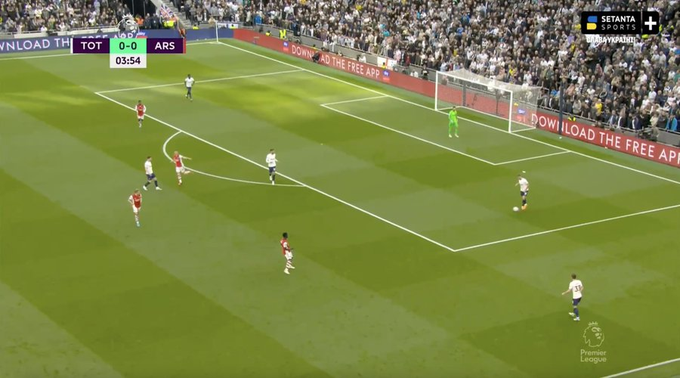
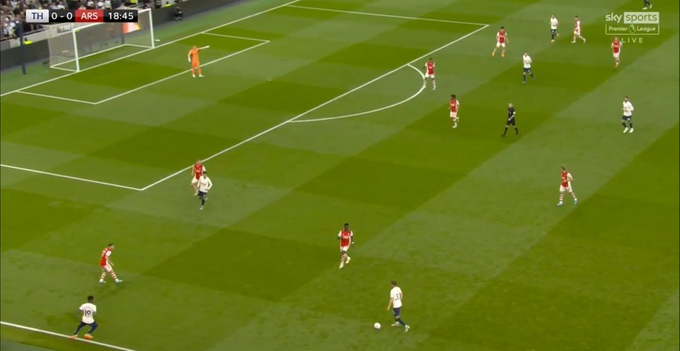
Below, Arteta wants to push Spurs out to one side of the pitch and man mark on the sides whilst closing off the passing lane to the free man which is the far side centre back (pic 1).
Spurs, though, want to use the ball wisely amongst the GK and centre backs to play out (pic 2).
Spurs, though, want to use the ball wisely amongst the GK and centre backs to play out (pic 2).
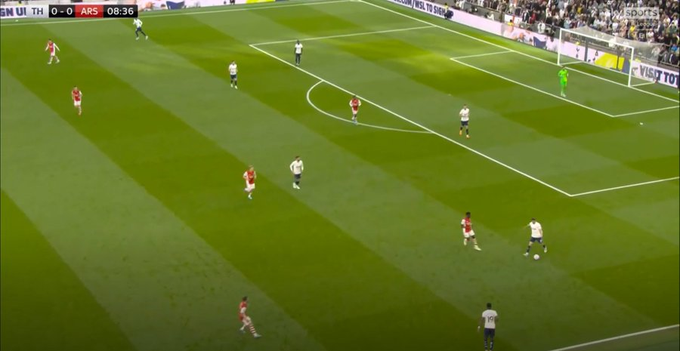
Arteta does this, though, to ensure Arsenal have an extra man in the last line to deal with Spurs' often devastating front 3. The ball-side fullback presses high against the Spurs wingback but the far side fullback tucks in alongside the centre backs & Partey screens the defence.

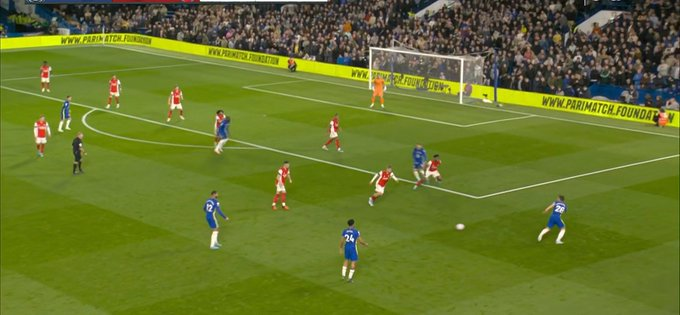
That makes sense against a team like Spurs who lack elite technical quality in the build-up and have a devastating front 3 in transition, but that very same tactic has seen Arteta's Arsenal get exploited by Tuchel's Chelsea before due to their excellent technical quality.
Heck, even Graham Potter's Brighton exploited that structure because they were good enough technically todo so (see below with a 5v4 in the build-up).
People may point to the fact that Arsenal were an inferior team back then which is true, but the approach is still a risky one..
People may point to the fact that Arsenal were an inferior team back then which is true, but the approach is still a risky one..
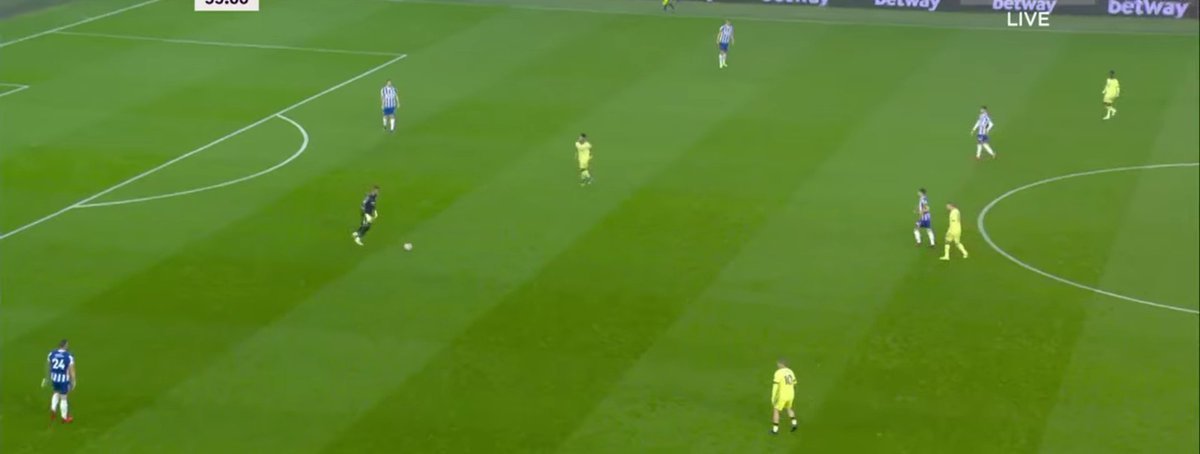
City are a team who will absolutely exploit that, so the best solution for Arteta would be to do exactly what he did most recently away at City, & that was a full-man marking approach which effectively nullified City's build-up for large periods, even if they got out on occasion.
City are a team that will always have joy possession-wise because their manager and players are elite, but it's about mitigating the quality they possess as much as possible.
Arteta has likely found the best way to do that by implementing the man-to-man approach across the park.
Arteta has likely found the best way to do that by implementing the man-to-man approach across the park.
The fact that he has successfully implemented that approach in the last fixture between the two teams in tandem with the fact that Arsenal went toe-to-toe with City with a heavily rotated team is mightily encouraging for Arsenal, but he has to get that aspect of coaching correct.
Logic suggests he will, but City are City, and they will have moments where they progress past Arsenal's press where they can A) directly exploit them in transition with someone like Haaland making runs in behind the last line or B) pinning Arsenal back and sustaining pressure.
Arsenal will want to prevent those themes & City will want to create those themes.
Arteta may drop Saka/Martinelli into the last line of defence when City do sustain attacks (see below), but it's something that is only a precautionary measure.
That's not the theme Arsenal want.
Arteta may drop Saka/Martinelli into the last line of defence when City do sustain attacks (see below), but it's something that is only a precautionary measure.
That's not the theme Arsenal want.
Arsenal will aim to keep the ball when they get it, and play the game in City's half. They're not as linear as City are from goal kicks in the sense that over 50% of the goal kicks Arsenal take are long, and that's because Arsenal's style is slightly more combative than City's.
Arsenal will of course play out from the back and will likely do so with decent success, but it's always risky to build out from the back against a high press as compact and as aggressive as City's.
Just look at how they invert the forwards in the press👇
Just look at how they invert the forwards in the press👇

Arteta's men will subsequently 'mix it up' when building play, and here they have the quality to A) play directly through the press and exploit City in defensive transition or B) utilise Ramsdale's abnormally long kicking to counterpress high and sustain attacks from high.
I was laughed at for saying Ramsdale is such a special signing partly because of his ability to punt the ball abnormally long, but Arsenal use this trait to their advantage because they can battle for second balls high & directly attack in transition or mount sustained pressure.
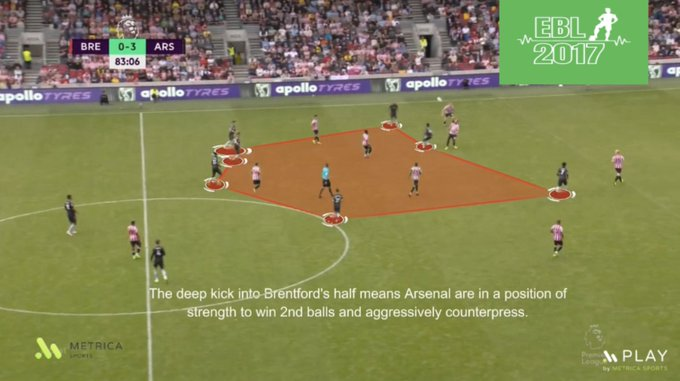
The problem with such an approach is that it's reliant on winning duels which isn't always a factor that is particularly reliable, but Arsenal are more physical than City as a whole, so they need to be as aggressive as they possibly can to really dominate this area of the game.
However, if successful, THIS is where Arsenal have a major advantage against Pep's team.
Pep is likely the best manager we've ever seen, but his teams are NOT used to sitting back behind the ball & it means that a team like Arsenal with special positional play can exploit them.
Pep is likely the best manager we've ever seen, but his teams are NOT used to sitting back behind the ball & it means that a team like Arsenal with special positional play can exploit them.
As good as City are, they won't stop Arsenal from having the ball entirely, and that means City will defend deep for periods and that means Arsenal *WILL* have a 5v4 overload in the last line of defence.
Not only that, but there's a potential mismatch in these instances...
Not only that, but there's a potential mismatch in these instances...
If Pep starts either Bernardo or Lewis as the inverted fullback, their role in City's settled shape out of possession is to defend as a fullback in a 4-4-2.
Not only is that problematic because they have a big distance to retreat into in transition, but imagine 'em 1v1 vs Saka..
Not only is that problematic because they have a big distance to retreat into in transition, but imagine 'em 1v1 vs Saka..
Logic suggests Pep won't set his team up in that manner to be exposed to such a situation, so it's possible he does something else entirely from a tactical perspective.
Aké nullified Saka to an exceptional standard in the FA Cup fixture, so starting him at left back makes sense.
Aké nullified Saka to an exceptional standard in the FA Cup fixture, so starting him at left back makes sense.
However, Walker is similarly useful for his defensive quality in 1v1 situations against Martinelli, so if Pep opts to start both Walker and Aké as the fullbacks in an attempt to nullify Martinelli and Saka then it may mean he opts for a more conventional build-up approach.
That's why I touched on City's 4-3-3 shape earlier on in the thread, because Pep is known for his 'galaxy brain' and tactical adaptations, particularly in the biggest games.
If that does turn out to be the case, then that could cause Arsenal some serious issues as a whole.
If that does turn out to be the case, then that could cause Arsenal some serious issues as a whole.
If Arteta sets his team to man-mark City's 3-2 build-up with Bernardo or Lewis inverted from fullback and City don't set up that way, they could really mitigate Arsenal's press.
If Pep plays with traditional fullbacks, this could give City more time on the ball in the build-up.
If Pep plays with traditional fullbacks, this could give City more time on the ball in the build-up.
John Stones, in the below clip, has lots of time on the ball when Rico Lewis is on the touchline because he drags Trossard out with him.
However, when he inverts, Arsenal can man-mark all over the park vs the 3-2 and Stones' time on the ball evaporates.
However, when he inverts, Arsenal can man-mark all over the park vs the 3-2 and Stones' time on the ball evaporates.

If Pep plays with traditional fullbacks and Bernardo in the #8 to help Rodri in the build-up, City could play through Arsenal's press and control the game with the ball as best as they can whilst also having high quality 1v1 defenders out wide to deal with Saka and Martinelli.
There is a hell of a lot to consider in this match-up because of the various tactical approaches that each coach can use based on how the opposition set up, so each team must be ready to adapt to a multitude of set ups.
Both teams have the tactical quality to adapt though!
Both teams have the tactical quality to adapt though!
Another aspect of the game that must be touched on is gamestate. If Arsenal, for example, go 1-0 up, they have to be brave.
They could, in theory, defend deep, counter attack, win duels, & use their technical level to see the game out, but that invites pressure vs City's attack.
They could, in theory, defend deep, counter attack, win duels, & use their technical level to see the game out, but that invites pressure vs City's attack.
City will play their possession-based and pressing-based style no matter what the scoreline is (unless there's 5 minutes left to go and they're hanging on, for example), so Arsenal must be mature enough to match that experienced and brave City approach should they go 1-0 up.
Either way, though, both teams and managers are special, and an ultra-entertaining & competitive game is guaranteed.
Make no mistake about it, these two sides are qualitatively up there with the *VERY* best English football has seen, but even with that in mind atmosphere is key.
Make no mistake about it, these two sides are qualitatively up there with the *VERY* best English football has seen, but even with that in mind atmosphere is key.
We can talk about tactics all we like, but home and away advantage is real, and it's undeniably a big bonus for Arsenal in this fixture, particularly when considering it's a nightly game which is a condition the Emirates becomes a fortress in.
It's up to City to mitigate that.
It's up to City to mitigate that.
With everything considered, both coaches have a lot to do to give their team the *best* chance of winning. Arteta has to prepare for 'more' but he has shown that he can go toe-to-toe with Pep with a weakened side.
All in all, the tactical battle will likely determine the winner.
All in all, the tactical battle will likely determine the winner.
Loading suggestions...