

For the first time since the 1960s, there are 3 competitive political blocs largely along the old regional divides.
Hence the latest survey, which was commissioned by @EiENigeria and conducted by @sbmintelligence, did not provide us with a clear front-runner.
Hence the latest survey, which was commissioned by @EiENigeria and conducted by @sbmintelligence, did not provide us with a clear front-runner.
The first 2023 election survey conducted by SBM was published in July 2022 and showed that only 41% of registered voters had collected their Permanent Voters Cards (PVCs).
This assumption of low turnout fed into our December 2022 projections, based on a 7,000-respondent survey.
This assumption of low turnout fed into our December 2022 projections, based on a 7,000-respondent survey.

The assumption of low turnout changed when, in January 2023, our 6,500-respondent survey on PVC collection showed a remarkable increase in PVC collection - 97%.

We believe that the surge in voter awareness done by
@inecnigeria and CSOs like Enough is Enough (EiE), through their #RSVP Campaign, have driven voter interest and bucked the low turnout trend in #Nigeria's elections.
@inecnigeria and CSOs like Enough is Enough (EiE), through their #RSVP Campaign, have driven voter interest and bucked the low turnout trend in #Nigeria's elections.
Many respondents were clear about whom they felt would win the presidential contest in their state but were not straightforward about their candidate preferences. Furthermore, many registered voters told us that ethnicity and religion would play an important part in their choice.
This runs contrary to recent commentary, which suggests that #NigeriaDecides2023 will be #Nigeria’s first post-modern election, where substantial issues will determine voter choice.
The respondents also said that they expect vote buying despite recent technological and legislative changes to curb that. While an overwhelming majority of respondents claim that they won’t sell their vote, more than a third have experienced vote buying in the past.
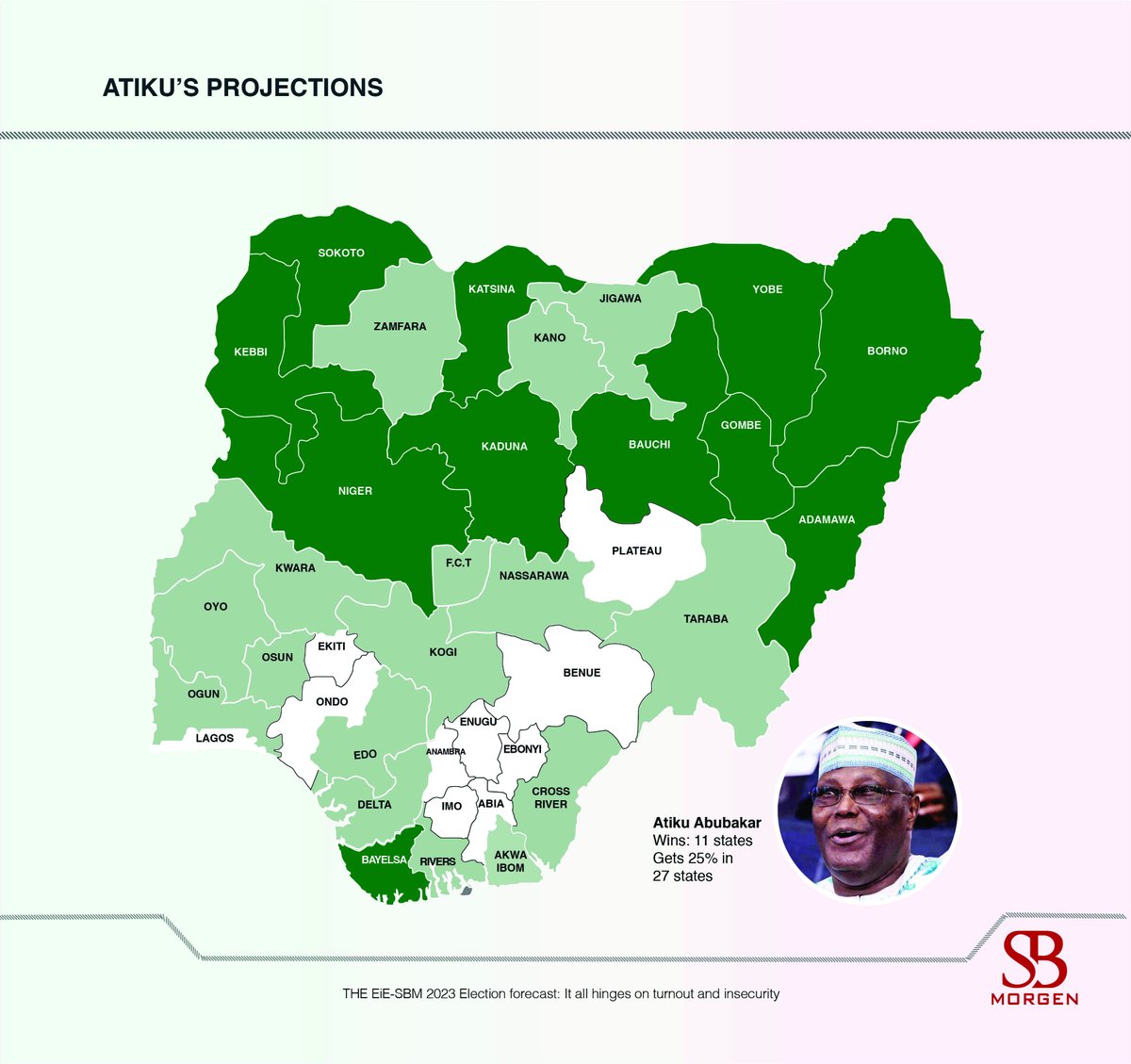

This outcome, however, is complicated by the fact that @officialABAT is likely to do well in two of the country’s biggest voting states—Kano and Lagos—and the heavily populated south-west and north-west states, thereby winning the popular vote, but not reaching 25% in 24 states.

For all of the reasons enumerated above, we maintain our initial assessment from our two previous forecasts: Nigerians will need a second round to decide their next President definitively.

@KwankwasoRM may garner sufficient votes in Kano and some states in the north-central and north-west geopolitical zones to complicate the political math for other candidates on both the popular vote and the “Road to 24” measures.
Another observation is about #Nigeria’s waning confidence in INEC’s ability to deliver a free, fair and credible election. The relationship between the electorate and INEC appears to be influenced by the possible impact of insecurity on Election Day;

Another salient point is the declining interest in down-ballot elections. Most citizens are focused on the presidential election, owing to the power arrogated to the centre by #CFRN99. Interest in @nassnigeria elections was less than 20%.

Despite this, we modelled for the National Assembly elections, which points to a Senate dominated by the APC and a House of Representatives with the PDP in the majority, leading to potential legislative gridlock in a divided 10th National Assembly.

The survey has attempted to account for demographics and voting numbers in each zone and their possible turnout to keep the citizenry aware of the issues pertinent to the coming 2023 elections.

We will publish a similar report on the governorship elections in the 28 Nigerian states that select their leaders along with the presidency in the lead-up to those elections in mid-March 2023.
For data wonks, download the working document here - bit.ly
Loading suggestions...