

This article by @Noahpinion amused me.
It seeks to explain why China can't quit coal energy, and is adding renewables on top of coal rather than retiring coal.
But it's a surface-level, highly incomplete explanation. Here's what's missing.🧵
noahpinion.substack.com
It seeks to explain why China can't quit coal energy, and is adding renewables on top of coal rather than retiring coal.
But it's a surface-level, highly incomplete explanation. Here's what's missing.🧵
noahpinion.substack.com
Noah's explanations for China's continued marriage to coal-fired energy are essentially as follows:
- addiction to low-quality investment to drive economic growth
- internal power politics that favor perpetuation of coal economy and the jobs/local econ activity it creates
- addiction to low-quality investment to drive economic growth
- internal power politics that favor perpetuation of coal economy and the jobs/local econ activity it creates
Both correct! But he only scratches the tip of the iceberg. Here's what's missing:
1) Coal is inseparable from the heavy industry at the heart of both China's construction boom + for-export sectors. Real estate + megaprojects feed steel/cement demand synonomous with coal 🔥.
1) Coal is inseparable from the heavy industry at the heart of both China's construction boom + for-export sectors. Real estate + megaprojects feed steel/cement demand synonomous with coal 🔥.
But this goes way deeper than just the mammoths of steel and cement.
Factories have their own captive onsite coal units. They run off the electricity from the turbines, but also use the process heat + steam, and may even produce/use coal gas to burn in other onsite processes.
Factories have their own captive onsite coal units. They run off the electricity from the turbines, but also use the process heat + steam, and may even produce/use coal gas to burn in other onsite processes.

China's chemical sector even uses coal as a feedstock for methanol + ammonia fertilizer production. Even much of PVC in China is from coal!
Other countries use oil/gas, but excessive dependence on O+G imports is discouraged from a policy perspective.
cen.acs.org
Other countries use oil/gas, but excessive dependence on O+G imports is discouraged from a policy perspective.
cen.acs.org
It's really not just power generation. Hundreds of coal units in China are hooked up directly to factories, providing poly-generation of electricity, process heat, potentially making gas or liquid fuels or coal chemicals to boot. Then you have coke for steel production, etc...
Can't emphasize enough how coal is inextricable from today's heavy industry in China. Some plants in south draw power from hydro, but these are the exception.
Industrial sites are often mine-to-mouth, with factory, coal units at the rim of the coal pits.
Industrial sites are often mine-to-mouth, with factory, coal units at the rim of the coal pits.
This cheap subsidized coal-fired power, in conjunction with cheap land and other forms of state support, is a critical factor in how Chinese firms are able to manufacture competitively in tough sectors like polysilicon or mineral processing where profit margins are razor thin.
2) Odd energy design/policy choices lead to excess coal burned in the power sector.
For ex, the current CO2 trading scheme makes no sense from a climate perspective, as it actually rewards more generation. @laurimyllyvirta rants about this sometimes:
For ex, the current CO2 trading scheme makes no sense from a climate perspective, as it actually rewards more generation. @laurimyllyvirta rants about this sometimes:
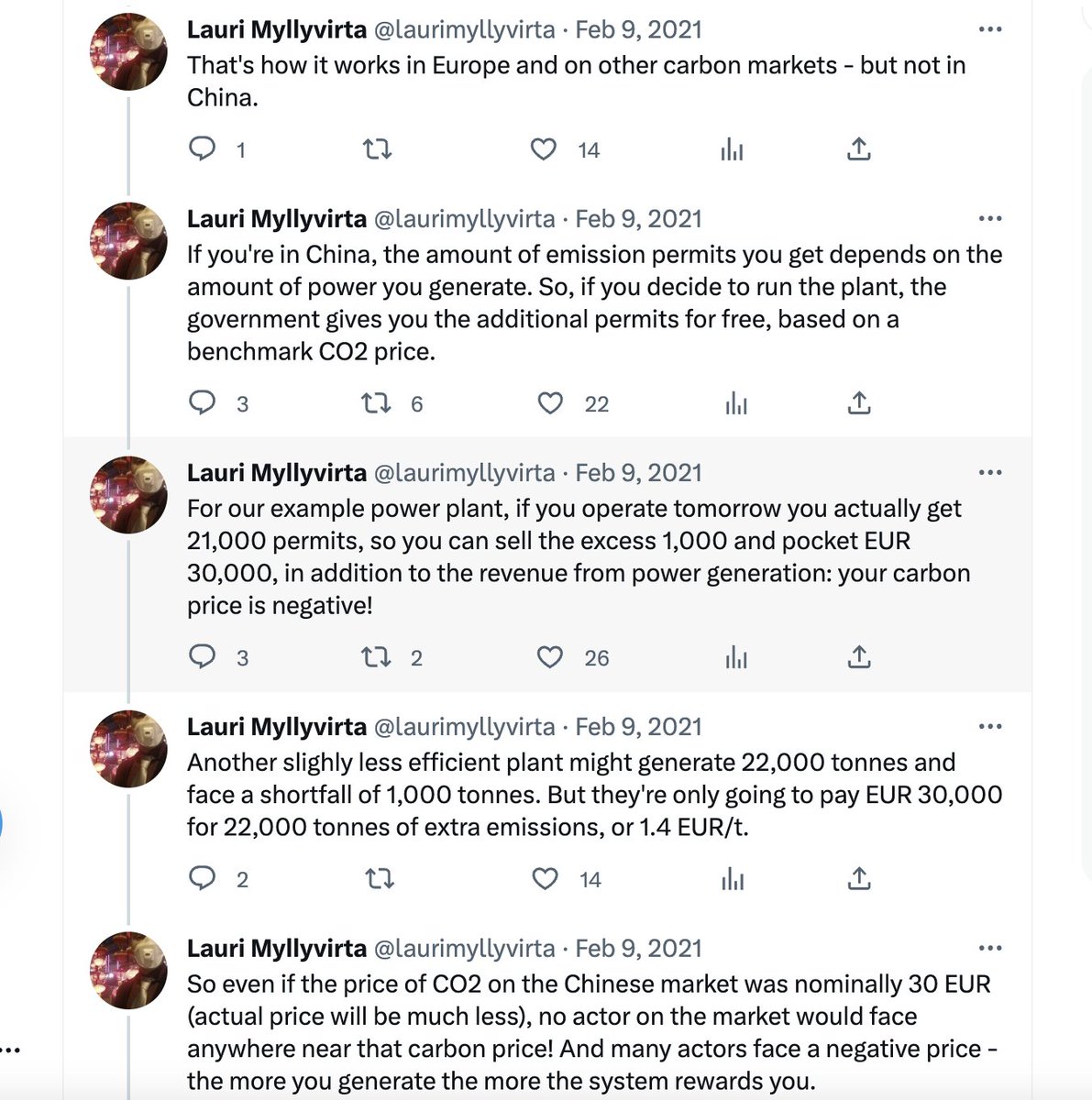
In addition to the wacky carbon trading scheme, inter-province electricity transmission lacks sufficient infrastructure and is too inflexible, which has led many provinces to build extra internal reserve coal-fired capacity to ensure resource adequacy.
Another example is how China's choice of high-voltage direct current long-distance transmission technology to send renewable power from remote regions to urban centers actually requires backup coal units to provide needed grid strength for lines to work:
3) While hinted at in 1) and 2) above, another looming consideration is energy security. China's coal reserves are plentiful, but O+G will always be import-dependent.
The domestic interest in coal, nuclear, and renewables together all starts to make more sense.
The domestic interest in coal, nuclear, and renewables together all starts to make more sense.
So coal isn't one of many economic levers that Chinese policymakers are using to try and drive growth--it's more that almost any lever in the whole Chinese economy, even food production or--ironically--the green economy, are linked to a bunch of coal-fired units somewhere.
This also all goes much, much deeper than the picture Noah paints of officials worrying about disgruntled coal miners.
He kinda frames China's transition from coal like a diet.
It's not a diet. It's essentially heart surgery on China's industry, power sector, and economy.
He kinda frames China's transition from coal like a diet.
It's not a diet. It's essentially heart surgery on China's industry, power sector, and economy.
One starts to see why uncomfortable policy decisions on things like the emissions trading cap, nat'l emissions peak date etc... have gotten kicked down the road, why industry arguments carry appeal, and why local/internal politics are fraught yet crucial.
But hey it could be worse!
Plenty of planned coal units have been cancelled across China in recent yrs, some mid-construction.
Big renewables+nuclear buildout happening.
Overseas coal finance phasing out.
2060 carbon neutral pledge remains a big deal.
foreignpolicy.com
Plenty of planned coal units have been cancelled across China in recent yrs, some mid-construction.
Big renewables+nuclear buildout happening.
Overseas coal finance phasing out.
2060 carbon neutral pledge remains a big deal.
foreignpolicy.com

Note: without an open civil society or freedom of press/expression, general society cannot muster the same political forces to oppose dirty industry + enviro degradation.
Especially when such industry is sited in regions w powerless minorities like Xinjiang + Inner Mongolia.
Especially when such industry is sited in regions w powerless minorities like Xinjiang + Inner Mongolia.
Heh, this analysis of debates over US-China climate cooperation + what it might look like is entertainingly off-target.
Other than CO2 border taxes, none of these parties would take any of these suggestions/framings seriously. At least we agree grand bargains are silly+unlikely.
Other than CO2 border taxes, none of these parties would take any of these suggestions/framings seriously. At least we agree grand bargains are silly+unlikely.
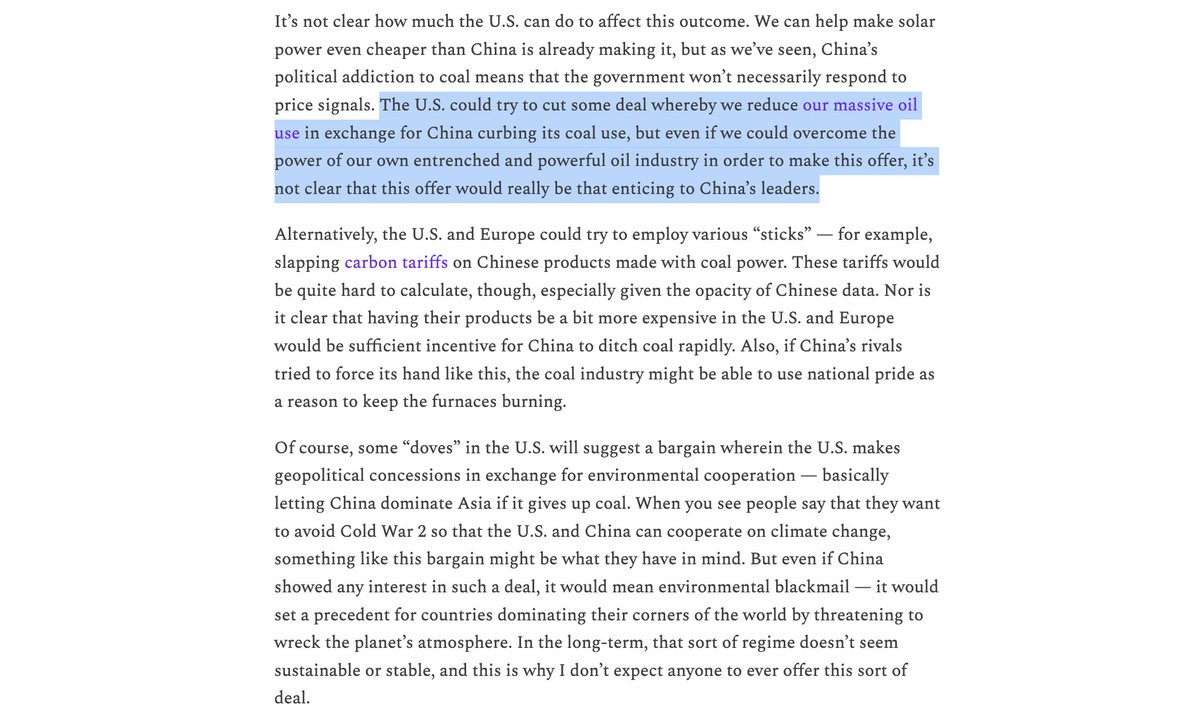
And I have absolutely no idea what to make of this gem.
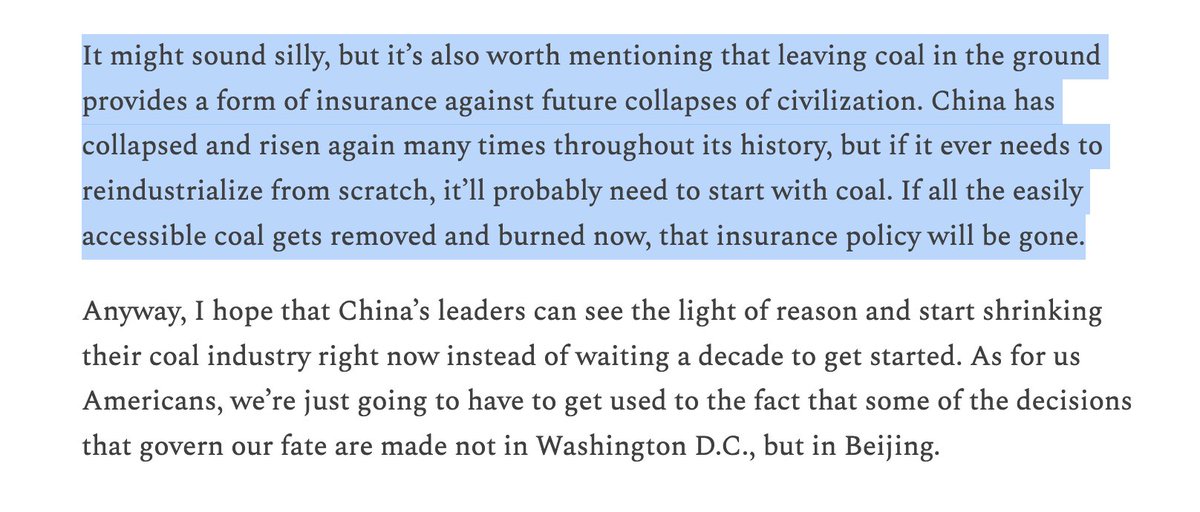
Anyways those are my 2 cents on the Gordian knot of coal in China.
Overall I'd say Noah's piece started out almost passable if basic/incomplete. With its subsequent thoughts on climate grand bargains + coal as a hedge vs societal collapse, it quite spectacularly jumps the shark.
Overall I'd say Noah's piece started out almost passable if basic/incomplete. With its subsequent thoughts on climate grand bargains + coal as a hedge vs societal collapse, it quite spectacularly jumps the shark.
Postscript:
OK "heart surgery" is probably over-catastrophizing a bit. Plenty of low-hanging fruit to cut coal burned + policymakers have ways to move fast if they want. Govt can force unneeded plants to close, fix interprovince power trading...
OK "heart surgery" is probably over-catastrophizing a bit. Plenty of low-hanging fruit to cut coal burned + policymakers have ways to move fast if they want. Govt can force unneeded plants to close, fix interprovince power trading...
I'm understating Chinese gas use a bit. China uses more gas for electricity than Japan does + uses more gas for industry than Japan consumes total.
You also don't **need** coal to do long-distance LCC-HVDC properly, there are a good # of alternatives.
You also don't **need** coal to do long-distance LCC-HVDC properly, there are a good # of alternatives.
Loading suggestions...