

Tulsi - Holy Basil - the most underappreciated medicinal herb in the West.
A THREAD
🧵
A THREAD
🧵
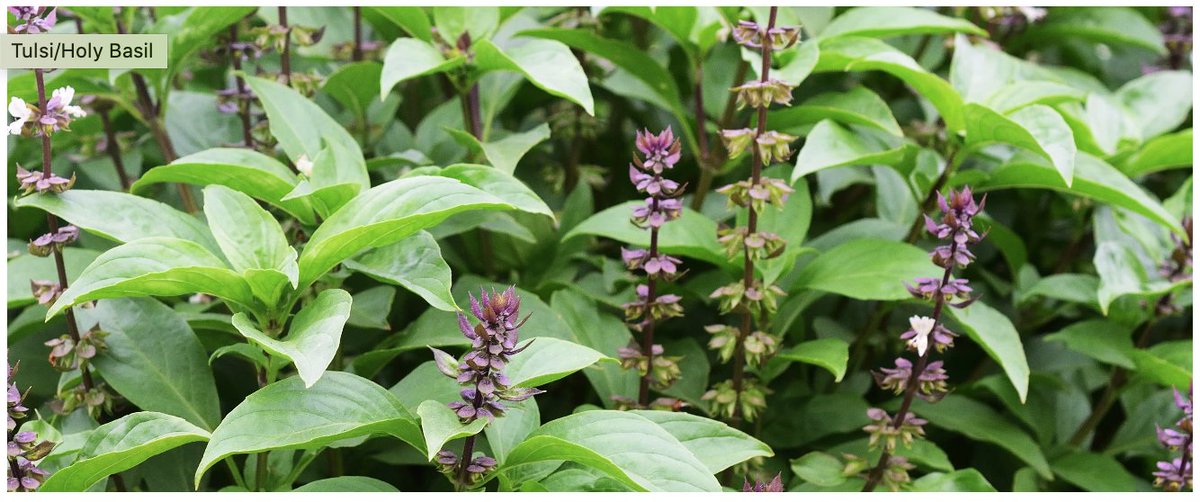
Tuls, is an aromatic herb native to India and is highly valued for its medicinal properties in the Ayurvedic + Siddha medical systems for thousands of years.
It is thought to have originated in north central India and now grows native throughout the eastern world tropics.
It is thought to have originated in north central India and now grows native throughout the eastern world tropics.
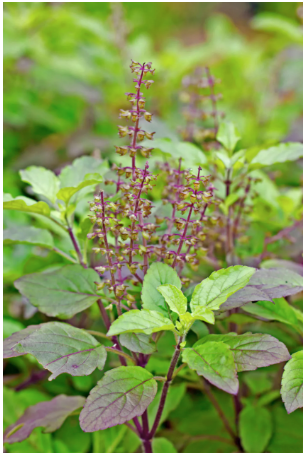
Tulsi is known as "The Incomparable One," "Mother Medicine of Nature," and "The Queen of Herbs" in Ayurveda and is treasured as an "elixir of life", unparalleled in both medical and spiritual virtues.
Tulsi is treasured in Hinduism, and every part of the tulsi plant is revered and considered sacred, including the leaves, stem, blossom, root, seeds, and oil. Even the surrounding soil, which has lately been discovered to carry beneficial endophytic fungi, is seen as divine.

Three types of tulsi are commonly described. Ocimum tenuiflorum (or Ocimum sanctum L.), which includes two types, Rama or Sri tulsi (green leaves) and Krishna or Shyama tulsi (purplish leaves); and Ocimum gratissimum, also known as Vana or wild or forest tulsi (dark green leaves)
Tulsi is increasingly being recognised as a potent adaptogen with a unique combination of pharmacological actions that promote wellbeing and resilience.
Numerous in vitro and animal studies attest to tulsi leaf having potent pharmacological actions that include adaptogenic, metabolic, immunomodulatory, anticancer, anti-inflammatory, antioxidant, hepatoprotective, radioprotective, antimicrobial, and antidiabetic effects.
Many of the physiological benefits of tulsi can be attributed to its ability to assist with the body's internal housekeeping and protection of the body from toxin-induced damage via increasing levels of antioxidant molecules.
tandfonline.com
tandfonline.com
Lab studies have shown that extracts are able to induce the killing of unwanted cancerous cells, thereby reducing the growth of experimental tumours and enhancing survival.
semanticscholar.org
semanticscholar.org
Tulsi not only protects against the damage caused by toxic compounds but also helps the body transform and eliminate them more effectively by increasing the activity of liver detoxification enzymes.
pubmed.ncbi.nlm.nih.gov
pubmed.ncbi.nlm.nih.gov
Numerous experimental studies have documented the ability of tulsi to protect against the damaging effects of various toxicants including butylparaben (food, pharmaceutical and cosmetic preservative); carbon tetrachloride (an industrial solvent) copper sulphate (a fungicide)...
ethanol; rogor (an insecticide); chlorpyrifos; endosulfan (an insecticide); lindane (a neurotoxin antiparasitic); meloxicam (an antiarthritic NSAID); paracetamol; haloperidol (an antipsychotic); various anti-tubercular drugs; lead; arsenic; iodine; mercury and radiation.
Yes, even radiation.
pubmed.ncbi.nlm.nih.gov
pubmed.ncbi.nlm.nih.gov
Tulsi has been shown in preclinical tests to increase swimming survival times in mice and to prevent stress-induced ulcers in rats, with antistress benefits comparable to those of antidepressant medications.
pubmed.ncbi.nlm.nih.gov
pubmed.ncbi.nlm.nih.gov
Recent research has shown that ethanolic and aqueous tulsi leaf extracts protect rats against stress-induced cardiovascular alterations.
pubmed.ncbi.nlm.nih.gov
pubmed.ncbi.nlm.nih.gov
Neurologically, tulsi has been shown to improve memory and cognitive function in animals and protect against age-related memory losses.
pubmed.ncbi.nlm.nih.gov
pubmed.ncbi.nlm.nih.gov
Tulsi has been demonstrated in animal studies to lower blood glucose levels, rectify aberrant lipid profiles, and protect the liver and kidneys from the metabolic damage caused by high glucose levels.
ncbi.nlm.nih.gov
ncbi.nlm.nih.gov
In humans, one randomised placebo-controlled clinical trial reported daily ingestion of 2.5 g of tulsi leaves led to significant improvements blood and urine glucose levels in type 2 diabetes patients after 4 weeks.
pubmed.ncbi.nlm.nih.gov
pubmed.ncbi.nlm.nih.gov
With regards to immunology, tulsi has also been shown to boost defences against infective threats by enhancing immune responses in non-stressed and stressed animals and healthy humans.
ncbi.nlm.nih.gov
ncbi.nlm.nih.gov
After 4 weeks of taking 300 mg of ethanolic tulsi leaf extract daily before food, one small trial demonstrated improved immune response with increased NK and T-helper cells in healthy adult participants compared to placebo volunteers.
pubmed.ncbi.nlm.nih.gov
pubmed.ncbi.nlm.nih.gov
A study in which volunteers were given nutrition bars fortified with 1 g of ethanolic tulsi leaf extract discovered that the intervention group had significantly improved exercise capacity, less fatigue, and an improved immune response to viral infection
semanticscholar.org
semanticscholar.org
With regards to COVID-19, eugenol, the aromatic compound in tulsi, was found to inhibit the interaction between SARS-CoV-2 spike S1 and ACE2 to induce therapeutic responses.
ncbi.nlm.nih.gov
ncbi.nlm.nih.gov
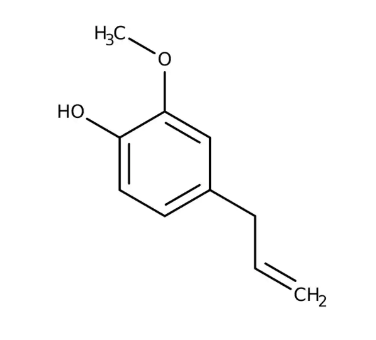
In SARS-CoV-2 spike S1-intoxicated mice, oral eugenol treatment reduced pulmonary inflammation and fever, improved heart function, and increased locomotor activities; with authors stating...
“Therefore, selective targeting of SARS-CoV-2 spike S1, but not ACE2, by eugenol may be beneficial for COVID-19 treatment.”
ncbi.nlm.nih.gov
ncbi.nlm.nih.gov
Eugenol has shown remarkable anti-inflammatory, antioxidant, analgesic, and antimicrobial properties, has a significant effect on human health, and may be the major bioactive component of tulsi.
ncbi.nlm.nih.gov
ncbi.nlm.nih.gov
The other researched bioactive compound in tulsi is ursolic acid, which is also found in apple peels.
Be beware that ursolic acid may have anti-fertility properties in men.
Be beware that ursolic acid may have anti-fertility properties in men.
In one study 2g fresh tulsi was given to male albino rabbits for 30 days and showed a significant decrease in sperm count but significant increase in testosterone levels.
pubmed.ncbi.nlm.nih.gov
pubmed.ncbi.nlm.nih.gov
However, results are mixed, with another study showing that ursolic acid protecting LPS-induced reduced sperm motility by increasing sperm density and motility.
pubmed.ncbi.nlm.nih.gov
pubmed.ncbi.nlm.nih.gov
There are no official dosages for tulsi. 250 mg taken twice daily to 14 g once a day of the leaf extract appears to be the range of dosages used in studies.
Find out more here 👇🏾
callingouttheshots.xyz
callingouttheshots.xyz
Tulsi has also been noted economic, safe and effective for domestic water defluoridation.
ncbi.nlm.nih.gov
ncbi.nlm.nih.gov
Loading suggestions...