

Kanneganti Hanumanthu and Uyyalavada Narasimha Reddy, two great freedom fighters from Andhra Pradesh, both of them sacrificed their life for cause of freedom on the same date.
Thread on these 2 great souls.
Thread on these 2 great souls.
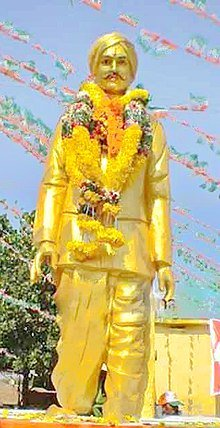
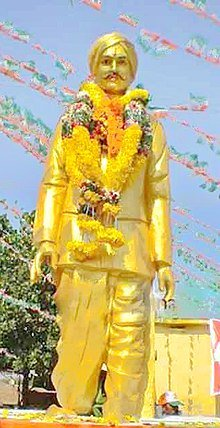
Kanneganti Hanumanthu was from Palnadu, a mostly arid district filled with hills, covering Markapur, Gurazala, Macherla, Narasaraopeta and Sattenapalli.
This region was famous for the historic battle of Palnadu during 1182 AD between Haiheya ruler Nalagamaraju aided by Nayakurala Nagamma and his step brother Malideva Raju aided by his wise minister Recherla Brahmanaidu.
Hanumanthu led the Pullari Satyagraha, against the draconian tax imposed by the British on the peasants for grazing their cattle or gathering wood in the forests.
He was born in 1870 to Venkatappayya and Achamma, their second child in a small village Minchalapadu near to Durgi in Guntur district.
A believer in Gandhian ideology, his Palnadu Satyagraha, would be an inspiration for many other revolutionaries. It was against the draconian Pullari tax, that Hanumanthu led the revolt as part of Gandhiji’s Non Cooperation Movement.
“Did you plant the tree? Did you water it? Who gave you the right to ask us to pay tax on our own land where we live?”
- Famous words of Hanumanthu to the British, when asked to pay the tax.
- Famous words of Hanumanthu to the British, when asked to pay the tax.
Leading a group of youth, Hanumanthu, led the revolt against the British in Palnadu. The masses came out in full support, women, older people blessed him, as he took on the British head on, giving them sleepless nights with his constant opposition.
Hanumanthu became a thorn in the flesh of the British, as all their strategies, came to nought against him. The British general Rutherford, along with the local collector Warner, tried to wean away some of the sections from Hanumanthu.
However the support of the masses was too strong to cause any impact. And so Rutherford tried to use deceit, offering Hanumanthu the zamindari of Durgi region to win him over, and extract as much tax as he wanted.
Kanneganti Hanumanthu however refused the offer saying he would never collect blood money from his fellow Indians.
#Respect
#Respect
February 22, 1922
Some of the British officials came to Minchalapadu village, the epicenter of the revolt, and warned Hanumanthu of severe consequences if the Pullari Tax was not paid.
Some of the British officials came to Minchalapadu village, the epicenter of the revolt, and warned Hanumanthu of severe consequences if the Pullari Tax was not paid.
With Gandhiji suspending the Non Cooperation Movement, Hanumanthu too agreed to pay tax. Around the same time, with the Mahashivratri festivities at Kotappa Konda taking place, Hanumanthu left to take part in the Prabhala procession there.
Taking advantage of his absence, the British surrounded the village, and began to take away the cattle there forcibly, beating up the elder and women with their rifle butts, when they tried to protest.
On hearing the news Hanumanthu rushed to his village, and pleaded with the British to stop harassing the residents. Inspite of Hanumanthu promising to pay the Pullari Tax, and requesting the Britishers not to harass his people, they kept beating up every one.
It was the village Karanam, who betrayed Hanumanthu, pointing him out to the British as they surrounded him and began to fire on him. Even as he kept pleading with the British that they would be paying the tax, they kept firing at him.
Not once, or twice but 26 times, as Hanumanthu's cries rent their air. His loyal farm hand, Ellamapalli Sheshayya too was shot dead brutally.
Hanumanthu, died pleading for mercy, so brutal were the British, that even when he asked for water, they stopped the villagers from giving it to him. For close to six hours, he waged a life and death struggle, before he breathed his last, his bullet ridden body falling.
The hero of Palnadu was no more, killed in the most brutal, shameful, callous manner, even when had agreed to suspend the revolt and pay the tax. When the enraged villagers of Minchalapadu, attacked the British with spears, bows, arrows, they were brutally suppressed.
The Britishers looted the village, it was one of the worst massacres ever, absolutely shameful. Palnadu mourned the brutal murder of it’s son, there was not a dry eye there. The British burried Hanumanthu at Kolaguntla in an unknown grave.
Years later in the popular Telugu movie Alluri Sitarama Raju, there was a lyric that went like this.
కన్నెగంటి హనుమంతు వెన్నులోని బాకు, కత్తి గట్టి సాగమంది కడ విజయం వరకు.
ఎలుగెత్తెను ఆ కంఠo మనదే రాజ్యం …జపియించెను ఆ వదనం వందే మాతరం.
కన్నెగంటి హనుమంతు వెన్నులోని బాకు, కత్తి గట్టి సాగమంది కడ విజయం వరకు.
ఎలుగెత్తెను ఆ కంఠo మనదే రాజ్యం …జపియించెను ఆ వదనం వందే మాతరం.
Loosely translated it means
The knife in the back of Kanneganti Hanumanthu, tells us to draw our sword and march towards victory. The voice from the throat proclaims that we shall rule, that face chants Vande Mataram.
The knife in the back of Kanneganti Hanumanthu, tells us to draw our sword and march towards victory. The voice from the throat proclaims that we shall rule, that face chants Vande Mataram.
Kanneganti Hanumanthu's sacrifice for the sake of Bharat, inspired many a revolutionary in Andhra. He would be an inspiration for a whole generation of Telugu freedom fighters. A true hero, who deserves a salute.
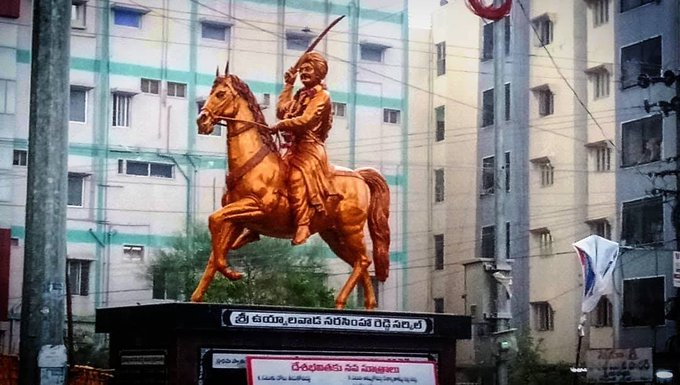
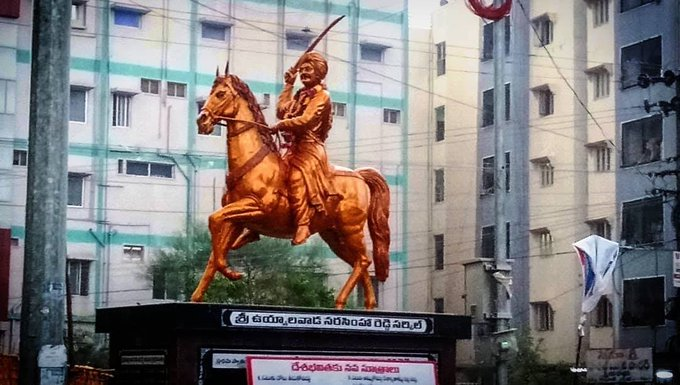
Uyyalavada Narasimha Reddy, born in Rupanagudi and grew up in Uyyalavada of Kurnool district, one of the prominent leaders of the Palegar Wars against the British much before 1857.
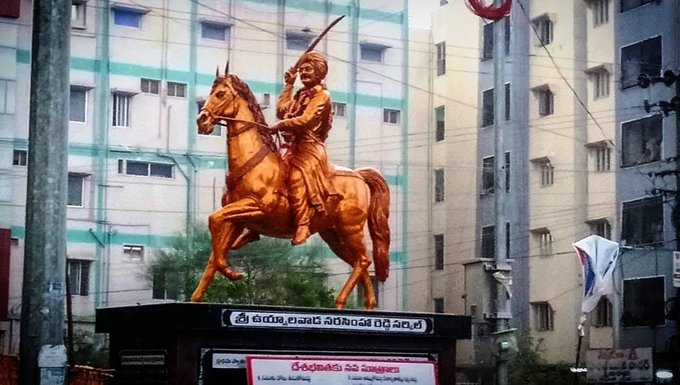
When the Nizam ceded the Rayalaseema region to the British, as part of their agreement, the Palegars came under the British rule. Keeping an eye on their large estates and wealth, the British abolished the Palegar system, and instead they were given some grants.
One of them was Uyyalavada in Kurnool district, whose Palegar was Pedda Malla Reddy, the adopted son of the Nosam zamindar Chenchumalla Jayarami Reddy. It was the son of Malla Reddy’s second wife Neelamma, who would gain fame for his revolt against the British.
Uyyalavada Narasimha Reddy, born in Rupanagudi and grew up in Uyyalavada, had around 66 villages under his control in Bellary, Kadapa, Anantapur, Kurnool districts, and was a patron of arts and literature.
The well known poets Obulacharya was his court poet, while he also felicitated another famous poet Venkata Subbayya. He had three wives, the first Sidammma, bore him a son Dora Subbayya, the second Peramma had a daughter, while two sons were born from his third wife Obulamma.
The bone of contention, was the monthly grant of around 11 rupees his father, used to get from the British, who however discontinued it on the grounds of him being the adopted son of the Zamindar , stating he was not the legal heir.
When Narasimha Reddy sent his associate to get the monthly grant due to them in 1846 to the treasury at Koilkuntla, the local Tahsildar rudely asked him to go away.
When his associate, conveyed the news of the Tahsildar’s rude behavior, a furious Narasimha Reddy decided to revolt against the British. The British had already seized his ancestral property in 1800, in lieu of which they had offered the monthly grant.
The zamindars of Wanaparthy, Munagala,Penugonda, Salaam Khan of Hyderabad, Papa Khan of Kurnnool, and many of the Boya, Chenchu tribes in the Nallamalla Hills joined hands with him in his revolt against the British.
With a 500 strong force of Boyas, Narasimha Reddy first attacked Koilkuntla treasury on July 10, 1846, killing the Tahsildar there beheading him. The treasurer Hari Singh, was killed, as he took the money due to him, and razed the treasury to the ground.
The British sensing danger cracked down hard. After capturing and torturing Narasimha Reddy’s associates Gosai Venkana,Obanna, the British were able to find proof of involvement in the attack on the treasury, and sent a unit under Captain Knott and Watson to capture him.
However Narasimha Reddy defeated the army forcing Knott and Watson to retreat, following which the British announced a reward of 1000 rupees to whoever could capture him.
Once again in a pitched battle in the Nallamalla forests at Giddalur, on July 23, Narasimha Reddy once again attacked the British forces, in a daring midnight raid, forcing them to retreat.
For quite some time he harassed the British through a series of guerrilla attacks, as they were unable to capture him. The British captured Narasimha Reddy’s family and imprisoned them at Kadapa.
As he came there to free them, the collector of Kadapa, Cochraine came to know, he was at the Jagganatha Temple at Perusomala in the Nallamalla hills, and surrounded the area with his army.
The British bribed Naraismha Reddy’s cook to mix toddy in his meal, making him intoxicated, while his gun was disabled. The inebriated Narasimha Reddy was captured on October 6, 1846, and bought to Koilkuntla, along with 900 of his associates.
While around 400 were left free,273 were freed on bail,around 112 were put in prison, while some were exiled to the Andamans. After a long trial Naraismha Reddy, was accused of waging war against the Government, as well as looting and murder.
And on February 22, 1847 at 7 AM, Uyyalavada Narasimha Reddy was publicly hanged at Jurreti. His head was put on display at the Koilkuntla fort, as a warning to the public against revolting. Another great son of Bharat gave up his life for the cause of freedom.
Kanneganti Hanumanthu and Uyyalavada Narasimha Reddy.
Different eras, different regions, and both sacrificed their lives on the same date for freedom.
Salute to these two heroes.
And thanks for following this long thread of mine patiently. #Naman
Different eras, different regions, and both sacrificed their lives on the same date for freedom.
Salute to these two heroes.
And thanks for following this long thread of mine patiently. #Naman
Loading suggestions...