

1/
EigenLayer will democratize ETH’s security for all onchain applications.
Oracle & bridge exploits will become a thing of the past. With @eigenlayer, $ETH will secure their operations and users.
Learn about this new frontier in protocol security in under 5 min🧵
EigenLayer will democratize ETH’s security for all onchain applications.
Oracle & bridge exploits will become a thing of the past. With @eigenlayer, $ETH will secure their operations and users.
Learn about this new frontier in protocol security in under 5 min🧵

2/ In this thread, I will cover
1️⃣ What is AVS
2️⃣ Current Flaws of AVS
3️⃣ What is Eigen Layer
4️⃣ Multiple Staking Modalities
5️⃣ Restaking Use Cases
6️⃣ Governance
7️⃣ Business Model
8️⃣ Final Thoughts
1️⃣ What is AVS
2️⃣ Current Flaws of AVS
3️⃣ What is Eigen Layer
4️⃣ Multiple Staking Modalities
5️⃣ Restaking Use Cases
6️⃣ Governance
7️⃣ Business Model
8️⃣ Final Thoughts
3/
1️⃣ What is AVS?
AVS stands for Actively Validated Services.
Typically refers to infrastructure modules, or middleware, on a blockchain that have their own validation semantics, e.g. oracles, bridges, data availability layers
1️⃣ What is AVS?
AVS stands for Actively Validated Services.
Typically refers to infrastructure modules, or middleware, on a blockchain that have their own validation semantics, e.g. oracles, bridges, data availability layers
4/
2️⃣ Current Flaws of AVS
Modules and non-EVM compatible modules are largely responsible for their own security. However, the current AVS model poses three critical flaws
2️⃣ Current Flaws of AVS
Modules and non-EVM compatible modules are largely responsible for their own security. However, the current AVS model poses three critical flaws
5/
🚫 Low Cost of Corruption
dApps with multiple trust networks (e.g. ETH + module) are more susceptible to attacks b/c the minimum cost of corruption for dApp = cost of corruption of module, which is provably less secure than ETH
🚫 Low Cost of Corruption
dApps with multiple trust networks (e.g. ETH + module) are more susceptible to attacks b/c the minimum cost of corruption for dApp = cost of corruption of module, which is provably less secure than ETH
6/
🚫 Capital Inefficiency
Users have to pay fees for a separate trust network in addition to gas fees for the blockchain. Trust networks are also costly to incentivize
🚫 Capital Inefficiency
Users have to pay fees for a separate trust network in addition to gas fees for the blockchain. Trust networks are also costly to incentivize
7/
🚫 Trust Fragmentation
As more modules & dApps are built, security becomes increasingly fragmented, making it difficult and expensive to bootstrap.
🚫 Trust Fragmentation
As more modules & dApps are built, security becomes increasingly fragmented, making it difficult and expensive to bootstrap.
8/
3️⃣ What is EigenLayer
EigenLayer solves these issues by creating an open marketplace for modules to use pooled security from ETH validators.
3️⃣ What is EigenLayer
EigenLayer solves these issues by creating an open marketplace for modules to use pooled security from ETH validators.
9/
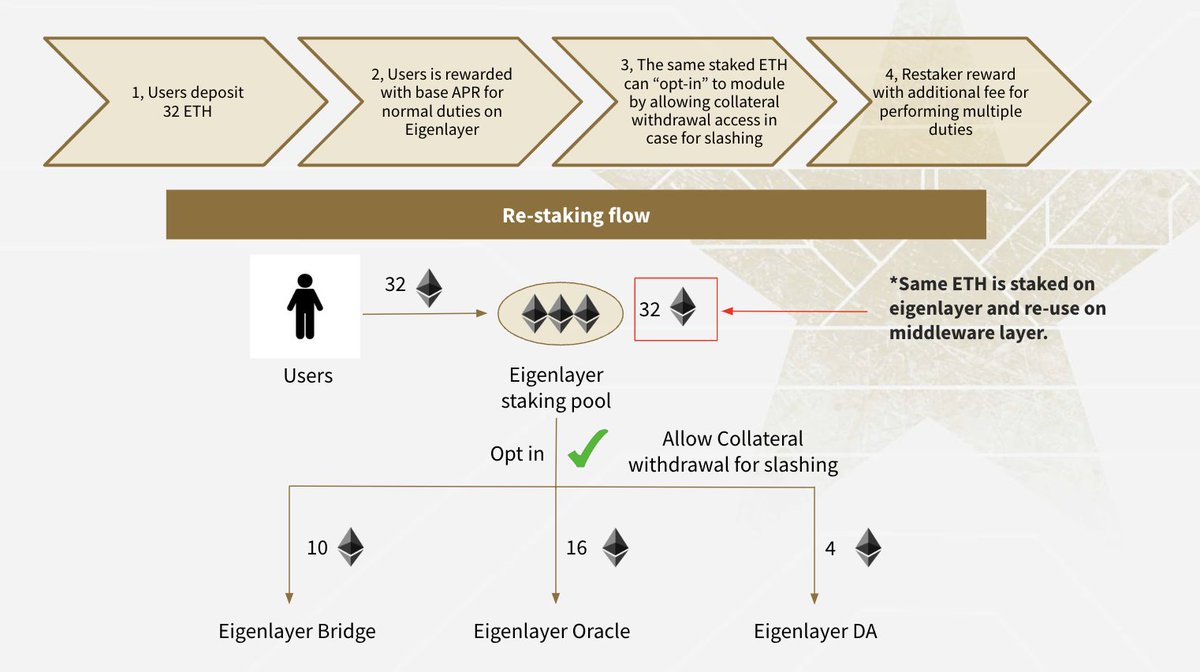
Validators can “restake” their staked ETH on EigenLayer and provide security by operating their own nodes or delegating to EigenLayer operators.
Validators can “restake” their staked ETH on EigenLayer and provide security by operating their own nodes or delegating to EigenLayer operators.
10/
Simply put, EigenLayer increases the minimal cost of corruption to that of Ethereum’s, greatly reducing the risk of a 51% attack.
Simply put, EigenLayer increases the minimal cost of corruption to that of Ethereum’s, greatly reducing the risk of a 51% attack.
11/
Restaked ETH can be freely reallocated among modules based on risk/reward.
Validators earn extra revenue for their services but are subject to requirements & extra slashing conditions imposed by various modules.
Restaked ETH can be freely reallocated among modules based on risk/reward.
Validators earn extra revenue for their services but are subject to requirements & extra slashing conditions imposed by various modules.
12/
4️⃣ Multiple Staking Modalities
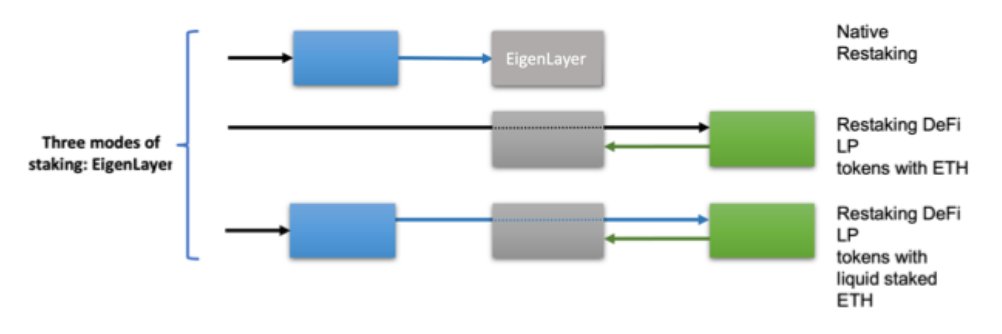
EigenLayer offers validators multiple options for staking, namely
(1) Native: Restake native $ETH
(2) LSD: Restake an LSD such as $stETH or $frxETH
(3) ETH LP: Restake LP token w/ $ETH
(4) LSD LP: Restake LP token with LSD
4️⃣ Multiple Staking Modalities
EigenLayer offers validators multiple options for staking, namely
(1) Native: Restake native $ETH
(2) LSD: Restake an LSD such as $stETH or $frxETH
(3) ETH LP: Restake LP token w/ $ETH
(4) LSD LP: Restake LP token with LSD
13/
Through these modalities, users can yield stack from various sources and earn rewards from e.g. liquid staking + LP + EigenLayer vs traditional staking.
Through these modalities, users can yield stack from various sources and earn rewards from e.g. liquid staking + LP + EigenLayer vs traditional staking.
14/
5️⃣ Restaking Use Cases
Here’s a list of what can be built / augmented with Eigen Layer
• Oracle
• Settlement Chains with Ultra-Low Latency:
• Decentralized Sequencers
• Fast-Mode Bridges for Rollups
• Hyperscale Data Availability Layer
• Opt-In MEV Management
5️⃣ Restaking Use Cases
Here’s a list of what can be built / augmented with Eigen Layer
• Oracle
• Settlement Chains with Ultra-Low Latency:
• Decentralized Sequencers
• Fast-Mode Bridges for Rollups
• Hyperscale Data Availability Layer
• Opt-In MEV Management
15/
6️⃣ Governance
Instead of a token-based quorum governance model, Eigenlayer will use a reputation-based committee composed of reputable individuals in the Ethereum and EigenLayer community.
6️⃣ Governance
Instead of a token-based quorum governance model, Eigenlayer will use a reputation-based committee composed of reputable individuals in the Ethereum and EigenLayer community.
16/
Duties of the committee includes:
(1) Enable upgrades to contracts
(2) Review and Veto slashing events
(3) Admit new AVS systemS into slashing review process
Duties of the committee includes:
(1) Enable upgrades to contracts
(2) Review and Veto slashing events
(3) Admit new AVS systemS into slashing review process
17/
New modules that wish to build on top of EigenLayer must be admitted by Veto committee
The admission process involves security audits & checking the validators' system requirements by committee members.
This can ensure the quality of AVS in EigenLayer's early phase.
New modules that wish to build on top of EigenLayer must be admitted by Veto committee
The admission process involves security audits & checking the validators' system requirements by committee members.
This can ensure the quality of AVS in EigenLayer's early phase.
18/
7️⃣ EigenLayer Business Model
EigenLayer’s whitepaper proposes 4 possible business models for the project.
I’ve summarized them into the following key takeaways
7️⃣ EigenLayer Business Model
EigenLayer’s whitepaper proposes 4 possible business models for the project.
I’ve summarized them into the following key takeaways
19/
If a module operates as a commercial service on EigenLayer, the company can earn a fraction of fees from gas as return for their services, while the rest of the fees go to ETH restakers
If a module operates as a commercial service on EigenLayer, the company can earn a fraction of fees from gas as return for their services, while the rest of the fees go to ETH restakers
20/
If a module operates as a protocol, the users can pay gas fees using its native token.
Fees are then divided between $AVS stakers and ETH restakers on EigenLayer, ensuring that the native token has its own utility.
If a module operates as a protocol, the users can pay gas fees using its native token.
Fees are then divided between $AVS stakers and ETH restakers on EigenLayer, ensuring that the native token has its own utility.
21/
8️⃣ Final thoughts
Eigenlayer enhances the security of modules and non-EVM modules while maintaining the value of native tokens.
8️⃣ Final thoughts
Eigenlayer enhances the security of modules and non-EVM modules while maintaining the value of native tokens.
22/
Modules and dApps can effectively outsource their security to ETH on EigenLayer, reduce costs, and focus on innovation that will drive the industry forward as a whole.
Needless to say, EigenLayer is a project you must keep your eye on.
Modules and dApps can effectively outsource their security to ETH on EigenLayer, reduce costs, and focus on innovation that will drive the industry forward as a whole.
Needless to say, EigenLayer is a project you must keep your eye on.
23/
I regularly post protocol breakdowns and institutional grade research reports for free
My EigenLayer deck is up next.
Follow me so you don’t miss it
I regularly post protocol breakdowns and institutional grade research reports for free
My EigenLayer deck is up next.
Follow me so you don’t miss it
27/
I put a lot of effort into this thread & upcoming research report.
If you learned something new, pls like + RT the first tweet:
I put a lot of effort into this thread & upcoming research report.
If you learned something new, pls like + RT the first tweet:
Loading suggestions...