

Mirrors rise of Japan Inc. in the 70s and 80s led by its increasingly dominant auto industry
Recall that it was an exogenous event - OPEC-driven fuel price spikes - that really propelled the popularity of Japan’s smaller/more fuel-efficient cars in the U.S.
Recall that it was an exogenous event - OPEC-driven fuel price spikes - that really propelled the popularity of Japan’s smaller/more fuel-efficient cars in the U.S.
Similarly, the confluence of various tech development pathways and cost reductions (e.g. battery, chips/electronics, solar) count as an exogenous shock that is now rapidly propelling Chinese EVs into the forefront.
One just prays that we will handle it a lot better this time. Asian Americans are deeply sensitive to the beating death of autoworker Vincent Chin at the height of Japan bashing in 1982.
en.m.wikipedia.org
en.m.wikipedia.org
This is another relevant data point suggesting that China’s relative level of economic development is similar to Japan in the late 70s.
nytimes.com
nytimes.com
Some more data points from something I wrote 7 years ago: lukecapital.substack.com
The table dates from 2012
The table dates from 2012

At the time (2016), I argued that China was roughly where Japan was in the mid-70s. Assuming it has continued to follow that path, China in 2023 would be roughly where Japan is in the late 70s / early 80s relative to a fully developed economy.
Urban population has continued to increase steadily and now sits at around 65%.
Japan reached this level by the mid-1970s
Japan reached this level by the mid-1970s
Life expectancy reached 78 years, a level Japan reached in the 1990s.
data.worldbank.org
data.worldbank.org
GDP per capita in 2023 (est. $14,500) is about 2.3x since 2012, a 7.8% CAGR. Japan averaged ~4% annual growth in the 1970s, with growth impacted by aforementioned spikes in oil prices
data.worldbank.org
data.worldbank.org
Another anecdotal data point to help triangulate relative development:
Japan's Tokaido Shinkansen opening up in 1964 + Tokyo hosting the Olympics the same year
China's first HSR line opened in 2008 - with Beijing also hosting the Olympics the same year
Japan's Tokaido Shinkansen opening up in 1964 + Tokyo hosting the Olympics the same year
China's first HSR line opened in 2008 - with Beijing also hosting the Olympics the same year
Figuring out where China's economic development relative to fully developed economies is critical in determining policy decisions
If China is late 70s Japan, the implication is that there is still a decade of catch-up growth and runway to make the transition ...
If China is late 70s Japan, the implication is that there is still a decade of catch-up growth and runway to make the transition ...
... if you think China is 1990s Japan, then one can understand why you think the Chinese economy is on the brink of a major collapse
ft.com
ft.com
Very valid to debate these two positions.
However, what is very clear is that if you thought China was already "late 80s Japan" 15 years ago, you were just flat-out wrong.
However, what is very clear is that if you thought China was already "late 80s Japan" 15 years ago, you were just flat-out wrong.
In any case, it's all about what happens going forward.
I've made the point before that China and Japan's economic development paths have diverged and there are fewer lessons for China from the Japan and other smaller East Asian tigers like SK and Taiwan ...
I've made the point before that China and Japan's economic development paths have diverged and there are fewer lessons for China from the Japan and other smaller East Asian tigers like SK and Taiwan ...
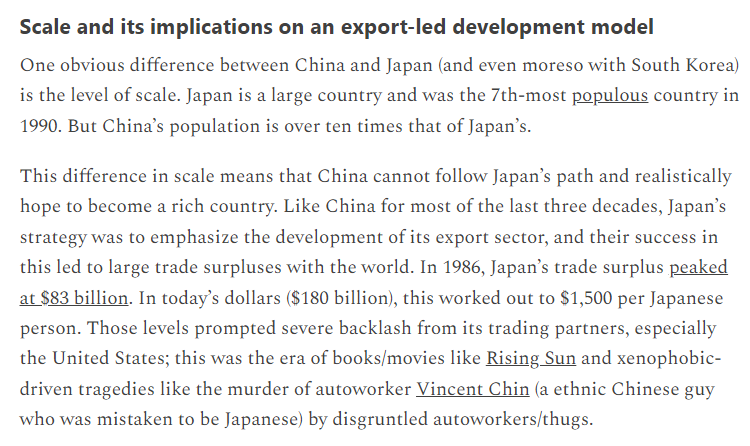
... namely that the export-led development model could not scale for an economy the size of China's due to the inevitable stress on trade relations that we have been witnessing since the GFC
1.4 billion people cannot get rich by exporting alone.
1.4 billion people cannot get rich by exporting alone.
On the flipside, China's scale is also its advantage in its ability to support and develop wholesale industries.
China's economy has the potential demand to re-create entire complex supply chains in ways that smaller economies like Japan and SK could not.
China's economy has the potential demand to re-create entire complex supply chains in ways that smaller economies like Japan and SK could not.
We are witnessing this in real-time with the effort to re-build the semicap value chain
Whether it will be successful or not still remains to be seen but this is clearly an endeavor that smaller economies would not even be able to undertake
Whether it will be successful or not still remains to be seen but this is clearly an endeavor that smaller economies would not even be able to undertake
Loading suggestions...