

The Ethereum ecosystem is hindered by disparate entities with their own networks of trust.
Can @Eigenlayer be the solution for increased security and additional revenue streams?
Let's dive into it with a thread 🧵
Can @Eigenlayer be the solution for increased security and additional revenue streams?
Let's dive into it with a thread 🧵

(1/23)
Join me in this thread, as I cover everything from its business model to innovative slashing analysis approach
1️⃣ What is @eigenlayer
2️⃣ Current Problems in Ethereum dApps
3️⃣ How @eigenlayer Resolves the Problems
4️⃣ Slashing Analysis
5️⃣ EigenLayer Token
6️⃣ Business Model
Join me in this thread, as I cover everything from its business model to innovative slashing analysis approach
1️⃣ What is @eigenlayer
2️⃣ Current Problems in Ethereum dApps
3️⃣ How @eigenlayer Resolves the Problems
4️⃣ Slashing Analysis
5️⃣ EigenLayer Token
6️⃣ Business Model
(2/23)
1️⃣ What is @eigenlayer
EigenLayer is a platform that leverages Ethereum security through restaking.
Staked $ETH can be rehypotehcated, enabling modules/protocols to benefit from Ethereum's robust security.
1️⃣ What is @eigenlayer
EigenLayer is a platform that leverages Ethereum security through restaking.
Staked $ETH can be rehypotehcated, enabling modules/protocols to benefit from Ethereum's robust security.
(3/23)
2️⃣ Current Problems in Ethereum dApps
Many dApps on Ethereum are missing out on its trust and security.
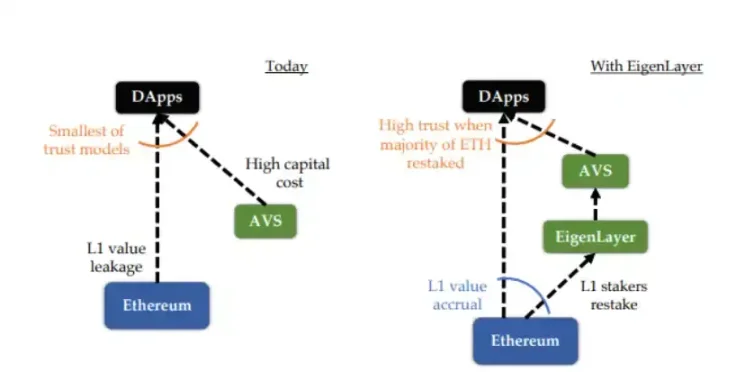
Actively Validated Services (AVS), like oracles and trusted execution environments, are responsible for their own security.
2️⃣ Current Problems in Ethereum dApps
Many dApps on Ethereum are missing out on its trust and security.
Actively Validated Services (AVS), like oracles and trusted execution environments, are responsible for their own security.
(4/23)
The existing AVS ecosystem, however, comes with distinct disadvantages:
(i) Capital inefficiency in bootstrapping new trust networks
(ii) Leakage of value
(iii) High staking reward costs
(iv) Weakened security for dApps
The existing AVS ecosystem, however, comes with distinct disadvantages:
(i) Capital inefficiency in bootstrapping new trust networks
(ii) Leakage of value
(iii) High staking reward costs
(iv) Weakened security for dApps
(5/23)
3️⃣ How @eigenlayer Resolves the Problems
EigenLayer brings in 2 innovative concepts to the Ethereum ecosystem:
(i) restaking
(ii) free-market governance.
3️⃣ How @eigenlayer Resolves the Problems
EigenLayer brings in 2 innovative concepts to the Ethereum ecosystem:
(i) restaking
(ii) free-market governance.
(6/23)
(i) Restaking
EigenLayer enables restaking of ETH to secure modules built on its platform.
Validators can opt into these modules, gaining additional revenue for providing security & validation services (subject to slashing conditions).
(i) Restaking
EigenLayer enables restaking of ETH to secure modules built on its platform.
Validators can opt into these modules, gaining additional revenue for providing security & validation services (subject to slashing conditions).
(7/23)
This allows for a deep transfer of cryptoeconomic security and expands the space of blockchain applications over which security can be pooled.
This allows for a deep transfer of cryptoeconomic security and expands the space of blockchain applications over which security can be pooled.
(8/23)
(ii) Free-market governance
EigenLayer's open market mechanism allows validators to determine their risk/reward trade-offs by opting in/out of each module.
(ii) Free-market governance
EigenLayer's open market mechanism allows validators to determine their risk/reward trade-offs by opting in/out of each module.
(9/23)
This accelerates open innovation of blockchain apps & increases profit, but comes with the risk of getting slashed if required security conditions are broken.
This accelerates open innovation of blockchain apps & increases profit, but comes with the risk of getting slashed if required security conditions are broken.
(10/23)
Opt-in validation makes it possible for new blockchain modules to exploit heterogeneous resources among validators for better tuned trade-offs of security and performance.
Opt-in validation makes it possible for new blockchain modules to exploit heterogeneous resources among validators for better tuned trade-offs of security and performance.
(11/23)
@eigenlayer solves various AVS ecosystem problems: bootstrapping for new AVS, capital cost, trust aggregation, and value accrual for ETH stakers, expanding open innovation beyond smart contract-based DApps to virtual machines, consensus protocols, and middleware.
@eigenlayer solves various AVS ecosystem problems: bootstrapping for new AVS, capital cost, trust aggregation, and value accrual for ETH stakers, expanding open innovation beyond smart contract-based DApps to virtual machines, consensus protocols, and middleware.
(12/23)
It vastly expands the space of blockchain applications over which security can be pooled, thus increasing the cost-of-corruption from the minimum-of-the-stake to the sum-of-the-stake.
It vastly expands the space of blockchain applications over which security can be pooled, thus increasing the cost-of-corruption from the minimum-of-the-stake to the sum-of-the-stake.
(13/23)
4️⃣ Slashing Analysis
EigenLayer uses slashing as a security mechanism to prevent corruption. It doesn't issue fungible tokens because each user has different slashing risks.
4️⃣ Slashing Analysis
EigenLayer uses slashing as a security mechanism to prevent corruption. It doesn't issue fungible tokens because each user has different slashing risks.
(14/23)
Risk management includes open-source dashboard monitoring, profit-from-corruption limitation, and security audits.
The governance committee is comprised of Ethereum and EigenLayer community members responsible for protocol upgrades and slashing reviews.
Risk management includes open-source dashboard monitoring, profit-from-corruption limitation, and security audits.
The governance committee is comprised of Ethereum and EigenLayer community members responsible for protocol upgrades and slashing reviews.
(15/23)
EigenLayer proposes hyperscale AVS and lightweight design patterns to maximize security and minimize centralization risk.
EigenLayer proposes hyperscale AVS and lightweight design patterns to maximize security and minimize centralization risk.
(16/23)
5️⃣ EigenLayer Token
EigenLayer has taken a prudent approach by not introducing its own token.
Instead, restakers are incentivized by the opportunity to earn yield from their staked ETH.
5️⃣ EigenLayer Token
EigenLayer has taken a prudent approach by not introducing its own token.
Instead, restakers are incentivized by the opportunity to earn yield from their staked ETH.
(17/23)
This not only aligns the interests of restakers with the security of the entire network, but also reduces the risk of introducing additional economic uncertainty.
This not only aligns the interests of restakers with the security of the entire network, but also reduces the risk of introducing additional economic uncertainty.
(18/23)
EigenLayer's commitment to the stability and growth of the broader AVS ecosystem is commendable, and a testament to their forward-thinking approach to building a more robust and sustainable blockchain infrastructure.
EigenLayer's commitment to the stability and growth of the broader AVS ecosystem is commendable, and a testament to their forward-thinking approach to building a more robust and sustainable blockchain infrastructure.
(19/23)
6️⃣ Business Model
EigenLayer enables different business models for AVSs:
(i) Users pay a fee for AVS service, income split between company's wallet & ETH restakers.
(ii) Tokenization of fees: fraction of fees go to $AVS token holders, rest to ETH restakers.
6️⃣ Business Model
EigenLayer enables different business models for AVSs:
(i) Users pay a fee for AVS service, income split between company's wallet & ETH restakers.
(ii) Tokenization of fees: fraction of fees go to $AVS token holders, rest to ETH restakers.
(20/23)
(iii) Users pay fees in $AVS, fraction goes to token holders, rest to ETH restakers.
(iv) Dual-coin staking: $AVS and ETH restakers operate together to drive $AVS utility while hedging against potential death spiral.
(iii) Users pay fees in $AVS, fraction goes to token holders, rest to ETH restakers.
(iv) Dual-coin staking: $AVS and ETH restakers operate together to drive $AVS utility while hedging against potential death spiral.
(22/23)
Tagging CT threadoooors (Part I)
@defi_mochi
@eli5_defi
@DefiIgnas
@defi_mochi
@midoji7
@karl_0x
@DeFiMinty
@Slappjakke
@rektdiomedes
@TheDeFinvestor
@LouisCooper_
@BackTheBunny
@crypto_linn
@DegenSpartan
@0xCrypto_doctor
@wintersoldierxz
Tagging CT threadoooors (Part I)
@defi_mochi
@eli5_defi
@DefiIgnas
@defi_mochi
@midoji7
@karl_0x
@DeFiMinty
@Slappjakke
@rektdiomedes
@TheDeFinvestor
@LouisCooper_
@BackTheBunny
@crypto_linn
@DegenSpartan
@0xCrypto_doctor
@wintersoldierxz
(23/23)
Tagging CT threadoooors (Part II)
@charlie_defi
@alpha_pls
@DeFi_Cheetah
@Louround_
@CryptoDeFiGuy
@0xJamesXXX
@ThorHartvigsen
@Chinchillah_
@0xTindorr
@0xCrypto_doctor
@VirtualKenji
@bizyugo
@DefiPrinces
@crypto_linn
@DAdvisoor
@GrowWithPassive
Tagging CT threadoooors (Part II)
@charlie_defi
@alpha_pls
@DeFi_Cheetah
@Louround_
@CryptoDeFiGuy
@0xJamesXXX
@ThorHartvigsen
@Chinchillah_
@0xTindorr
@0xCrypto_doctor
@VirtualKenji
@bizyugo
@DefiPrinces
@crypto_linn
@DAdvisoor
@GrowWithPassive
Loading suggestions...