

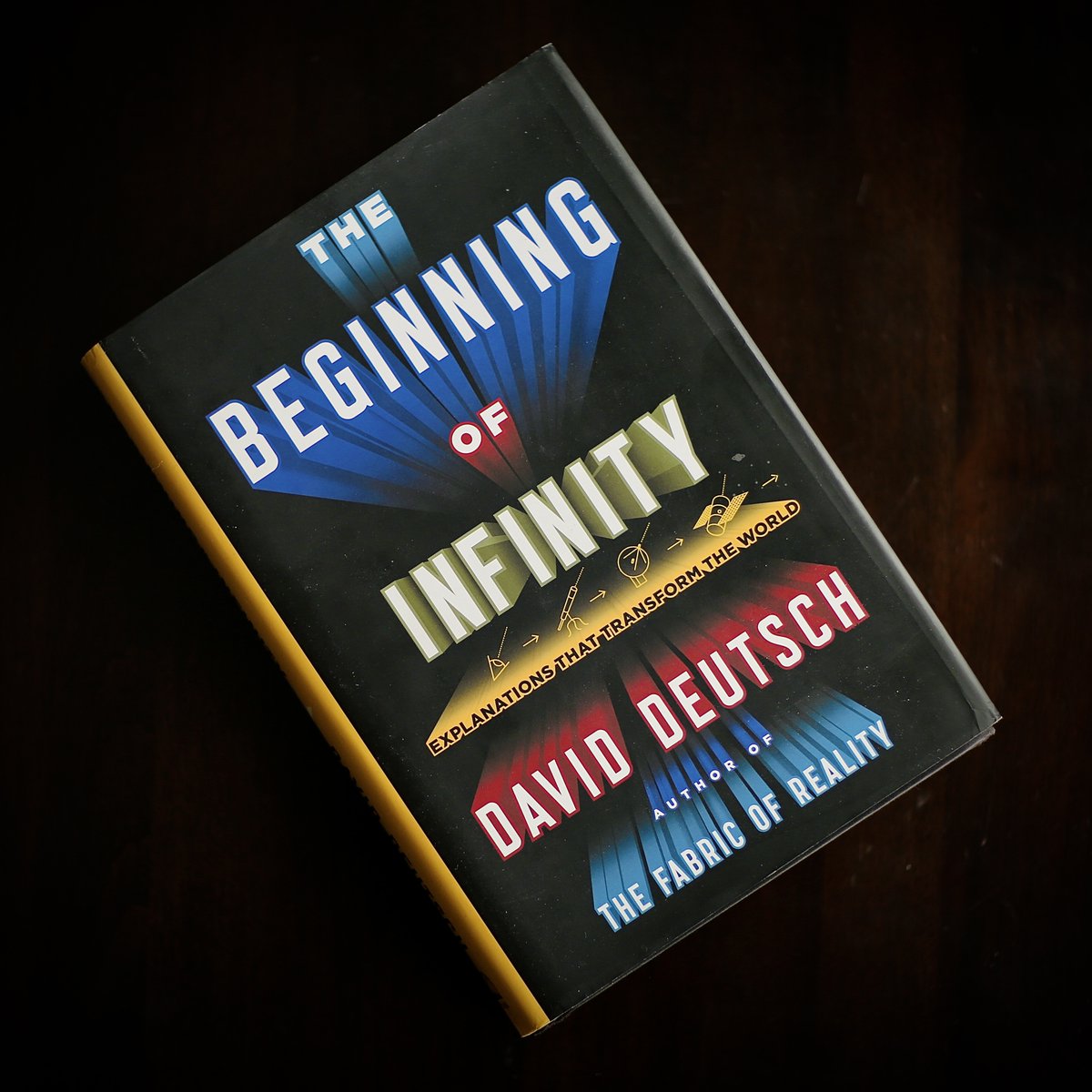
The Beginning of Infinity by @DavidDeutschOxf
Highly original, rational and optimistic. It explores and establishes deep connections between the laws of nature, knowledge, and the human potential for progress.
Thank you @naval for this great recommendation.
A thread 🧵
Highly original, rational and optimistic. It explores and establishes deep connections between the laws of nature, knowledge, and the human potential for progress.
Thank you @naval for this great recommendation.
A thread 🧵
Behind it all is surely an idea so simple, so beautiful, that when we grasp it - in a decade, a century, or a millennium - we will all say to each other, how could it have been otherwise?
- John Archibald Wheeler
- John Archibald Wheeler
The real key to science is that our explanatory theories – which include those interpretations – can be improved, through conjecture, criticism, and testing.
Solving a problem means creating an explanation that does not have the conflict.
Solving a problem means creating an explanation that does not have the conflict.
People can apply creativity even to tasks that computers and other machines do uncreatively.
Science is not mindless toil for which rare moments of discovery are the compensation: the toil can be creative, and fun, just as the discovery of new explanations is.
Science is not mindless toil for which rare moments of discovery are the compensation: the toil can be creative, and fun, just as the discovery of new explanations is.
It is inevitable that we face problems, but no particular problem is inevitable. We survive, and thrive, by solving each problem as it comes up.
Everything that is not forbidden by laws of nature is soluble (achievable), given the right knowledge.
Everything that is not forbidden by laws of nature is soluble (achievable), given the right knowledge.
People are the most significant entities in the cosmic scheme of things. They are not ‘supported’ by their environments but support themselves by creating knowledge.
Once they have suitable knowledge, they are capable of sparking unlimited further progress.
Once they have suitable knowledge, they are capable of sparking unlimited further progress.
People often try to improve explanations even when they have received them accurately: they make creative amendments, spurred by their own criticism.
If they then pass the explanation on to others, they usually try to pass on what they consider to be the improved version.
If they then pass the explanation on to others, they usually try to pass on what they consider to be the improved version.
The problem has been not that the world is so complex that we cannot understand why it looks as it does, but it is that it is so simple that we cannot yet understand it.
Explanations do not form a hierarchy with the lowest level being the most fundamental. Rather, explanations at any level of emergence can be fundamental.
We can have multiple explanations of the same phenomenon at different levels of emergence and still remain consistent.
We can have multiple explanations of the same phenomenon at different levels of emergence and still remain consistent.
Without error-correction all information processing, and hence all knowledge-creation, is necessarily bounded.
Error-correction is the beginning of infinity.
Error-correction is the beginning of infinity.
Becoming better at pretending to think is not the same coming closer to being able to think.
Proof is a physical process: whether a mathematical proposition is provable or unprovable depends on the laws of physics.
Similarly, whether a task or pattern is simple, or complex depends on what the laws of physics are.
Similarly, whether a task or pattern is simple, or complex depends on what the laws of physics are.
The harm that can flow from any innovation that does not destroy the growth of knowledge is always finite; the good can be unlimited.
Problems are soluble.
An optimistic civilization is open and not afraid to innovate and is based on traditions of criticism.
Its institutions keep improving, and the most important knowledge that they embody is knowledge of how to detect and eliminate errors.
An optimistic civilization is open and not afraid to innovate and is based on traditions of criticism.
Its institutions keep improving, and the most important knowledge that they embody is knowledge of how to detect and eliminate errors.
In science, the main impact of bad philosophy has been through the idea of separating a scientific theory into (explanationless) predictions and (arbitrary) interpretation.
Progress is the only effective way of opposing bad philosophy.
Progress is the only effective way of opposing bad philosophy.
It does not make sense to include everyone’s favored policies, or parts of them, in the new decision; what is necessary for progress is to exclude ideas that fail to survive criticism, and to prevent their entrenchment, and to promote the creation of new ideas.
Why do humans appreciate objective beauty if there has been no equivalent of that co-evolution in our past?
We are universal explainers and can create knowledge about anything. The amount of information in a human mind is more than that in the genome of any species.
We are universal explainers and can create knowledge about anything. The amount of information in a human mind is more than that in the genome of any species.
Scientific observation is impossible without pre-existing knowledge about what to look at, what to look for, how to look, and how to interpret what one sees.
Therefore, theory has to come first. It has to be conjectured not derived.
Therefore, theory has to come first. It has to be conjectured not derived.
Only progress is sustainable.
If we choose to embark on an open-ended journey of creation and exploration whose every step is unsustainable until it is redeemed by the next – if this becomes the prevailing ethic and aspiration of our society – the beginning of infinity will have become sustainable.
What lies ahead of us is in any case infinity.
All we can choose is whether it is an infinity of ignorance or of knowledge, wrong or right, death or life.
All we can choose is whether it is an infinity of ignorance or of knowledge, wrong or right, death or life.
Thank you for going through the thread. Follow me at @readswithravi for more book learning, reviews, and lessons. Teach or share with others what you learn, that's how we grow.
Retweet the first tweet so you can share these with others.
Retweet the first tweet so you can share these with others.
Loading suggestions...