

Brahmin clout at IITs is ending. At least 30% of the zonal toppers are Baniyas. The ‘Kota Coaching Factory’ is also a Baniya owned phenomenon. Change is welcome. #Sociology #IIT #Caste Thread 🧵⬇️


The IT revolution in its early years was led by the IIT graduates and postgraduates, and most of them were Brahmins. Sociologist Carol Upadhya’s study on the software professionals with 132 respondents in Bengaluru revealed that 48% per of them were Brahmins.
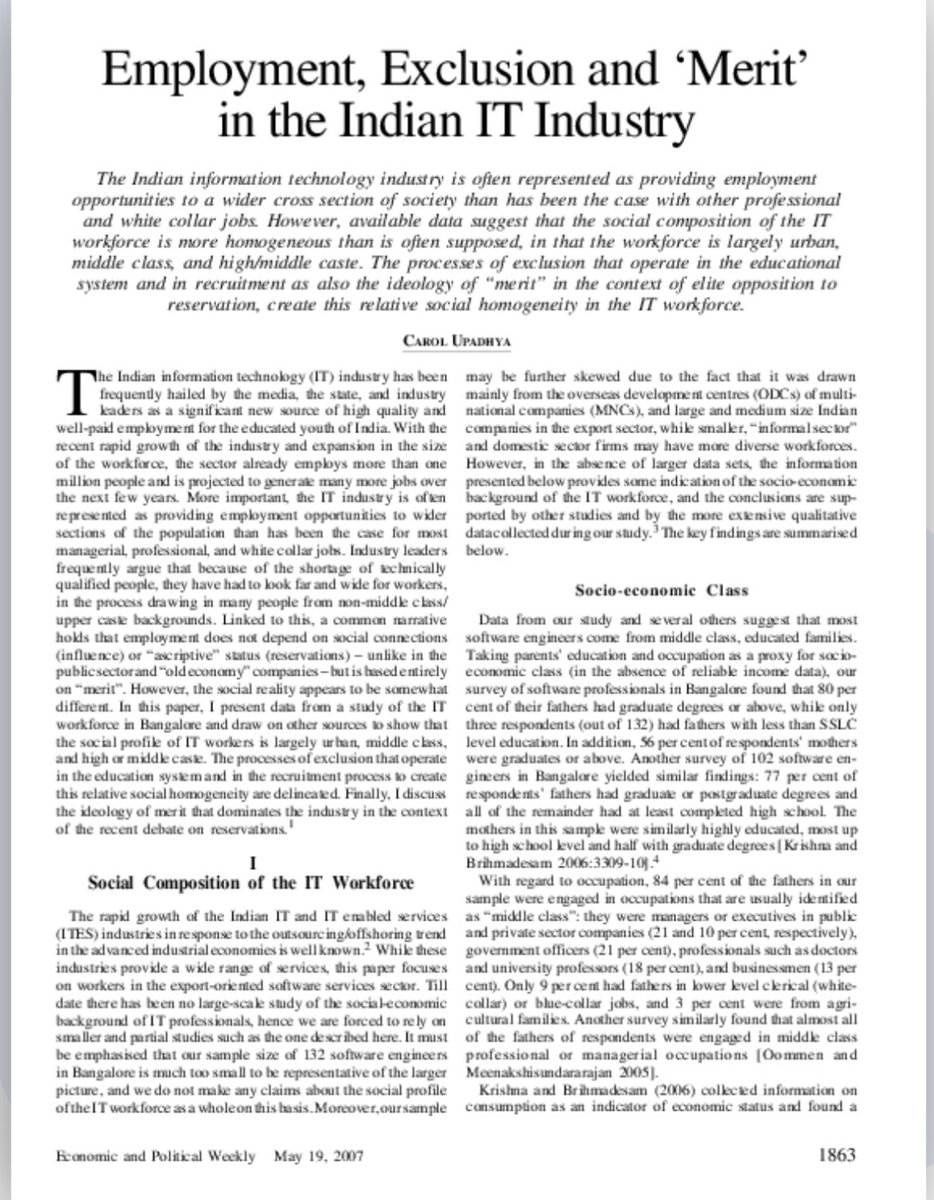

Now things are changing.
If we take the most valuable IT-based startups that took shape in the last few years, most of them have a strong north Indian Baniya engineers/managers footprints.
If we take the most valuable IT-based startups that took shape in the last few years, most of them have a strong north Indian Baniya engineers/managers footprints.
Flipkart (Bansals), OYO (Ritesh Agarwal), Ola (Bhavish Agarwal), Zomato (Deepender Goyal), Policybazaar (Alok Bansal), Lens Kart (Peyush Bansal), bOAT (Aman Gupta), Dream11 (Harsh Jain)), UC (Varun Khaitan), Licious (Vivek Gupta), and BrowserStack (Nakul Agarwal) long list indeed
Baniya power is a reality and even if they have not yet replaced Brahmins in this arena, they are posing a potent threat to the latter’s supremacy. We are going to see many more Baniyas grabbing the spaces, once considered exclusive domains of the Brahmins.
Historically, knowledge in India was associated with the hierarchical system of the caste and varna. this system of caste–based hierarchy of knowledge remained intact during the Muslim and British Rule as well…
The Muslim rulers avoided interfering in the affairs of the Hindus. That’s how the caste hierarchies remained intact, even after almost six centuries of Muslim rule in large part of India.
Brahmin domination was reproduced in the field of engineering education as well. Sociology faculty at @Harvard University, @ajanthasub studied this in her book “Caste of Merit.”

She argued: “Engineering came to be associated with classroom-based theoretical knowledge and professional service to the state and disassociated from an earlier British orientation around guild apprenticeship and private industry…
Initially, this meant racial exclusivity. But dual pressures— from England to do colonialism “on the cheap” and from nationalists charging Britain with underdevelopment— led to a lifting of the racial glass ceiling and entry of upper castes into the engineering service.”
Despite having technical skills, the artisan classes got sidestepped and the literate upper caste became the natural catchment area for talent in engineering education.
In the post-Independence era, IITs at Kharagpur (1951), Bombay (1958), Madras (1959) and Delhi (1961) were founded with foreign collaboration and liberal funding from the Union government. Till 1973, there was no reservation for any social class in the IITs.

SC-ST quota was introduced in the IITs 1973 and the OBC quota in 2009-11. Faculty quota in IITs is still being subverted, using some mechanism or the other. Initial absence of quotas at the IIT admissions and faculty recruitment made these institutions Savarna bastions.
The IITs have also evolved systems to fish out the reserved category students. Studies published in 2003 suggest that close to half the seats reserved for SCs and STs remain vacant and that of those admitted, a significant proportion are obliged to drop out.
Thus the IITs remained upper–caste spaces despite implementing reservation. Implementation of quota was and is being resisted by the IIT faculty as they have normalised the idea of IITs being merit oriented institutions.
The Baniya challenge: Meanwhile, an interesting change vis a vis the IITs and the overall domain of professional education that started in the 90s. It started as a trickle but has now taken the shape of a well-endowed stream. It’s the Baniya power!
In JEE Advanced 2020 results, out of the 35 Zonal toppers, 12 candidates have overtly Baniya surnames — Agarwal, Gupta, Dalmia, Jain, Kejriwal etc. It means that at least 30% of the zonal toppers are Baniyas. This number may go up as many candidates don’t use such overt surnames.
I have checked the advertisements of some of the big coaching institutes, who proudly publish the names and photos of the successful candidates. I can safely say that the Baniya candidates dominate these advertisements.
Another fact is that almost all big coaching institutes in north India are owned by the Baniyas. The ‘Kota Factory’ is a Baniya phenomenon.
I try to provide some reasons for this shift.
This trend picked up pace after the change in pattern for the Joint Entrance Exam in 2002 and then in 2005. There may be some clues in these changes.
This trend picked up pace after the change in pattern for the Joint Entrance Exam in 2002 and then in 2005. There may be some clues in these changes.
In the post-liberalised economy, private business and entrepreneurship became the prime site of wealth creation. This might have benefited the Baniyas more. This urban middle class of Baniyas might be providing the talent pool for engineering entrance tests.
Proliferation of coaching and its role in securing good rank might have benefitted certain groups of students. As the engineering coaching now starts early (as early as class VII), the social class that can afford the financial burden of coaching becomes the beneficiary.
And last, but not the least, different forms of capital—economic (money), cultural (cultivation and credentials), and social (connections) are interchangeable and can be converted to the other.
We have to see if the Baniyas are successfully converting their financial capital into social and cultural capitals and subverting the Brahmin domination in education, especially in the IITs.
Conclusion: Education might be one of the fields where money is playing a bigger role than the coincidence of birth in a caste. We must welcome this change.
Loading suggestions...