
John Boyd's argument in "Patterns of Conflict" that Genghis Khan conducted warfare based on the tenets of Sun Tzu illustrates neatly Clausewitz's admonition that reliance on ancient military history to clarify contemporary theory is too often driven by "vanity and quackery."
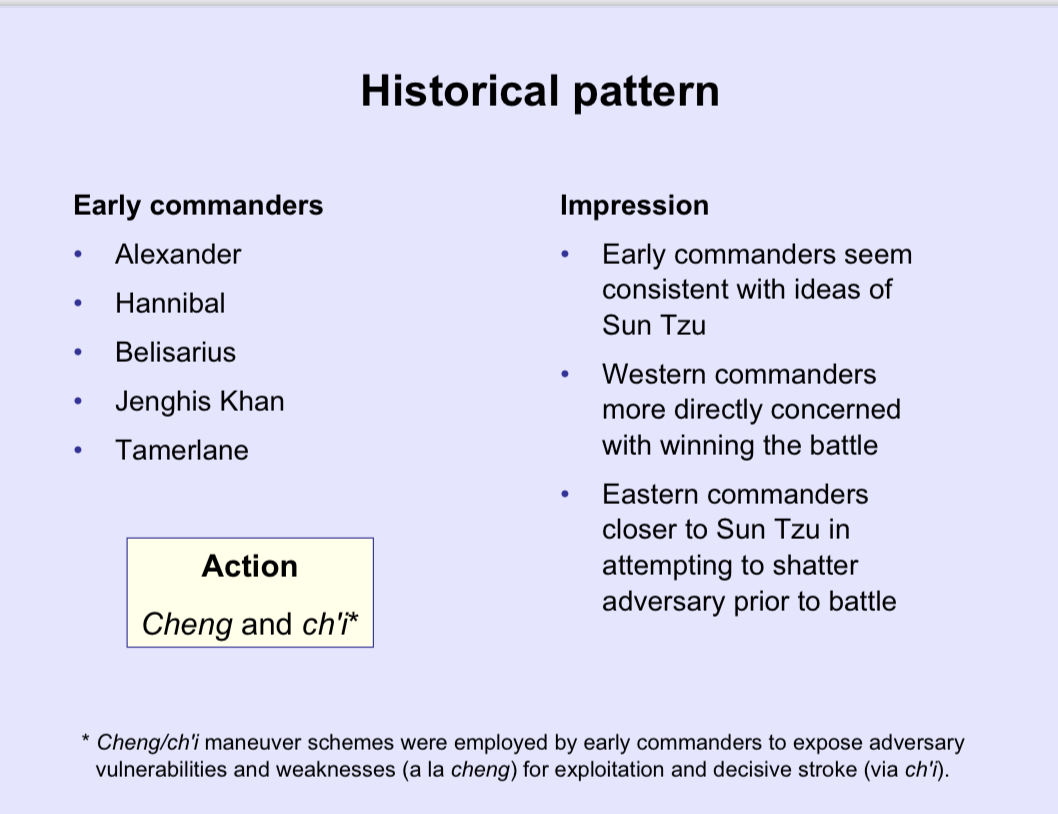
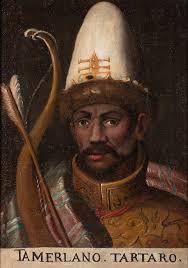
Boyd claims "Chingis Khan and Tamerlane had access to Sun Tzu’s ideas, remember they conquered the Chinese empire state which had access to him, so it’s not surprising." This is flimsy evidence. First, Genghis Khan did not live to see the conquest of China, but this is irrelevant
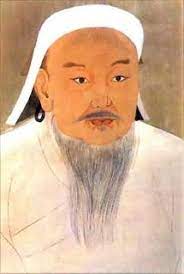
What is relevant is that the Chinese empire the Mongols eventually conquered--the Song--was the dynasty which first codified Sun Tzu's text into its official military education system. All Song generals (not Mongol ones) were therefore required to diligently study this work.
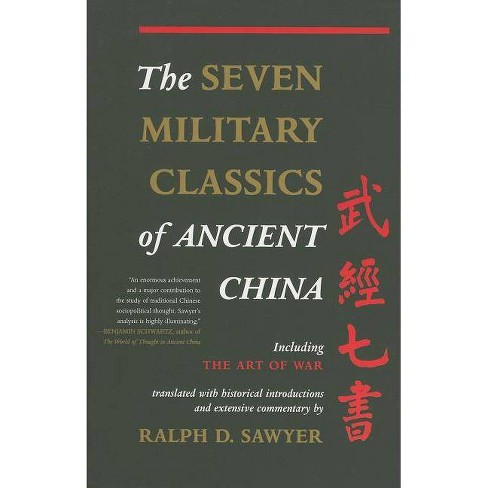
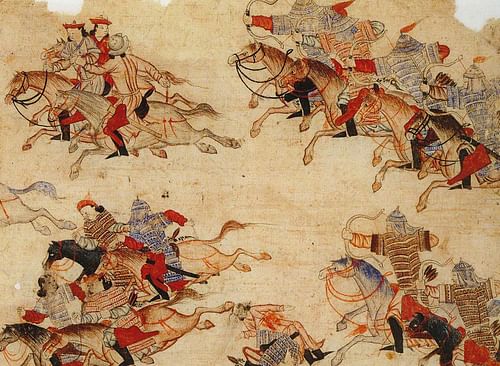
Ironically, then, it was the military generals who prioritized and fetishized the study of Sun Tzu who were decisively defeated by a highly maneuverable steppe army which had no cultural, historical, or practical reasons to be beholden to its ancient doctrines.
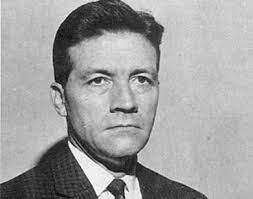
But Boyd was not overly concerned with historical (or textual) accuracy. He was concerned with proving an unbroken chain (or pattern) of military victories for armies relying on a doctrine of maneuver, and "read into" Sun Tzu's Art of War the philosophical origins of this theory.
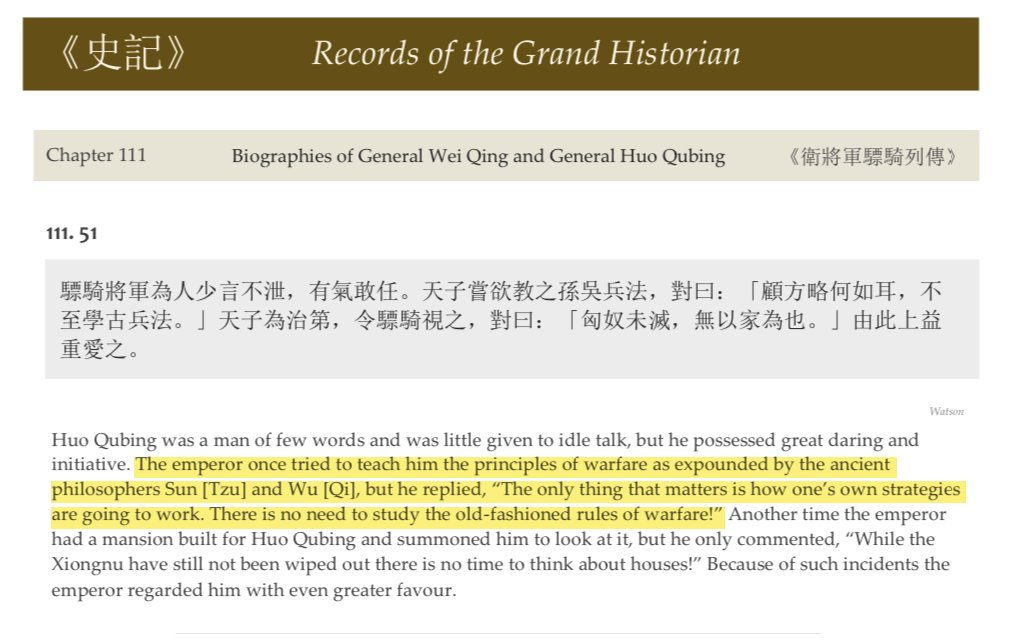
What he never bothered exploring is that the Chinese themselves considered one of the main flaws in Sun Tzu's text was that it was ill-suited for conceptualizing highly mobile steppe armies. In fact, Chinese generals who fared best against these forces disdained Sun Tzu's text.
One of the most successful Chinese commanders battling against the Xiongnu tribes (ancestors to the later Mongols) was a general named Huo Qubing. According to the account found in Sima Qian's history, he was dismissive of Sun Tzu's relevance to the kind of war he was fighting:
Others, @lorgepter and @scholars_stage included, have noted this issue, in which tenets discussed in Sun Tzu are often tied to a very specific era and way of fighting that might not be directly relevant to later commanders and armies.
scholars-stage.org
scholars-stage.org
Boyd spent great effort examining Clausewitz with a fine-tooth comb, looking for flaws in his thinking, and some of his criticism is valid. But he never bothered to apply this same exacting standard to Sun Tzu. Had he done so, he might also have found contradictions in that text.
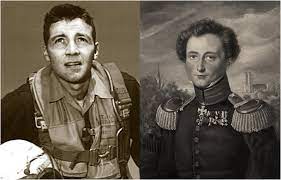
This does not mean that all of Boyd's ideas are bunk. There is also much to admire. But we need to be clear-eyed about the limits of his strongly held beliefs, like his insistence that he found a clear "historical pattern" of maneuver warfare's dominance built on Sun Tzu's ideas.
And this is why Clausewitz warns that the farther back in history we reach to find clarity, the more likely these historical analogies become "sheer decoration, designed to cover gaps and blemishes" in one's own theory. Clausewitz's judgement applies equally well to Boyd:
"The main objection to this superficial treatment is not that the writer pretends he is trying to prove something but that he himself has never mastered the event he cites, and such superficial, irresponsible handling of history leads to wrong ideas and bogus theorizing."
Loading suggestions...