

Return on Invested Capital (ROIC) is THE most important metric in valuation.
It’ll determine your investment success in any given company.
Give me 5-6 minutes (maximum) to explain in detail👇
It’ll determine your investment success in any given company.
Give me 5-6 minutes (maximum) to explain in detail👇
1. Why is ROIC so Important?
In the long run, your return on an investment will be about the same as the ROIC of the company.
The price you pay for the company becomes less important with every year of your investment.
In the long run, your return on an investment will be about the same as the ROIC of the company.
The price you pay for the company becomes less important with every year of your investment.
2. What drives superior ROIC?
Strategy, Competitive advantages, and ROIC are linked.
To show this, let’s look at the per-unit formula of ROIC:
Strategy, Competitive advantages, and ROIC are linked.
To show this, let’s look at the per-unit formula of ROIC:
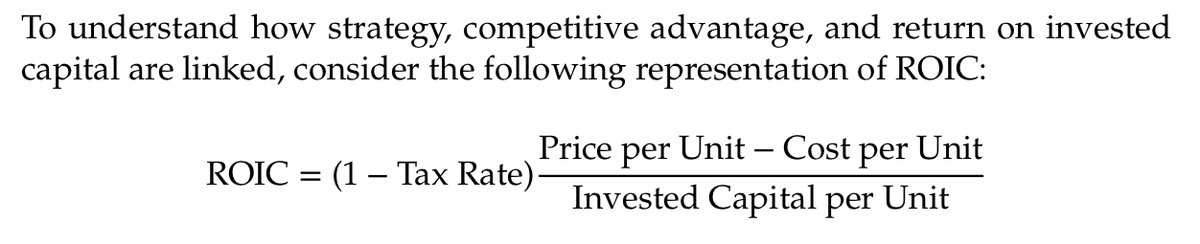
A competitive advantage leads to higher ROIC because it enables
- Charging a premium price
Or
- Producing more efficiently
Let’s take a look at how this can be achieved.
- Charging a premium price
Or
- Producing more efficiently
Let’s take a look at how this can be achieved.
There are five sources of advantage that allow companies to charge a price premium:
1. Innovative Products
Innovative products yield high returns on invested capital.
However, only when protected by patents or difficult to copy (best case: both).
1. Innovative Products
Innovative products yield high returns on invested capital.
However, only when protected by patents or difficult to copy (best case: both).
2. Quality
Quality is defined as a real or perceived difference between one product an another.
This difference also must increase the willingness to pay from the customers.
Quality is defined as a real or perceived difference between one product an another.
This difference also must increase the willingness to pay from the customers.
3. Brand
Often mentioned in one breath with quality, and they’re indeed similar.
However, while the quality of a company may matter more than its established branding, sometimes it’s the other way around.
Strong brands can charge premiums even without higher quality products.
Often mentioned in one breath with quality, and they’re indeed similar.
However, while the quality of a company may matter more than its established branding, sometimes it’s the other way around.
Strong brands can charge premiums even without higher quality products.
4. Customer Lock-In
Also called switching costs.
The more complex a change in products is, the less likely it will happen.
This decreases competition and thus leads to premium prices.
Adobe and Microsoft are great examples.
Also called switching costs.
The more complex a change in products is, the less likely it will happen.
This decreases competition and thus leads to premium prices.
Adobe and Microsoft are great examples.
5. Rational Price Discipline
This topic touches on game theory.
The forces of competition drive down prices in industries with many competitors.
Even when they could settle for a higher price and all have higher returns.
The individual incentives always lead to low prices.
This topic touches on game theory.
The forces of competition drive down prices in industries with many competitors.
Even when they could settle for a higher price and all have higher returns.
The individual incentives always lead to low prices.
Now, let’s take a brief look into the 4 forces that contribute to cost and capital efficiency:
1. Innovative Business Method
Innovative business models can differentiate themselves from others and become hard to copy.
Established companies often fail to adapt due to size.
1. Innovative Business Method
Innovative business models can differentiate themselves from others and become hard to copy.
Established companies often fail to adapt due to size.
2. Unique Resources
Sometimes a company has access to unique resources that cannot be replicated.
You often see geography play a role here.
Especially in mining businesses or when special raw materials are needed.
Sometimes a company has access to unique resources that cannot be replicated.
You often see geography play a role here.
Especially in mining businesses or when special raw materials are needed.
3. Economies of Scale
Increasing production can lead to lower costs and thus create a spiral of advantages,
The more a company produces, the more it can sell, while prices for production go down.
Increasing production can lead to lower costs and thus create a spiral of advantages,
The more a company produces, the more it can sell, while prices for production go down.
4. Scalable Products or Processes
This means that the cost of serving additional customers is low.
Think of a movie production.
You have fix costs when producing but after that, you don’t have any new costs involved with the amount of viewers.
This means that the cost of serving additional customers is low.
Think of a movie production.
You have fix costs when producing but after that, you don’t have any new costs involved with the amount of viewers.
Last but not least, Sustainability of ROIC.
The longer a company can sustain a high ROIC, the more value it creates, and the better your returns.
There are 3 factors that play a role.
(It’ll be over soon… I promise😉)
The longer a company can sustain a high ROIC, the more value it creates, and the better your returns.
There are 3 factors that play a role.
(It’ll be over soon… I promise😉)
1. Length of Product Life Cycle
The longer the life cycle, the better its chances of sustaining its ROIC.
It’s about locking in the customer in a product that he will use for a long time.
Think back to Adobe and Microsoft. They did phenomenal jobs doing that.
The longer the life cycle, the better its chances of sustaining its ROIC.
It’s about locking in the customer in a product that he will use for a long time.
Think back to Adobe and Microsoft. They did phenomenal jobs doing that.
2. Persistence of Competitive Advantage
In general, brand and quality tend t have more staying power than advantages caused by innovation,
Industries with lots of innovation mostly evolve fast, and one innovation is followed by the next quickly.
In general, brand and quality tend t have more staying power than advantages caused by innovation,
Industries with lots of innovation mostly evolve fast, and one innovation is followed by the next quickly.
3. Potential for Product Renewal
A product cycle can only go for so long.
After that, companies must be in a position to deliver the next product right away.
The goal is that no one else is going to fill the spot.
Once again, brand power is key here.
A product cycle can only go for so long.
After that, companies must be in a position to deliver the next product right away.
The goal is that no one else is going to fill the spot.
Once again, brand power is key here.
Summary:
1. ROIC is driven by competitive advantages that enable price premiums and/or cost and capital efficiencies.
2. It’s key to extend the life cycle of products that offer high ROICs or fill the spot with new products.
1. ROIC is driven by competitive advantages that enable price premiums and/or cost and capital efficiencies.
2. It’s key to extend the life cycle of products that offer high ROICs or fill the spot with new products.
This has been a detailed one.
Thanks for taking the time!
I Foyt enjoyed it, please Like and Retweet this Thread so more people can see it.
Follow me @MnkeDaniel for more content.
Thanks, and have a great day!
Thanks for taking the time!
I Foyt enjoyed it, please Like and Retweet this Thread so more people can see it.
Follow me @MnkeDaniel for more content.
Thanks, and have a great day!
Loading suggestions...