
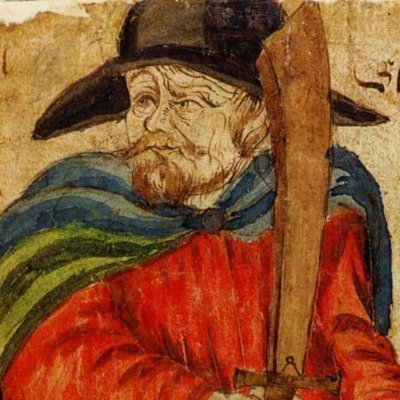
The Death Song of the Venerable Bede
Bede of Jarrow died on Thursday/May 26th, 735. He left behind mournful followers, a life of pious learning and devotion, and a monumental body of work that forever changed the standard of Western learning.
He also left behind a little poem🧵
Bede of Jarrow died on Thursday/May 26th, 735. He left behind mournful followers, a life of pious learning and devotion, and a monumental body of work that forever changed the standard of Western learning.
He also left behind a little poem🧵
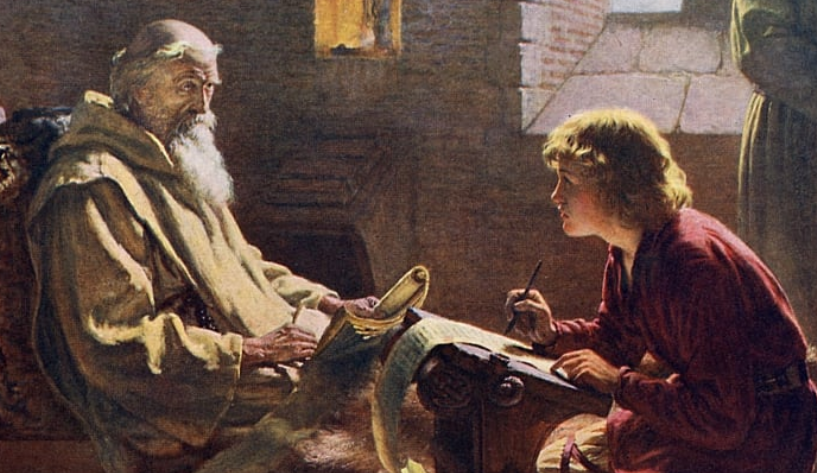
Cuthbert describes Bede's death in a letter to a man named Cuthwine. Bede suffers bouts of breathlessness and swelling in his feet, and begins to sequester himself in prayer as his death draws near. He sets his affairs in order; he distributes his belonging to his fellows...
including his treasures of pepper, napkins, and
incense. He urges his brother to finish a copy of the gospel of John he was translating into Old English. He sang, talked, and read with his students as the end approached.
incense. He urges his brother to finish a copy of the gospel of John he was translating into Old English. He sang, talked, and read with his students as the end approached.

Finally, Bede asked to be placed on the floor of his cell, in the spot where he typically knelt in prayer. He dies singing “Glory be to the Father and to the Son and to the Holy Spirit”

Cuthbert relates that Bede composes a poem during these last days. Cuthbert states that Bede "was well-versed in our native songs." It is a humble 5-line meditation on passing from life into death.

Here it is in West Saxon, the most proliferate dialect of Old English:
For þam nedfere ‖ næni wyrþeþ
þances snotera, ‖ þonne him þearf sy
to gehicgenne ‖ ær his heonengange
hwæt his gaste ‖ godes oþþe yfeles
æfter deaþe heonon ‖ demed weorþe.
For þam nedfere ‖ næni wyrþeþ
þances snotera, ‖ þonne him þearf sy
to gehicgenne ‖ ær his heonengange
hwæt his gaste ‖ godes oþþe yfeles
æfter deaþe heonon ‖ demed weorþe.
And here in the Northumbrian dialect:
Fore thaem neidfaerae ‖ naenig uuiurthit
thoncsnotturra, ‖ than him tharf sie
to ymbhycggannae ‖ aer his hiniongae
huaet his gastae ‖ godaes aeththa yflaes
aefter deothdaege ‖ doemid uueorthae.
Fore thaem neidfaerae ‖ naenig uuiurthit
thoncsnotturra, ‖ than him tharf sie
to ymbhycggannae ‖ aer his hiniongae
huaet his gastae ‖ godaes aeththa yflaes
aefter deothdaege ‖ doemid uueorthae.
A basic modern translation might read as such:
Before the unavoidable journey there, no one becomes wiser in thought than him who, by need,
ponders, before his going hence,
what good and evil within his soul,
after his day of death, will be judged.
Before the unavoidable journey there, no one becomes wiser in thought than him who, by need,
ponders, before his going hence,
what good and evil within his soul,
after his day of death, will be judged.
The sentiment of the poem is heavy with the essence of Memento Mori; it is both the God man and the Wise man who live in contemplation of death, thus finding peace and resolution in a life where death is inevitable.
The end of wisdom, then, is to meet death without fear.
The end of wisdom, then, is to meet death without fear.

Bede's little poem goes on to become one of the most proliferated Anglo Saxon poem of the age. It survives in well over 30 manuscripts, in multiple dialects.
There is of course debate on whether or not Bede is the true author of the poem. I of course trust Cuthbert's telling, and considering the weight of the moment and the man, the poem only adds to the legacy and shadow of Bede's life on the history of England, and indeed, the West.
It is a trusty Anglo-Saxon poem that possesses the spiritual utility common amongst so much Germanic poetry, and I find it rings true and potent to me all these years later, long after Bede sang his final song.

Loading suggestions...